
How to Start a Transport Business in India
Costs, registration, GST, permits and real earnings for starting a transport business in India, updated for the 2026 rules that most guides still get wrong.

Lokesh R
CEO of Trucks India
Created 10 September 2026 · 12 min read
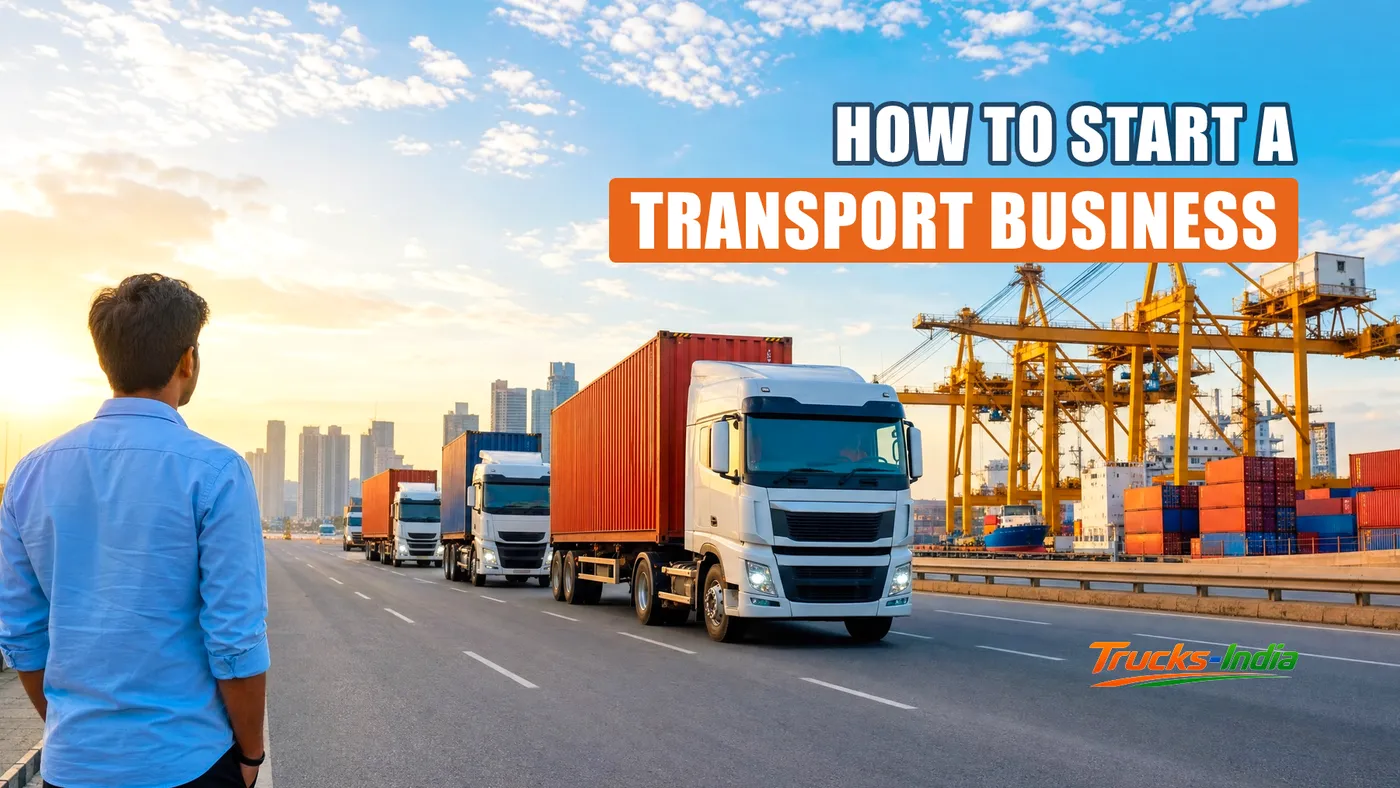
Most people who ask this question already have the hard part figured out. They know somebody who needs goods moved, or they have driven for someone else long enough to see where the money goes. What stops them is the paperwork, the loan and the fear of buying the wrong truck.
That fear is reasonable. The truck is the business. Buy one that is too small for the loads you can win and you run at a loss on every trip. Buy one that is too big and the EMI eats the margin before the diesel does.
One thing to settle before the detail. A transport business, a transportation business and a trucking business are the same thing under three names, and you will see all three on registration forms, in loan applications and in client contracts. Nothing in the process below changes depending on which one your paperwork happens to use.
This guide walks through the whole thing in order: the segment, the money, the registration, the tax, the permits and the realistic earnings. The rules quoted here are current as of September 2026, and two of them changed recently enough that most guides still have them wrong.
How to start a transport business in India
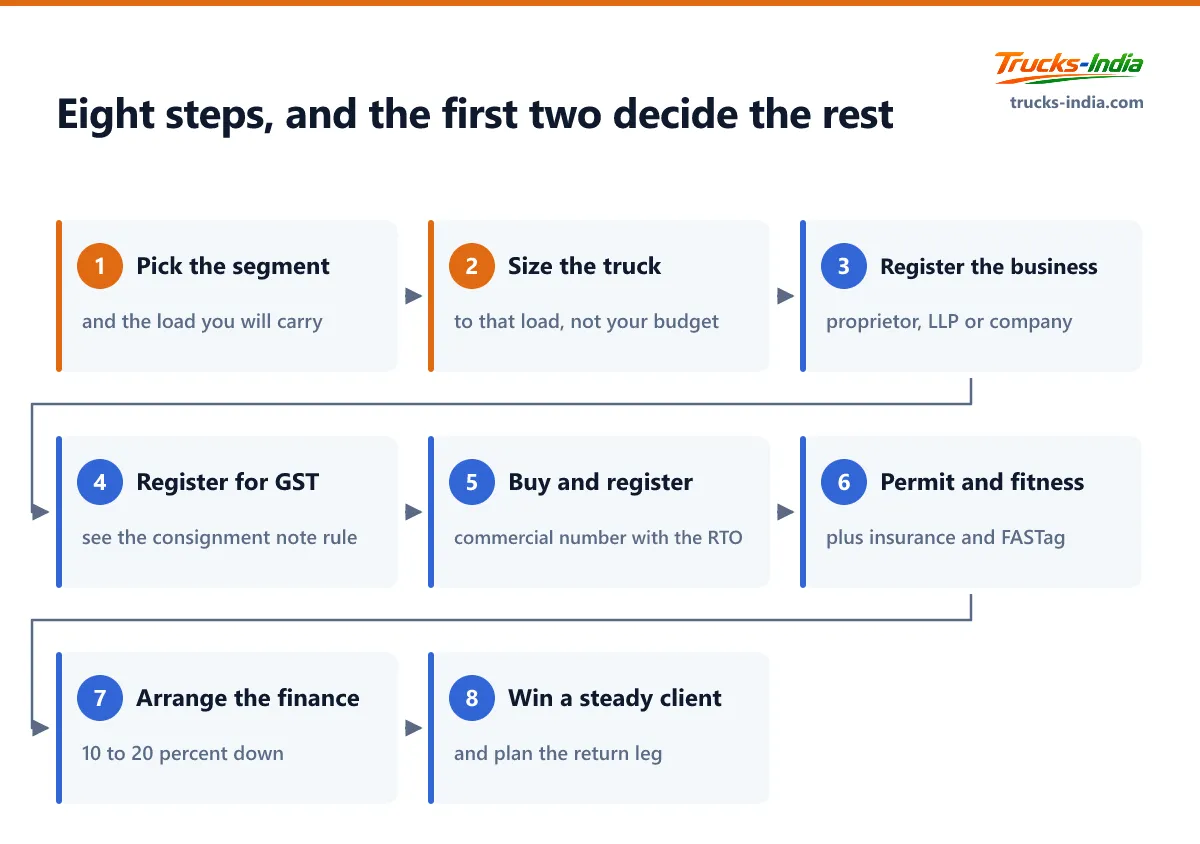
The sequence matters more than the speed. Doing these in the wrong order is how people end up with a truck they cannot legally load.
- Pick the segment and the load you will carry
- Size the truck to that load, not to your budget
- Register the business
- Register for GST
- Buy and register the vehicle with the RTO
- Get the permit, fitness certificate and insurance
- Arrange the finance
- Find your first steady client
Steps one and two decide whether the rest is worth doing. Everything after step three is process, and process is just time and fees.
Pick the segment before you pick the truck
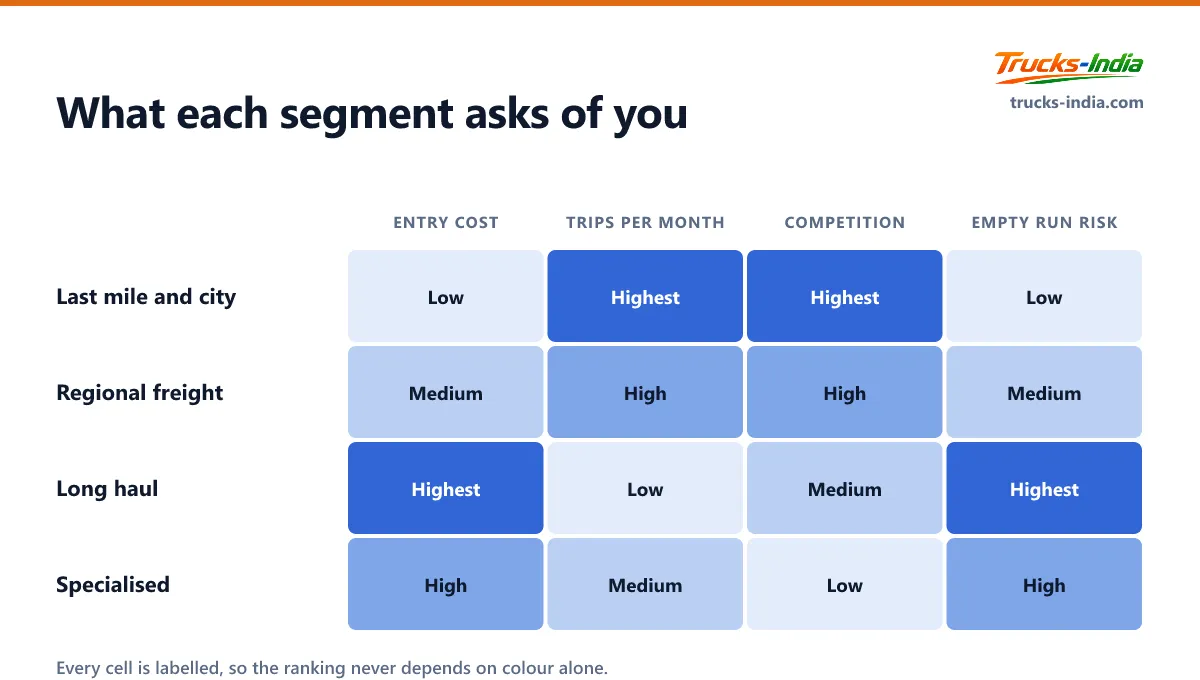
New transporters usually start in one of four places.
- Last mile and city delivery. Mini trucks and small pickups moving e-commerce parcels, FMCG stock and building material inside a city. Lowest entry cost, highest number of trips, most competition. Typical vehicles are the Tata Ace Gold, Mahindra Jeeto, Ashok Leyland Dost and Maruti Super Carry CNG.
- Regional freight. Light and intermediate commercial vehicles running 200 to 600 km between towns. Better rates than city work, and the loads are more predictable. This is the ground held by the Eicher Pro 2059 XP Plus, Tata Ultra T16, Mahindra Furio 11 and Ashok Leyland Boss 1215.
- Long haul. Heavy trucks and tractor trailers on national routes. Highest revenue per trip, highest EMI, and the one that punishes an empty return leg hardest. Think Tata Signa 5530S 4x2, Ashok Leyland AVTR 5525 4x2, BharatBenz 4832R or Mahindra Blazo X 55.
- Specialised. Tippers for mining and construction, transit mixers for concrete, tankers for liquids. Rates are good because the vehicle is not interchangeable, which is also the risk. Examples include the AVTR 3520 8x4 tipper, Blazo X 28 transit mixer, Tata Signa 2823K RMC and SML Isuzu Super Tipper.
Talk to two or three potential clients before you decide. If the only work you can reliably win is 3 tonne city loads, a 55 tonne tractor trailer is not ambition, it is a liability. The full taxonomy of weight classes, axle configurations and body types is in the guide to types of trucks in India, which is the right place to start if you are weighing segments against each other.
What it actually costs to start
Your capital splits into the truck, the paperwork and the working capital. The truck is the obvious part and the one people over-plan. The working capital is the part that sinks first time owners. Two costs routinely missing from a first budget are the gap between on road and ex showroom price and the load body, which the dealer does not quote because a fabricator builds it.
On the vehicle, entry points differ sharply by segment. Rather than quote a figure that will be stale by the time you read it, check the live price bands: trucks under 10 lakh covers most mini trucks and small pickups, 10 to 20 lakh covers the light and intermediate range, and 40 to 50 lakh is where multi axle haulage begins.
Budget separately for these, because none of them are optional.
- RTO commercial registration and road tax, which varies by state and is charged on vehicle cost
- Body building, if you are buying a chassis rather than a fully built vehicle
- Insurance for the first year
- Permit and fitness certificate fees
- FASTag and an opening toll balance
- Two to three months of diesel, driver salary and EMI held in reserve
That last line is the one to take seriously. Payment cycles in freight run 30 to 60 days, sometimes longer. You will pay for diesel and salaries weeks before your first invoice clears, and a business that cannot survive that gap does not survive at all.
Register the business
Four structures are common, and the choice is mostly about liability and how many trucks you plan to run.
- Sole proprietorship. Fastest and cheapest. Fine for one or two trucks. Your personal assets are exposed.
- Partnership firm. Simple, suits family run fleets, but partners carry unlimited liability.
- LLP. Limited liability with lighter compliance than a company. A sensible middle for a growing fleet.
- Private limited company. Heaviest compliance, easiest route to institutional finance and corporate contracts. Worth it once you are past a handful of vehicles or bidding for large client accounts.
Alongside the structure you will need a PAN and TAN in the business name, a current account, and Udyam registration if you want to be counted as an MSME. Udyam is free and takes minutes, and it is what makes you eligible for several credit schemes.
GST, and the rule that catches most new transporters
Here is where a lot of published advice is out of date.
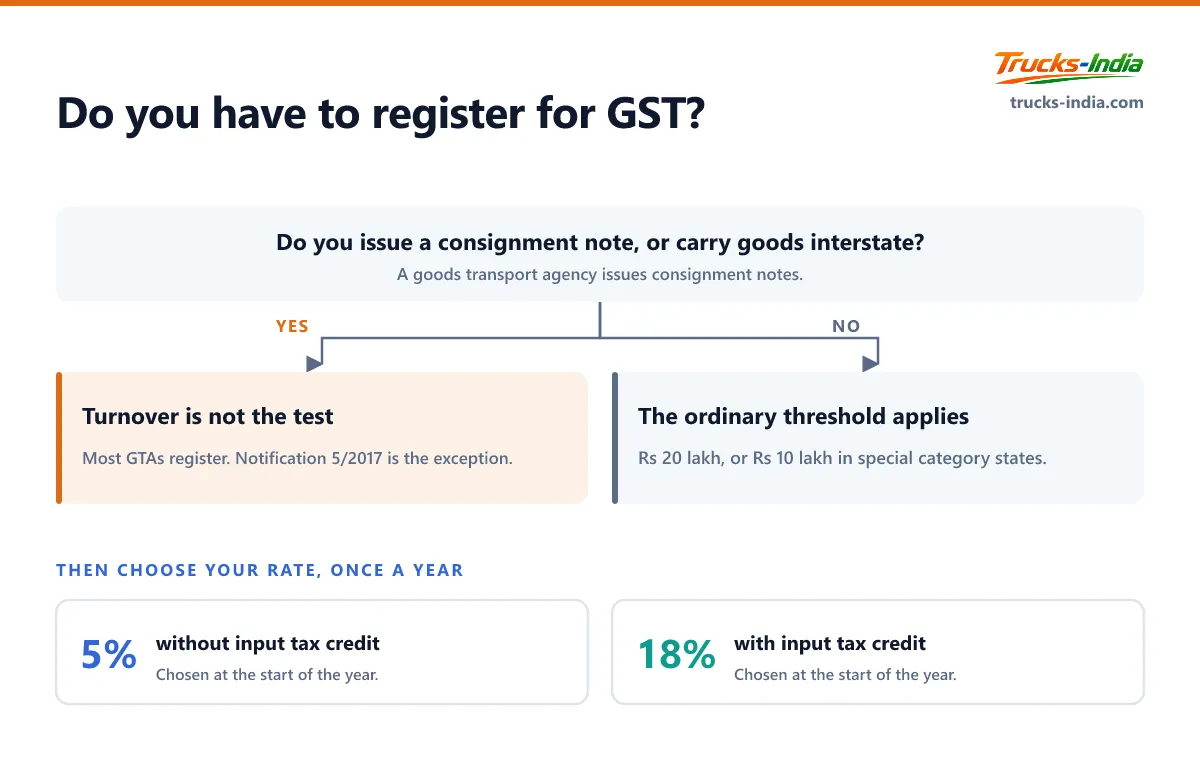
The commonly repeated line is that you only need GST registration once turnover crosses 20 lakh rupees, or 10 lakh in special category states. That threshold is real for ordinary service providers and it is not the whole story for a transporter. Most operators who issue consignment notes end up registering, but there is a genuine exception: Notification 5/2017 exempts a person making only supplies on which the recipient pays under reverse charge, so a goods transport agency carrying exclusively for registered businesses can sit outside registration even above the threshold. The moment any part of your output falls outside reverse charge, that exemption ends. Our GST guide works through which case you are in.
On the rate, a Goods Transport Agency has two options: 5 percent without input tax credit, or 18 percent with input tax credit. The old 12 percent forward charge slab was rationalised into 18 percent with effect from 22 September 2025, so any guide still presenting 12 percent as a live option is describing rules that no longer apply.
Much of the time the tax is paid by your client rather than by you, under the reverse charge mechanism, when the recipient is a registered business. Which option suits you depends on how much input credit you can actually claim on fuel, tyres and maintenance, and that is a genuine calculation rather than a default. Take it to a chartered accountant before your first financial year begins, because the option is exercised at the start of the year and you cannot casually switch mid-year.
Permits, fitness and the annual paperwork
A goods vehicle needs a permit to carry commercial loads. If you stay inside one state, a state goods carriage permit is enough. The moment you cross a border for hire or reward, you need a national permit.
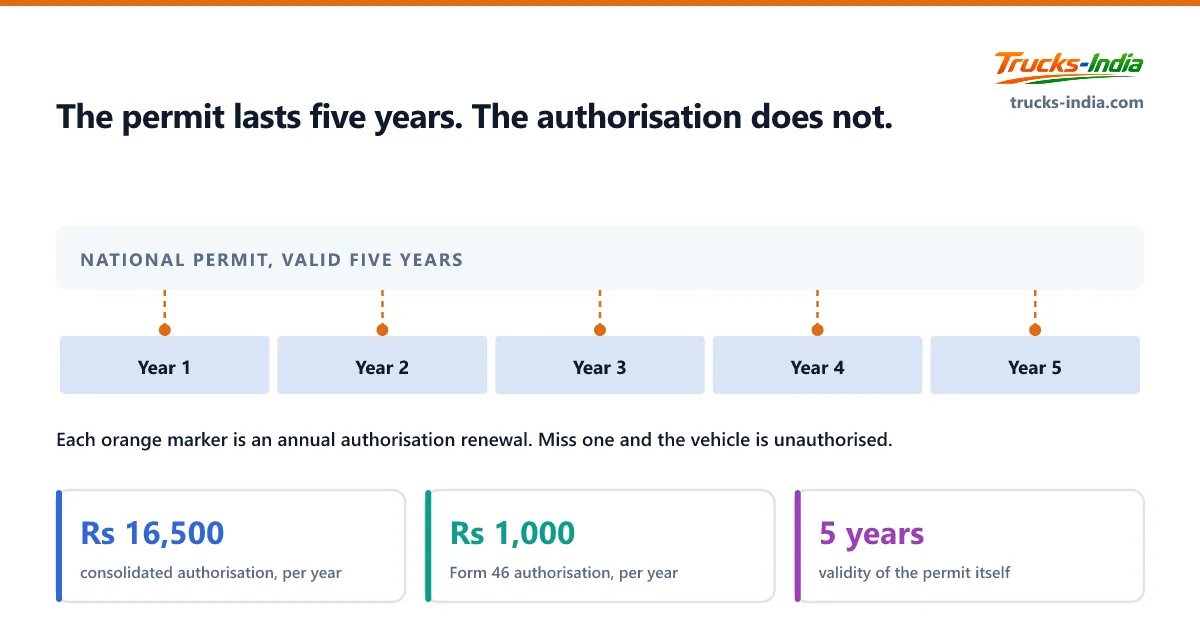
The national permit is where the structure confuses people. The permit document itself runs for five years. The authorisation that lets you operate across states is annual, and it has to be renewed every year. The consolidated national permit authorisation fee is 16,500 rupees a year under Rule 87(2) of the Central Motor Vehicles Rules, paid through the Parivahan portal, with a Form 46 authorisation fee of about 1,000 rupees a year to your home state authority. Exact amounts vary by state and vehicle, and a lapsed renewal attracts a daily late fee, so treat the renewal date as a hard diary entry rather than a reminder.
You will also carry and renew:
- A fitness certificate for the vehicle, renewed periodically after the initial validity
- Commercial vehicle insurance, at minimum third party, though comprehensive is the sane choice on a financed truck
- A pollution under control certificate
- A commercial driving licence for whoever drives, which for heavy vehicles means an HMV endorsement
Each of those has its own cycle and its own penalty for lapsing. The national permit guide covers the five year permit and its annual authorisation, the fitness certificate guide covers the renewal schedule as the vehicle ages, and the documents to carry guide covers what must physically be in the cab.
How to finance the truck
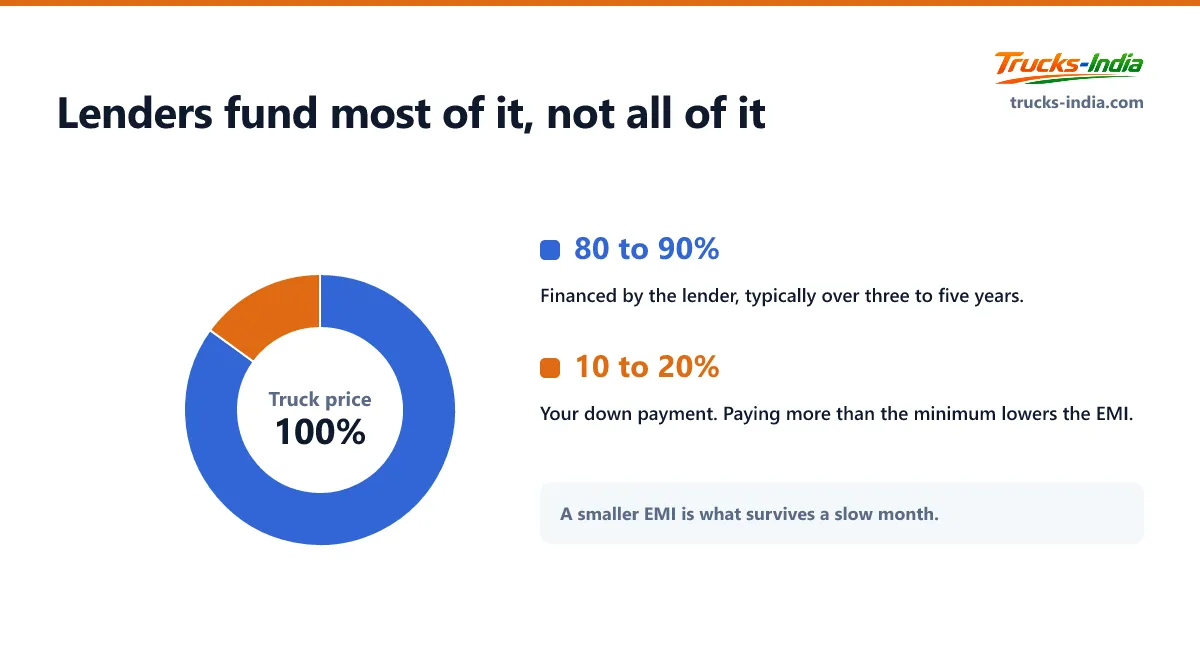
Almost nobody buys the first truck outright. Lenders typically fund 80 to 90 percent of the vehicle cost, leaving you a down payment of 10 to 20 percent, with tenures around three to five years. Rates move with your credit profile, the lender and whether you have run a fleet before, so gather at least three quotes rather than accepting the dealership's first offer.
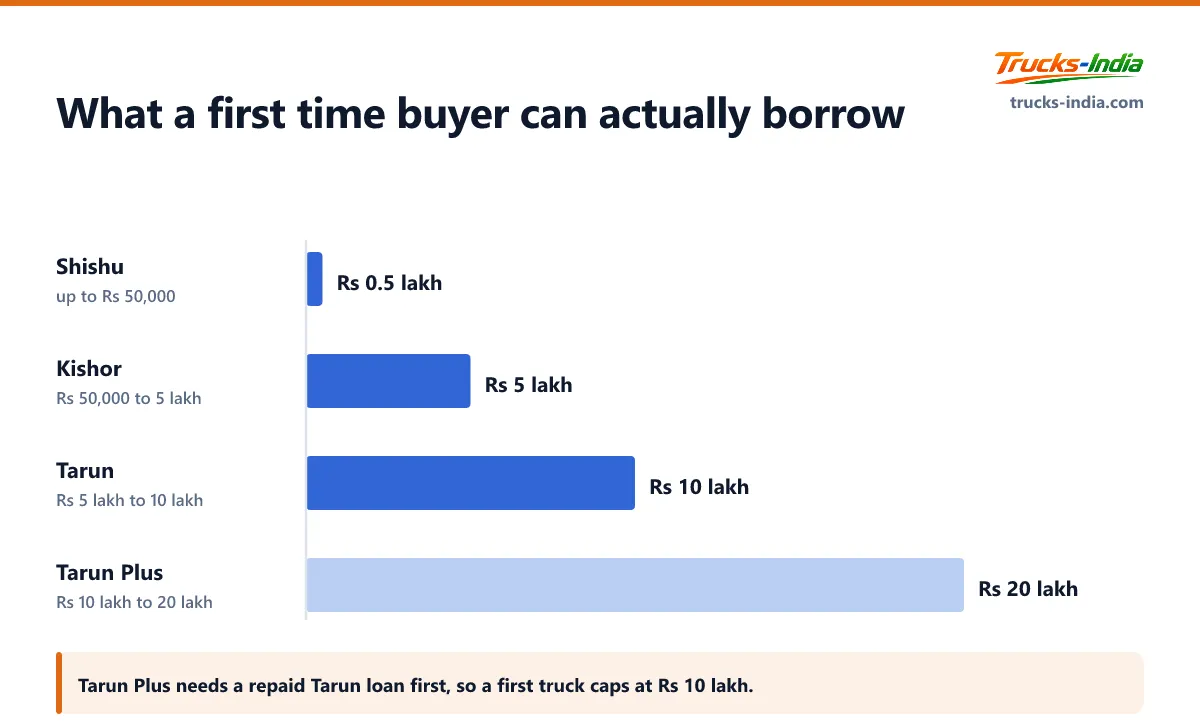
If you want a government backed route, the Pradhan Mantri Mudra Yojana lends without collateral in four tiers: Shishu up to 50,000 rupees, Kishor from 50,000 to 5 lakh, Tarun from 5 to 10 lakh, and Tarun Plus from 10 to 20 lakh.
Read that last tier carefully, because it is widely misreported. Tarun Plus is only open to borrowers who have already taken and fully repaid a Tarun loan. A first time applicant cannot walk in and ask for 20 lakh. Your practical collateral free ceiling on a first truck is 10 lakh, which buys into the mini truck and small pickup segment and not much beyond it. Check the Tata Ace Gold on road price and the Tata Intra V30 to see what that budget reaches. Details are on the Mudra site.
Two habits protect you here. Put down more than the minimum if you can, because a smaller EMI is the difference between surviving a slow month and defaulting in one. And run the EMI against a realistic number of loaded trips per month, not the best month you can imagine.
The commercial vehicle loan guide goes through what rate you will actually be offered, how much of the on road price a lender really funds, and the documents to have ready before you apply.
What you will actually earn
Freight revenue is simple to model and easy to get wrong, because the costs are relentless and the revenue is lumpy.
Revenue is trips multiplied by the rate per trip. Against that, subtract diesel, driver wages, tolls, maintenance and tyres, insurance and permits spread monthly, and the EMI. Diesel alone is usually the largest single line, which is why mileage matters more than sticker price over a truck's life. A vehicle that is 2 lakh cheaper but two kilometres per litre thirstier will cost you far more than the saving across five years.
Three variables decide whether you make money.
- Empty running. A truck earning on the outbound leg and running empty on the return is roughly halving its revenue on the same fuel and wage bill. Return loads are the single biggest lever a small operator has.
- Payment cycles. Profit on paper means nothing if clients pay in 60 days and your EMI is monthly.
- Downtime. A truck in a workshop earns nothing and still owes its EMI. Preventive servicing is cheaper than the breakdown that strands a load.
Before committing to any model, put its real mileage and payload against your expected route. Compare a Pro 2059 XP Plus mileage figure against the Signa 5530S specifications and the gap between segments becomes obvious. Every model page on Trucks India carries both, and today's fuel prices give you the number your costing starts from.
Where first time transporters lose money
- Buying more truck than the available loads justify, then carrying an EMI the work cannot cover
- Ignoring the return leg when quoting a rate
- Starting with no cash reserve and no plan for a 60 day payment cycle
- Missing the annual national permit authorisation renewal and running unauthorised
- Choosing on ex-showroom price rather than on road price plus running cost
- Treating maintenance as an expense to defer rather than a schedule to keep
Trucks to compare
A few trucks for a transport business on Trucks India, with ex-showroom price and rated payload. Open one for its full price, specifications and mileage.
Browse more: Mini trucks, Light commercial vehicles, Heavy trucks, Tata Motors trucks, Mahindra trucks
Frequently asked questions
It depends entirely on the segment. A single mini truck operation starts in the under 10 lakh vehicle band, while multi axle haulage begins around 40 lakh and up. Whatever the vehicle costs, add registration, road tax, body building, insurance, permits, and two to three months of running costs held in reserve for the payment cycle.
Usually, but not automatically. The 20 lakh threshold is not the only test for a transporter. A goods transport agency whose entire output is taxed under reverse charge is exempt from registration under Notification 5/2017, even above the threshold, and loses that exemption as soon as any supply falls outside reverse charge. It turns on your customer mix rather than your turnover. Our GST guide works through both rules.
A Goods Transport Agency can opt for 5 percent without input tax credit, or 18 percent with input tax credit. The earlier 12 percent forward charge slab was rationalised into 18 percent from 22 September 2025. In many cases the client pays the tax under the reverse charge mechanism rather than the transporter.
Rarely. Most lenders fund 80 to 90 percent of vehicle cost and expect 10 to 20 percent from you. Schemes advertising full funding usually attach a higher rate or extra security. A larger down payment lowers the EMI, which is what actually keeps a young transport business solvent.
No. A state goods carriage permit covers intra state work. You need a national permit the moment you carry goods for hire across a state border, and its authorisation must be renewed every year even though the permit itself runs five years.
The same way you start a transport business, because they are the same thing. Pick the segment and the vehicle first, arrange the finance, register the entity, take GST registration if you will issue consignment notes, register the vehicle commercially and obtain the goods carriage or national permit. The eight steps above set out the order.
It can be, but the margin comes from utilisation rather than from rates. Operators who fill the return leg, keep vehicles serviced and get paid on time do well. Operators who buy an oversized truck and run it half empty rarely recover.
Where this fits
Compare entry level options on the trucks under 10 lakh and mini truck pages, then check running cost against today's fuel prices.
Not sure which truck your first route can actually pay for? Trucks India lists on road price, payload and mileage for every model sold in India, so you can size the EMI against the load before you sign anything.
Call +91 93422 00875About the author
Lokesh R
CEO of Trucks India
Lokesh R is the founder of Trucks India, an independent heavy-vehicle marketplace and research platform operated from Chennai, Tamil Nadu, founded in 2025. Under his direction, Only Heavy publishes specifications and prices sourced from manufacturers, authorised dealer price lists and official regulatory schedules, with every model page checked by a named reviewer, prices re-verified monthly and after any GST revision, and no advertiser able to buy a rating, ranking or comparison result.


