
Types of Trucks in India
Every type of truck sold in India explained: the N1 to N3 weight classes, SCV to HCV segments, axle configurations like 6x4 and 10x2, and the main body types.

Lokesh R
CEO of Trucks India
Created 13 September 2026 · 7 min read
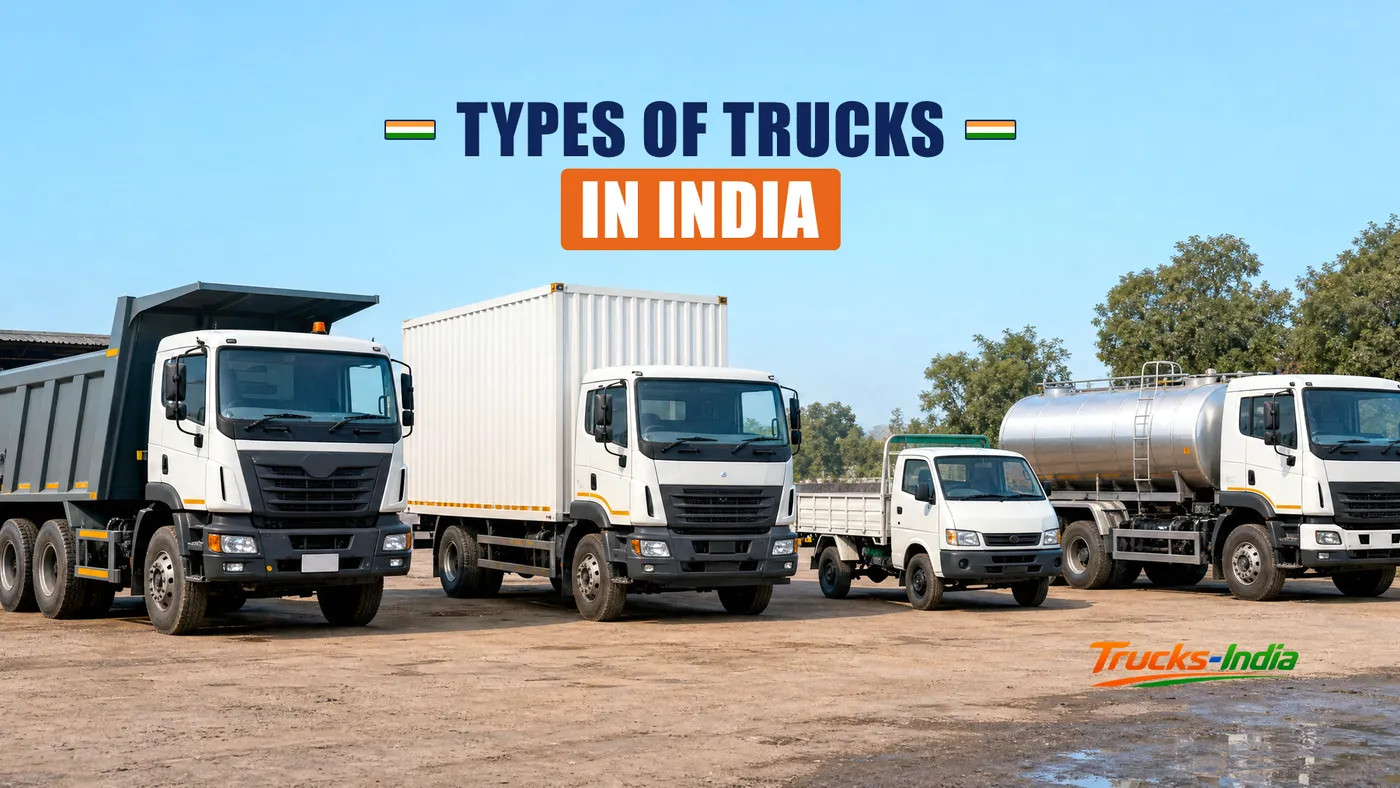
Ask what kind of truck someone runs and you will get one of three different answers: a weight class, an axle count, or a body type. All three are correct, because Indian goods vehicles are classified in three separate ways at once and each one answers a different question.
The weight class decides what the law asks of you. The axle configuration decides what you can legally carry. The body type decides what work the vehicle can actually do.
This guide covers all three, in the order a buyer needs them.
The three ways trucks are classified
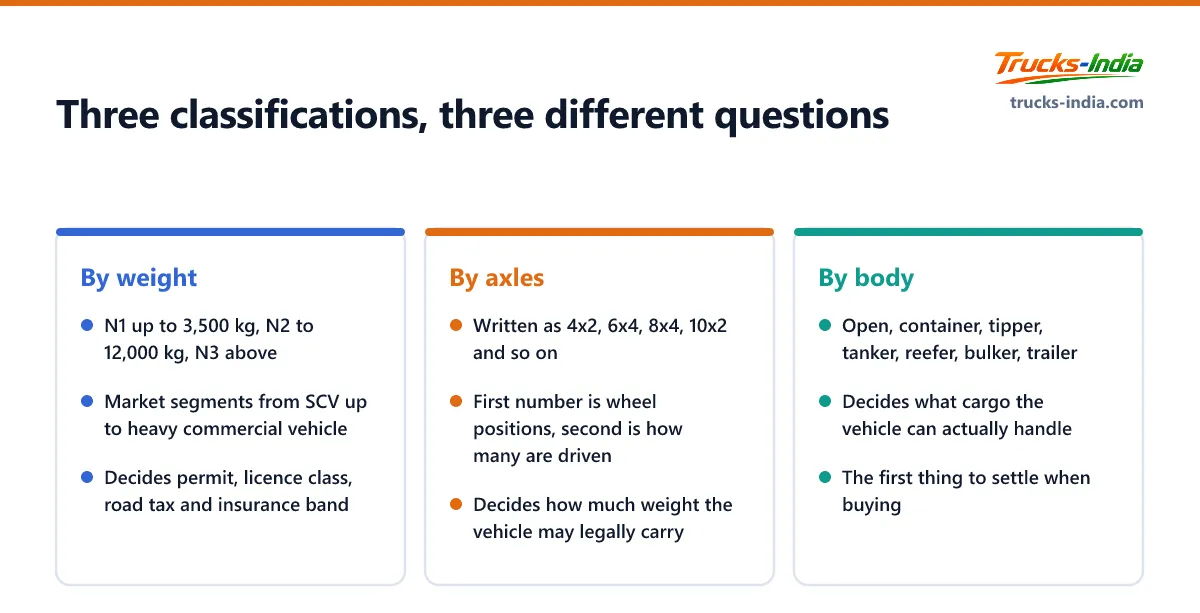
By gross vehicle weight, which is the legal classification. It decides your permit requirement, your licence class, your road tax and your insurance band.
By axle configuration, written as 4x2, 6x4, 10x2 and so on. It decides how much weight the vehicle may legally carry, because the law sets limits per axle rather than per truck.
By body type, meaning tipper, container, tanker and the rest. It decides what cargo the vehicle can handle.
A single truck has all three at once. A 6x4 tipper in the heavy category is being described three ways in one phrase.
Weight classes
India follows the international N category system for goods vehicles.
- N1 trucks: gross vehicle weight up to 3,500 kg
- N2 trucks: gross vehicle weight above 3,500 kg and up to 12,000 kg
- N3 trucks: gross vehicle weight above 12,000 kg
One threshold inside this matters more than the category boundaries. Goods vehicles with a gross vehicle weight not exceeding 3,000 kg are exempt from the permit requirement under Section 66(3) of the Motor Vehicles Act. That single line separates the small commercial vehicle segment from everything else in compliance terms, and it is covered in the national permit for your truck.
The market uses its own segment names on top of these:
- SCV, small commercial vehicle. The sub one tonne payload segment, largely last mile.
- LCV, light commercial vehicle. Roughly up to 7.5 tonnes gross.
- ICV, intermediate commercial vehicle. The band between light and medium.
- MCV and HCV, medium and heavy commercial vehicles, often grouped as M&HCV.
- Tractor trailer, an articulated combination of a puller and a semi trailer.
Browse them as the catalogue groups them: mini trucks and small commercial vehicles, pickups and heavier trucks.
Axle configurations, and why they matter
The notation is simple once you know it. The first number is the total count of wheel positions, the second is how many of them are driven.
- 4x2: two axles, one driven. The standard configuration for light and medium rigid trucks.
- 6x2: three axles, one driven. More load capacity, less traction.
- 6x4: three axles, two driven. The workhorse configuration for tippers and rough site work.
- 8x2 and 8x4: four axles. Higher payload; the 8x4 adds traction for construction duty.
- 10x2 and 12x2: five and six axle rigids, used for high volume bulk work on good roads.
More axles means more permissible weight, not more engine. The reason is that Indian axle load limits are set per axle, so spreading the load across more of them raises what the vehicle may legally carry. A rigid truck's permissible gross weight is derived from the sum of its axle limits, which the axle load guide sets out in full.
The practical consequence for a buyer: if your loads are dense and heavy, axles matter. If your loads are bulky and light, volume matters and the extra axles are cost you do not recover.
Body types
This is the classification that decides what work you can take.
Open body or flatbed. A flat platform with no sides, or with drop sides. The most flexible body for general freight, machinery and anything that loads from the side or the top. Exposed to weather.
Half body and full body. Fixed sides of part or full height. General freight that needs containment but not sealing.
Container body. A fully enclosed box. Secure and weatherproof, the standard for parcel, e-commerce, FMCG and anything that must arrive dry. Loses some payload to the weight of the body.
Tipper. A hydraulically raised body that discharges by gravity. Sand, aggregate, coal, construction and mining. Built heavier than a general freight truck because the duty cycle is brutal. See tippers in the catalogue.
Tanker. Liquid cargo, from water and milk to fuel and chemicals. Chemical and fuel work needs a hazardous goods licence endorsement and specialised insurance, and pays accordingly.
Refrigerated or reefer. An insulated body with an active cooling unit. Pharmaceuticals, dairy, frozen and fresh produce. Higher capital cost, higher running cost because the cooling unit consumes fuel, and higher rates to match.
Bulker. A pressurised or gravity discharge body for powdered cargo such as cement and fly ash.
Car carrier. A multi deck body for moving vehicles. Highly specific work and highly specific customers.
Trailer and low bed. A puller tractor with a semi trailer, including low bed and multi axle trailers for over dimensional and heavy machinery cargo. See tractor trailers.
Electric and alternative fuel
Battery electric goods vehicles have become a real option at the light end, particularly in last mile and intra city distribution where the daily range is predictable and the vehicle returns to the same depot to charge.
The economics differ from diesel in a specific way: higher purchase price, substantially lower running cost per kilometre, and a payback that depends entirely on how many kilometres you actually run. For a vehicle doing genuinely high daily distance on a fixed route, that arithmetic can work. For irregular or long haul work it usually does not yet. The catalogue lists what is available as electric commercial vehicles.
The arithmetic behind that, including the PM E-DRIVE subsidy and what depot charging actually costs per kilometre, is worked through in the electric truck running cost guide.
CNG sits between the two on both price and running cost and is worth considering wherever the fuelling network on your route is dense, and the CNG running cost guide sets out the payback calculation.
Choosing a type
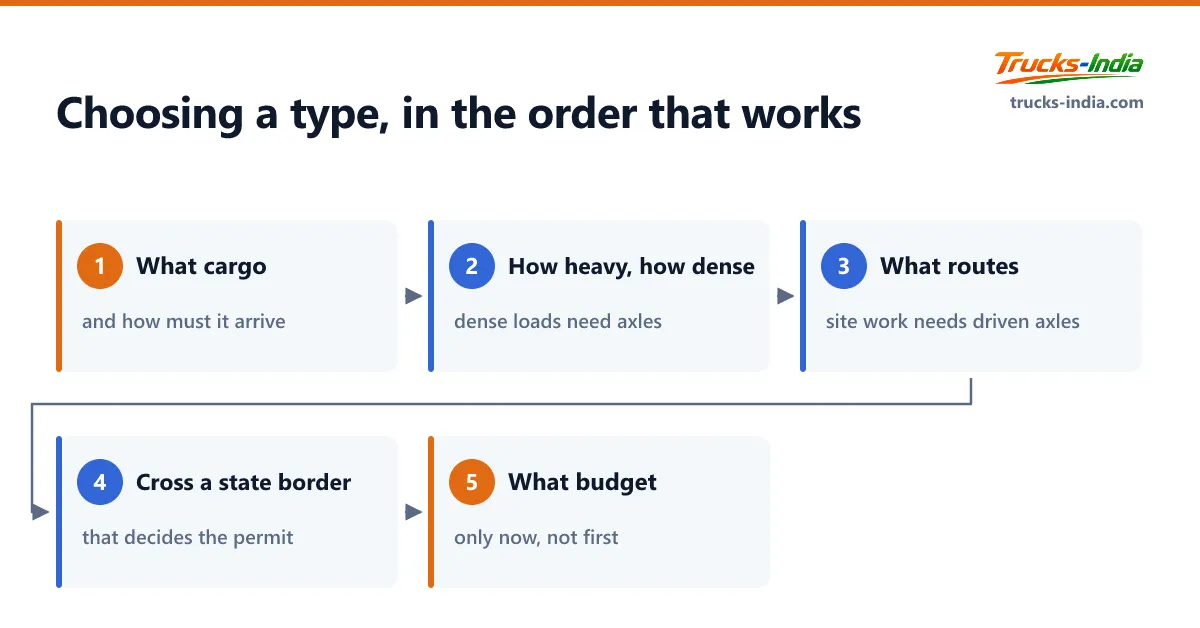
Work through it in this order and the answer usually falls out.
- What cargo, and in what condition must it arrive? That picks the body type before anything else.
- How heavy and how dense is a typical load? Dense loads point to more axles. Bulky light loads point to more volume.
- What routes, and what road conditions? Site and mine work needs driven axles. Highway work does not.
- Does it cross a state border? That decides the permit, which is a real annual cost.
- What is the budget? Only now. Compare within your band: 5 to 10 lakh, 10 to 20 lakh, 20 to 30 lakh or 30 to 40 lakh.
Buyers routinely start at step five and work backwards, which is how people end up with a vehicle that is wrong for the work at a price they liked.
The investment guide covers what each band costs to put on the road, and the guide to margin per trip shows how body type feeds into cost per kilometre.
Trucks to compare
A few popular trucks on Trucks India, with ex-showroom price and rated payload. Open one for its full price, specifications and mileage.
Browse more: Mini trucks, Light commercial vehicles, Heavy trucks, Mahindra trucks, Tata Motors trucks, Ashok Leyland trucks
Frequently asked questions
Trucks are classified three ways at once: by gross vehicle weight into N1, N2 and N3 categories and market segments from small commercial vehicle up to heavy commercial vehicle; by axle configuration such as 4x2, 6x4 or 10x2; and by body type such as open, container, tipper, tanker, reefer or trailer.
The first number is the count of wheel positions and the second is how many are driven. A 6x4 has three axles with two of them driven, which gives both higher permissible weight and the traction needed for tipper and site work. A 6x2 has the same three axles with only one driven.
They are market segments defined by gross vehicle weight. Light commercial vehicles run roughly up to 7.5 tonnes, medium sit above that, and heavy commercial vehicles are the largest rigid and articulated vehicles. The legal classification underneath them is N1 up to 3,500 kg, N2 up to 12,000 kg and N3 above that.
Start from the cargo and the condition it must arrive in. Open bodies suit general and oversized freight, container bodies suit anything that must stay dry and secure, tippers suit construction and bulk, tankers suit liquids, and reefers suit temperature controlled goods. The body decides the work you can take.
No. Goods vehicles with a gross vehicle weight not exceeding 3,000 kg are exempt under Section 66(3) of the Motor Vehicles Act. Everything above that needs a state permit for intrastate work or a national permit for interstate work.
At the light end, for high daily mileage on fixed routes with depot charging, the lower running cost can outweigh the higher purchase price. For irregular routes or long haul the arithmetic usually does not work yet. The deciding variable is how many kilometres you actually run each day.
Where this fits
Choosing a type comes before choosing a model. See our guide to starting a transport business.
Once you know the type you need, the model choice is a question of payload, mileage and price. Trucks India lists all three for every model sold in India.
Call +91 93422 00875About the author
Lokesh R
CEO of Trucks India
Lokesh R is the founder of Trucks India, an independent heavy-vehicle marketplace and research platform operated from Chennai, Tamil Nadu, founded in 2025. Under his direction, Only Heavy publishes specifications and prices sourced from manufacturers, authorised dealer price lists and official regulatory schedules, with every model page checked by a named reviewer, prices re-verified monthly and after any GST revision, and no advertiser able to buy a rating, ranking or comparison result.


