
Fitness Certificate for Commercial Vehicle
How the fitness certificate works for Indian goods vehicles: two years then annual after eight, what the test checks, renewal, and the fifteen year change.

Lokesh R
CEO of Trucks India
Created 2 September 2026 · 6 min read
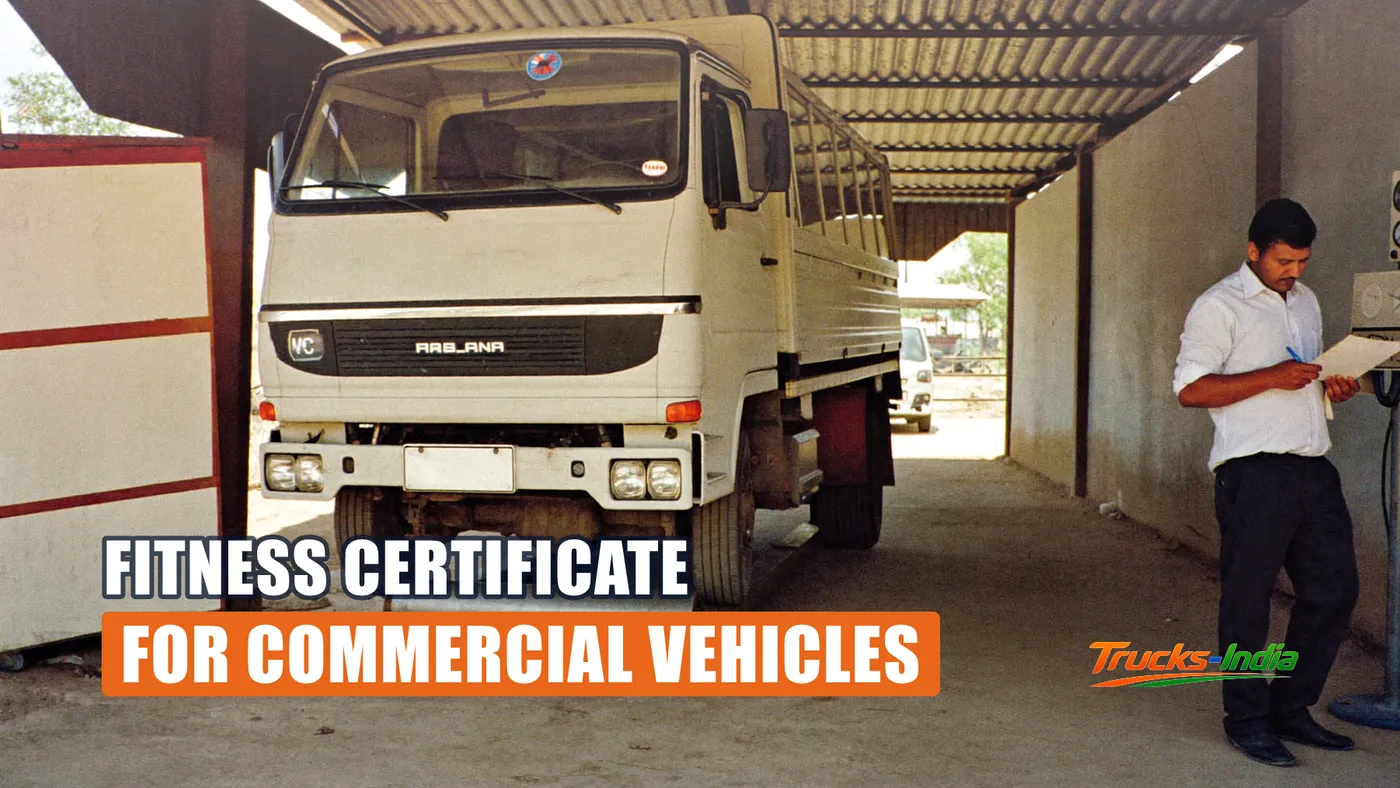
Every goods vehicle in India needs a fitness certificate to be legally on the road, and the renewal gets more frequent the older the truck gets. That escalation is deliberate policy, and it is the thing owners plan for least.
A new vehicle is comfortable for two years. An eight year old vehicle is back at the testing station every twelve months. A fifteen year old vehicle faces a harder test at an automated station with higher fees, and a failure there ends the vehicle's working life.
What it is, and what it is not
A certificate of fitness records that a transport vehicle has been inspected and found roadworthy. It covers the mechanical and safety condition of the vehicle: brakes, steering, suspension, lights, tyres, chassis, body and the safety equipment the rules require.
It is not the pollution certificate, which measures exhaust emissions only and runs on its own much shorter cycle. Both are required and they are separate documents, as the PUC guide sets out.
A private car does not need one. Every transport vehicle does, from the day it is registered, and it cannot legally operate without a current certificate.
The validity schedule
This is the part to plan around, because it changes twice in a vehicle's life.
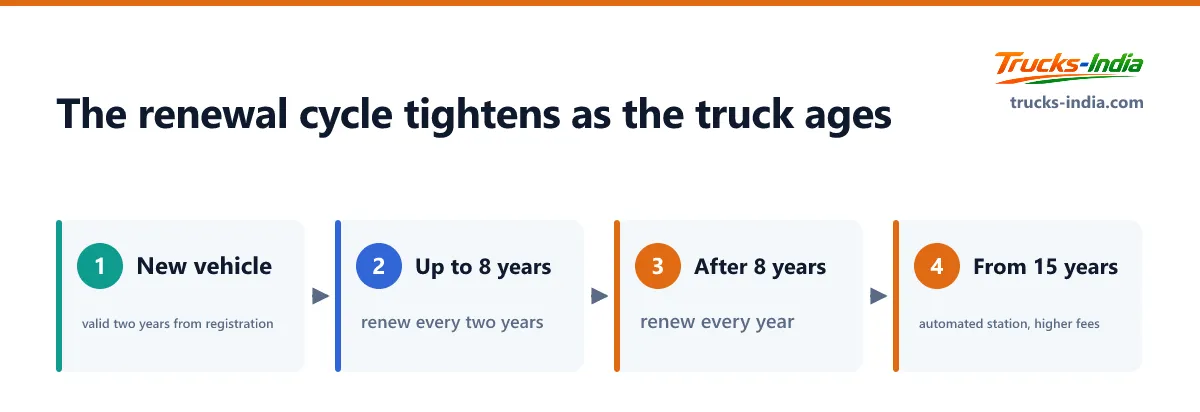
A new transport vehicle receives a fitness certificate valid for two years from registration.
From then until the vehicle is eight years old, renewal is on a two year cycle.
After eight years, renewal becomes annual. The vehicle is now at the testing station every twelve months for the rest of its working life.
At fifteen years, the regime changes again. The vehicle must be tested at an Automated Testing Station, fees are deliberately higher from this point, and a failure means the vehicle is treated as an end of life vehicle. That threshold and what follows it are covered in the scrappage policy guide.
Read those three steps together and the pattern is clear. The state is not trying to retire your truck at a fixed age; it is making an old truck progressively more expensive and more inconvenient to keep certified.
Automated testing stations
The older manual inspection is being replaced by Automated Testing Stations, where the vehicle is assessed by instrumented equipment rather than by eye.
For an operator this cuts both ways. The process is more consistent and less discretionary, which is welcome. It is also less forgiving, because a machine measuring brake force does not accept that the vehicle is fine really. A truck that passed manual inspections on reputation will not necessarily pass an automated one.
If your vehicle is approaching an automated test for the first time, get the brakes, lights, steering play and suspension looked at beforehand rather than presenting it and hoping.
What gets a vehicle failed
The recurring ones, in rough order of frequency:
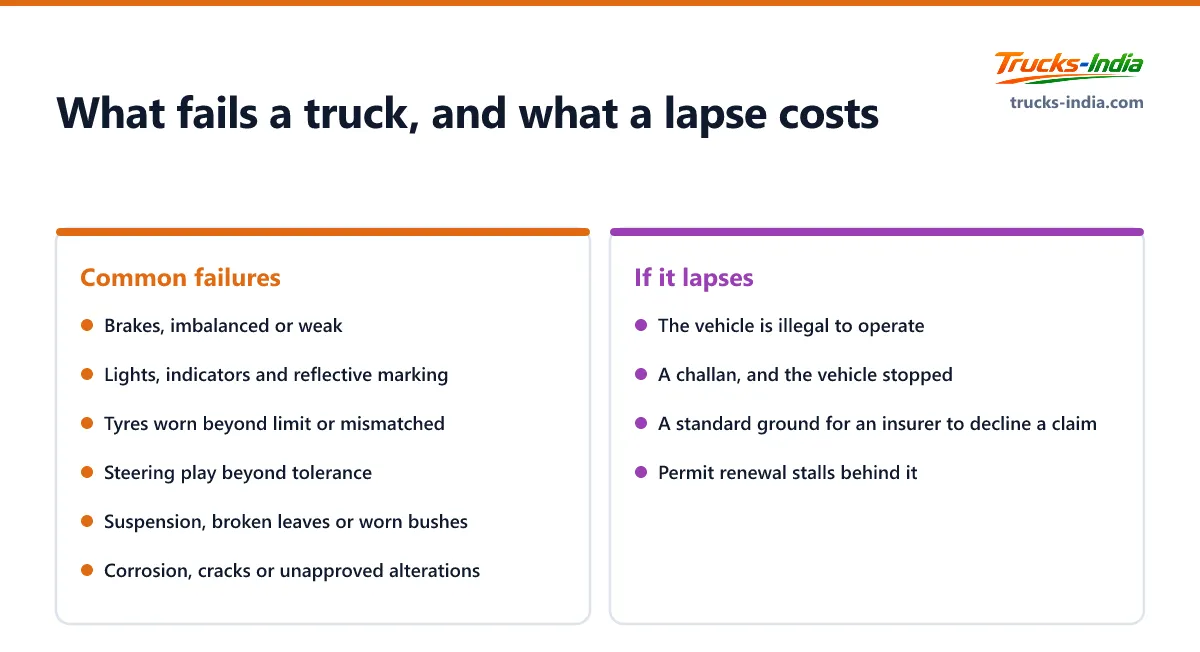
- Brakes, either imbalance between wheels or inadequate force
- Lights and indicators, including reflectors and the mandatory reflective markings
- Tyres, worn beyond limit or mismatched
- Steering play beyond tolerance
- Suspension, broken leaves or worn bushes
- Body and chassis, corrosion, cracks or an unapproved alteration
- Emission, where it is checked alongside
Two of those are worth separate attention. Unapproved alterations fail a vehicle and are a common surprise for owners who fitted something they considered harmless, which the modification rules guide covers. And reflective marking is both a fitness item and a roadside fine in its own right, covered in the reflective tape guide.
How renewal works
The sequence is straightforward.
- Apply through the Parivahan portal or at the RTO, in the prescribed form.
- Pay the fitness test and certificate fees, which rise with vehicle age and are higher from fifteen years.
- Present the vehicle for inspection at the appointed station on the appointed day.
- Collect the certificate, or the list of defects if it failed.
- Rectify and re-present if it failed, paying again.
Apply before expiry. A lapsed certificate means the vehicle is not legally operable, and late renewal attracts additional fees for the period of delay.
What it costs, and the cost nobody counts
The statutory fees are modest, rising with age and stepping up at fifteen years by design.
The cost that actually hurts is downtime. The vehicle has to travel to the station, wait, be tested, and travel back. On a failure it does that twice with a repair in between. A day and a half of a truck not working is worth more than the fee, which is the argument for presenting a vehicle in good order the first time rather than treating the test as the inspection.
That is the same logic as the maintenance guide: preventive work is cheaper than the alternative, and the alternative is never scheduled conveniently.
What happens without one
An expired fitness certificate makes the vehicle illegal to operate. Three things follow.
A challan, and the vehicle stopped until the position is resolved.
An insurance problem. A lapsed fitness certificate at the time of an incident is one of the standard grounds an insurer uses to decline a commercial vehicle claim, as the insurance guide sets out. That is a far larger exposure than the fine.
A permit problem, because a current fitness certificate is required to obtain and renew a permit. Let fitness lapse and the permit renewal stalls behind it.
Frequently asked questions
Two years for a new transport vehicle from the date of registration, then renewal every two years until the vehicle is eight years old, and annually after that. From fifteen years the test moves to an Automated Testing Station with higher fees.
No. The fitness certificate covers the mechanical and safety condition of the vehicle, such as brakes, steering, suspension, lights and body. The PUC measures exhaust emissions only and runs on a much shorter cycle. Both are required and both are separate documents.
A facility where the vehicle is assessed with instrumented equipment rather than by visual inspection. It is more consistent and less discretionary, and also less forgiving, so a vehicle that passed manual inspections may not pass an automated test without preparation.
Brakes, either imbalanced or weak, followed by lights and reflectors, worn or mismatched tyres, excessive steering play, worn suspension, and corrosion, cracks or unapproved alterations to the body and chassis.
The vehicle is illegal to operate. You face a challan and a stopped vehicle, your insurer gains a standard ground to decline a claim arising while it was lapsed, and any permit renewal stalls because a current fitness certificate is a prerequisite.
Apply through Parivahan or at the RTO in the prescribed form, pay the test and certificate fees, present the vehicle for inspection on the appointed day, and collect the certificate or the defect list. Apply before expiry, because late renewal attracts additional fees for the delay.
Where this fits
Fitness is one of the annual renewals that keeps a truck earning. See our guide to documents to carry in a truck.
When the test ends a vehicle's life, the replacement decision starts with payload and price. Trucks India lists both for every model sold in India.
Call +91 93422 00875About the author
Lokesh R
CEO of Trucks India
Lokesh R is the founder of Trucks India, an independent heavy-vehicle marketplace and research platform operated from Chennai, Tamil Nadu, founded in 2025. Under his direction, Only Heavy publishes specifications and prices sourced from manufacturers, authorised dealer price lists and official regulatory schedules, with every model page checked by a named reviewer, prices re-verified monthly and after any GST revision, and no advertiser able to buy a rating, ranking or comparison result.


