
On Road Price vs Ex Showroom Price of a Truck
What sits between a truck's ex showroom and on road price in India: the 18 percent GST, state road tax, registration fees, insurance and the body nobody quotes.

Lokesh R
CEO of Trucks India
Created 19 September 2026 · 7 min read
The number in the advertisement is not the number you pay. Everybody knows that. What catches buyers out is how much of the gap is fixed by law, how much varies by the state you register in, and how much the dealer simply left out.
There is also a change worth knowing before you negotiate anything. GST on goods transport vehicles fell from 28 percent to 18 percent on 22 September 2025. If you are working from a quotation, a calculator or an article written before that date, the tax line is wrong and the error is large.
This guide takes the price apart, line by line.
The short answer
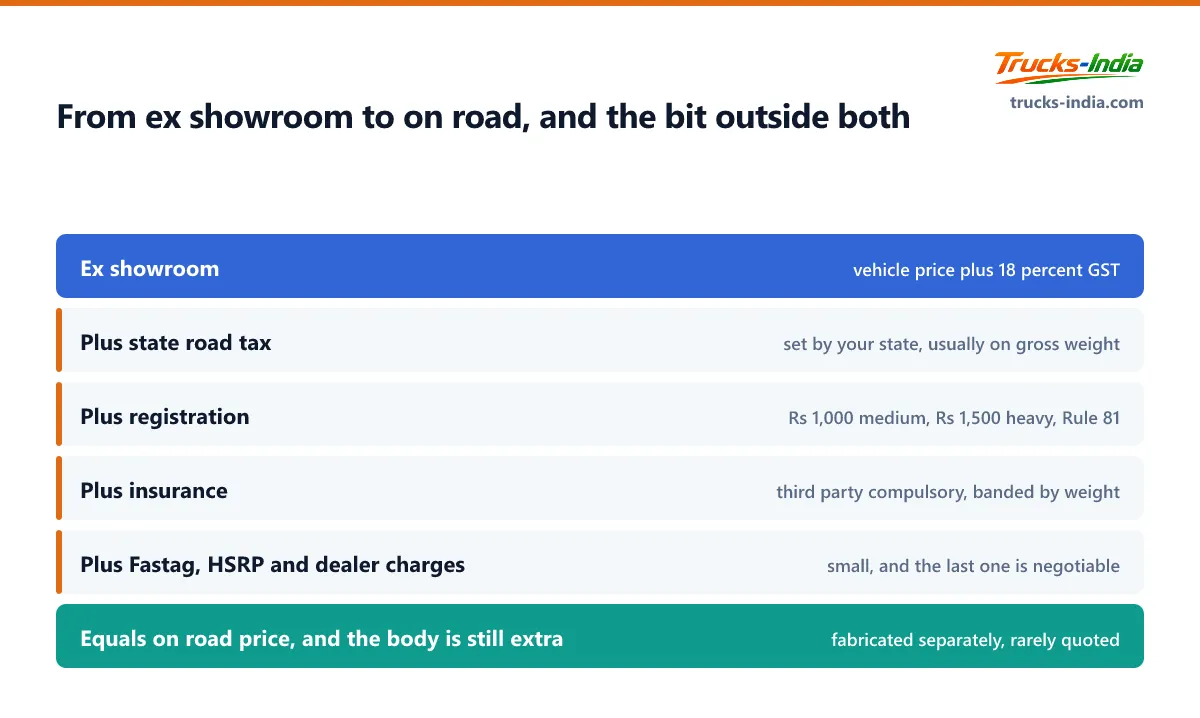
Ex showroom price is the vehicle plus GST, and nothing else. It is the manufacturer's price with tax on it, sitting in the showroom, not yet legal to drive.
On road price is what it costs to put that vehicle on the road in your name: ex showroom, plus state road tax, plus registration, plus insurance, plus the smaller statutory bits.
For a goods vehicle there is a third number that belongs to neither and surprises people most: the body. A chassis is not a truck until somebody builds a load body on it, and that cost sits outside both figures on most quotations.
What makes up the ex showroom price
Two components.
The vehicle price set by the manufacturer, which is what dealer discounting works on.
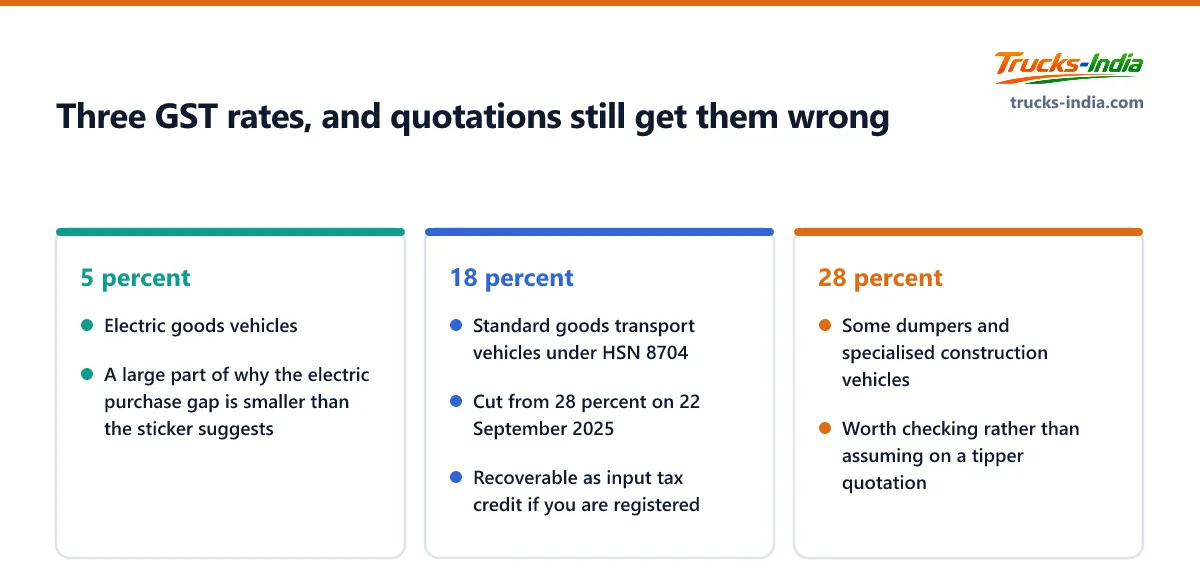
GST at 18 percent for standard goods transport vehicles under HSN 8704, reduced from 28 percent with effect from 22 September 2025 in the rationalisation agreed at the 56th GST Council meeting.
Two exceptions worth knowing. Electric goods vehicles sit at 5 percent, which is a substantial part of why the purchase gap between an electric and a diesel light commercial vehicle is narrower than the sticker suggests. And some dumpers and specialised construction vehicles remain at 28 percent, so a tipper quotation is worth checking rather than assuming.
If you are GST registered and will claim input tax credit on the vehicle, this line is recoverable and your real cost is the pre tax figure. If you are not, it is a cost. That single distinction changes the arithmetic more than any discount you will negotiate.
Registration is the small number
This one is genuinely minor and people over-weight it.
Under Rule 81 of the Central Motor Vehicles Rules 1989, registration of a medium goods vehicle costs Rs 1,000 and a heavy goods vehicle Rs 1,500. A smart card registration certificate adds about Rs 200.
That is the whole statutory registration fee. If a quotation shows tens of thousands against a line called registration, it is bundling road tax, handling charges or both, and you are entitled to ask which.
Road tax is the big variable
This is where the states differ and where a quotation from another city stops being useful.
Road tax on motor vehicles is a state subject. Each state sets its own rate for goods vehicles, generally on gross vehicle weight rather than on price, which is the opposite of how private cars are taxed.
The structural difference that catches first time buyers: a private car pays a one time lifetime tax at registration. A commercial goods vehicle usually does not. Depending on the state, it pays quarterly, annually or on a multi year basis, so road tax is a recurring operating cost rather than a single entry in your purchase budget.
Two consequences follow. Your on road price only includes the first tax period, not the vehicle's lifetime. And when you compare an on road quotation against a price you saw online, check they cover the same period in the same state, because very often they do not.
Get the figure for your own gross vehicle weight from your own RTO. Anybody quoting a single national road tax percentage for goods vehicles is guessing.
Insurance
Third party liability cover is compulsory and is included in any honest on road figure. The premium is banded by gross vehicle weight and set centrally, so it is identical at every insurer for a given weight class and there is nothing to shop for.
One recent change in your favour: GST on third party insurance for goods carriage vehicles was cut from 12 percent to 5 percent in September 2025.
Own damage cover is optional in law and effectively compulsory if there is a loan against the vehicle. It is the part of the premium that actually varies, and the truck insurance guide covers what to look for.
The body, which is in neither number
For most goods vehicles the dealer sells you a chassis. The load body is built separately by a fabricator, and on many quotations it appears as a footnote or not at all.
This is not a small line. A container body, a tipper body or a reefer body can be a serious fraction of what you spend, and it is the single most common reason a buyer's finance falls short on delivery day, because lenders typically write the loan against the chassis invoice rather than the built vehicle. The body building cost guide sizes it, and the loan guide explains why the gap lands in cash.
The rest of the quotation
Smaller, but worth reading rather than initialling.
- FASTag, which is mandatory and cheap, and which has its own rules for commercial vehicles
- High security registration plate, the HSRP, which is mandatory and also cheap
- Temporary registration, where your state uses it
- Handling, logistics or documentation charges, which are the dealer's own and are negotiable
- Extended warranty or an annual maintenance contract, frequently pre added to the quotation without being asked for, and removable
That last one deserves a second look rather than a reflex. Sometimes it is worth having, which the warranty and AMC guide works through, but it should be a decision rather than a default.
How to read a quotation properly
Ask for it itemised, and check four things.
- Is the GST line at 18 percent, or is it still at the old 28? For an electric vehicle, is it at 5?
- What period does the road tax cover, and is it for your registering state?
- Is the body included, and if so at what specification, or is this a chassis price?
- Which lines are the dealer's own charges rather than statutory? Those are the ones you can argue about.
The statutory lines are fixed. Arguing about them wastes goodwill you could spend on the one number that is genuinely negotiable, which is the vehicle price itself.
Trucks to compare
A few popular trucks on Trucks India, with ex-showroom price and rated payload. Open one for its full price, specifications and mileage.
Browse more: Mini trucks, Light commercial vehicles, Heavy trucks, Ashok Leyland trucks, Euler EV trucks, Premier Motors trucks, Maruti Suzuki trucks
Frequently asked questions
Ex showroom is the vehicle price plus GST. On road price adds state road tax, registration, insurance and the smaller statutory charges, so it is what it costs to put the vehicle legally on the road in your name. For a goods vehicle the load body is usually outside both figures.
18 percent for standard goods transport vehicles under HSN 8704, reduced from 28 percent with effect from 22 September 2025. Electric goods vehicles are at 5 percent, and certain dumpers and specialised construction vehicles remain at 28 percent.
Under Rule 81 of the Central Motor Vehicles Rules, Rs 1,000 for a medium goods vehicle and Rs 1,500 for a heavy goods vehicle, plus roughly Rs 200 for a smart card certificate. Anything much larger on a quotation under the heading registration is bundling road tax or dealer charges.
It is set by each state, generally on gross vehicle weight rather than on price, and unlike a private car it is usually paid quarterly, annually or over a multi year period rather than once for the vehicle's life. Confirm the figure and the period with your own RTO.
Usually not. Dealers sell a chassis and the load body is built separately by a fabricator. Because lenders write the loan against the chassis invoice, the body is a common reason buyers find themselves short of cash on delivery day.
Because road tax is a state subject and the rates differ, and because dealer handling charges differ. The statutory portion changes with where you register the vehicle, not with where you buy it.
Where this fits
The price you actually pay decides the loan. See our guide to commercial vehicle loans.
Start from a real on road figure rather than an advertised one. Trucks India lists on road price, payload and mileage for every model sold in India.
Call +91 93422 00875About the author
Lokesh R
CEO of Trucks India
Lokesh R is the founder of Trucks India, an independent heavy-vehicle marketplace and research platform operated from Chennai, Tamil Nadu, founded in 2025. Under his direction, Only Heavy publishes specifications and prices sourced from manufacturers, authorised dealer price lists and official regulatory schedules, with every model page checked by a named reviewer, prices re-verified monthly and after any GST revision, and no advertiser able to buy a rating, ranking or comparison result.


