
Commercial Vehicle Loan in India
How commercial vehicle loans work in India: the rate you will actually get, how much of the on road price is funded, tenure, documents and the EMI trap.

Lokesh R
CEO of Trucks India
Created 7 September 2026 · 8 min read
Almost nobody buys their first truck with cash. The loan is the purchase, and the terms you accept decide whether the vehicle earns for you or for the lender.
Most guides on this stop at a rate table. That is the least useful part, because the advertised rate is a starting figure that almost no first time buyer gets. What decides your actual cost is which category of borrower the lender puts you in, how much of the on road price the loan actually covers, and whether the EMI was set against realistic utilisation or hopeful utilisation.
This guide covers those three, in that order.
What a commercial vehicle loan actually costs
Rates across banks and NBFCs sit in a wide band, and the spread is not noise. It is the lender pricing your risk.
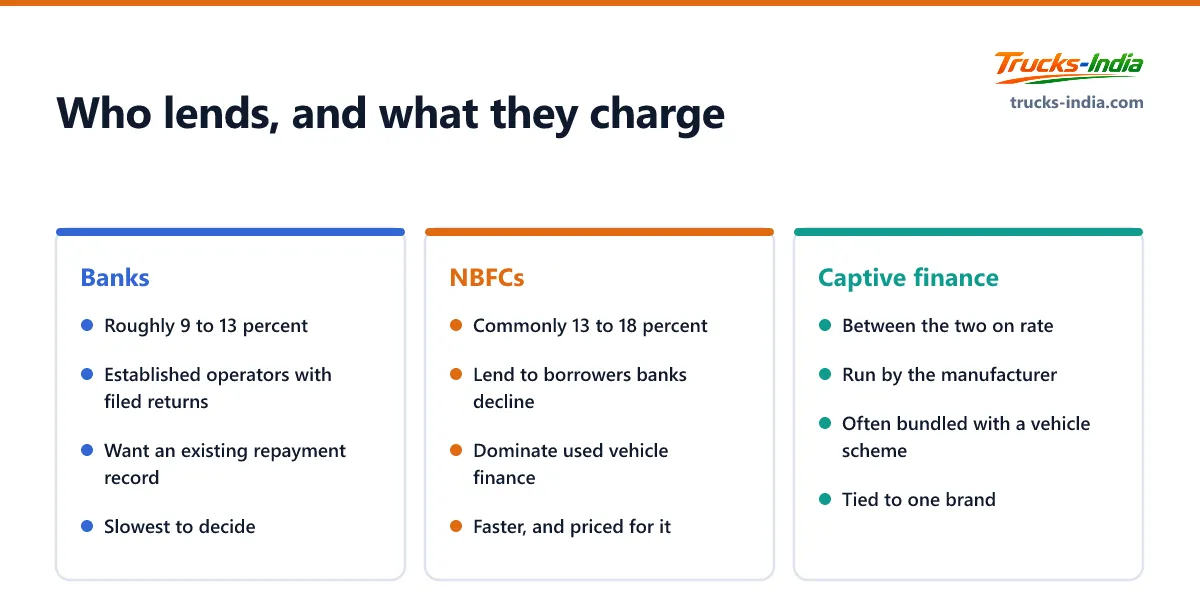
- Banks publish the lowest rates, roughly 9 to 13 percent, and hand them to established operators with filed returns and an existing repayment record.
- NBFCs such as Shriram Finance, Sundaram Finance, Cholamandalam and Tata Capital price higher, commonly 13 to 18 percent, and lend to people banks decline.
- Captive finance arms run by the manufacturers sit in between and often bundle a scheme with the vehicle.
Advertised rates starting around 8 or 9 percent are real, but they are the floor of the band, not the middle of it. A first time buyer with no transport track record should plan around the upper half.
The one number that matters more than the rate is the total interest over the tenure. Stretching a loan from 48 to 60 months drops the EMI and raises what you pay by a meaningful margin. Lenders lead with the EMI because it is the comfortable number. Ask for the total.
First time buyer, or existing operator
Lenders sort commercial vehicle borrowers into categories, and the category sets your rate more firmly than your credit score does.
A first time user is someone with no commercial vehicle in their name and no history of repaying one. That profile carries the highest pricing and the largest down payment demand, regardless of how good your salary slips look, because a salaried credit history says nothing about whether a truck will earn.
An existing operator with one or two vehicles already running, EMIs paid on time and returns filed, is a different proposition entirely. The second vehicle is almost always cheaper to finance than the first, which is one reason the scaling guides tell you to prove the first truck before adding a second.
If you are in the first category, the levers you have are a larger down payment, a guarantor, and evidence of committed work. A signed contract or a written attachment arrangement with a transporter moves a file further than another salary slip does.
How much the loan actually covers
This is where first time buyers get caught, and it is a simple mechanical thing.
Lenders talk in loan to value, typically 75 to 90 percent. The question nobody asks is: value of what?
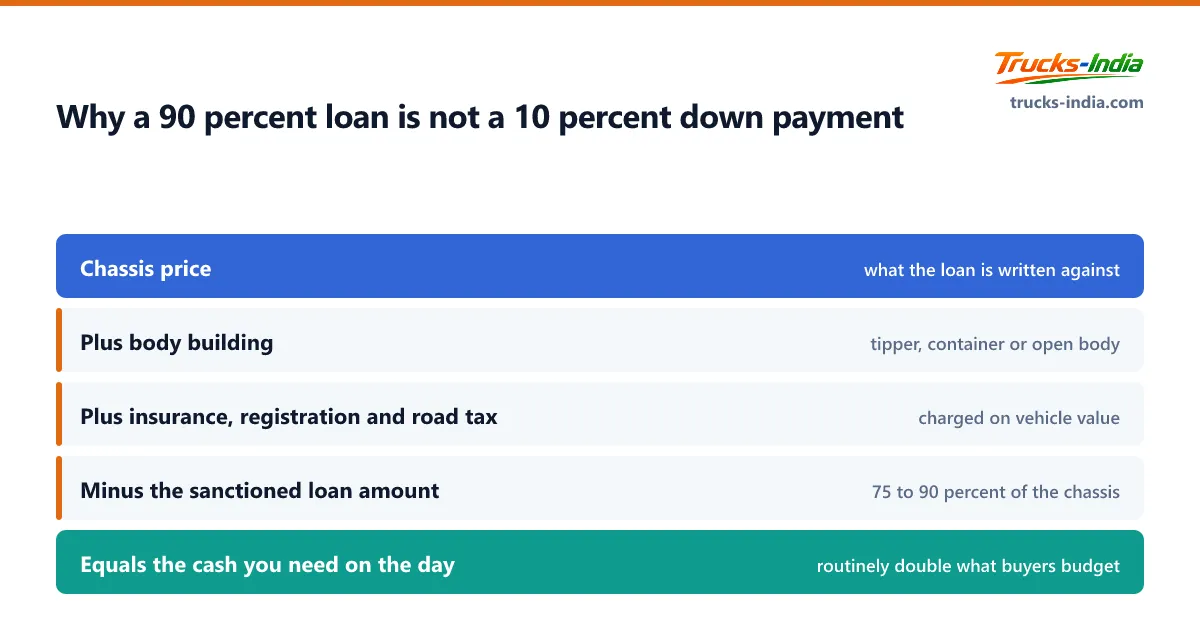
Most commercial vehicle loans are written against the chassis invoice, not the on road price. For a goods vehicle the body is built separately, and body building on a tipper or a container body is a substantial cost of its own. So is insurance, registration and road tax, which are charged on the vehicle's value and run to a serious figure on a heavy vehicle.
The practical result is that a loan described as 90 percent leaves you finding considerably more than 10 percent in cash. Work out your own gap before you sit down with a financier.
- Chassis price
- Plus body building
- Plus insurance, registration and road tax
- Minus the sanctioned loan amount
Whatever is left is what you need on the day, and it is routinely double what people budget.
Tenure, and the EMI trap
Tenures run from 12 to 60 months as standard, with some lenders going to 84.
The temptation with a long tenure is obvious: a smaller EMI looks survivable. The problem is that a truck's earning is not flat. It has strong months and thin months, and the thin ones are when the EMI is due anyway.
The rule that keeps operators solvent is to set the EMI against a conservative utilisation assumption, not an optimistic one. If you have priced the vehicle on 22 loaded days a month, run the EMI test at 16. If it still clears, the loan is sized correctly. If it only works at 22, you have bought a vehicle that cannot survive a slow month, a breakdown, or a client who pays at 60 days instead of 30.
That last one deserves its own line, because it is the most common cash squeeze in the business. Your customer's payment cycle does not pause for your EMI date.
Documents lenders ask for
The list varies by lender but the spine of it does not.
- KYC: PAN and Aadhaar for the applicant, and for the guarantor if there is one
- Address proof for the business and the applicant
- Bank statements, usually six to twelve months
- Income proof: income tax returns, or for existing operators, the transport business's returns
- Business proof: GST registration, Udyam registration, or the partnership deed or incorporation certificate
- Existing vehicle papers if you already run one, including the registration certificate and a repayment record
- Quotation from the dealer for the chassis and the body
Two of these are worth preparing early rather than scrambling for. Udyam registration is free and lenders ask for it routinely. And your current account name must match your GST record, because a mismatch there stalls files for weeks.
The documents guide covers the full set across the whole setup, not just the loan. When the time comes to close the loan early, the foreclosure guide covers the RBI rules on prepayment charges and the hypothecation removal that has to follow.
Used vehicles are financed differently
A loan against a used truck is not the same product. Expect a higher rate, a shorter tenure, a lower loan to value, and a valuation step where the lender decides what the vehicle is worth rather than accepting the seller's number.
NBFCs dominate used commercial vehicle finance for a reason. Banks are reluctant, and the operators buying used are often the ones banks decline. If the used route is where your budget lands, plan on NBFC pricing and a valuation that comes in below the asking price.
What actually gets a file approved
Beyond the paperwork, lenders are assessing one thing: whether this truck will earn enough to pay for itself.
What helps:
- Evidence of committed work. A contract, an attachment arrangement, or a regular route with a named client.
- An existing repayment record, even a small one. A cleanly repaid two wheeler loan beats no history at all.
- A larger down payment. It lowers the lender's exposure and moves your rate down with it.
- A guarantor with assets or an existing transport business.
What hurts:
- Cheque bounces in the last twelve months, which are read as a direct signal
- A gap between your declared income and your bank statements
- No plan for the load beyond an intention to find one
If you have no committed work yet, the guide to getting loads and the contracts guide are worth reading before the loan application rather than after it.
Where to start
Get the on road price right before you talk to any lender, because every number in the conversation is derived from it. Compare models within the band you can actually service, whether that is 10 to 20 lakh or 20 to 30 lakh, and choose on payload and mileage rather than on the EMI the dealer quotes you.
The investment guide covers what the whole setup costs beyond the vehicle, and the margin guide shows where the EMI sits in your cost per kilometre.
Trucks to compare
A few popular trucks on Trucks India, with ex-showroom price and rated payload. Open one for its full price, specifications and mileage.
Browse more: Mini trucks, Light commercial vehicles, Heavy trucks, Ashok Leyland trucks, Force Motors trucks, Mahindra trucks, Euler EV trucks
Frequently asked questions
Banks typically price between 9 and 13 percent for established operators, and NBFCs between 13 and 18 percent for borrowers banks decline. Advertised rates near 8 or 9 percent are the floor of the band. A first time buyer with no transport history should plan for the upper half.
Lenders quote 75 to 90 percent loan to value, but usually against the chassis invoice rather than the on road price. Once body building, insurance, registration and road tax are added, the cash needed on the day is well above the stated 10 to 25 percent. Calculate the gap yourself before committing.
Yes, but at higher pricing and a larger down payment, because a first time user has no record of repaying a commercial vehicle. A guarantor, a signed contract or an attachment arrangement, and a bigger down payment are the three levers that improve the terms.
Commonly 60 months, with some lenders offering up to 84. A longer tenure lowers the EMI and raises total interest. Size the EMI against a conservative utilisation assumption rather than your best month.
PAN and Aadhaar, address proof, six to twelve months of bank statements, income tax returns, business proof such as GST or Udyam registration, papers for any existing vehicle, and the dealer's quotation for chassis and body. Udyam registration is free and worth doing before you apply.
Yes. Expect a higher rate, shorter tenure, lower loan to value and a lender valuation that often comes in under the asking price. NBFCs handle most used commercial vehicle finance because banks are reluctant in this segment.
Where this fits
The loan is one step in setting up. See our guide to starting a transport business for the full sequence.
Your EMI is set against the on road price, so the model you choose decides the loan before the lender does. Trucks India lists on road price, payload and mileage for every model sold in India.
Call +91 93422 00875About the author
Lokesh R
CEO of Trucks India
Lokesh R is the founder of Trucks India, an independent heavy-vehicle marketplace and research platform operated from Chennai, Tamil Nadu, founded in 2025. Under his direction, Only Heavy publishes specifications and prices sourced from manufacturers, authorised dealer price lists and official regulatory schedules, with every model page checked by a named reviewer, prices re-verified monthly and after any GST revision, and no advertiser able to buy a rating, ranking or comparison result.


