
Documents to Carry in a Truck While Driving
Every document a truck must carry in India, which ones are accepted digitally on DigiLocker or mParivahan, and the five that stop a vehicle at a check post.

Lokesh R
CEO of Trucks India
Created 1 September 2026 · 5 min read

A check post is not the place to discover that a paper is missing. The officer is not interested in where the original is, and the vehicle does not move until the position is resolved.
The list is short and it has not changed much in years. What has changed is that most of it can now be carried digitally, which removes the old excuse about the originals being in the office, and removes the old risk of the folder going missing with the driver.
The vehicle papers
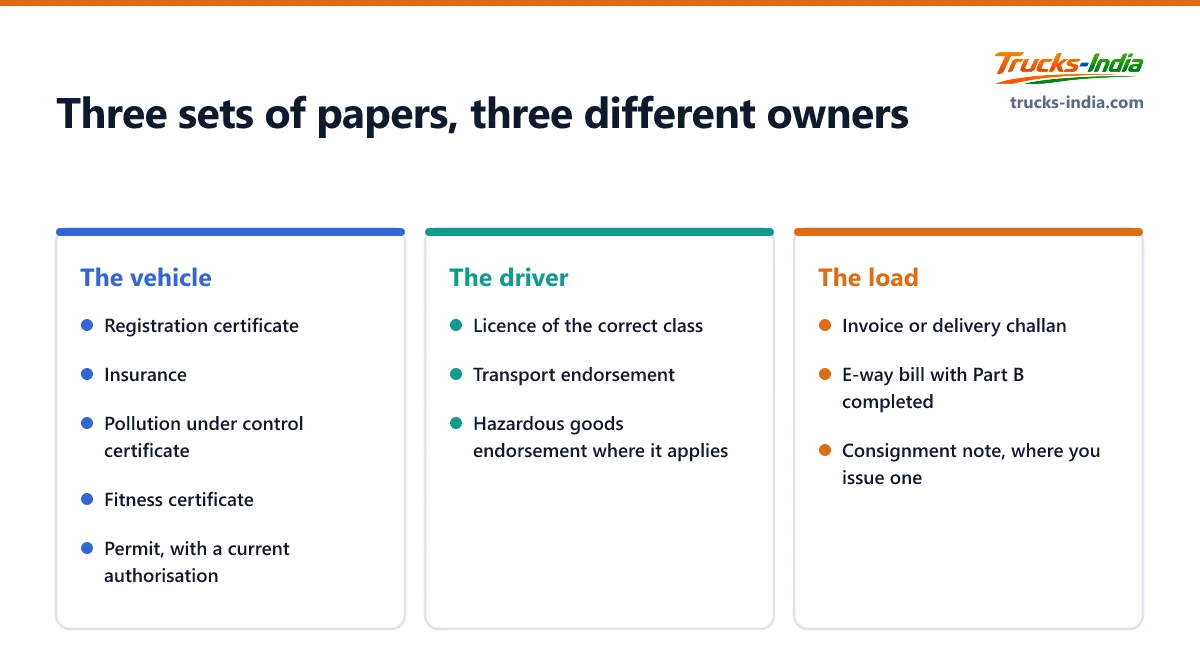
Five documents belong to the truck and must be current every day it works.
Registration certificate. The RC, proving the vehicle is registered and showing its gross vehicle weight, unladen weight and body type. Everything else references it.
Insurance. At minimum a valid third party policy. This is the one most often checked and the one whose lapse carries the widest consequences, since an uninsured vehicle in an incident is a personal liability.
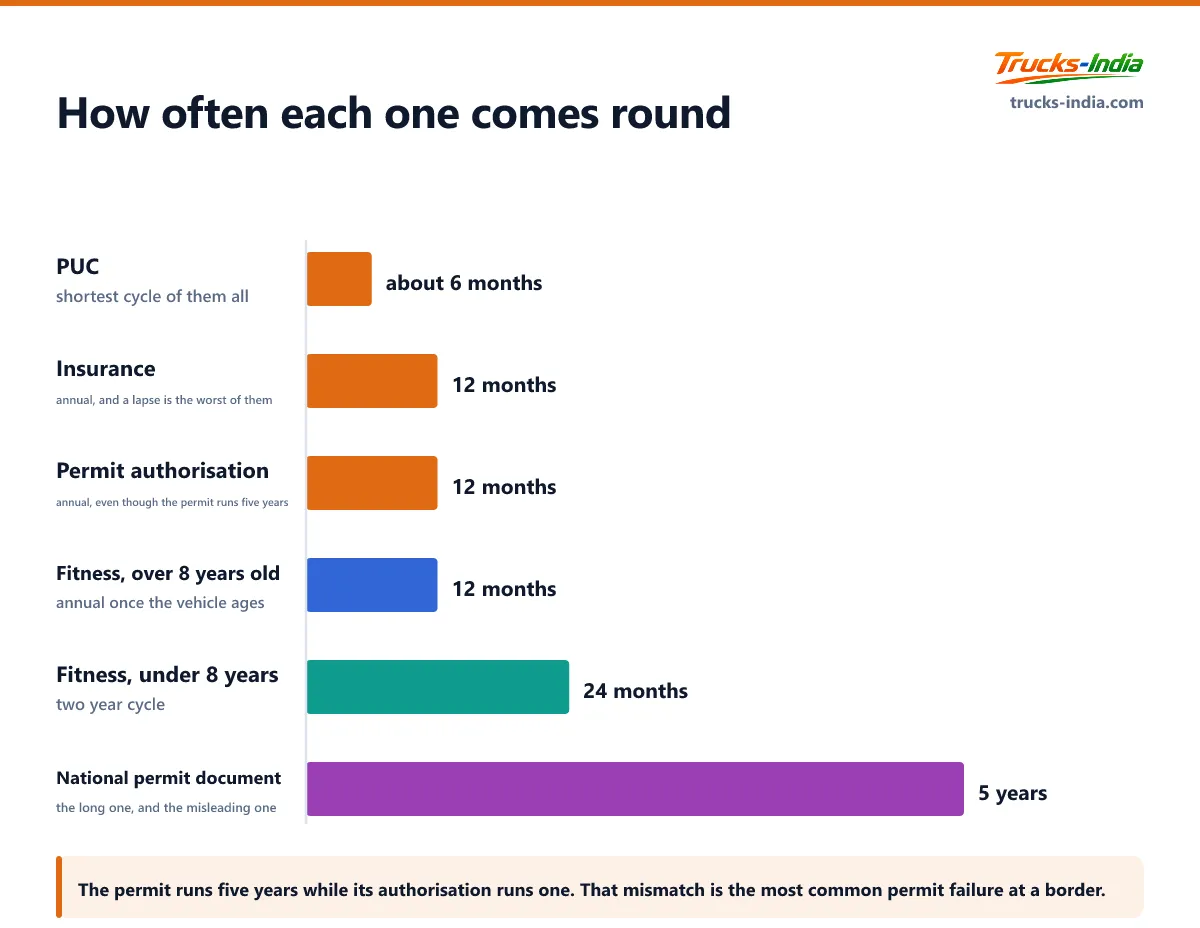
Pollution under control certificate. The PUC. Short validity, easy to let slip, and the penalty is disproportionate to the cost of renewal, which the PUC guide covers.
Fitness certificate. Mandatory for a transport vehicle and renewed far more often than people expect once the vehicle ages, which the fitness certificate guide sets out.
Permit. The goods carriage permit for intrastate work, or the national permit with its current authorisation for interstate. The authorisation is annual even though the permit runs five years, and that mismatch is the most common permit failure at a border. The permit and authorisation rules explain it.
Vehicles with a gross vehicle weight not exceeding 3,000 kg are exempt from the permit requirement under Section 66(3) of the Motor Vehicles Act, so that one does not apply to the smallest commercial vehicles.
The driver's papers
Driving licence of the correct class, with the transport endorsement. A licence that covers a light commercial vehicle does not cover a heavy one, and driving outside your class is both an offence and the most common ground on which an insurer rejects a claim. The heavy vehicle licence classes set out which one covers what.
A hazardous goods endorsement as well, if that is what is on the back.
The consignment papers
These change with every load rather than belonging to the vehicle.
Invoice or delivery challan for the goods being carried.
E-way bill where the consignment requires one, with Part B completed and the vehicle number matching the truck it is actually in. The e-way bill guide covers the transporter's side of that.
Consignment note or lorry receipt, where you issue one. Worth knowing that issuing consignment notes is precisely what makes an operator a goods transport agency for GST purposes, which the GST guide explains.
What can be carried digitally
This is the part worth acting on, because it removes a whole category of problem.
Under the Ministry's clarification on electronic documents, digital copies held in DigiLocker or on the mParivahan app are treated as valid for the registration certificate, insurance, fitness and PUC, and for the driving licence. An officer is expected to accept them.
Two caveats that matter in practice.
A photograph or a scan in the phone gallery is not the same thing. The acceptance rests on the document being pulled from the official system, not on it being an image. A screenshot is not a document.
Enforcement varies. Some officers are entirely comfortable with a digital record and some are not, and arguing the point on a roadside at night is a poor use of an evening. The sensible arrangement is digital as the primary and a physical folder in the cab as the fallback, not one or the other.
What to keep in the cab regardless
A small folder, kept in the vehicle rather than in the office, holding:
- Photocopies of the RC, insurance, fitness, PUC and permit
- The driver's licence, which the driver carries anyway
- A page with the owner's phone number, the insurer's claim helpline and the roadside assistance number
- The vehicle's chassis and engine numbers written down
That last item sounds trivial until there is an incident and somebody needs them quickly. The breakdown guide and the accident guide both start from having that information to hand.
The renewal calendar is the real answer
Every failure in this list traces back to a date somebody did not track. On one vehicle it is five or six renewal dates a year. On six vehicles it is roughly thirty, which is past the point where memory works.
Put insurance, fitness, PUC, permit authorisation and the driver's licence expiry in one calendar with reminders a month ahead. It is the cheapest compliance measure available and it removes almost everything in this guide as a source of trouble.
Trucks to compare
A few trucks for a transport business on Trucks India, with ex-showroom price and rated payload. Open one for its full price, specifications and mileage.
₹4.5-5.25 Lakh · 765 kg payload · Petrol
Browse more: Mini trucks, Light commercial vehicles, Heavy trucks, Ashok Leyland trucks, Mahindra trucks, Force Motors trucks, Maruti Suzuki trucks
Frequently asked questions
The registration certificate, valid insurance, pollution under control certificate, fitness certificate and the permit, plus the driver's licence of the correct class. For the load itself, the invoice or delivery challan, the e-way bill where one is required, and the consignment note if you issue one.
Yes. Documents held in DigiLocker or on the mParivahan app are treated as valid for the registration certificate, insurance, fitness, PUC and driving licence, because they are pulled from the official system. A photograph or screenshot in the phone gallery is not the same thing and does not carry the same standing.
Not if its gross vehicle weight does not exceed 3,000 kg, which is exempt under Section 66(3) of the Motor Vehicles Act. Everything above that needs a goods carriage permit for intrastate work or a national permit for interstate.
Insurance, the permit authorisation and the e-way bill, in roughly that order. The permit trips people up because the document runs five years while the authorisation on it is annual, so a valid looking permit can still be unauthorised.
Not for the items available digitally, where a DigiLocker or mParivahan record is acceptable. In practice most operators keep photocopies in a cab folder as a fallback, because enforcement attitudes to digital records still vary between officers and states.
The vehicle is generally not permitted to proceed until the position is resolved, and a challan follows. The cost is rarely the fine itself; it is the stopped load and the delivery you have missed.
Where this fits
These are the papers that travel. See our guide to the documents required to start a transport business for the ones that stay in the office.
Compliance follows the vehicle. Trucks India lists gross weight, payload and price for every model sold in India.
Call +91 93422 00875About the author
Lokesh R
CEO of Trucks India
Lokesh R is the founder of Trucks India, an independent heavy-vehicle marketplace and research platform operated from Chennai, Tamil Nadu, founded in 2025. Under his direction, Only Heavy publishes specifications and prices sourced from manufacturers, authorised dealer price lists and official regulatory schedules, with every model page checked by a named reviewer, prices re-verified monthly and after any GST revision, and no advertiser able to buy a rating, ranking or comparison result.


