
Truck Driver Salary in India
Truck driver salary in India by experience and vehicle type, how pay is actually structured with bhatta and trip incentives, and the full cost to an owner.

Lokesh R
CEO of Trucks India
Created 10 September 2026 · 7 min read
Two people read this question very differently.
A driver wants to know what the job pays and what raises it. An owner wants to know what a driver costs, which is a larger number than the salary, and what it takes to keep one.
Both are answered by the same set of figures, so this guide gives them together. The wage bands come first, then what actually sits on top of them, then the part owners underestimate: why drivers leave, and what that costs.
What a truck driver earns per month
Pay tracks the class of vehicle and the kind of work far more closely than it tracks years of service.
- Entry level, holding a fresh heavy vehicle licence, on short haul or regional routes: roughly Rs 15,000 to Rs 22,000 a month.
- Experienced, running long haul interstate: roughly Rs 25,000 to Rs 40,000.
- Specialised work, meaning tankers, hazardous goods, refrigerated bodies or over dimensional cargo: Rs 40,000 and upwards, with the top of that band well past Rs 60,000.
Broad national averages land near the lower end, around Rs 20,000 to Rs 30,000, because the national pool is dominated by light and medium vehicle work. That average is a poor guide to any particular job. The distribution matters more than the middle of it.
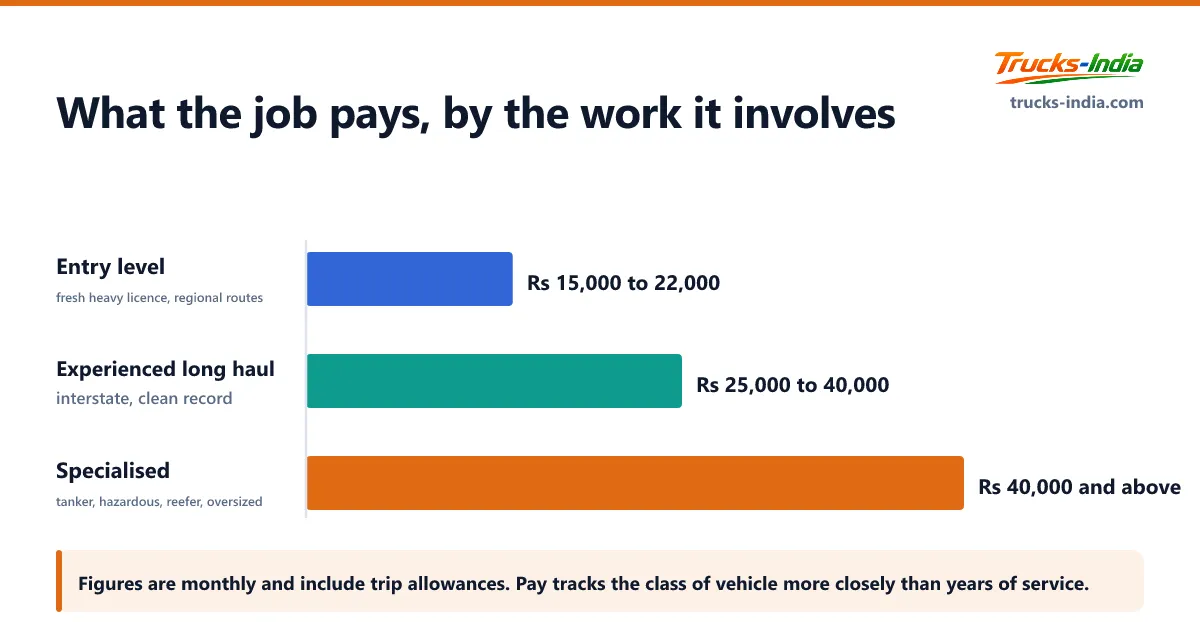
Two things move a driver up these bands faster than time does: a licence endorsement for hazardous goods, and a clean record on long interstate routes. The second is the harder one to acquire and the one owners pay for.
How the pay is actually structured
Very few Indian truck drivers are paid a single flat salary, which is why quoted averages are confusing.
The common structure has three parts:
- A monthly wage, the fixed base
- Bhatta, a daily trip allowance covering food and expenses on the road
- A trip incentive, paid per trip or per tonne or per kilometre
Some operators pay almost nothing as fixed wage and almost everything as trip payment. That structure looks cheap on the wage line and behaves very differently in practice: in a slow month the driver earns little and starts looking elsewhere, and you lose them exactly when work picks up.
The mixed structure, a fixed wage that covers a driver's basic obligations plus trip payments that reward output, is what most stable operations settle on.
What a driver actually costs an owner
The salary is not the cost. Budget for the full number.
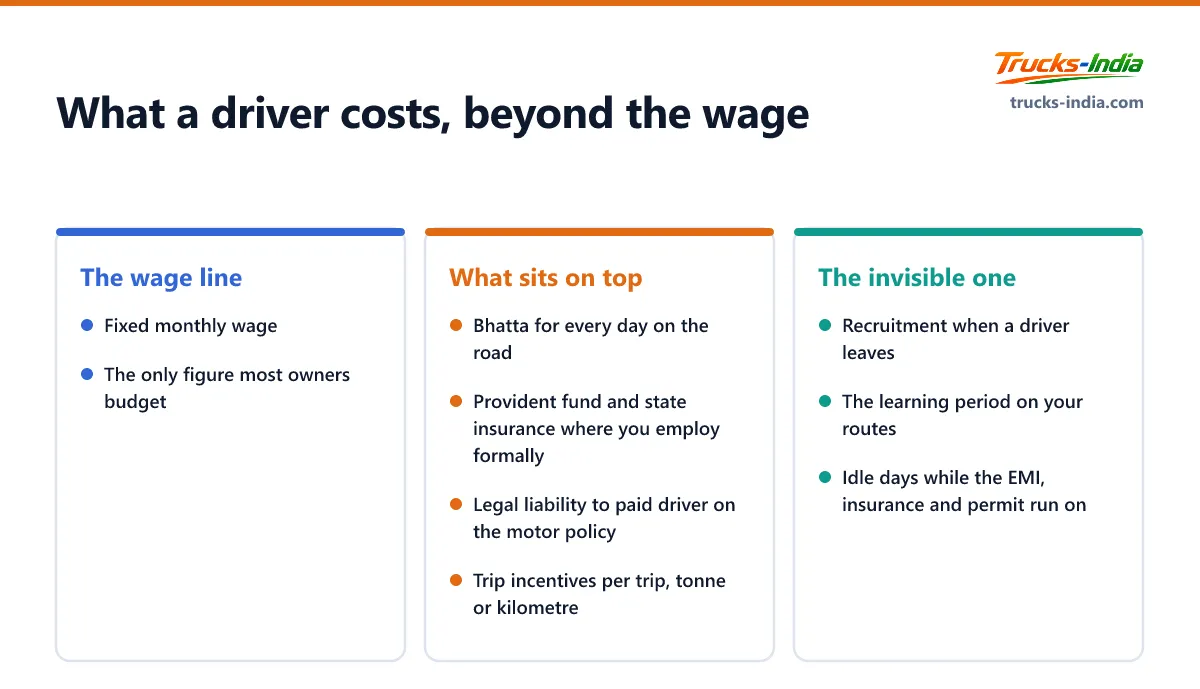
- The fixed monthly wage
- Bhatta for every day on the road, which on long haul is most of the month
- Statutory contributions where you employ formally, meaning provident fund and employee state insurance
- Legal liability to paid driver on the insurance policy, which is a small premium and a serious exposure without it
- The replacement cost when the driver leaves, covering recruitment, the learning period and any idle days
Where your headcount crosses the statutory thresholds there are provident fund and state insurance contributions on top, which the PF and ESI guide sets out along with the working hours the Motor Transport Workers Act actually allows.
That last line is invisible on any monthly statement and is often the largest of them. A truck standing idle for ten days between drivers earns nothing while the EMI, insurance and permit costs continue.
If you drive the vehicle yourself, the wage becomes part of your own income instead of a cost, which changes the economics substantially. The truck owner income guide works through what that looks like in take home terms.
Why drivers leave, and what actually retains them
Ask operators what their binding constraint is and most say drivers rather than trucks or loads. A vehicle without a driver earns nothing and still owes its instalment, which makes retention a financial question rather than an administrative one.
What retains drivers, roughly in order of how much it matters:
- Paying on time, every time. This ranks above the amount. A driver who is paid reliably will stay on a slightly lower wage than one who is paid late.
- Predictable home time. Knowing when they get back matters enormously and costs you nothing to plan.
- A vehicle in good condition. Breakdowns are the driver's problem before they are yours, and a truck with a reputation for failing is hard to staff.
- Handling the documentation properly, including making sure the licence class matches the vehicle.
- Recruiting before the vacancy, not after it.
What does not retain drivers: a wage rise offered after they have announced they are leaving.
Regional variation
Pay is higher where the freight is dense and the cost of living is higher. Maharashtra, Delhi and the western corridor generally pay above the national average, and rates in the north east and parts of the east sit below it.
The variation is smaller than people expect, though, because drivers are mobile. A long haul driver based in one state routinely works routes that touch six, and the market prices the route rather than the home town.
Licence class is not a detail
An owner hiring a driver for a heavy vehicle must confirm the licence actually covers that class. A licence for a light commercial vehicle does not cover a heavy one, and the gap has two consequences: the trip is illegal, and an insurer has solid grounds to reject a claim arising from it.
This is the single most common reason a commercial vehicle insurance claim fails. Check the licence category against the vehicle at hiring and again at renewal. The heavy vehicle licence guide sets out which class covers what.
For drivers: what raises your pay
If you are on the other side of this, the levers are concrete.
- Get the heavy vehicle endorsement if you are still on a light commercial licence. It is the single biggest step in the pay ladder.
- Add a hazardous goods endorsement. Tanker and chemical work pays a clear premium and the endorsement is a training and certification matter, not a matter of waiting.
- Build a clean long haul record. Interstate work pays more, and operators hire for it on reputation.
- Learn the paperwork. A driver who handles the e-way bill, the consignment note and a check post cleanly is worth more than one who calls the owner each time.
Frequently asked questions
Broad national averages sit around Rs 20,000 to Rs 30,000 a month, but the range is wide. Entry level regional work pays roughly Rs 15,000 to Rs 22,000, experienced long haul Rs 25,000 to Rs 40,000, and specialised tanker or hazardous goods work Rs 40,000 and above.
An experienced driver on interstate long haul typically earns Rs 25,000 to Rs 40,000 a month including trip allowances. Specialised categories such as tankers, refrigerated bodies and over dimensional cargo pay beyond that, with the top of the range past Rs 60,000.
Usually in three parts: a fixed monthly wage, bhatta paid daily for expenses on the road, and a trip incentive per trip, per tonne or per kilometre. Operators who pay almost everything as trip incentive tend to lose drivers in slow months.
More than the wage. Add bhatta, statutory contributions if you employ formally, the legal liability to paid driver cover on the insurance policy, and the cost of idle days when a driver leaves. The replacement cost is the line owners most often omit.
Pay has not kept pace with the conditions, home time is unpredictable, and the work is physically demanding. Operators who pay on time and plan predictable rotations fill vacancies more easily than those who simply offer more money.
Yes. A heavy motor vehicle licence is a separate class and a light commercial vehicle licence does not cover it. Driving outside your licence class makes the trip illegal and gives the insurer grounds to reject any claim arising from it.
Where this fits
Wages are one line in the cost sheet. See our guide to transport business profit margin for the whole picture.
Driver cost follows the class of vehicle you run. Trucks India lists payload, mileage and on road price for every model sold in India.
Call +91 93422 00875About the author
Lokesh R
CEO of Trucks India
Lokesh R is the founder of Trucks India, an independent heavy-vehicle marketplace and research platform operated from Chennai, Tamil Nadu, founded in 2025. Under his direction, Only Heavy publishes specifications and prices sourced from manufacturers, authorised dealer price lists and official regulatory schedules, with every model page checked by a named reviewer, prices re-verified monthly and after any GST revision, and no advertiser able to buy a rating, ranking or comparison result.


