
Truck Body Building Cost in India
What truck body building costs in India by body type, what drives the price, why the body eats your payload, and what to check before paying a fabricator.

Lokesh R
CEO of Trucks India
Created 20 September 2026 · 7 min read
A dealer sells you a chassis. A fabricator turns it into a truck. Almost nobody tells a first time buyer that these are two separate transactions with two separate bills, and the second one is not small.
It is also the line most likely to leave you short of money on delivery day, because lenders write the loan against the chassis invoice. A loan described as ninety percent of the vehicle is ninety percent of a number that does not include the body at all.
This guide covers what a body actually costs, what drives the price, and what to check before you pay a fabricator.
Why the body is a separate bill
Most goods vehicles in India are sold as a chassis with a cab. The manufacturer builds the driveline, the cab and the frame. What goes on the back is somebody else's work.
That arrangement exists because the same chassis serves completely different jobs. One buyer wants an open platform for steel, another a sealed container for parcels, a third a tipping body for sand. Building one body at the factory would suit nobody, so the market splits the vehicle in two.
Some manufacturers now offer factory fitted bodies on popular models, which removes the coordination problem and usually costs more than a local fabricator. That trade is covered further down.
What drives the price
Four things, in roughly this order of impact.
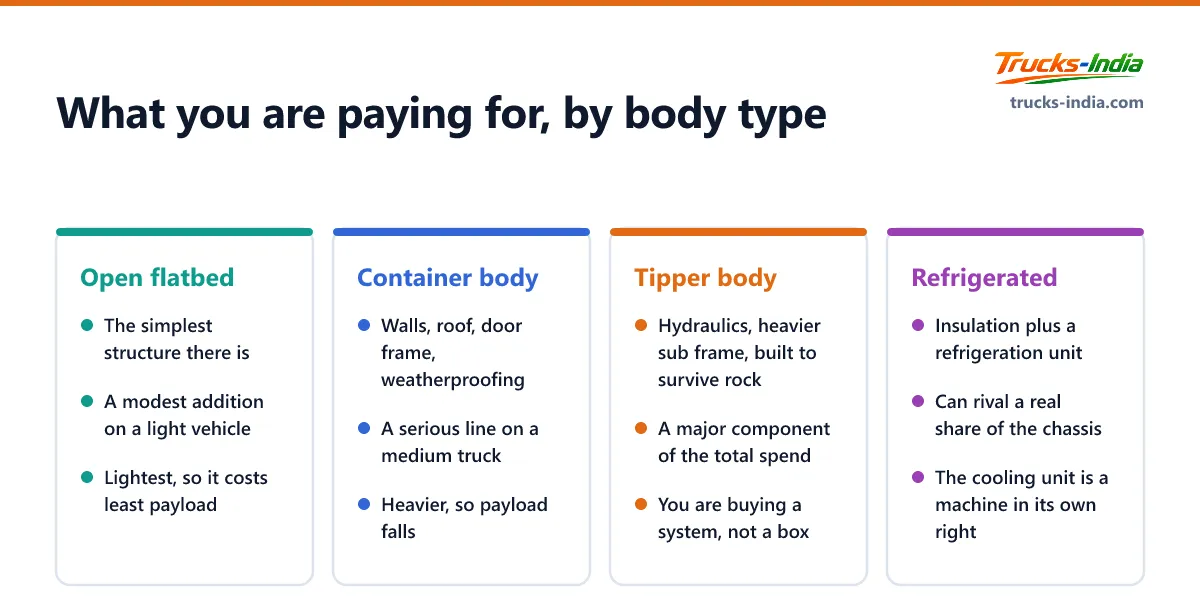
The body type. The truck body types sold in India differ enormously in what they cost to build. An open flatbed is the simplest structure there is. A container body adds walls, a roof, a door frame and weatherproofing. A tipper adds a hydraulic system, a heavier sub frame and a body built to survive rock. A reefer adds insulation and a refrigeration unit, which is a machine in its own right.
The length. Bodies are priced substantially by size, and the jump from a 14 foot to a 19 foot or 22 foot body is a real step in both material and cost.
The material specification. Mild steel is the default. Higher grade steel, or aluminium on bodies where weight matters, costs more and weighs less, which is a trade you are making on purpose or by accident.
Who builds it. A recognised fabricator with a workshop, a warranty and a queue costs more than a roadside shop. The difference shows up in three or four years, not in the first month.
The cost in proportion, not in rupees
Anybody quoting you one national figure for a truck body is guessing, because the four factors above move it enormously and steel prices move under all of them.
What is more useful is the proportion. For a light commercial vehicle a simple open body is a modest addition. For a container body on a medium truck it becomes a serious line. For a tipper body with hydraulics it is a major component of the total spend, because you are buying a structure and a hydraulic system, not a box. A refrigerated body is in a different league again, frequently rivalling a meaningful share of the chassis itself once the cooling unit is counted.
The practical instruction is the same whatever segment you are in. Get the body quotation in writing before you sign for the chassis, and add it to the chassis figure before you decide the vehicle is affordable. The on road price guide covers where it sits against the other costs, and the loan guide covers why the financier will not cover it for you.
The body eats your payload
This is the part experienced operators watch and new buyers discover later.
Gross vehicle weight is fixed by the vehicle's specification. Unladen weight includes the body. So every kilogram of body is a kilogram you cannot carry, for the life of the truck.
A heavy over engineered body on a chassis with modest gross weight can cost you hundreds of kilograms of paying load on every single trip. Over a few years that is a large number, and it never appears as a cost anywhere.
The counterweight is that an under built body fails, and a body that fails on a loaded truck is worse than a heavy one. The judgement is to match the build to the work: a body for cement bags does not need the structure of a body for steel coil.
Work out your real payload from the registration certificate rather than the brochure, which the axle load and payload guide sets out.
Factory body or local fabricator
A factory fitted body arrives as one vehicle, with one warranty, one invoice and no coordination. Registration is simpler because the vehicle is complete. It typically costs more and gives you less say in the specification.
A local fabricator is cheaper, builds to your exact requirement, and can repair what they built. Against that you are managing two suppliers, the warranty position is less clean, and quality varies enormously between workshops in the same town.
Most Indian operators use a local fabricator and are right to. The exception is a first time buyer with no fabricator relationship and no way to judge build quality, for whom the factory option removes a risk they cannot otherwise price.
What to check before you pay
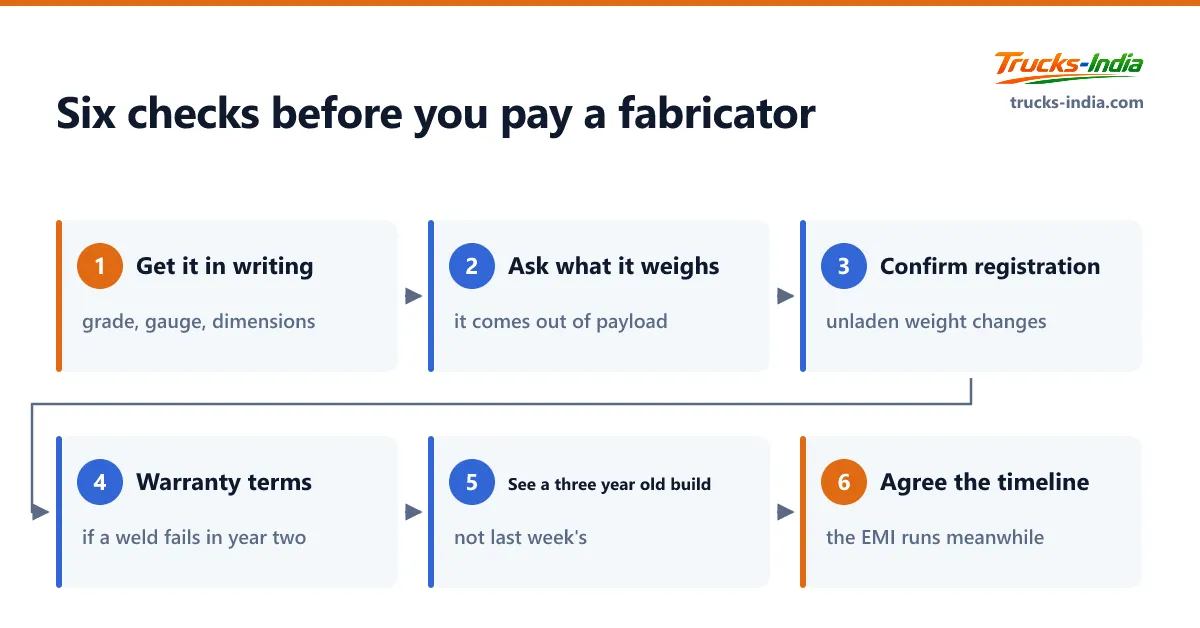
- Get it in writing, with the material grade, the gauge, the dimensions and the finish specified rather than described.
- Ask what it weighs. If the fabricator cannot tell you, that is informative in itself.
- Confirm the registration position. The body affects the vehicle's unladen weight and the registration certificate has to reflect the vehicle as built.
- Ask about the warranty and what happens if a weld fails in year two.
- See a body they built three years ago, not one they finished last week. Corrosion and fatigue are what you are buying against.
- Agree the timeline, because a chassis sitting at a fabricator is a chassis paying interest and earning nothing.
That last point is the one that costs money quietly. A two week overrun on body building is two weeks of instalment with no revenue against it.
Trucks to compare
A few popular trucks on Trucks India, with ex-showroom price and rated payload. Open one for its full price, specifications and mileage.
Browse more: Mini trucks, Light commercial vehicles, Heavy trucks, Tata Motors trucks, Ashok Leyland trucks
Frequently asked questions
It varies too widely for a single figure to be honest, because body type, length, material grade and the fabricator all move it substantially and steel prices move under all of them. As a proportion, a simple open body is a modest addition, a container body is a serious line, a tipper body with hydraulics is a major component, and a refrigerated body can rival a meaningful share of the chassis.
Usually not. Dealers sell a chassis with a cab, and the load body is a separate transaction with a fabricator. Get the body quotation before you commit to the chassis.
Yes, directly. Gross vehicle weight is fixed, and unladen weight includes the body, so every kilogram of body is a kilogram of cargo you can never carry. A heavier body than the work requires costs you paying load on every trip for the life of the vehicle.
A factory body gives you one vehicle, one warranty and no coordination, at a higher price and with less choice of specification. A local fabricator is cheaper and builds to your requirement, but quality varies and you manage two suppliers. Most Indian operators use a fabricator; a first time buyer with no way to judge build quality may prefer the factory option.
Usually not. Commercial vehicle loans are typically written against the chassis invoice rather than the completed vehicle, which is why the body is the most common reason buyers are short of cash on delivery day.
Material grade and gauge, dimensions, finish, the finished weight of the body, the warranty terms, the build timeline, and how the registration certificate will reflect the vehicle as built. Ask to see a body the workshop built three years ago rather than last week.
Where this fits
The body is the cost missing from most quotations. See our guide to on road price versus ex showroom.
The body you can afford depends on the payload the chassis gives you. Trucks India lists payload and gross weight for every model sold in India.
Call +91 93422 00875About the author
Lokesh R
CEO of Trucks India
Lokesh R is the founder of Trucks India, an independent heavy-vehicle marketplace and research platform operated from Chennai, Tamil Nadu, founded in 2025. Under his direction, Only Heavy publishes specifications and prices sourced from manufacturers, authorised dealer price lists and official regulatory schedules, with every model page checked by a named reviewer, prices re-verified monthly and after any GST revision, and no advertiser able to buy a rating, ranking or comparison result.


