
GST on Transport Services in India
GST on goods transport in India for operators: the three GTA options after 22 September 2025, reverse charge, Annexure V deadlines, registration and exemptions.

Lokesh R
CEO of Trucks India
Created 16 September 2026 · 8 min read

Most guides to this topic are written for the person paying the freight bill. This one is written for the person sending it.
That changes what matters. A shipper needs to know what rate appears on the invoice and whether they can claim it. A transporter needs to know something harder: which of three options to operate under, whether they have to register at all, what the declaration deadline is, and what happens if they miss it.
The rules also moved recently. The 12 percent slab that half the internet still quotes was rationalised into 18 percent with effect from 22 September 2025, and the small consignment exemptions that many pages still list were abolished back in July 2022. Both are worth getting right before you price a contract.
GST on transport services, the short answer
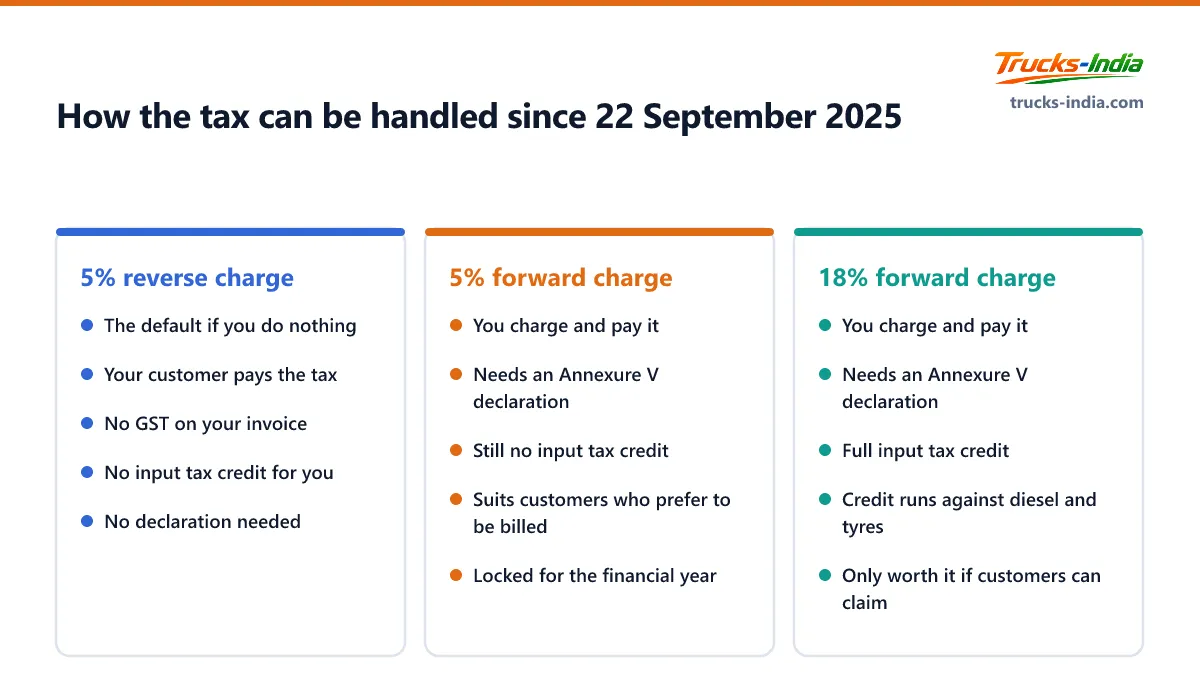
For goods moved by road by a goods transport agency, there are three ways the tax can be handled since 22 September 2025.
- 5 percent under reverse charge. The default. Your customer pays the tax, not you. No input tax credit for you.
- 5 percent under forward charge. You charge and pay it, after filing a declaration. No input tax credit.
- 18 percent under forward charge. You charge and pay it, after the same declaration, and you claim full input tax credit.
The 12 percent option no longer exists. If a page offers it to you as a live choice, that page has not been updated since September 2025.
Passenger transport, rail, air and courier sit on entirely different rates and are outside this guide, which is about moving goods by road.
What counts as a goods transport agency
This is the definition everything else hangs on, and it is narrower than people assume.
A goods transport agency is someone who transports goods by road and issues a consignment note. The consignment note is what makes you a GTA. It is not about owning trucks, and it is not about the size of the operation.
The practical consequence catches people out in both directions. An individual truck owner who simply carries goods without issuing a consignment note is not a GTA, and transport of goods by road by anyone other than a GTA or a courier agency is exempt. But the moment you issue consignment notes, the GTA rules apply to you in full.
If you are unsure whether the document your office issues counts as a consignment note, that is a question for a chartered accountant with the actual document in front of them, not a question to settle from an article.
Reverse charge, and who actually pays
Reverse charge is the default for GTA services, and it means the recipient pays the tax directly to the government instead of paying it to you.
It applies when your customer is one of the specified recipients:
- A factory registered under the Factories Act
- Any person registered under GST
- A body corporate
- A partnership firm, registered or not
- A co-operative society
- A casual taxable person
In practice that covers most business customers. When you carry for one of them under reverse charge, your invoice carries no GST, they pay 5 percent to the government, and you claim no input tax credit on your diesel, tyres or maintenance.
This is the arrangement most small transporters operate under without ever choosing it, because it is what happens if you do nothing.
Forward charge, and the declaration that switches it on
To charge GST yourself rather than leave it to the customer, you file a declaration in Annexure V on the GST portal. It is not automatic and it is not retrospective.
The deadlines matter more than the form does.
- For an existing GTA, the declaration is due by 31 March of the financial year preceding the one you want it to apply to. Miss it and you wait a year.
- For a newly registered GTA, you get 45 days from the date of registration to file it.
- Once filed, the option is deemed to continue for subsequent years until you actively reverse it. You do not re-file annually.
Having filed, you then operate at either 5 percent without input tax credit or 18 percent with it.
Which option leaves you better off
This is the decision, and it is genuinely a calculation rather than a default.
Reverse charge at 5 percent costs you nothing to administer and gives you nothing back. No GST on your invoice, no credit on your inputs.
Forward charge at 5 percent puts the compliance on you and still gives you no credit. It exists mainly for transporters whose customers prefer to be billed with tax rather than handle reverse charge themselves.
Forward charge at 18 percent is the only one that returns input tax credit. That credit runs against the GST you pay on diesel, tyres, spares, servicing and AdBlue, which for a working truck is not a small number.
The rough test: if your customers are registered businesses who can themselves claim the 18 percent you charge, the higher rate costs them nothing in net terms and hands you the credit on your inputs. If your customers are unregistered and cannot claim it, 18 percent makes you more expensive than the transporter next to you.
Take your actual input spend and your actual customer mix to a chartered accountant before 31 March, because the choice is locked for the year once the window closes.
When you must register, and when you need not
Two rules operate here, and the second one is widely missed.
The ordinary threshold for a service provider is 20 lakh rupees of aggregate turnover, or 10 lakh in the special category states.
Separately, Notification 5/2017-Central Tax dated 19 June 2017 exempts a person from registration where they make only supplies on which the recipient pays under reverse charge. A goods transport agency whose entire output goes to specified recipients under reverse charge therefore need not register, even above the threshold.
The condition is the word "only". The moment any part of your output falls outside reverse charge, whether because you carried for an unregistered customer or because you opted into forward charge, the exemption stops applying and ordinary registration rules resume.
So the honest answer to "must a transporter register" is: usually, but not always, and it depends on the composition of your customers rather than on your size. Confirm your own position rather than assuming either way.
What is exempt
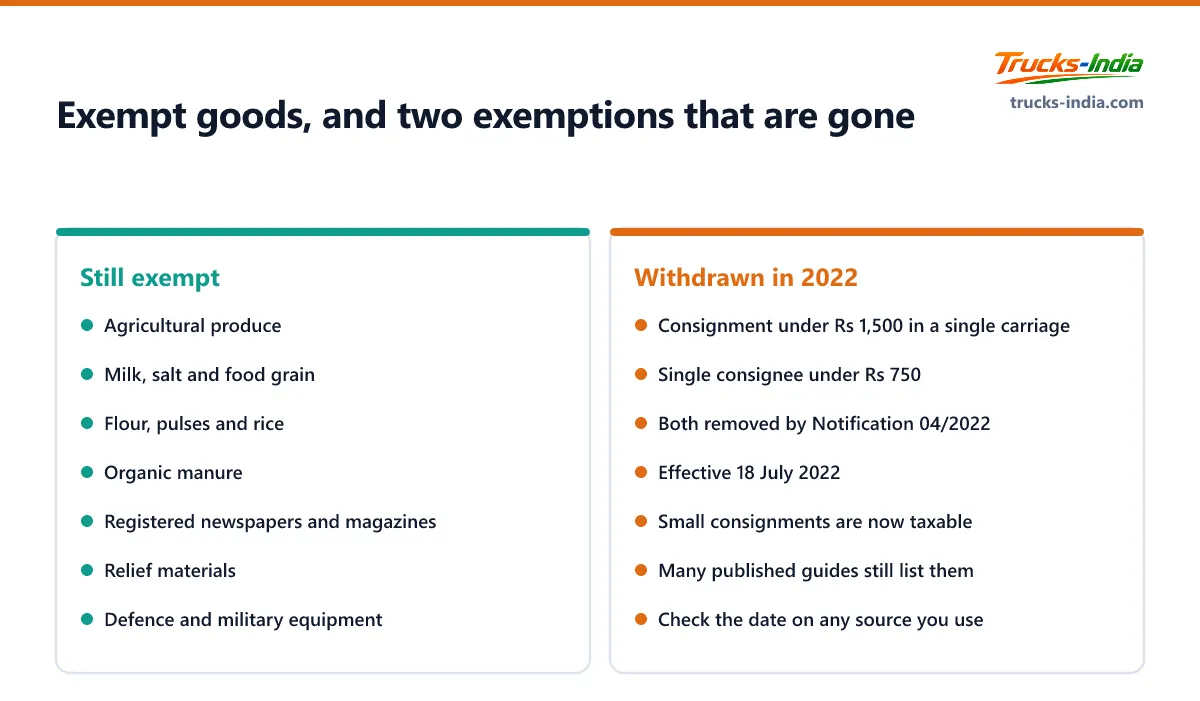
Transport of these goods by a goods transport agency carries no GST:
- Agricultural produce
- Milk, salt and food grain, including flour, pulses and rice
- Organic manure
- Newspapers or magazines registered with the Registrar of Newspapers
- Relief materials for victims of natural or man made disasters, calamities, accidents or mishaps
- Defence or military equipment
Two exemptions that many pages still list no longer exist. The relief for a consignment under 1,500 rupees in a single carriage, and for a single consignee under 750 rupees, were withdrawn by Notification 04/2022 with effect from 18 July 2022. Small consignments are taxable. If you are working from a guide that still quotes those figures, it is more than four years out of date.
What this means in practice for a truck owner
If you carry for registered businesses and issue consignment notes, reverse charge at 5 percent is your default and you probably do nothing. Check whether your customer mix makes 18 percent forward charge worth the input credit.
If you are buying your first truck, the GST decision is not urgent on day one, but the Annexure V deadline is annual and unforgiving, so know which side of 31 March you are on.
If you are pricing a contract, be clear which basis your rate is quoted on. A rate agreed without settling whether GST is extra, included, or the customer's problem under reverse charge is a dispute waiting for the first invoice.
If input credit is the deciding factor, work out what you actually spend on diesel, tyres and servicing over a year. Start from today's fuel prices and the real mileage on your model's page, because that number is usually larger than owners expect and it is what makes 18 percent worth considering.
GST is one piece of setting up properly. The full guide to starting a transport business covers the sequence around it, the registration process covers the entity and the other registrations, and the margin guide shows where input credit lands in your cost per kilometre.
Frequently asked questions
For goods moved by road by a goods transport agency, 5 percent under reverse charge is the default, or 5 percent without input tax credit or 18 percent with it under forward charge. The 12 percent slab was rationalised into 18 percent with effect from 22 September 2025.
The recipient, when they are a specified recipient: a registered person, factory, body corporate, partnership firm, co-operative society or casual taxable person. Your invoice carries no GST and you claim no input tax credit.
Someone who transports goods by road and issues a consignment note. The consignment note is the defining test. Transport of goods by road by anyone who is not a GTA or a courier agency is exempt.
Not always. The ordinary threshold is 20 lakh rupees, or 10 lakh in special category states, but Notification 5/2017 exempts a person making only supplies taxed under reverse charge. A GTA carrying exclusively for specified recipients need not register even above the threshold. Any output outside reverse charge ends that exemption.
File a declaration in Annexure V on the GST portal. An existing GTA files by 31 March of the preceding financial year. A newly registered one has 45 days from registration. Once filed it continues until you reverse it.
No. Agricultural produce is exempt, along with milk, salt, food grain including flour, pulses and rice, organic manure, registered newspapers and magazines, relief materials and defence equipment. The old 1,500 and 750 rupee small consignment exemptions were withdrawn on 18 July 2022.
Where this fits
GST is one part of setting up. See our guide to starting a transport business for the whole sequence.
Whichever GST option you choose, the vehicle decides your running cost. Trucks India lists on road price, payload and mileage for every model sold in India.
Call +91 93422 00875About the author
Lokesh R
CEO of Trucks India
Lokesh R is the founder of Trucks India, an independent heavy-vehicle marketplace and research platform operated from Chennai, Tamil Nadu, founded in 2025. Under his direction, Only Heavy publishes specifications and prices sourced from manufacturers, authorised dealer price lists and official regulatory schedules, with every model page checked by a named reviewer, prices re-verified monthly and after any GST revision, and no advertiser able to buy a rating, ranking or comparison result.


