Lorry Receipt Format: What an LR or Bilty Must Contain, With a Fill-In Template
Use this lorry receipt format to issue a complete LR or bilty: consignor, consignee, GSTIN, goods, weight, freight and vehicle fields, with a fill-in template.

Lokesh R
CEO of Trucks India
Created 4 October 2026 · 8 min read
Key takeaways
- Under the Carriage by Road Act, 2007, a common carrier must issue a goods receipt in triplicate and give the original to the consignor.
- The goods receipt is prima facie evidence of the weight, packages and particulars written on it, so a vague description weakens the transporter's own position.
- Every LR needs both parties' names, addresses and GSTINs, the goods and their declared value, weight, packages, vehicle number, freight and payment basis.
- The LR and the freight bill are different documents. The LR records the consignment; the bill asks for payment and can cover several LRs.
- The LR number is the transport document number used on the e-way bill, so the two must match.
Most transporters print their lorry receipt format from a book someone handed them years ago. That works until a consignment goes short, an officer stops the truck at a check post, or a consignee refuses to pay freight, and the LR turns out to be missing the one field that would have settled the matter.
This guide covers what an LR, bilty or goods receipt must contain, why each field earns its place, how many copies to make and who keeps them. It ends with a fill-in template you can copy straight into Word or Excel.
Lorry receipt format: what an LR is
A lorry receipt, or LR, is the document a transporter issues when it accepts goods for carriage. It confirms that the goods were received, records what they were and in what condition, names who sent them and who is to receive them, and states the freight.
The same document goes by several names. Bilty is common in the north and west, GR (goods receipt) is the term the law uses, and consignment note is the GST term. A lorry receipt copy or "LR copy" simply means one of its carbon copies.
In law, the Carriage by Road Act, 2007 governs anyone in the business of a common carrier. Three of its sections shape the format.
- Section 3: no one may run a common carrier business without a certificate of registration.
- Section 8: the consignor executes a goods forwarding note, including a declaration of the consignment's value and of any dangerous or hazardous goods, and is responsible for its accuracy.
- Section 9: the carrier issues a goods receipt in triplicate, the original goes to the consignor, and it must include the carrier's undertaking about its liability.
Section 9 adds the sentence every transporter should know: the goods receipt is prima facie evidence of the weight or measure, the particulars and the number of packages stated on it. Whatever you write becomes the starting point in any dispute.
Why the LR matters to a transporter
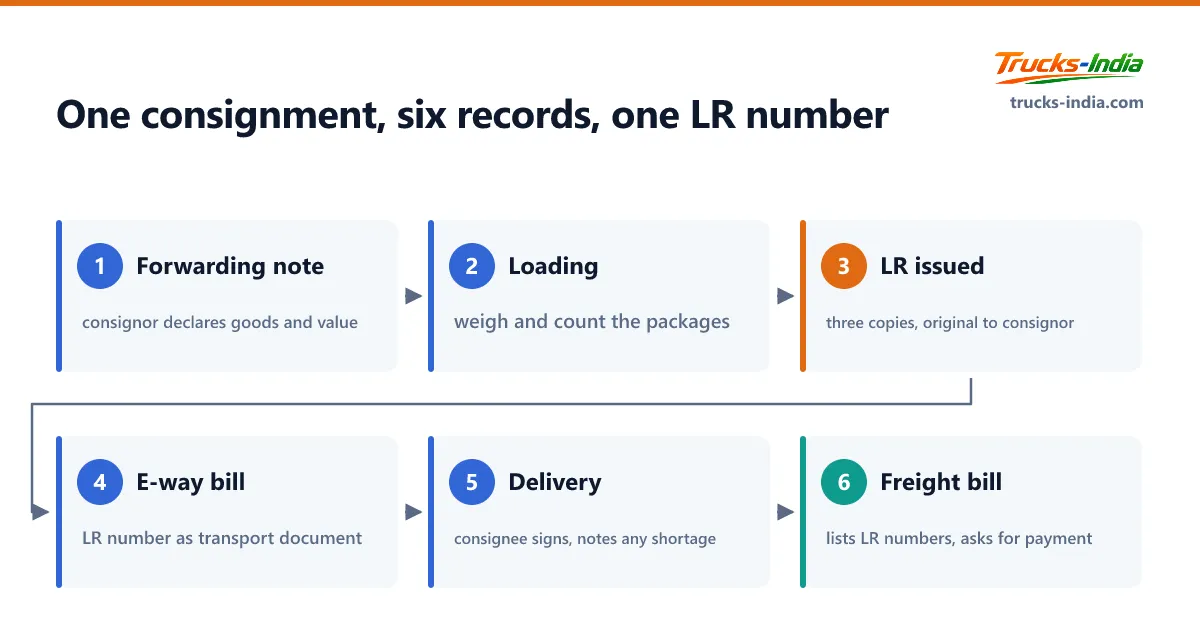
The LR is the contract. Without one, a short delivery becomes your word against the consignor's, and a consignee who refuses to pay freight has nothing on paper binding them.
It also does four practical jobs.
It defines your GST position. Under GST, a goods transport agency is someone who carries goods by road and issues a consignment note. Issuing LRs is therefore what puts you in that category, and the GST on transport services guide explains reverse charge and the forward charge options that follow.
It links to the e-way bill. The e-way bill carries a transport document number, and for road movement that is your LR number. A mismatch between the two is an easy reason to detain a vehicle, as the e-way bill guide for transporters explains.
It travels with the truck. The consignee copy is one of the documents a truck must carry alongside the invoice and e-way bill.
It supports an insurance claim. A transit or carrier's liability claim starts with the LR, the declared value and the condition noted at loading.
The fields of a lorry receipt, and why each one matters
The parties
The consignor and consignee, each with full name, address, phone number and GSTIN. GSTINs matter because reverse charge depends on who the recipient is, and because the e-way bill uses the same numbers. Add who pays the freight, since that party is the recipient of your service for GST.
The goods
A plain description of the goods, the number of packages and how they are packed, the actual weight and, where you charge on it, the charged weight. Add the invoice number and declared value from the consignor's goods forwarding note. Under Section 8, the consignor answers for these particulars, but only if they are written down.
Write "said to contain" before the description when you have not opened the packages. It records that you are relying on the consignor's word.
The vehicle and route
The vehicle number, the driver's name, the from and to stations and the booking branch. If the goods move to a second vehicle on the way, record the change on the LR or issue a linked LR, because the e-way bill must be updated too.
The freight
The rate and basis (per tonne, per trip or per package), freight amount, any loading, unloading, hamali or detention charges, advance received and balance due. Mark the payment term clearly: Paid (consignor paid), To Pay (consignee pays on delivery) or To Be Billed (freight goes on a later bill).
Liability and signatures
The carrier's liability undertaking, a risk clause stating whether the goods travel at owner's risk or carrier's risk, the GST payable by line, and signatures of the booking clerk and consignor. On the consignee copy, the delivery section gets the receiver's signature, date, seal and any remarks on shortage or damage.
Fill-in lorry receipt template
Copy this list into Word or Excel, one line per field, and print it in a serially numbered book.
- Transporter: name, address, phone, GSTIN, carrier registration number
- LR number and date: serial, never reused
- Booking branch / From: __________ To: __________
- Consignor: name, address, phone, GSTIN
- Consignee: name, address, phone, GSTIN
- Freight payable by: Consignor / Consignee / Third party (name and GSTIN)
- Invoice number and date: __________ Declared value: Rs __________
- E-way bill number: __________
- Description of goods (said to contain): __________
- Number of packages and packing: __________
- Actual weight: ______ kg Charged weight: ______ kg
- Vehicle number: __________ Driver name and phone: __________
- Freight rate and basis: Rs ______ per tonne / trip / package
- Freight: Rs ______ Loading / unloading / other: Rs ______ Total: Rs ______
- Advance received: Rs ______ Balance: Rs ______
- Payment term: Paid / To Pay / To Be Billed
- GST payable by: Consignor / Consignee / Transporter
- Risk: Owner's risk / Carrier's risk
- Carrier's liability undertaking: printed clause
- Signature of booking clerk and consignor
- Delivery record: received in good condition / remarks, receiver's name, signature, seal and date
A filled example
Here is how a complete LR reads. LR No. 1045, dated 3 October, booked at Salem for Madurai. Both parties, a cement dealer sending and a hardware store receiving, have GSTINs. The goods are 400 bags of cement, said to contain, invoice value Rs 1.6 lakh, actual and charged weight 20,000 kg. Freight is Rs 1,100 per tonne, Rs 22,000 in total, marked To Pay, with GST payable by the consignee under reverse charge. Every number on it can be checked at the delivery point.
Bilty format for transport: copies and who keeps them
The Act requires three copies, with the original to the consignor. In practice, the copies usually go like this: the consignor copy is the original and the sender's proof of dispatch; the consignee copy travels with the truck and is surrendered at delivery; the transporter copy stays at the booking office. Many offices add a driver copy as a fourth.
Number every copy identically, use carbonless paper or software, and never leave a signed blank LR with a driver or agent.
Lorry bill format and lorry invoice format
The LR is not a bill. A freight bill or lorry invoice is the demand for payment, and it often covers several LRs in a month for the same customer.
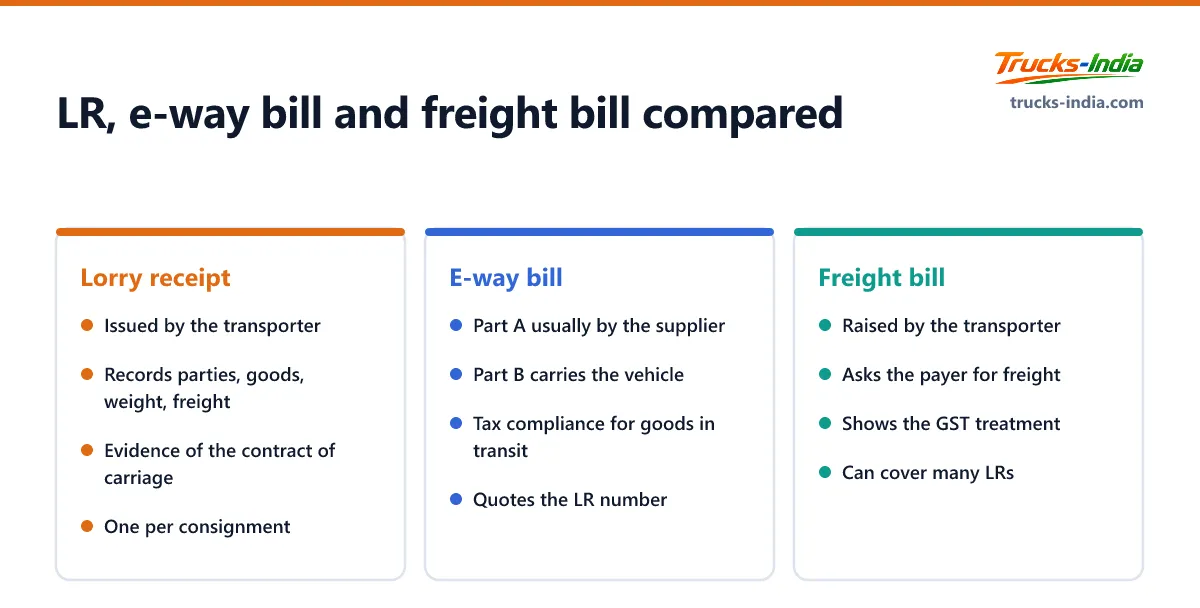
A lorry invoice format should carry your name, address and GSTIN, an invoice number and date, the billing party's name and GSTIN, a line for each LR number, date, route, vehicle and freight, the total, the GST treatment (a reverse charge statement or the tax charged under forward charge), bank details and payment terms. Keep the LR numbers on the bill. They are how the customer's accounts team matches your claim to their receipts.
Lorry receipt format in Word, Excel or software
A Word or Excel template is fine for a single truck. Once you run several vehicles, transport management software that issues numbered LRs, pulls GSTINs and generates the e-way bill from the same entry saves errors. Some transporters also let customers track a consignment by LR number on their own website or by phone, which cuts the "where is my load" calls. Corporate clients who give contracts to transporters increasingly expect both.
Common LR mistakes
- "Goods as per invoice" as the description, which proves nothing in a short delivery dispute.
- No declared value, which leaves your liability open to argument.
- Weight left blank or copied from the invoice without weighing.
- Wrong or missing GSTIN, which breaks the reverse charge trail.
- Vehicle number not updated after a transhipment.
- No receiver's signature on the consignee copy, so freight on "To Pay" consignments cannot be proved.
A complete lorry receipt format protects the freight you are owed, the liability you carry and the tax position you have chosen, all on one page. Spend an afternoon fixing the template once, and every LR after that does its job.
Trucks to compare
A few popular trucks on Trucks India, with ex-showroom price and rated payload. Open one for its full price, specifications and mileage.
Browse more: Mini trucks, Light commercial vehicles, Heavy trucks, Switch Mobility trucks, Maruti Suzuki trucks, Tata Motors trucks
Frequently asked questions
A lorry receipt, or LR, is the document a transporter issues on accepting goods for carriage. It records the consignor, consignee, goods, weight, packages, vehicle and freight. Under the Carriage by Road Act, 2007 it is called a goods receipt and must be issued in triplicate.
None in substance. Bilty is the name used in much of north and west India for the same document. GR or goods receipt is the legal term, and consignment note is the term used under GST.
One of the copies of the lorry receipt. The consignor gets the original, the consignee copy travels with the goods and is handed over at delivery, and the transporter keeps an office copy. Many transporters add a driver copy.
A transporter that issues a consignment note is treated as a goods transport agency under GST, which brings reverse charge or forward charge into play. Whether you should issue one, and what follows, is covered in our guide to GST on transport services.
Through the transporter that issued it. Many transport companies offer tracking by LR number on their website or by phone. The LR number also appears on the e-way bill as the transport document number.
The transporter issues the LR. Before that, the consignor fills a goods forwarding note with the goods' details and value, and the transporter issues the goods receipt on loading or acceptance of the goods.
Where this fits
The LR is also your consignment note for GST. Our guide to GST on transport services explains what issuing one means for your tax position.
The weight on your LR has to sit inside the truck's legal payload. Check payload and GVW for every model on Trucks India before you quote a load.
Call +91 93422 00875About the author
Lokesh R
CEO of Trucks India
Lokesh R is the founder of Trucks India, an independent heavy-vehicle marketplace and research platform operated from Chennai, Tamil Nadu, founded in 2025. Under his direction, Only Heavy publishes specifications and prices sourced from manufacturers, authorised dealer price lists and official regulatory schedules, with every model page checked by a named reviewer, prices re-verified monthly and after any GST revision, and no advertiser able to buy a rating, ranking or comparison result.