
How to Increase Truck Mileage
Practical ways to improve truck fuel efficiency in India: tyre pressure, driving habits, idling, load and route, and the maintenance items that cost mileage.

Lokesh R
CEO of Trucks India
Created 25 September 2026 · 7 min read

Diesel is the largest single cost in running a truck, and unlike your instalment or your insurance it moves every day with how the vehicle is driven and maintained.
A few percent on fuel economy does not sound like much. Across a year of running it is a number most owners would be delighted to find anywhere else in the business, and almost all of it comes from habits rather than from equipment.
Measure it first, properly
You cannot improve what you are estimating.
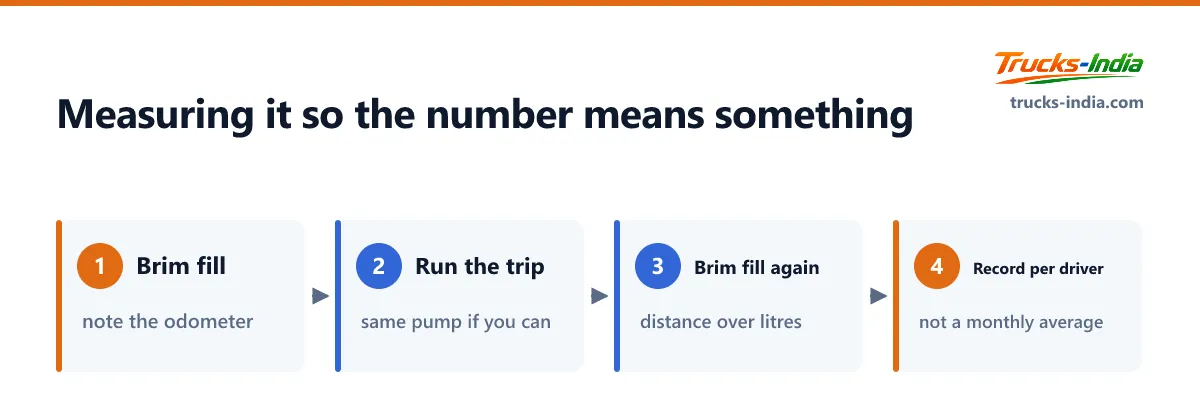
Tank to tank is the only method that works. Fill to the brim, note the odometer, run, fill to the brim again, and divide the distance by the litres. Do it consistently at the same pump if you can, because pump calibration varies.
Record it per trip, not per month. A monthly average hides the trip where something went wrong, and that trip is the information you wanted.
Record per vehicle and per driver. The same truck on the same route with two drivers can return noticeably different figures, and until you measure it that conversation is just opinion.
A sustained drop is the single best early warning system you have. It means a mechanical problem, a driving problem or theft, and all three are cheaper caught early. Which one it is, is usually answerable from the pattern: a gradual decline is mechanical, a step change is theft or a driver change.
Tyre pressure, which is free
The highest return ten minutes in truck operation, and the most consistently skipped.
An underinflated tyre deforms more as it rolls, and that deformation is energy coming out of your diesel. It also destroys the tyre, which costs you the largest line in your maintenance budget and the retreads you would have had, as the tyre guide explains.
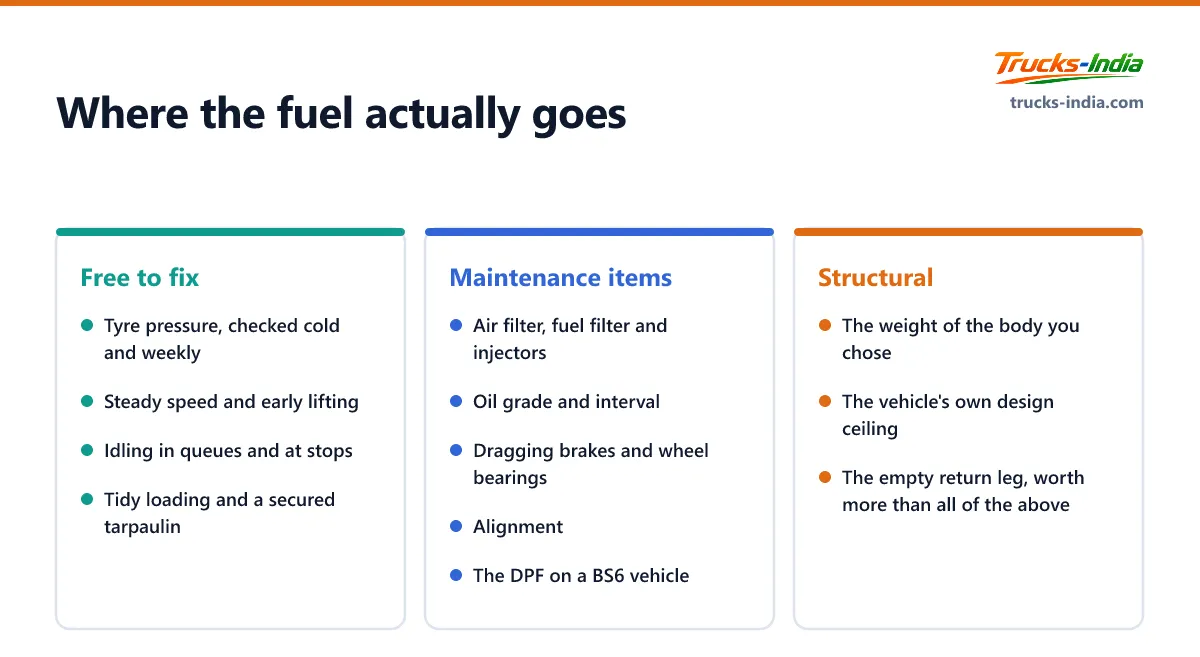
Check cold, weekly at minimum, every tyre including the spare. Cold matters: a hot tyre reads high and will fool you into letting air out of a tyre that was already low.
While you are there, check alignment. A misaligned axle drags the vehicle slightly sideways down every kilometre of road, which you pay for in both fuel and tyres.
Driving, which is most of the remaining difference
Two drivers, one truck, one route, meaningfully different fuel. This is where the biggest controllable gap sits.
Steady speed beats fast and slow. Every deceleration is fuel already burnt being thrown away as heat in the brakes. Anticipating traffic and lifting early rather than braking late is the whole skill.
Stay off the top of the range. Aerodynamic drag rises sharply with speed and a truck is a large flat object. The vehicle is speed limited to 80 anyway, as the speed governor guide covers, and the last few kilometres per hour are the most expensive.
Use the gearbox properly. Short shifting and keeping the engine in its economical band rather than revving through gears.
Do not idle. More on this below, because it deserves its own section.
The way to change driving is not a lecture. It is measurement plus a share of the saving. Show a driver their own figures against the other driver's, and give them a stake in the improvement, and it changes. Without measurement it does not.
Idling is money burned standing still
A heavy diesel engine at idle burns a real quantity of fuel per hour and produces nothing at all.
Add up where it happens: waiting at loading points, waiting at unloading points, queuing at toll plazas, queuing at check posts, stopped for meals with the engine running, running the engine overnight for cab comfort.
On a truck with long waiting times this is one of the largest single recoverable losses on the vehicle, and it costs nothing to fix beyond the habit.
Two honest caveats. Cab comfort is a real issue in Indian summers, and telling a driver to sit in a closed cab at 44 degrees is not a plan. And some engines need a brief cool down after heavy running before shut down. Neither justifies an hour at idle in a loading queue.
If you have tracking fitted for AIS-140 compliance, the idling report is already in the platform you are paying for, as the AIS-140 guide notes. Most owners never open it.
Maintenance that shows up in the fuel
Specific items, each of which costs mileage when neglected.
Air filter. A clogged filter starves the engine and the effect is immediate. Cheap, quick, often overlooked.
Fuel filter and injectors. Poor spray pattern means incomplete combustion, and injectors are sensitive to fuel quality.
Engine oil at the right grade and interval. The wrong grade or an overdue change adds internal friction.
Brakes dragging. A binding brake is a permanent handbrake you cannot feel. It shows up as heat at the wheel and as fuel.
Wheel bearings and alignment, both quiet sources of drag.
On a BS6 vehicle, the DPF. A clogged particulate filter raises back pressure and costs fuel, and on short urban work it clogs faster, as the BS6 emission norms guide explains.
All of these sit in the schedule in the service schedule guide. The argument for servicing on time is not tidiness, it is that the neglected version costs you diesel every day until it is fixed.
Load, body and route
Weight. Every extra kilogram costs fuel, and that includes a heavier body than the work requires, which you carry empty as well as loaded, as the body building guide covers.
Overloading does not save fuel per tonne. It burns more diesel, destroys tyres and suspension, and now attracts a multiplied toll charge as well as the statutory penalty. The full cost is in the axle load limits.
Aerodynamics. A flapping tarpaulin, an open tail board at speed, a badly loaded high stack. Tidy loading is worth real fuel on a highway run.
The empty return leg is the biggest fuel waste in the business, because it is a whole trip's diesel with no revenue. Nothing in this guide comes close to it. Fixing it is a load problem rather than a fuel problem, and it is covered in the load finding guide.
Realistic expectations
Be honest about what is available.
Pressure and maintenance discipline recover what you were losing, rather than beating the vehicle's design.
Driving habit is the largest controllable variable after that.
Idling is pure recovery and costs nothing.
The vehicle itself sets the ceiling. No habit turns a heavy old truck into an efficient new one, and if your cost per kilometre is structurally uncompetitive the answer is the replacement decision rather than another checklist.
Fuel additives and unapproved devices promising large gains are, with very few exceptions, not worth the money. Nothing that arrives in a bottle beats correct tyre pressure.
Trucks to compare
A few popular trucks on Trucks India, with ex-showroom price and rated payload. Open one for its full price, specifications and mileage.
Browse more: Mini trucks, Light commercial vehicles, Heavy trucks, Tata Motors trucks, Ashok Leyland trucks
Frequently asked questions
Start with tyre pressure checked cold and weekly, then driving habit, then eliminating idling, then the maintenance items that cost fuel when neglected: air filter, fuel filter and injectors, oil grade and interval, dragging brakes and alignment. Measure tank to tank per trip so you can see what worked.
Tank to tank. Fill to the brim, note the odometer, run, fill to the brim again, and divide distance by litres. Use the same pump where possible, and record per trip and per driver rather than as a monthly average.
A heavy diesel engine at idle burns a real quantity per hour and produces nothing. Across loading queues, toll and check post waits and overnight running for cab comfort, it is one of the largest recoverable losses on a truck, and it costs nothing to fix.
Yes, significantly. An underinflated tyre deforms more as it rolls and that energy comes from your diesel. It also destroys the casing, costing you the tyre and its future retreads, which is the largest line in a heavy vehicle maintenance budget.
With very few exceptions they are not worth the money. Nothing that arrives in a bottle delivers what correct tyre pressure, a clean air filter and steady driving deliver for nothing.
A step change usually means fuel theft or a change of driver; a gradual decline usually means a mechanical cause such as a clogged filter, poor injectors, dragging brakes or misalignment. That is why per trip records are worth keeping, because the pattern tells you which to investigate.
Where this fits
Fuel is the biggest line in the cost sheet. See our guide to transport business profit margin.
Some of the difference is the vehicle. Trucks India lists mileage, payload and price for every model sold in India.
Call +91 93422 00875About the author
Lokesh R
CEO of Trucks India
Lokesh R is the founder of Trucks India, an independent heavy-vehicle marketplace and research platform operated from Chennai, Tamil Nadu, founded in 2025. Under his direction, Only Heavy publishes specifications and prices sourced from manufacturers, authorised dealer price lists and official regulatory schedules, with every model page checked by a named reviewer, prices re-verified monthly and after any GST revision, and no advertiser able to buy a rating, ranking or comparison result.


