
Toll Charges for Truck Per Km
How Indian truck toll is calculated, why axle count decides your class, the passes and discounts available, and how to price toll into a freight rate.

Lokesh R
CEO of Trucks India
Created 24 September 2026 · 6 min read

Ask an operator what a trip costs and they will give you a diesel figure. Ask what the toll was and you get an estimate, usually low.
On a long haul national highway run, toll is one of the three largest costs of the trip, behind diesel and the driver. It is also the most predictable of the three, which means there is no excuse for guessing it when you quote a rate.
How the rate is built
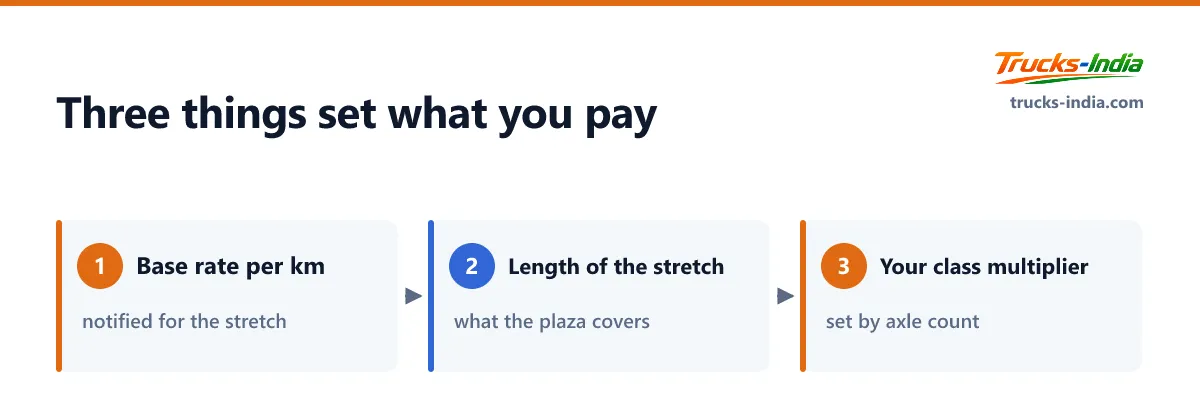
Toll on national highways is not a flat charge. It is calculated under the National Highways Fee (Determination of Rates and Collection) Rules, and three things set what you pay.
A base rate per kilometre, notified for the stretch.
The length of the tolled stretch the plaza covers.
A multiplier for your vehicle class.
Rates are revised annually, typically with reference to wholesale price movement, which is why last year's figure for a familiar route is reliably a little low.
Rates also differ between an ordinary national highway, an expressway and a structure such as a major bridge or tunnel, which are charged on their own basis. A route that swapped onto a new expressway is not comparable to the same journey last year.
Why axle count decides your bill
For goods vehicles the class is set by axle count, not by tonnage, not by body type and not by what the vehicle is carrying.
The ladder runs roughly: light commercial vehicles and mini buses, then two axle trucks and buses, then three axle vehicles, then heavy construction machinery and multi axle vehicles of four to six axles, then seven axles and above. Each step is a higher multiple of the car rate, and the top of the ladder is several times the bottom.
The commercial consequence is one people miss when specifying a vehicle. Adding an axle raises your legal payload and raises your toll class at the same time. On a route with many plazas that is a real annual number, and it belongs in the comparison alongside the payload gain. The payload side is in the overloading rules.
Getting the actual number for your route
Do not estimate. There are three ways to get it properly.
The NHAI fee calculator, which gives plaza by plaza charges for a route by vehicle class. This is the authoritative source and it is free.
Your own FASTag statement, which is the real figure you actually paid, plaza by plaza, with dates. For a route you already run this beats any calculator, and it is the strongest argument for running a central FASTag account rather than letting drivers top up, as the FASTag guide explains.
Route planning apps, which are convenient and are estimates. Fine for a quotation, not for a reconciliation.
Work it out once per regular route and keep the number. Your corridors do not change often.
Discounts you may be leaving on the table
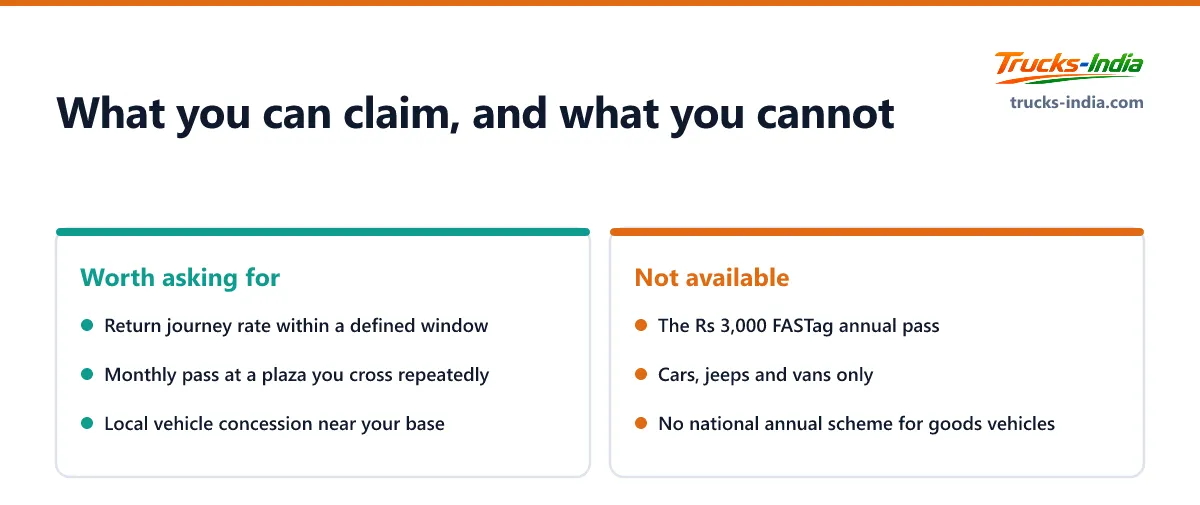
Return journey. Many plazas offer a discounted rate for a return crossing within a defined window, commonly the same day. On out and back work this is significant and it is forfeited simply by not knowing.
Monthly passes at individual plazas, for vehicles crossing the same plaza repeatedly.
Local vehicle concessions for vehicles registered within a defined distance of a plaza, which matter enormously for short haul work past a single plaza.
The annual pass does not apply. The ₹3,000 FASTag annual pass is for private cars, jeeps and vans. Commercial vehicles are excluded, and operators regularly go looking for something that is not there.
Overload charging changed in April 2026
Toll is now also how overload penalties are collected.
The Fourth Amendment Rules 2026, in force from 15 April 2026, charge overloaded vehicles on a tiered basis: no overload fee up to 10 percent excess, two times the base rate above 10 and up to 40 percent, and four times the base rate above 40 percent.
Weight is measured by certified equipment at the plaza, and where a plaza has no weighing facility no overload fee is levied. Collection is through FASTag only.
That tiering deserves attention when you plan loads. Ten percent is a tolerance; forty percent is a cliff. A vehicle routinely running twenty percent over is now paying double toll at every equipped plaza on the route, on top of the Section 194 penalty if it is stopped.
Putting toll into your rate
The mistake is treating toll as an afterthought and absorbing it.
Calculate it per route, from the NHAI calculator or your own FASTag history.
Express it per kilometre so it sits beside diesel and wages in the same cost sheet, which is how the transport business profit margin guide builds cost per kilometre.
Quote it explicitly. On a contract, say whether the rate is inclusive of toll or whether toll is reimbursed at actuals. A rate agreed without settling that is a dispute waiting for the first invoice, which the contracts guide covers.
Revisit annually, because rates move every year and a contract priced on last year's toll quietly loses margin.
Is avoiding the highway cheaper
Occasionally, and less often than drivers believe.
A state highway alternative avoids the toll and usually costs you more in time, in fuel from lower average speed and more braking, in wear from worse surfaces, and in risk. Longer routes also burn more diesel, which at the state diesel prices in today's fuel prices is rarely trivial.
Work it out for the specific route rather than assuming either way. For most loaded long haul on a good corridor, the highway wins once time and wear are counted honestly.
Frequently asked questions
Under the National Highways Fee Rules, from a notified base rate per kilometre for the stretch, the length of the tolled section, and a multiplier for your vehicle class. Rates are revised annually, and expressways and major structures are charged on their own basis.
Axles. For goods vehicles the class is set by axle count rather than by tonnage or body type, running from light commercial vehicles up through two axle, three axle, four to six axle and seven axle and above, each a higher multiple of the car rate.
Use the NHAI fee calculator, which gives plaza by plaza charges by vehicle class. For a route you already run, your own FASTag statement is better still, because it is what you actually paid.
No. The ₹3,000 FASTag annual pass covers private cars, jeeps and vans only. What is available to goods vehicles is plaza level monthly passes, local vehicle concessions and return journey discounts.
Since 15 April 2026, no overload fee up to 10 percent excess, two times the base rate above 10 and up to 40 percent, and four times above 40 percent. Weight is measured by certified equipment at the plaza, no fee applies where a plaza has no weighing facility, and collection is through FASTag only.
Usually not on loaded long haul. Avoiding toll typically costs more in time, fuel from a lower average speed, and wear from worse surfaces. Work it out for the specific route rather than assuming, and count the time and wear honestly.
Where this fits
Toll belongs in your cost per kilometre. See our guide to transport business profit margin.
Axle configuration decides your toll class and your payload together. Trucks India lists configuration for every model in India.
Call +91 93422 00875About the author
Lokesh R
CEO of Trucks India
Lokesh R is the founder of Trucks India, an independent heavy-vehicle marketplace and research platform operated from Chennai, Tamil Nadu, founded in 2025. Under his direction, Only Heavy publishes specifications and prices sourced from manufacturers, authorised dealer price lists and official regulatory schedules, with every model page checked by a named reviewer, prices re-verified monthly and after any GST revision, and no advertiser able to buy a rating, ranking or comparison result.


