
Best Tyre Brand for Truck in India
Which truck tyre brand to buy in India, why cost per kilometre beats sticker price, what retreading is worth, and the two habits that destroy tyre life.

Lokesh R
CEO of Trucks India
Created 21 September 2026 · 7 min read
Tyres are the largest single maintenance cost on a heavy vehicle, usually by a wide margin. They are also the item owners choose worst, because the decision gets made on the sticker price of one tyre rather than on what that tyre costs per kilometre.
A cheaper tyre that lasts sixty percent as long is not cheaper. A tyre with a weak casing that cannot be retreaded is much more expensive than it looks, because retreading is where most of the saving in Indian trucking actually lives.
This guide covers the brands, the way to compare them properly, and the two things that destroy tyre life regardless of which one you buy.
The brands, honestly
India has a deep domestic tyre industry and the truck segment is dominated by it.
MRF leads on volume and is the default choice across much of the country. Strong dealer coverage, strong resale recognition, and the widest availability when you need a replacement in an unfamiliar town.
Apollo is the other large domestic player in commercial tyres, with a serious presence in truck and bus radials and its own retreading operation.
JK Tyre has long been a heavy commercial vehicle specialist and is well regarded in the segment.
CEAT rounds out the major domestic four, and along with MRF and Apollo ranks among the strongest tyre brands globally.
Bridgestone, Michelin, Goodyear and Yokohama together hold roughly eleven percent of the Indian market. They typically cost more and are bought by fleets running high mileage on good roads, where the longer life and lower rolling resistance repay the premium.
There is no single correct answer, and anybody who gives you one without asking about your route has not answered your question.
Compare on cost per kilometre, not price
This is the whole discipline, and it is simple arithmetic.
A tyre at a twenty percent premium that runs forty percent longer is substantially cheaper. A cheap tyre that gives you half the life of a mid range one is a bad purchase even though it felt like a saving on the day.
You cannot do this calculation from a brochure, because claimed tread life is obtained under conditions that are not your route. You can do it from your own records, which is why the preventive maintenance guide recommends keeping tyre position history per vehicle. After one full set you will know what each brand returns on your roads, and that number is worth more than every review you can read.
What a truck tyre costs
For the common 10.00 R20 heavy commercial size, a major brand radial such as the MRF Steel Muscle sits in the region of Rs 27,000 to Rs 29,000 per tyre, with pairs advertised around Rs 32,000 depending on pattern and seller.
Treat that as an anchor rather than a quote. Tyre pricing moves with natural rubber and crude prices, varies by pattern within the same brand, and varies again between an organised dealer and a local seller. Size matters more than anything: a light commercial vehicle tyre is a fraction of the figure above.
Check what your own vehicle runs before shopping. Fitting a size or load rating the vehicle was not designed for is a false economy that shows up in handling and in your insurance position.
Radial or bias, and why it matters more than brand
For most highway work this choice moves your cost per kilometre more than the badge does.
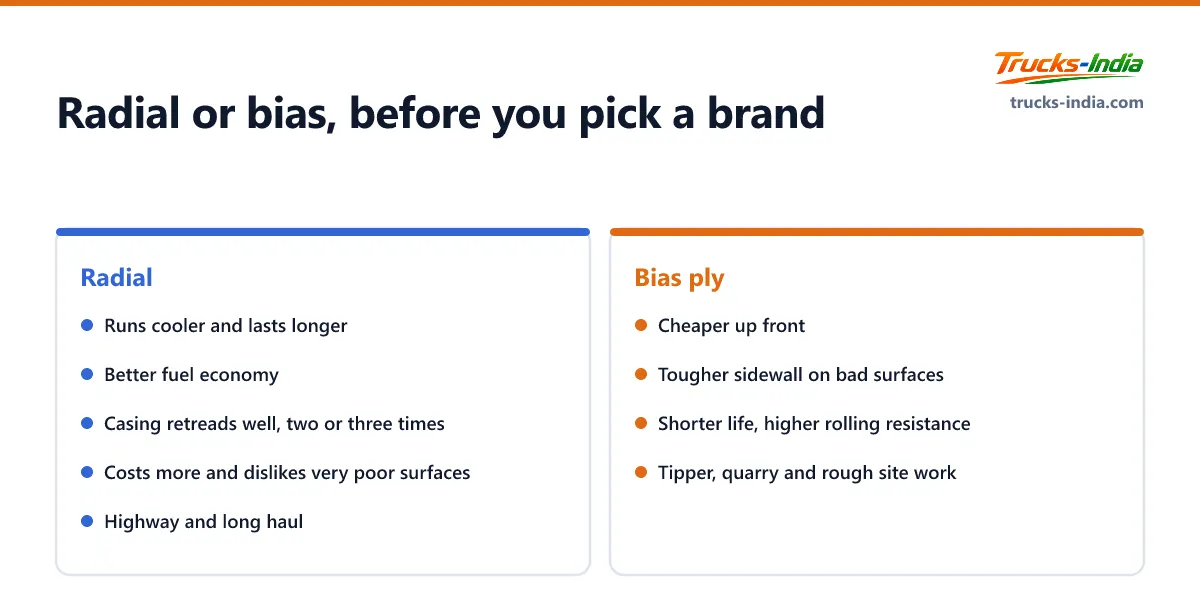
Radial tyres run cooler, last longer, give better fuel economy and produce a casing that retreads well. They cost more up front and are less tolerant of very poor road surfaces and severe overloading.
Bias ply tyres are cheaper, tougher against sidewall damage on bad surfaces and rough sites, and give shorter life with higher rolling resistance.
The practical split: highway and long haul work belongs on radials, and tipper, quarry and rough site work is where bias still earns its place. India has moved heavily towards radials in the highway segment for exactly this reason.
Retreading is where the money is
This is the part that separates operators who manage tyre cost from those who merely pay it.
Retreading replaces worn tread on a sound casing, and it costs a fraction of a new tyre. A NITI Aayog assessment put the potential saving at roughly Rs 25,000 per truck tyre. A good casing can typically be retreaded two or three times.
Which changes what you are buying. You are not buying tread, you are buying a casing that will survive to be retreaded more than once. A cheap tyre whose casing is scrap at first wear has cost you every future retread as well.
Two things destroy a casing and both are avoidable:
- Running underinflated, which builds heat in the sidewall and ruins the casing structure
- Running overloaded, which does the same faster
Which brings us to the two habits.
The two things that decide tyre life
Pressure. Underinflation is the single fastest way to destroy a truck tyre and it costs nothing to prevent. Check pressures cold, weekly at minimum, every tyre including the spare. This is the highest return ten minutes in truck operation and it is skipped constantly.
Load. A consistently overloaded truck destroys tyres well before their normal life and ruins the casings so they cannot be retreaded. That cost is rarely counted when somebody decides the extra tonne is free money, and what the extra tonne really costs is set out in the axle load limits.
Alignment and rotation matter too. Poor alignment wears tyres unevenly and irreversibly, and rotating positions on schedule evens out wear across the set.
How to choose, in practice
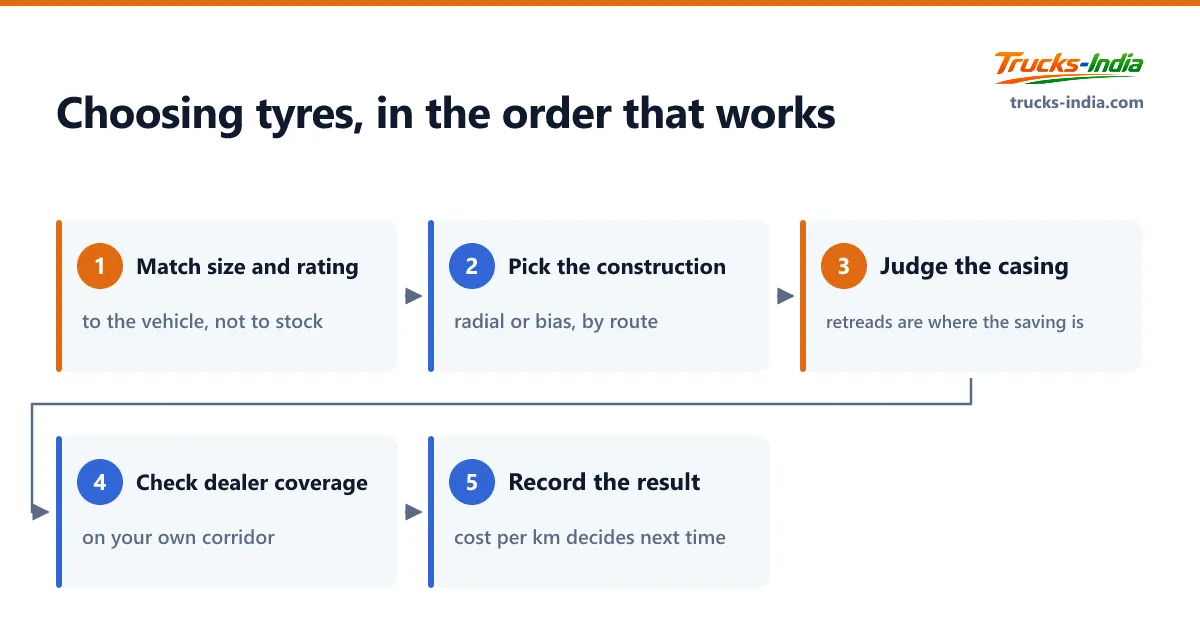
- Match the size and load rating to the vehicle, not to what is in stock.
- Pick the construction for your route, radial for highway, bias where surfaces are genuinely bad.
- Shortlist on casing reputation and retreadability, not on price per tyre.
- Check dealer coverage on your corridor, because a tyre you cannot replace in Dhule is a problem wherever you bought it.
- Record the result and let the next purchase be decided by your own cost per kilometre rather than by advice.
Point five is the one that compounds. Two years of records make this decision for you.
Frequently asked questions
There is no single answer without knowing the route. MRF leads on volume and dealer coverage, Apollo, JK Tyre and CEAT are the other major domestic players, and Bridgestone, Michelin, Goodyear and Yokohama hold about eleven percent of the market at a premium that suits high mileage highway fleets. Judge on cost per kilometre from your own records.
For the common 10.00 R20 heavy commercial size, a major brand radial sits roughly in the Rs 27,000 to Rs 29,000 range per tyre, moving with rubber and crude prices and varying by pattern and seller. Light commercial sizes are a fraction of that.
It depends on road surface, load discipline and pressure maintenance far more than on brand, so brochure figures are a poor guide. Track your own tyres by position and calculate cost per kilometre after one full set; that number is what should drive the next purchase.
Yes, and it is where most of the saving lives. Retreading costs a fraction of a new tyre, a NITI Aayog assessment put the potential saving near Rs 25,000 per truck tyre, and a sound casing can usually be retreaded two or three times. It only works if the casing survived, which underinflation and overloading prevent.
Radials for highway and long haul: cooler running, longer life, better fuel economy and casings that retread well. Bias ply where surfaces are genuinely bad, such as tipper, quarry and site work, where sidewall toughness matters more than tread life.
Underinflation and overloading, in that order. Both build heat in the sidewall and destroy the casing, which costs you the future retreads as well as the current tread. Weekly cold pressure checks on every tyre are the highest return routine in truck operation.
Where this fits
Tyres are the biggest line in the maintenance budget. See our guide to truck maintenance cost and schedule.
Tyre size and load rating follow from the vehicle. Trucks India lists specifications for every model sold in India.
Call +91 93422 00875About the author
Lokesh R
CEO of Trucks India
Lokesh R is the founder of Trucks India, an independent heavy-vehicle marketplace and research platform operated from Chennai, Tamil Nadu, founded in 2025. Under his direction, Only Heavy publishes specifications and prices sourced from manufacturers, authorised dealer price lists and official regulatory schedules, with every model page checked by a named reviewer, prices re-verified monthly and after any GST revision, and no advertiser able to buy a rating, ranking or comparison result.


