
How to Get Load for Your Truck in India
The realistic ways to find freight in India: brokers, transport nagar, load apps, direct clients, attachment and return loads, and the trade offs of each.

Lokesh R
CEO of Trucks India
Created 25 August 2026 · 7 min read
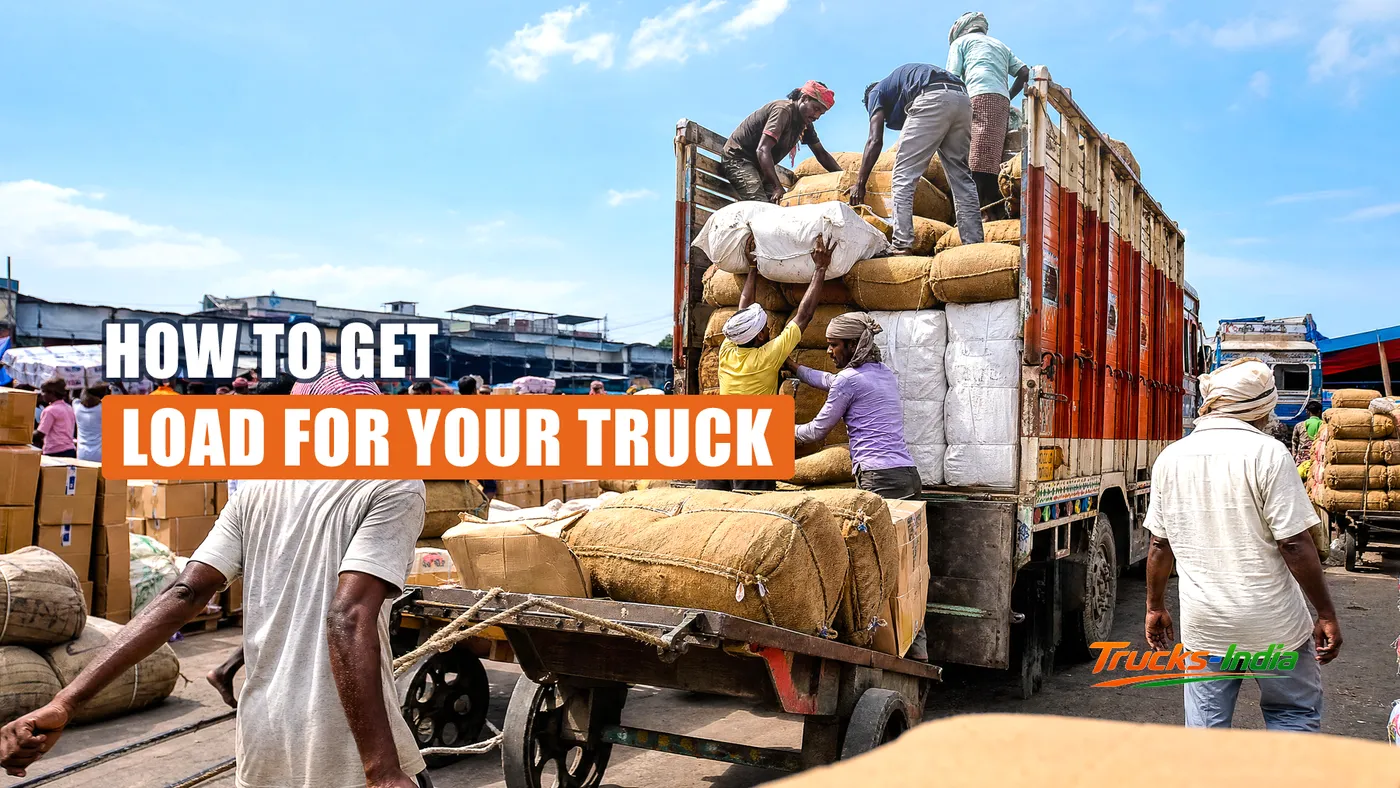
Buying the truck is the part with a clear process. Finding loads is the part that decides whether the truck pays for itself, and it has no process at all until you build one.
Most new owners start where everyone starts, at the transport nagar or with a broker who knows their vehicle type. That works, and it should not be where you stop. The operators who do well have three or four sources running at once, so that a quiet week in one does not mean an idle truck.
Here are the channels, what each is good for, and how to move from taking whatever comes to choosing.
How to get load for a truck, the six channels
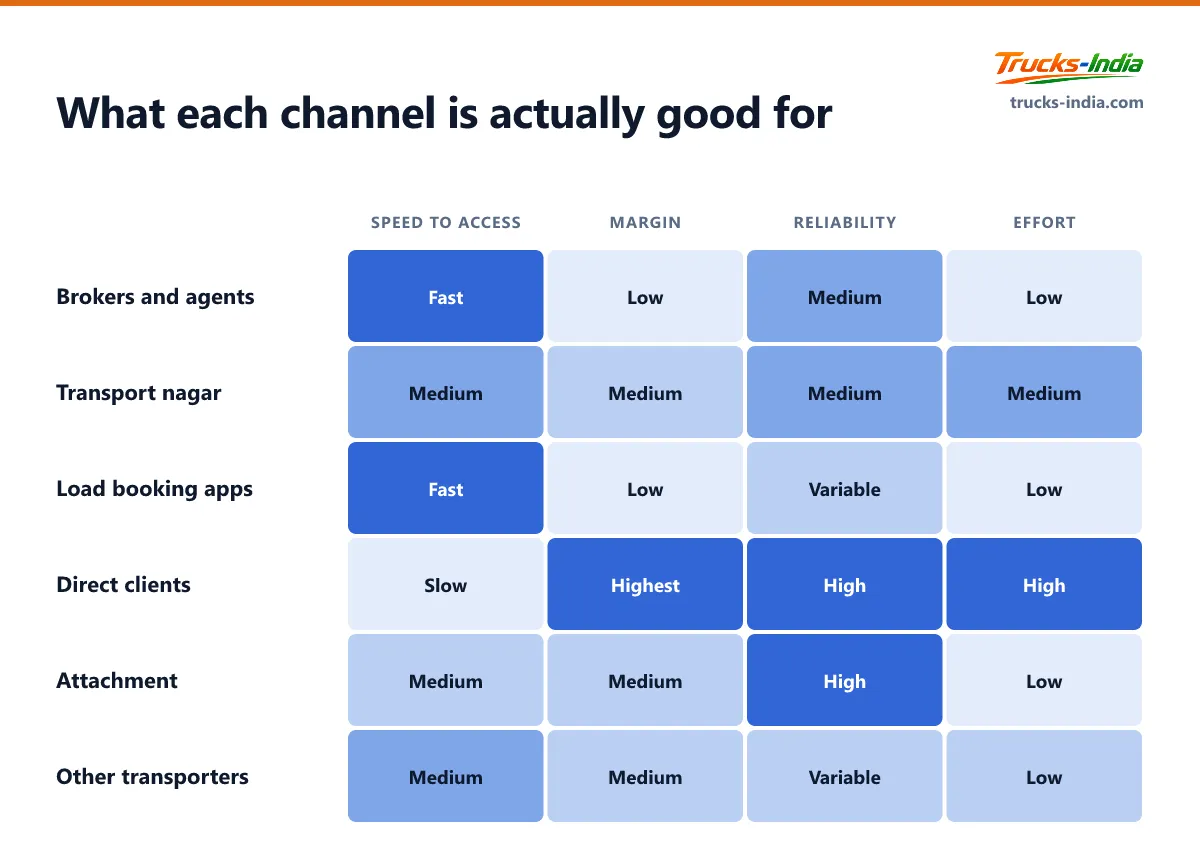
- Brokers and commission agents. Fastest to access, lowest margin.
- Transport nagar and freight markets. Physical, relationship driven, still central in most cities.
- Load booking apps and online boards. Best for filling gaps and return legs.
- Direct clients. Highest margin, slowest to build.
- Attachment with a logistics company. Steady volume, fixed terms.
- Other transporters. Overflow work from operators with more loads than trucks.
Run at least three. A truck dependent on one source is a truck that stops when that source goes quiet.
Brokers and commission agents
The traditional route, and the one almost every operator uses at some point. A broker holds relationships with shippers and matches loads to available vehicles, taking a commission.
Good for: starting out, unfamiliar routes, filling a gap this week.
The trade: the commission comes out of your rate, and you have limited visibility of what the shipper actually paid. You are also last in line when good loads are allocated, until the broker knows your vehicle is reliable.
Making it work: be the operator who answers the phone, arrives when promised and does not damage cargo. Brokers allocate the best loads to the least trouble, and reliability compounds faster here than anywhere else.
Transport nagar and freight markets
Every major city has a freight hub where transporters, brokers and shippers meet. It remains a genuinely important channel, particularly for full truck loads on established corridors.
Good for: building a local reputation, finding return loads at the far end of a corridor, learning what rates actually are on your route.
The trade: it takes physical presence and time, and rates are visible to everyone, which keeps them competitive.
Making it work: be known at both ends of your main corridor rather than one. The return leg is where most operators lose money, and being a familiar face at the destination is the cheapest fix available.
Load booking apps and online boards
Digital load boards have become a real channel in Indian road transport, particularly for filling return legs.
Platforms operating in this space include Vahak, a marketplace connecting transporters and shippers, BlackBuck, which matches loads and offers fleet tooling, Wheelseye, a technology platform for truck transportation, TrucksUp, which covers finding and booking loads, and Porter, aimed mostly at intra city and last mile movement.
Good for: return loads, new corridors, and seeing rate benchmarks you would otherwise have to ask around for.
The trade: competition on price is visible and immediate, and quality of counterparties varies. Verify who you are dealing with before committing a vehicle.
Making it work: use apps to fill gaps rather than as your primary source. An operator whose entire book comes from bidding on apps is competing purely on rate, which is the weakest position in freight.
Direct clients
Manufacturers, wholesalers, distributors and traders who need goods moved regularly. This is where margins are best because nobody is taking a cut in between.
Good for: stable, repeat volume and predictable cash flow once established.
The trade: slow to win. Larger companies run vendor onboarding with documentation requirements, and they usually want to see that you are established before they commit.
Making it work: start local and specific. A distributor in your own city with a regular route is a more realistic first direct client than a national manufacturer. Have your paperwork ready, because onboarding stalls on missing documents more than on anything else: GST certificate, PAN, cancelled cheque, vehicle registration, insurance and the driver's licence.
Attachment with a logistics company
Attaching your vehicle to a larger logistics or courier company means running their loads on their terms, usually with a defined rate and a more reliable payment cycle.
Good for: steady utilisation without the work of finding loads, and predictable payments.
The trade: rates are set rather than negotiated per trip, and you have less control over routing. Terms vary a great deal between companies, so read them properly.
Other transporters
Operators with more loads than trucks routinely pass work on. This is one of the most underused channels for a new owner, and it costs nothing but relationships.
Good for: filling gaps, and getting work on corridors you would not otherwise reach.
Making it work: be useful to them. Transporters pass overflow to people who will not embarrass them in front of their client.
The return leg is the real problem
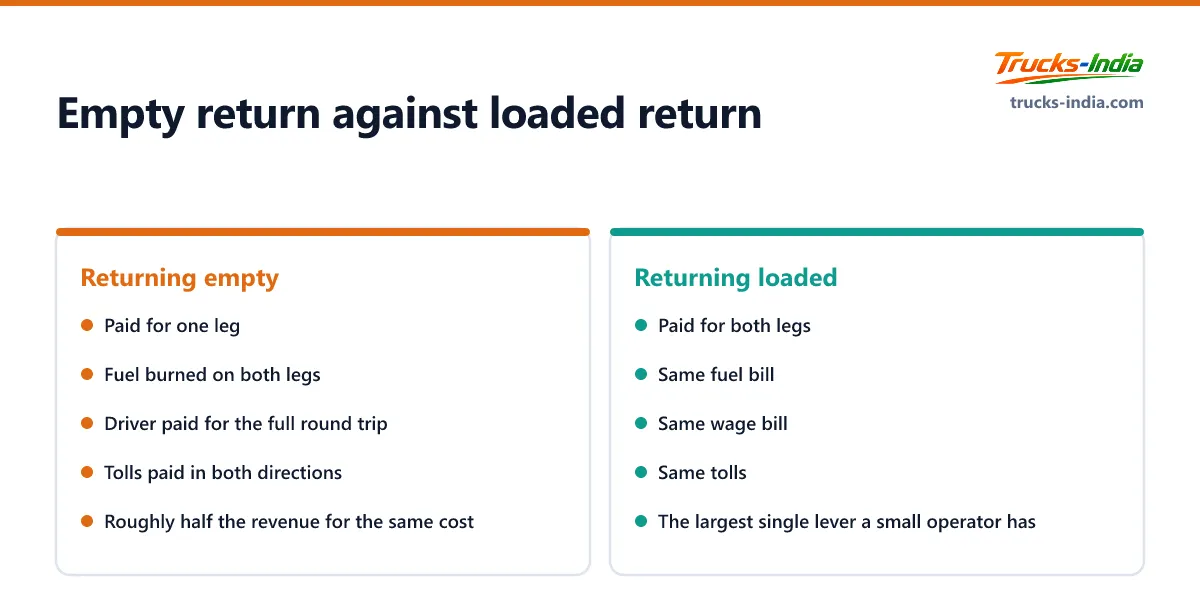
Everything above is easier in the outbound direction. The channel that solves your return leg is worth more than the one that fills your outbound, because an empty return halves your revenue on nearly the same fuel and wage bill.
Practical approaches: build a contact at the destination end of your main corridor, use load apps specifically for the return, and consider running a slightly different route home if a loaded alternative exists. Many operators discover their most profitable corridor is not the one they started with, but the one where both directions carry freight.
The vocabulary, so you can search properly
The same thing is advertised under half a dozen names, and knowing them widens what you can find.
Load board is the older term, borrowed from American trucking, for a listing of available freight. In India the boards mostly live inside the apps rather than on separate websites.
Load matching and load posting describe the two directions of the same exchange. A shipper posts a load, the platform matches it to a truck. When an app talks about matching, that is what it means.
Freight loads for trucks and loads for trucks are the phrasings shippers and brokers use. Get loads for my truck is the phrasing owners use. They return different results on the same platform, so it is worth trying both when a search comes back thin.
Owner drivers and hired drivers find work through the same channels, though a hired driver usually takes what the owner accepts rather than choosing loads themselves.
The apps themselves differ more than the category name suggests, and a truck booking app and a load booking app are opposite sides of one marketplace rather than the same product.
Before you accept a rate
Know your cost per kilometre before you negotiate. A rate that sounds acceptable can be a loss once you count diesel for the full run including the empty leg, tolls, and the per kilometre share of tyres and maintenance.
Take the mileage figure from your model's page, put it against today's fuel prices, and you can judge a rate in about a minute rather than by feel.
Three of these channels are worth their own detail: load booking apps for filling return legs, winning a freight contract for committed volume, and attachment with a company for steady utilisation without the hunt.
Trucks to compare
A few trucks for a transport business on Trucks India, with ex-showroom price and rated payload. Open one for its full price, specifications and mileage.
Browse more: Mini trucks, Light commercial vehicles, Heavy trucks, Tata Motors trucks, Ashok Leyland trucks, Mahindra trucks
Frequently asked questions
Use several channels at once: brokers, your local transport nagar, load booking apps such as Vahak, BlackBuck, Wheelseye, TrucksUp or Porter, direct clients, attachment with a logistics company, and overflow work from other transporters.
They serve different needs. Vahak, BlackBuck, Wheelseye and TrucksUp focus on matching loads with transporters across corridors, while Porter is oriented to intra city and last mile work. Most operators use apps to fill return legs rather than as a primary source.
Start local and specific, with distributors or manufacturers on a route you already run. Have your GST certificate, PAN, cancelled cheque, vehicle registration and insurance ready, since vendor onboarding usually stalls on documentation.
Build relationships at the destination end of your corridor, not only at home, and use load apps specifically to fill returns. Some operators change their route home entirely to one where freight flows both ways.
Attachment gives steadier utilisation and more predictable payment, at fixed rates and with less control over routing. Finding your own loads pays more per trip but requires the work of finding them and chasing payment.
Where this fits
Finding your first steady client is step eight of eight. See our guide to starting a transport business.
The right loads depend on the payload you carry. Trucks India lists payload, mileage and on road price for every model sold in India.
Call +91 93422 00875About the author
Lokesh R
CEO of Trucks India
Lokesh R is the founder of Trucks India, an independent heavy-vehicle marketplace and research platform operated from Chennai, Tamil Nadu, founded in 2025. Under his direction, Only Heavy publishes specifications and prices sourced from manufacturers, authorised dealer price lists and official regulatory schedules, with every model page checked by a named reviewer, prices re-verified monthly and after any GST revision, and no advertiser able to buy a rating, ranking or comparison result.


