
Diesel Theft Prevention in Trucks
How diesel goes missing from Indian trucks, how to tell real theft from a mechanical fault, and what stops it, from locking caps to tank level sensors.

Lokesh R
CEO of Trucks India
Created 25 September 2026 · 6 min read
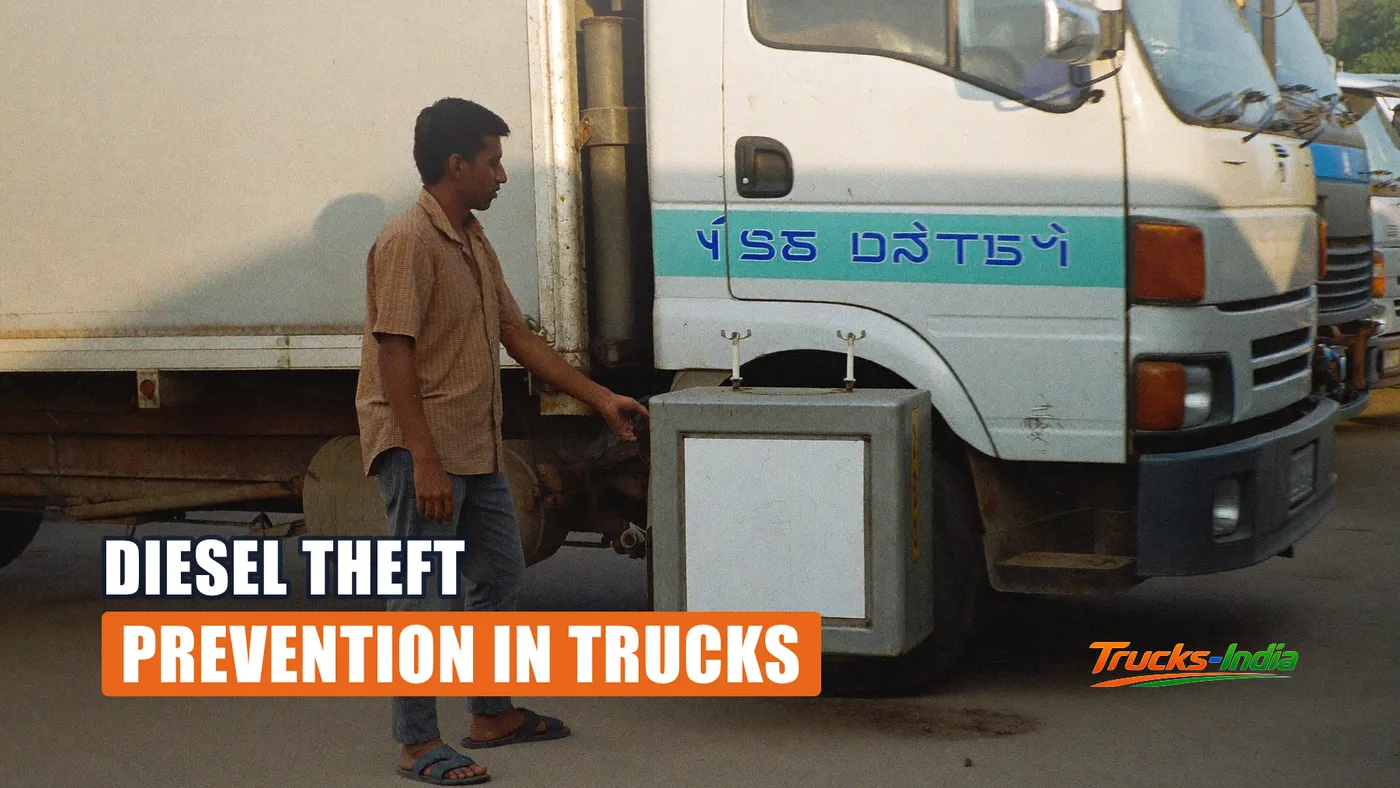
Almost every operator running vehicles they do not drive themselves suspects fuel is going missing. Very few can prove it, and the ones who cannot prove it usually deal with it by accusing people, which loses them drivers without recovering any diesel.
The way out is not suspicion. It is measurement. Once you can see fuel per trip per vehicle per driver, theft stops being a feeling and becomes a pattern you can point at, and most of it stops without a confrontation.
The four ways diesel goes missing
Only one of them is a driver with a pipe, which is why blanket suspicion is both unfair and ineffective.
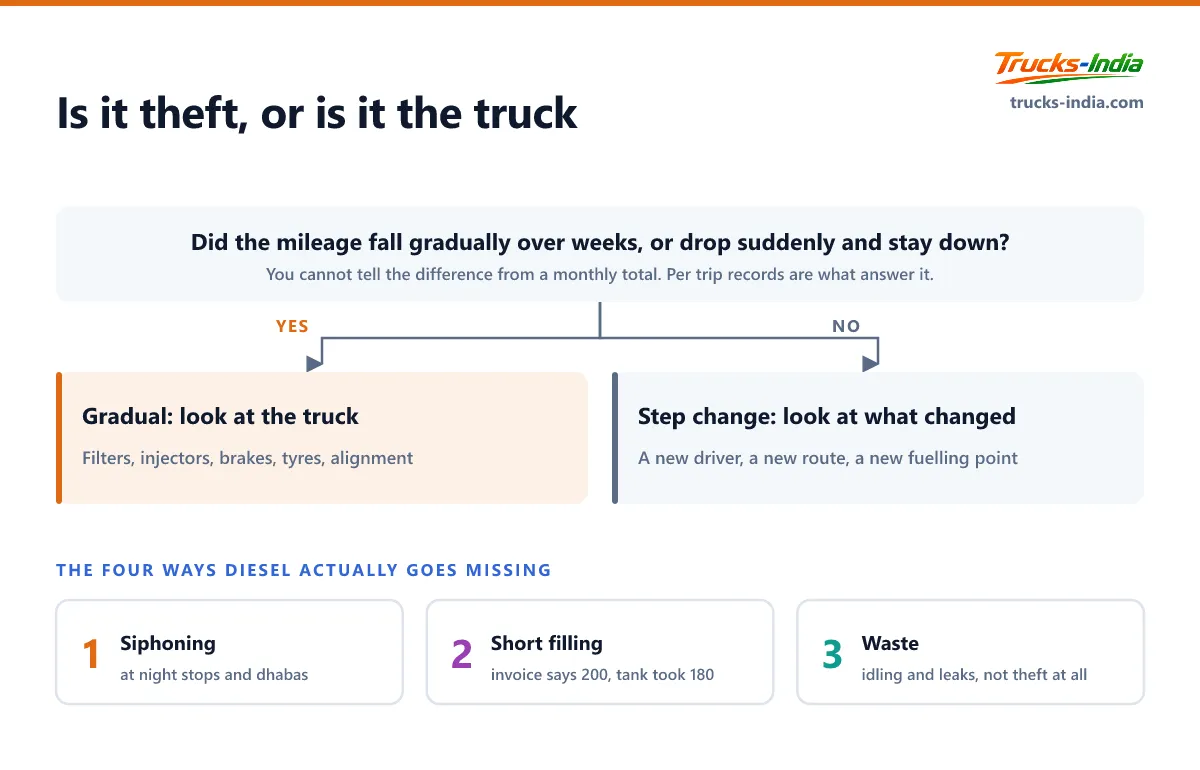
Siphoning from the tank. The obvious one. Happens at night stops, at dhabas, and at unattended parking. Sometimes the driver, often not.
Short filling at the pump. The invoice says 200 litres and 180 went in. The driver may be complicit or may be the one being cheated. This is invisible without measurement.
Selling surplus after a genuine fill. A full tank, a quantity sold on, and the trip completed on the rest.
Waste that is not theft at all. Idling, a leaking line, a dragging brake, an over rich injector, a clogged air filter. Every one of these looks exactly like theft on a monthly fuel bill, and accusing somebody of stealing your own maintenance neglect is a fast way to lose a good driver.
That last category is the reason this guide starts with measurement rather than with locks.
Telling theft from a fault
The pattern tells you, and it is reliable enough to act on.
A gradual decline over weeks is almost always mechanical. Filters, injectors, brakes, tyres, alignment. Work through the list in the mileage guide before suspecting anybody.
A step change is theft or a change of circumstance. The figure was steady, then it dropped and stayed down. Check what else changed on that date: a new driver, a new route, a new fuelling point.
Loss on specific trips or specific routes points at a place rather than a person.
Loss concentrated on one driver across vehicles points at the person.
You cannot see any of these from a monthly total. You need per trip records, which is the whole argument for the measurement discipline below.
Measure before you act
Tank to tank, per trip. Brim fill, odometer, run, brim fill. Distance divided by litres. Same pump where possible.
Record per vehicle and per driver. The comparison is where the information is.
Reconcile fuel invoices against the tank. Litres billed should match litres the tank could physically have taken. A 200 litre fill into a tank that was a third full and holds 300 is arithmetic that does not work, and that check alone catches most short filling.
Log odometer readings at every fill, not occasionally.
None of this requires equipment. A notebook in the cab and a spreadsheet at the office does it, and for a single vehicle that is the right answer.
What actually stops it
In rough order of cost against effect.
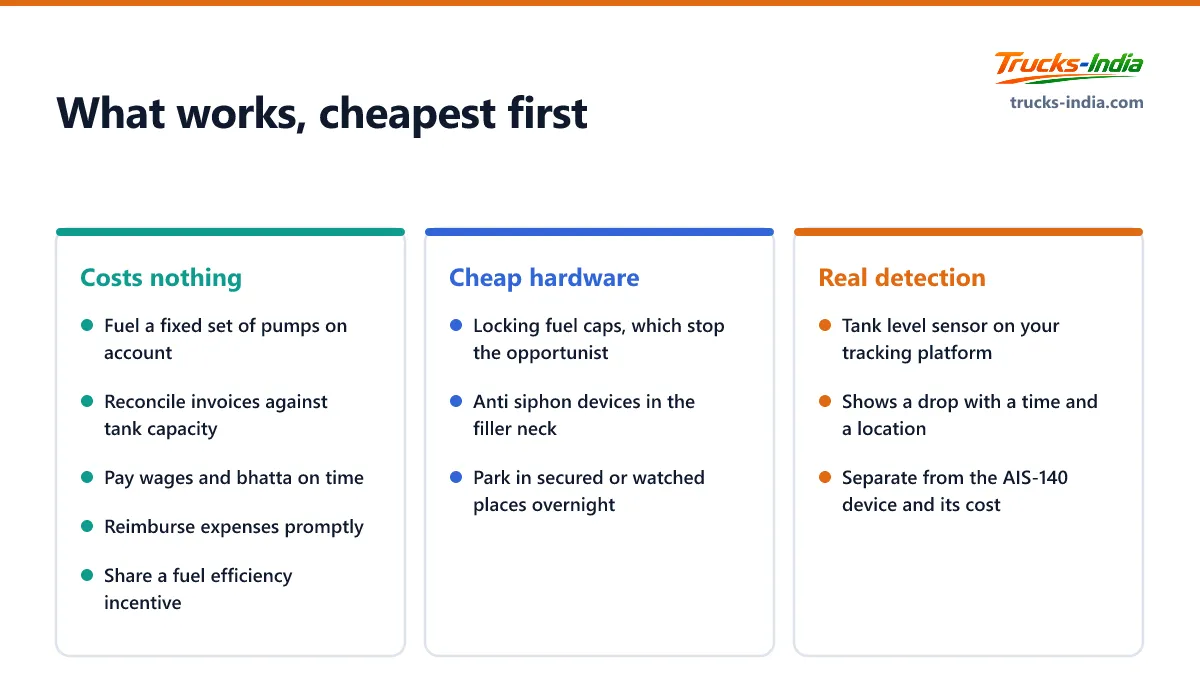
Fuel a fixed set of pumps on account. This is the single most effective measure available and it costs nothing. An account fill produces a record you can reconcile, removes cash from the transaction, and makes short filling far harder because the pump has an ongoing relationship to protect.
Locking fuel caps. Cheap and worth fitting. They stop the opportunist. They do not stop somebody determined and they do nothing about short filling.
Anti siphon devices in the filler neck. More effective than a cap alone against siphoning.
Park where it matters. Most siphoning happens at unattended night stops. A secured yard or a lit dhaba with a watchman changes the exposure more than most hardware.
Fuel level sensors, which is where real detection lives. A sensor in the tank reporting to your tracking platform shows the level continuously, so a sudden drop while the vehicle is stationary is visible with a time and a location. This is the only method that produces evidence rather than inference.
Be clear that a sensor is not the same as your AIS-140 device. The compliance tracker reports location, not fuel. Fuel monitoring is a separate sensor at a separate cost, usually on the same platform, as the AIS-140 guide explains.
Whether a sensor is worth it
Do the arithmetic rather than buying on frustration.
Estimate the litres you believe you are losing per month. Multiply by the diesel price in your state, which for most states sits between roughly ₹82 and ₹104 a litre and which you can read off today's fuel prices. Compare that against the sensor cost plus the monthly platform subscription, across the vehicles you would fit.
The result is usually clear. On a single vehicle with modest suspected loss, the notebook and account fuelling do the job. Across a fleet with a real recurring gap, sensors pay for themselves quickly and keep paying.
The part most owners get wrong
Fuel theft is a management problem before it is a security problem.
Pay drivers properly and on time. A large share of small scale pilferage in Indian trucking traces back to drivers recovering money they feel is owed, usually delayed bhatta or unreimbursed expenses. Paying reliably removes the justification, and it is cheaper than the diesel. What a driver really costs, beyond the wage, is in what truck drivers are paid.
Reimburse expenses promptly, so the driver is never funding your trip from their own pocket.
Share the gain. A driver on a fuel efficiency incentive has a reason to protect the diesel rather than a reason to be indifferent to it.
Show the data without accusing. Put the figures in front of the driver and ask what they make of it. Most conversations end with the number improving and nobody being called a thief.
Act on real evidence, quickly and quietly. When a sensor gives you a time, a place and a litre drop, that is a different conversation and it should be a short one.
Trucks to compare
A few popular trucks on Trucks India, with ex-showroom price and rated payload. Open one for its full price, specifications and mileage.
₹4.5-5.25 Lakh · 765 kg payload · Petrol
Browse more: Mini trucks, Light commercial vehicles, Heavy trucks, Mahindra trucks, Force Motors trucks, Maruti Suzuki trucks, Omega trucks
Frequently asked questions
Compare fuel per trip per vehicle and per driver. A step change in mileage that stays down suggests theft or a change of circumstance; a gradual decline over weeks is almost always mechanical. A monthly total cannot tell you the difference, which is why per trip records matter.
Fuelling at a fixed set of pumps on account. It costs nothing, removes cash from the transaction, produces a record you can reconcile against tank capacity, and makes short filling much harder. Locking caps and anti siphon devices come next.
Yes, and they are the only method that produces evidence rather than inference. A tank sensor reporting to your tracking platform shows a sudden drop with a time and a location. It is a separate sensor from your AIS-140 compliance device, at separate cost.
No, and assuming so is the common mistake. Idling, a clogged air filter, poor injectors, dragging brakes, misalignment and underinflated tyres all look identical to theft on a fuel bill. Work through the mechanical causes before suspecting anybody.
None is normal, but small scale pilferage is widespread and often traces to delayed payments rather than dishonesty. Paying wages and bhatta on time, reimbursing expenses promptly and sharing a fuel efficiency incentive removes most of the motivation more cheaply than hardware does.
Not on suspicion. Put the figures in front of them and ask what they make of it, which usually improves the number without an accusation. Act firmly only when you have real evidence such as a sensor showing a litre drop at a specific time and place.
Where this fits
Fuel loss shows up first as falling mileage. See our guide to increasing truck mileage.
Know what the vehicle should return before deciding what is missing. Trucks India lists rated mileage for every model in India.
Call +91 93422 00875About the author
Lokesh R
CEO of Trucks India
Lokesh R is the founder of Trucks India, an independent heavy-vehicle marketplace and research platform operated from Chennai, Tamil Nadu, founded in 2025. Under his direction, Only Heavy publishes specifications and prices sourced from manufacturers, authorised dealer price lists and official regulatory schedules, with every model page checked by a named reviewer, prices re-verified monthly and after any GST revision, and no advertiser able to buy a rating, ranking or comparison result.


