
Axle Load Limit and Overloading Rules in India
Axle load limits in India after the 2018 revision, the Section 194 penalty, the tiered highway overload fee from April 2026, and your real legal payload.

Lokesh R
CEO of Trucks India
Created 18 September 2026 · 7 min read
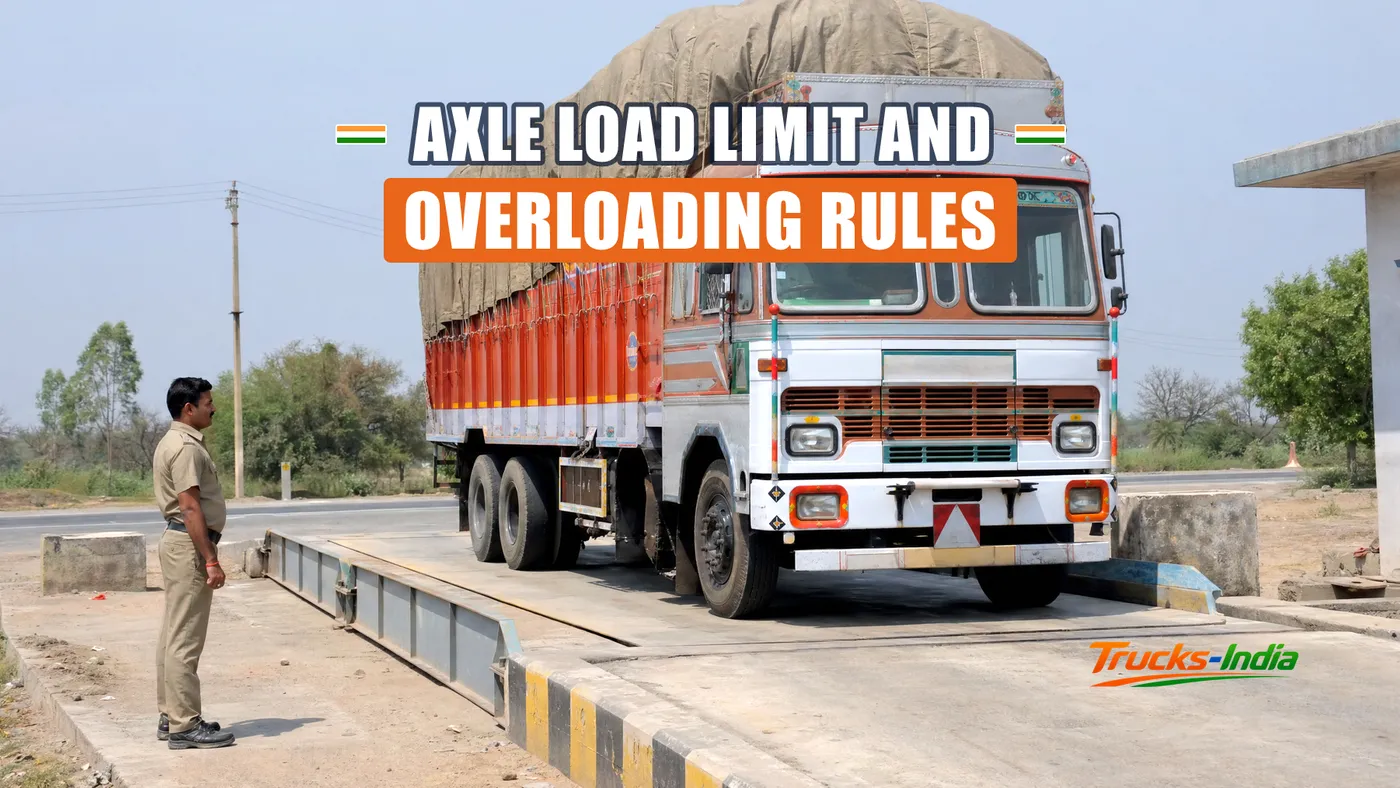
Overloading looks like free money. One extra tonne on a trip you were making anyway, with no extra diesel worth mentioning and no extra driver.
The arithmetic stops working the moment you count what it actually costs: a statutory penalty that scales with the excess, a toll charge that from April 2026 can run at four times the normal rate, tyres and suspension consumed faster than they should be, and an insurer with clean grounds to decline a claim.
This guide sets out the legal limits, the penalties as they now stand, and how to work out what your own vehicle may carry.
The permissible axle loads
India raised these limits by roughly 20 to 25 percent in a notification dated 16 July 2018, bringing them closer to international practice. The figures below are that revision.
Single axle
- One tyre: 3 tonnes
- Two tyres: 7.5 tonnes
- Four tyres: 11.5 tonnes
Tandem axle, where the two axles sit under 1.8 m apart
- Rigid trucks, trailers and semi trailers: 21 tonnes
- Puller tractors for hydraulic and pneumatic trailers: 28.5 tonnes
Tridem axle, where the outer axles sit under 3 m apart
- Rigid vehicles, trailers and semi trailers: 27 tonnes
- Modular hydraulic trailer, two axles with four tyres each: 18 tonnes
On top of the per axle figures sit two overall caps. Gross vehicle weight is fixed at 49 tonnes for rigid trucks and 55 tonnes for semi articulated trailers and truck trailers, with a permissible tolerance of 5 percent.
The reason more axles means more payload follows directly from this table. The law limits each axle, so the vehicle's ceiling is the sum of its axles, subject to the overall cap. That is why a 10x2 rigid carries more than a 6x2 without a bigger engine, and it is covered further in the guide to truck types.
How to work out your own legal payload
Two numbers, both on the registration certificate.
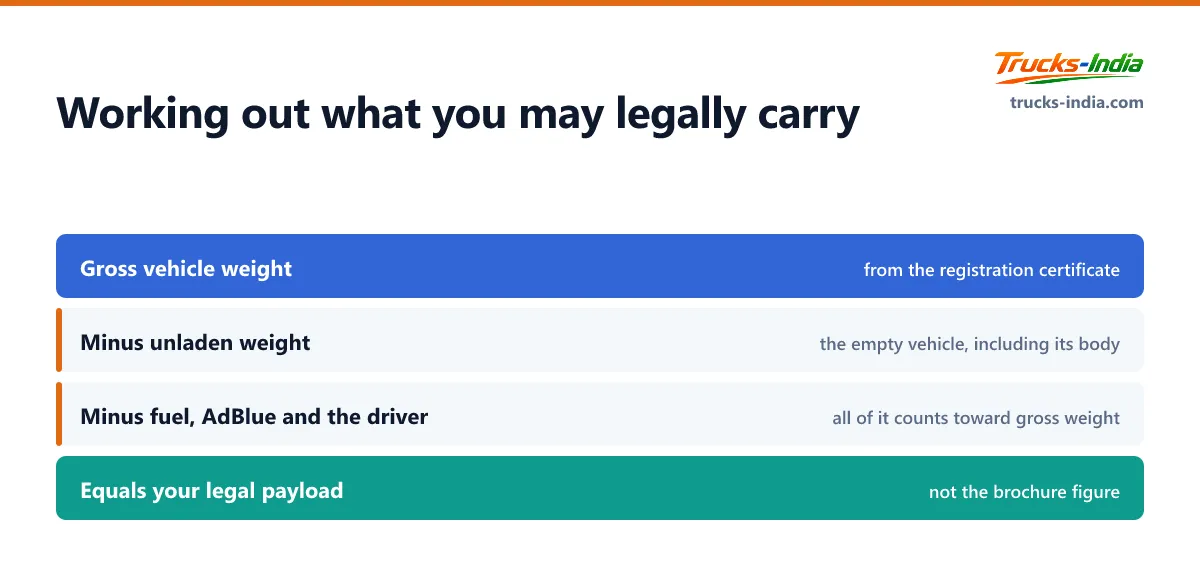
Gross vehicle weight is the maximum the vehicle may weigh, fully loaded. Unladen weight, sometimes called kerb weight, is what it weighs empty, including the body.
Subtract the second from the first and the difference is your legal payload. That is the figure, not the one on the brochure and not the one the loading agent tells you.
Two things routinely erode it. Body building adds weight, so a vehicle with a heavy container or tipper body has less payload than the same chassis with a light open body. And fuel, AdBlue, the driver and any accessories count, because gross vehicle weight is the whole thing on the road.
If you have never weighed your own truck empty on a weighbridge with a full tank, the number you are working from is an assumption.
The penalty under the Motor Vehicles Act
Overloading is dealt with under Section 194 of the Motor Vehicles Act 1988, as amended in 2019.
The penalty is Rs 20,000, plus Rs 2,000 for every additional tonne of excess weight.
There is a second consequence that costs more than the fine on a time sensitive load: the vehicle is not permitted to move until the excess is removed. That means arranging another vehicle, at the roadside, for part of a consignment, while the original truck waits.
The new highway overload fee, from April 2026
This is the change most pages have not caught up with.
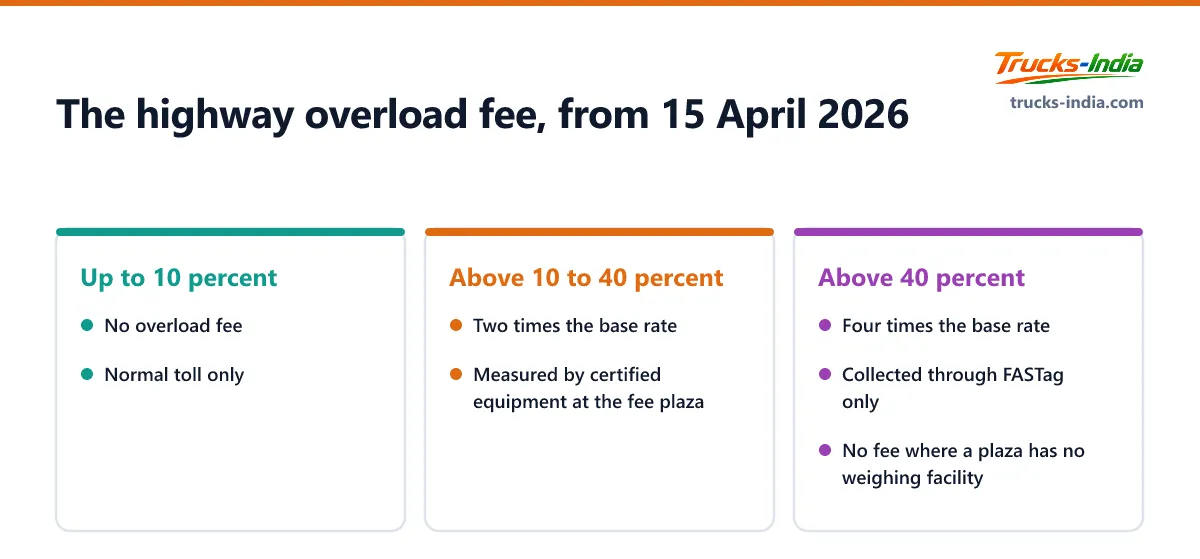
The National Highways Fee (Determination of Rates and Collection) Fourth Amendment Rules 2026 came into force on 15 April 2026 and changed how overloaded vehicles are charged at toll plazas. The structure is now tiered by how far over the limit you are:
- Up to 10 percent excess: no overload fee
- Above 10 percent and up to 40 percent: two times the base rate
- Above 40 percent: four times the base rate
Three details matter in practice. Overloading is determined using certified weighing equipment installed at the fee plaza. Where a plaza has no weighing facility, no overload fee is levied. And the fee is collected through FASTag only.
This sits alongside the Section 194 penalty rather than replacing it. A significantly overloaded vehicle can now face a statutory fine, a quadrupled toll charge, and an order not to proceed until the excess comes off.
Why overloading does not pay
Set aside the enforcement for a moment. The vehicle itself makes the case.
Tyres fail first. Load and pressure together determine tyre life, and a consistently overloaded truck destroys tyres well before their normal life. Tyres are usually the largest single line in a heavy vehicle's maintenance budget.
Suspension and chassis take permanent damage. Leaf springs, bushes and mountings are specified for a load. Run beyond it habitually and the wear is structural rather than cosmetic.
Braking distance increases with weight, which is the safety argument and also the insurance argument.
Fuel consumption rises, eroding the extra revenue the additional tonne was supposed to earn.
An insurance claim can be rejected. Overloading at the time of an incident is one of the standard grounds insurers use to decline commercial vehicle claims, alongside a lapsed permit and a driver holding the wrong licence class. The insurance guide covers the full list.
Put those together and the extra tonne is rarely profitable even when nobody stops you. When someone does, it is straightforwardly a loss.
What to do instead
Know your real payload. Weigh the vehicle empty, subtract from the gross vehicle weight on the registration certificate, and work from that number.
Put it in writing with your customer. Rate disputes over weight almost always trace back to a rate agreed without settling the tonnage. State the maximum you will carry when you quote.
Weigh before you leave, not after. A weighbridge check at origin costs very little against a penalty and a stranded load. Securing the load properly matters just as much as its weight, and the load securing guide covers projection limits and restraint.
Match the vehicle to the work. If you are routinely turning down weight because the truck cannot take it legally, the answer is a higher payload vehicle or an additional axle, not a heavier load on the one you have. Compare payload across models in the catalogue before assuming your current vehicle is the constraint.
Frequently asked questions
Following the 16 July 2018 revision: 3 tonnes for a single axle with one tyre, 7.5 tonnes with two tyres and 11.5 tonnes with four tyres; 21 tonnes for a tandem axle under 1.8 m spacing on rigid trucks, trailers and semi trailers; and 27 tonnes for a tridem axle with outer spacing under 3 m. Overall gross vehicle weight is capped at 49 tonnes for rigid trucks and 55 tonnes for semi articulated combinations, with 5 percent tolerance.
Rs 20,000 plus Rs 2,000 for each additional tonne of excess, under Section 194 of the Motor Vehicles Act as amended in 2019. The vehicle also may not move until the excess load is removed, which usually costs more than the fine itself.
Under rules effective 15 April 2026, no overload fee applies up to 10 percent excess, two times the base rate applies above 10 and up to 40 percent, and four times the base rate applies above 40 percent. Weight is measured by certified equipment at the fee plaza, no fee is charged where no weighing facility exists, and payment is through FASTag only.
Subtract the unladen or kerb weight from the gross vehicle weight, both shown on the registration certificate. Remember that fuel, AdBlue, the driver and accessories all count toward gross vehicle weight, and that a heavier body reduces payload on the same chassis.
Yes. Overloading at the time of an incident is one of the standard grounds on which insurers decline commercial vehicle claims, along with a lapsed permit or fitness certificate and a driver holding the wrong licence class.
Because the law sets limits per axle rather than per vehicle. Spreading the same load over more axles keeps each one within its ceiling, so the vehicle's permissible total rises, subject to the overall gross vehicle weight cap.
Where this fits
Load limits decide what a truck can legally earn per trip. See our guide to transport business profit margin.
Legal payload is a specification, not a negotiation. Trucks India lists payload and weight for every model sold in India.
Call +91 93422 00875About the author
Lokesh R
CEO of Trucks India
Lokesh R is the founder of Trucks India, an independent heavy-vehicle marketplace and research platform operated from Chennai, Tamil Nadu, founded in 2025. Under his direction, Only Heavy publishes specifications and prices sourced from manufacturers, authorised dealer price lists and official regulatory schedules, with every model page checked by a named reviewer, prices re-verified monthly and after any GST revision, and no advertiser able to buy a rating, ranking or comparison result.


