
BS6 Emission Norms for Trucks in India
BS6 emission norms in India explained for truck owners: what changed from BS4, how AdBlue and the DPF work, limp mode, BS6 Phase 2 and what it means for resale.

Lokesh R
CEO of Trucks India
Created 15 September 2026 · 7 min read
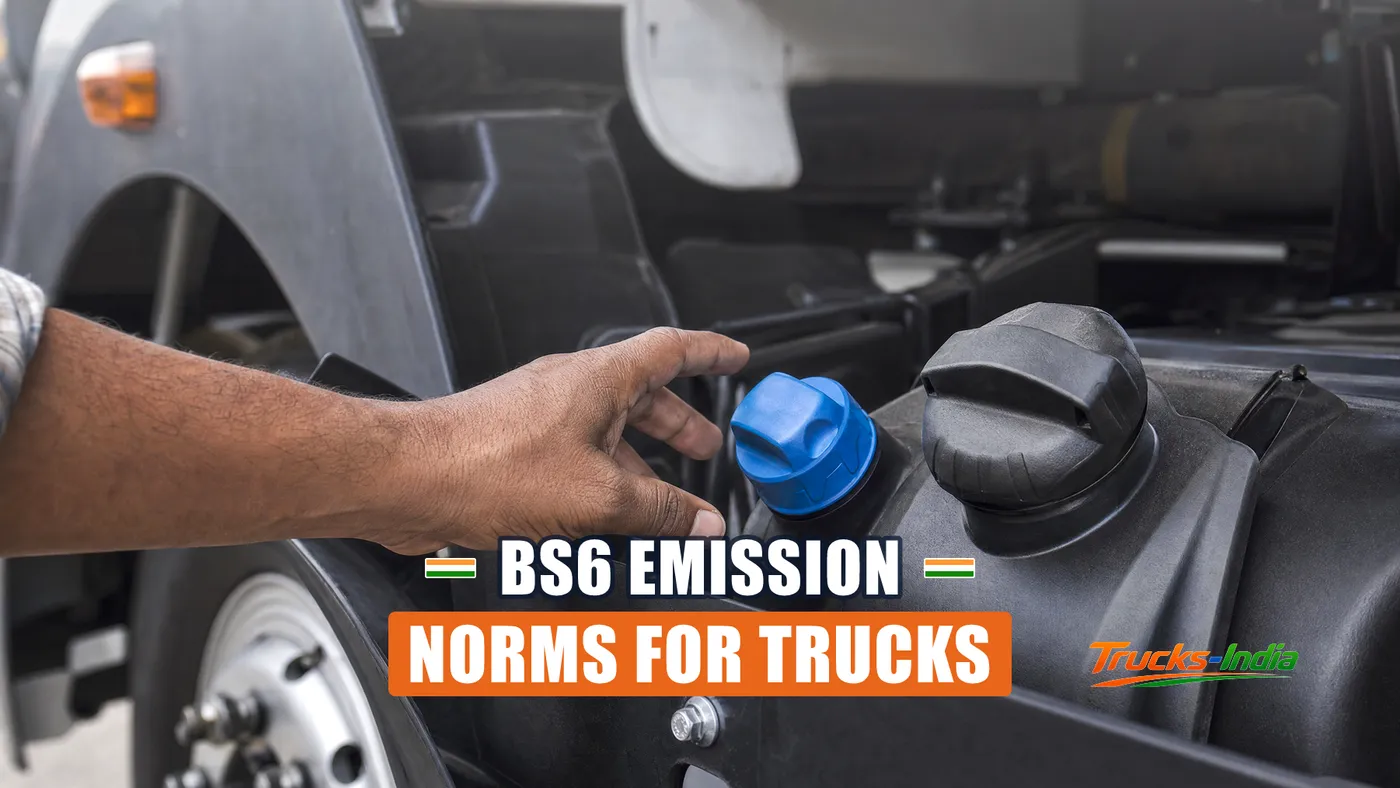
For a truck owner, BS6 is not an environmental policy. It is a set of components on your vehicle that can put it into limp mode on a highway if you neglect them.
That is the part most explanations skip. They cover what the standard reduced and when it arrived, and stop before the things that cost you money: what AdBlue actually is, what happens when it runs out, why the filter clogs on short city runs, and why tampering with any of it is a very expensive idea.
This guide covers the standard, then the parts you have to live with.
What BS6 is, in one paragraph
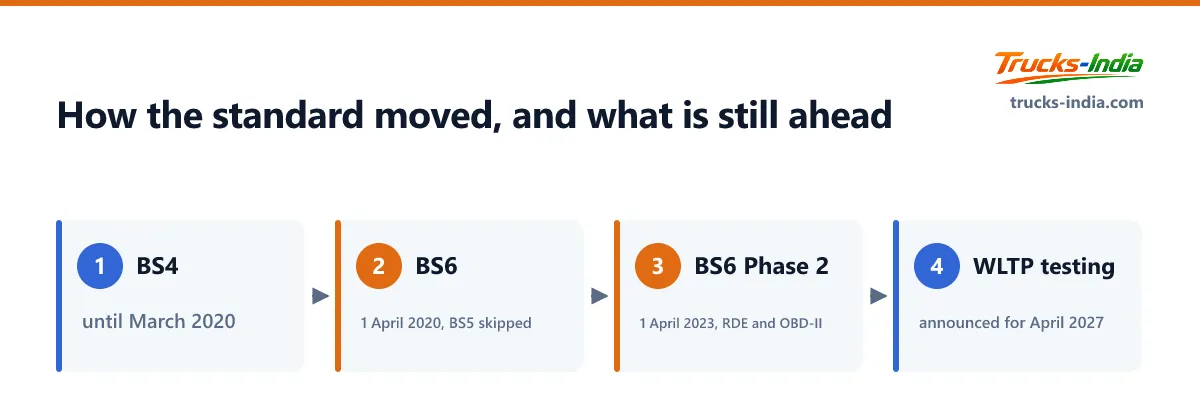
Bharat Stage norms are India's emission standards for vehicles. BS6 took effect on 1 April 2020, and India skipped BS5 entirely to get there, compressing what was planned as two steps into one.
The jump was large. For heavy diesel vehicles, permitted oxides of nitrogen fell by roughly 87 percent against BS4, and particulate matter fell sharply alongside it. Fuel changed at the same time: BS6 diesel carries 10 parts per million of sulphur against 50 ppm under BS4, because the aftertreatment hardware cannot survive high sulphur fuel.
Every new commercial vehicle sold in India today is BS6. The standard is not a choice you make when buying.
What is physically on a BS6 truck
Four things, and three of them need your attention.
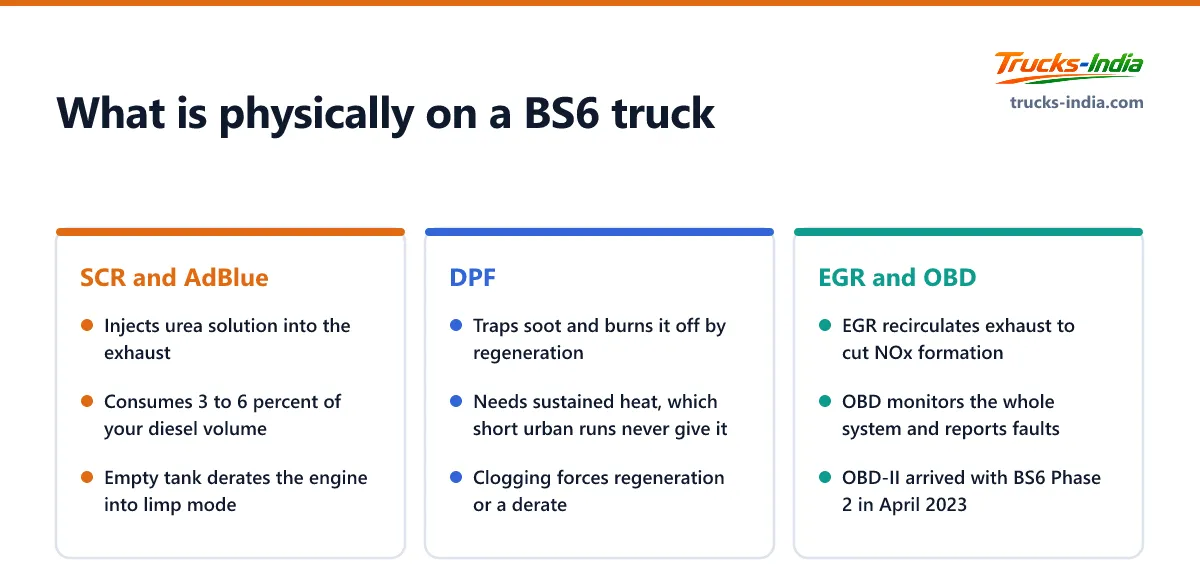
SCR, selective catalytic reduction. This is the system that consumes AdBlue. It injects a urea solution into the exhaust, which converts nitrogen oxides into nitrogen and water.
DPF, the diesel particulate filter. It traps soot from the exhaust and periodically burns it off in a process called regeneration.
EGR, exhaust gas recirculation. Routes some exhaust back into the intake to lower combustion temperature and cut NOx formation.
OBD, on board diagnostics. Monitors the whole emission system and reports faults. Under BS6 Phase 2 this became OBD-II, a more capable stage that catches more conditions and reports them earlier.
AdBlue, and the limp mode nobody warns you about
AdBlue is the trade name for diesel exhaust fluid, a solution of urea in demineralised water. It is not a fuel additive and it does not go in the diesel tank. It has its own filler, usually with a blue cap.
Three facts a new BS6 owner needs.
Consumption runs around 3 to 6 percent of your diesel consumption. On a truck burning 1,000 litres of diesel a month, budget 30 to 60 litres of AdBlue. It is a real line in your running cost, not a rounding error.
If it runs out, the vehicle derates. The engine management deliberately cuts torque and limits speed, and the truck enters what operators call limp mode. This is by design, not a fault. A loaded truck crawling at restricted speed on a highway is an expensive afternoon, and it happens to owners who treat the AdBlue gauge as optional.
Quality matters. AdBlue must meet the ISO 22241 specification. Cheap unbranded fluid with the wrong urea concentration or contaminants will damage the SCR catalyst, and replacing that costs far more than years of buying proper fluid. Buy from a reputable source and keep it sealed, because it degrades with heat and age.
The DPF, and why city work clogs it
The particulate filter cleans itself by burning off trapped soot. That process needs sustained high exhaust temperature, which comes from sustained load and speed.
A truck on long highway runs regenerates passively and the owner rarely thinks about it. A truck doing short urban stop start work never gets hot enough, soot accumulates, and eventually the system forces an active regeneration or throws a warning and derates.
If your work is predominantly short urban distribution, plan for it:
- Complete active regeneration cycles when the vehicle asks for one rather than switching off partway
- Build in an occasional longer run at sustained speed
- Expect DPF servicing to appear in your maintenance schedule in a way it never did on a BS4 vehicle
This is one of the genuine running cost differences between BS4 and BS6 for city operators, and it is rarely mentioned at the point of sale.
Do not tamper with any of it
There is a market in devices and software that disable SCR or remove the DPF, sold on the promise of better mileage and no AdBlue bill.
Three reasons not to. It is illegal, and the vehicle will fail emission testing, which puts your pollution certificate and therefore your fitness and your insurance at risk. It voids the warranty completely. And it frequently damages the engine, because BS6 engines are calibrated on the assumption that the aftertreatment is present and working.
The saving is real and the downside is the vehicle. It is not a close call.
BS6 Phase 2, from April 2023
The second phase took effect on 1 April 2023 and tightened how compliance is proven rather than changing the limits themselves.
Real driving emissions testing was the main addition. Instead of certifying a vehicle only on a laboratory cycle, emissions are measured on public roads with portable measurement equipment, across gradients, traffic and highway conditions. The intent was to close the gap between lab performance and road performance.
OBD-II came with it, monitoring the emission system more comprehensively and flagging faults sooner.
For an owner buying today this is transparent. Everything on sale meets it. It matters when comparing a vehicle built before April 2023 with one built after, because the hardware and calibration differ.
Looking further out, India has announced a move to WLTP based testing under the Bharat Stage framework from April 2027. That is a testing methodology change rather than a new stage, and nothing you buy today becomes non compliant because of it.
What this means if you are buying used
BS4 commercial vehicles could not be sold or registered new after 31 March 2020, but vehicles already on the road continue to operate legally.
Two things follow. A used BS4 truck is cheaper to buy and simpler to run, with no AdBlue, no DPF and fewer sensors to fail. And it carries more resale and regulatory risk as it ages, because older commercial vehicles face tightening restrictions in several cities and face the fitness regime set out in the scrappage policy guide.
If you are weighing a used BS4 vehicle against a new BS6 one, the AdBlue and DPF costs are real but modest against the purchase price gap. The deciding factors are usually how many years you intend to run it and where it will operate.
Frequently asked questions
Bharat Stage 6 is India's current vehicle emission standard, effective from 1 April 2020. India skipped BS5 to reach it. For heavy diesel vehicles it cut permitted oxides of nitrogen by roughly 87 percent against BS4, and BS6 diesel carries 10 ppm sulphur against 50 ppm previously.
AdBlue is diesel exhaust fluid, a urea solution injected into the exhaust to convert nitrogen oxides into nitrogen and water. It has its own tank and filler, and consumption runs roughly 3 to 6 percent of diesel consumption.
The engine management derates the vehicle, cutting torque and limiting speed, until the fluid is refilled. This is designed behaviour rather than a fault. Treat the AdBlue level with the same attention as the fuel gauge.
The diesel particulate filter traps soot and burns it off through regeneration, which needs sustained high exhaust temperature. Short urban stop start work never reaches that temperature reliably, so soot accumulates. City operators should expect DPF attention in their maintenance schedule.
No. It is illegal, the vehicle will fail emission testing and put your pollution certificate at risk, the warranty is void, and BS6 engines are frequently damaged by running without the aftertreatment they were calibrated for.
Effective 1 April 2023, it added real driving emissions testing on public roads using portable measurement equipment, and upgraded on board diagnostics to OBD-II. The emission limits themselves did not change; how compliance is proven did.
Where this fits
Emission compliance is part of what a modern truck costs to run. See our guide to transport business profit margin.
Every new truck sold in India is BS6, so the differences that matter now are payload, mileage and price. Trucks India lists all three for every model.
Call +91 93422 00875About the author
Lokesh R
CEO of Trucks India
Lokesh R is the founder of Trucks India, an independent heavy-vehicle marketplace and research platform operated from Chennai, Tamil Nadu, founded in 2025. Under his direction, Only Heavy publishes specifications and prices sourced from manufacturers, authorised dealer price lists and official regulatory schedules, with every model page checked by a named reviewer, prices re-verified monthly and after any GST revision, and no advertiser able to buy a rating, ranking or comparison result.


