
Truck Maintenance Cost and Schedule in India
What truck maintenance costs in India, service intervals for oil, filters, brakes and tyres, BS6 specific items, and the records that predict failures.

Lokesh R
CEO of Trucks India
Created 17 September 2026 · 7 min read
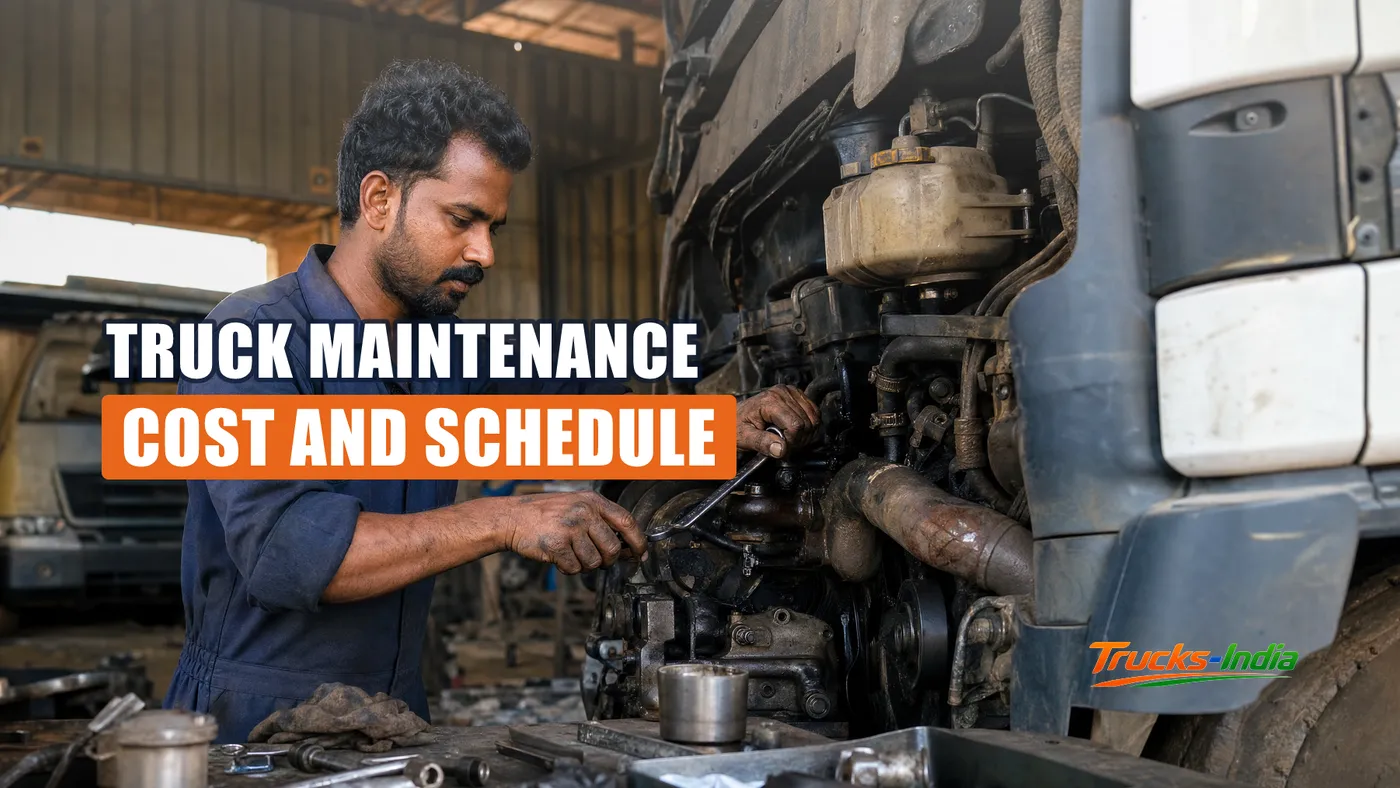
The most expensive part of truck maintenance is not the bill. It is the day the truck spends in a workshop, because a vehicle in a bay earns nothing while the instalment, the insurance and often the driver's wage carry on as normal.
That single fact should shape how you think about this. Preventive servicing is not a cost you are minimising. It is the cheaper of two options, and the other one arrives unannounced on a highway three hundred kilometres from your base.
This guide covers what to service and when, what the wear items actually cost, and the record keeping that tells you a problem is coming.
Think in cost per kilometre, not cost per service
A service bill is a meaningless number on its own. The same invoice on a truck running 8,000 km a month and one running 3,000 km describes two completely different businesses.
Convert everything to cost per kilometre and the picture becomes usable. Total the last twelve months of maintenance spend, divide by the kilometres run in that period, and you have a figure you can compare across vehicles and across years. A rising number means something is wearing out faster than it should.
That number belongs beside your fuel and tyre cost per kilometre in the overall cost sheet, which the transport profit margin guide works through in full.
The service schedule
Intervals vary by manufacturer and by duty cycle, and your own manual overrides anything written here. What follows is the shape of a schedule for a heavy commercial vehicle in Indian conditions.
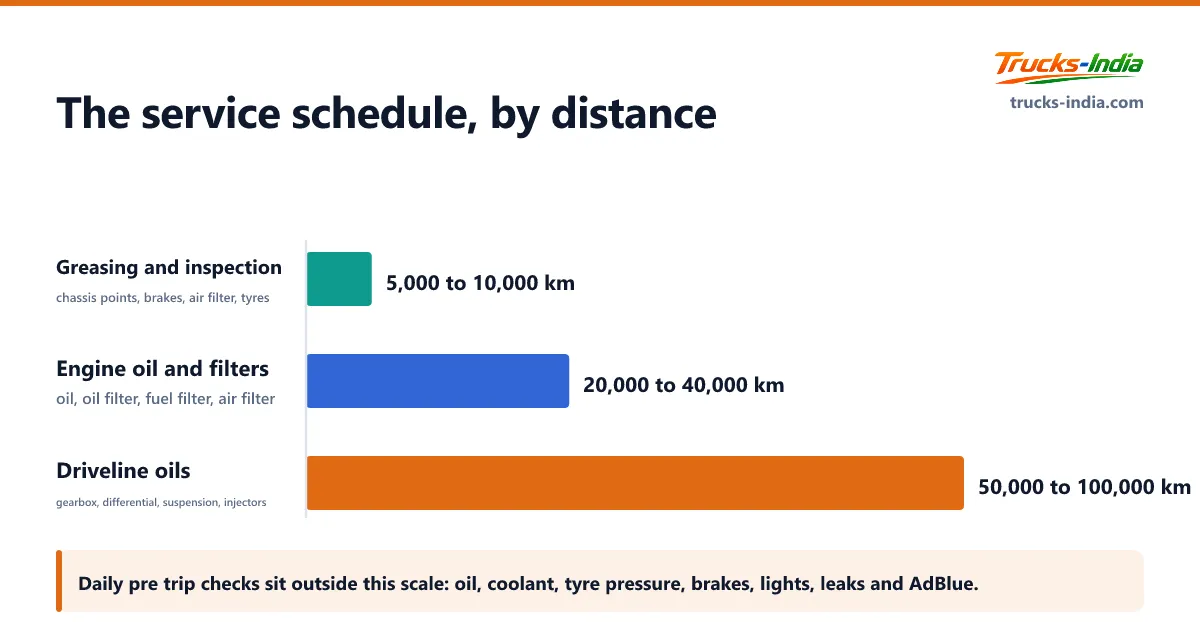
Daily, before the first trip. This is the driver's job and it takes ten minutes.
- Engine oil and coolant level
- Tyre pressure, including the spare
- Brake feel and air pressure build up
- Lights, indicators and horn
- Visible leaks under the vehicle
- AdBlue level on a BS6 vehicle
Every 5,000 to 10,000 km. Greasing of chassis points, visual brake inspection, air filter check and clean, tyre pressure and wear check, battery terminals.
Every 20,000 to 40,000 km. Engine oil and oil filter, fuel filter, air filter replacement, brake adjustment, clutch adjustment. Modern heavy vehicle engines run longer oil intervals than older ones, and the manual is the authority.
Every 50,000 to 100,000 km. Gearbox and differential oil, brake lining assessment, suspension inspection, injector and turbocharger inspection, wheel alignment.
Annually, regardless of distance. Coolant condition, air dryer cartridge, full brake system inspection, and the compliance items that share the calendar: fitness certificate, insurance, permit authorisation and pollution certificate.
What the wear items actually cost
These are the lines that dominate a maintenance budget. Prices vary widely by model, region and whether you buy genuine or aftermarket parts, so treat the lives rather than the rupees as the useful information.
Tyres are the largest single maintenance cost on a heavy vehicle, usually by a wide margin, and choosing them on cost per kilometre rather than sticker price is covered in the truck tyre guide. Life depends enormously on road surface, load discipline and pressure maintenance. Underinflation is the fastest way to destroy a tyre and it is entirely preventable. Retreading a good casing is standard practice and materially cheaper than a new tyre, provided the casing was not run flat or overloaded.
Brake linings wear with terrain and driving style more than with distance. Hill routes eat them.
Clutch plate is a driver dependent item. The same vehicle on the same route can double or halve clutch life depending on who is driving it.
Battery typically lasts two to three years in Indian conditions.
Leaf springs and suspension bushes wear faster on poor roads and on vehicles that run consistently heavy.
Injectors and turbocharger are the expensive end. Both are sensitive to fuel quality and to oil change discipline, which is the argument for servicing on time rather than when convenient.
What BS6 added to the list
A BS6 truck has maintenance items a BS4 truck never had, and city operators feel them most.
- AdBlue consumption of roughly 3 to 6 percent of diesel consumption, and a system that derates the engine when the tank empties
- Diesel particulate filter attention, particularly on short urban runs where the exhaust never gets hot enough to regenerate the filter cleanly
- More sensors, which means more fault codes and more diagnostic time
- Greater sensitivity to fuel and fluid quality, because the aftertreatment hardware is damaged by contaminants that an older engine tolerated
None of this is a reason to avoid a BS6 vehicle, since every new truck is one. It is a reason to budget differently than you did on an older vehicle. The BS6 emission norms guide covers how the systems work.
Records are the cheap part that saves the expensive part
With one truck you notice when something sounds wrong. With four you cannot, and instinct stops scaling.
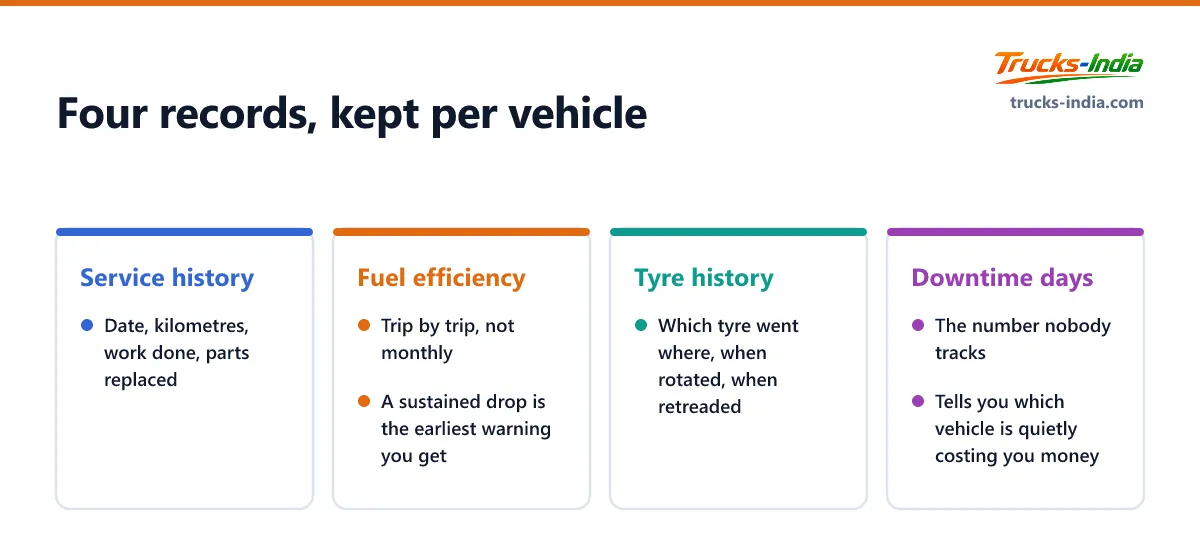
Keep four things per vehicle:
- A service history. Date, kilometres, what was done, what was replaced.
- Fuel efficiency, trip by trip. This is the single best early warning system you have. A sustained drop in mileage is usually either a mechanical problem or a driving problem, and both are cheaper caught early.
- Tyre position history. Which tyre went where, when it was rotated, when it was retreaded.
- Downtime days. The number nobody tracks and the one that tells you which vehicle is quietly costing you money.
A fleet average hides the truck that is losing money. Measuring per vehicle is what reveals it, which is why the fleet guide treats per vehicle measurement as a prerequisite for adding a second truck.
Authorised service, local workshop, or a mix
Authorised service centres have the diagnostic equipment, the genuine parts and the warranty relationship. During the warranty period, servicing elsewhere risks the warranty, and on a BS6 vehicle the diagnostics genuinely matter.
Local workshops are cheaper and often faster, and for mechanical work on an out of warranty vehicle they are the sensible choice in most of the country.
The mix that works for most operators is authorised service while the vehicle is under warranty and for anything involving the emission system or electronics, and a trusted local workshop for routine mechanical work afterwards.
One thing worth checking before you buy rather than after: where the nearest service point for that manufacturer is on your routes. A brand with thin coverage on your corridor costs you in towing and downtime in a way that never appears in the purchase price comparison. What that looks like on the day is in the highway breakdown guide.
Annual maintenance contracts
Manufacturers and dealers sell AMC packages covering scheduled servicing for a fixed fee.
They make sense when you want predictable cash flow, when the vehicle is under warranty anyway, or when you lack the time to manage servicing across several vehicles. They make less sense for an owner driver running a single out of warranty truck near a good workshop, where pay as you go is usually cheaper.
Read what the contract excludes. Most AMCs cover scheduled servicing and consumables, not wear items like tyres, clutch and brake linings, which is where the money actually goes.
Trucks to compare
A few popular trucks on Trucks India, with ex-showroom price and rated payload. Open one for its full price, specifications and mileage.
Browse more: Mini trucks, Light commercial vehicles, Heavy trucks, Tata Motors trucks, Ashok Leyland trucks
Frequently asked questions
It varies too much by vehicle, age and duty cycle for a single figure to help. Convert your own spend to cost per kilometre by totalling twelve months of maintenance and dividing by kilometres run. That number is comparable across vehicles and years, and a rising trend is the signal worth acting on.
Greasing and inspections every 5,000 to 10,000 km, engine oil and filters typically every 20,000 to 40,000 km, and gearbox and differential oil every 50,000 to 100,000 km. Your manufacturer's manual overrides these ranges, and heavy duty cycles shorten every interval.
Tyres, usually by a wide margin on a heavy vehicle. Life depends heavily on pressure discipline, load discipline and road surface. Retreading a sound casing is standard practice and materially cheaper than buying new.
AdBlue at roughly 3 to 6 percent of diesel consumption, attention to the diesel particulate filter especially on short urban runs, more sensors and therefore more diagnostic work, and greater sensitivity to fuel and fluid quality than older engines.
It suits operators who want predictable costs or who run several vehicles and lack time to manage servicing. It suits a single out of warranty truck near a good workshop less well. Check the exclusions, because most contracts leave out tyres, clutch and brake linings.
Watch fuel efficiency trip by trip. A sustained drop is usually the earliest sign of either a mechanical fault or a driving problem, and both cost less to fix early. Track it per vehicle rather than as a fleet average.
Where this fits
Maintenance is one line in the cost sheet. See our guide to transport business profit margin for the whole picture.
Parts availability and service reach differ by manufacturer, and both show up in your downtime. Trucks India lists every model sold in India with payload, mileage and price.
Call +91 93422 00875About the author
Lokesh R
CEO of Trucks India
Lokesh R is the founder of Trucks India, an independent heavy-vehicle marketplace and research platform operated from Chennai, Tamil Nadu, founded in 2025. Under his direction, Only Heavy publishes specifications and prices sourced from manufacturers, authorised dealer price lists and official regulatory schedules, with every model page checked by a named reviewer, prices re-verified monthly and after any GST revision, and no advertiser able to buy a rating, ranking or comparison result.


