
Speed Governor for Commercial Vehicle
Speed governor rules for Indian commercial vehicles: the 80 kmph cap under CMVR Rule 118, the 60 kmph categories, AIS-018, and the penalty for tampering.

Lokesh R
CEO of Trucks India
Created 5 September 2026 · 6 min read

Every transport vehicle manufactured in India since October 2015 leaves the factory with its top speed electronically capped. Not as a manufacturer's preference, as a legal requirement, and the cap is 80 kilometres per hour for most goods vehicles.
Owners still ask how to remove it. The short answer is that tampering carries a fine and can get the vehicle impounded, and it will fail its next fitness test. The longer answer is that on most Indian freight routes the governor costs you far less time than it appears to.
The rule
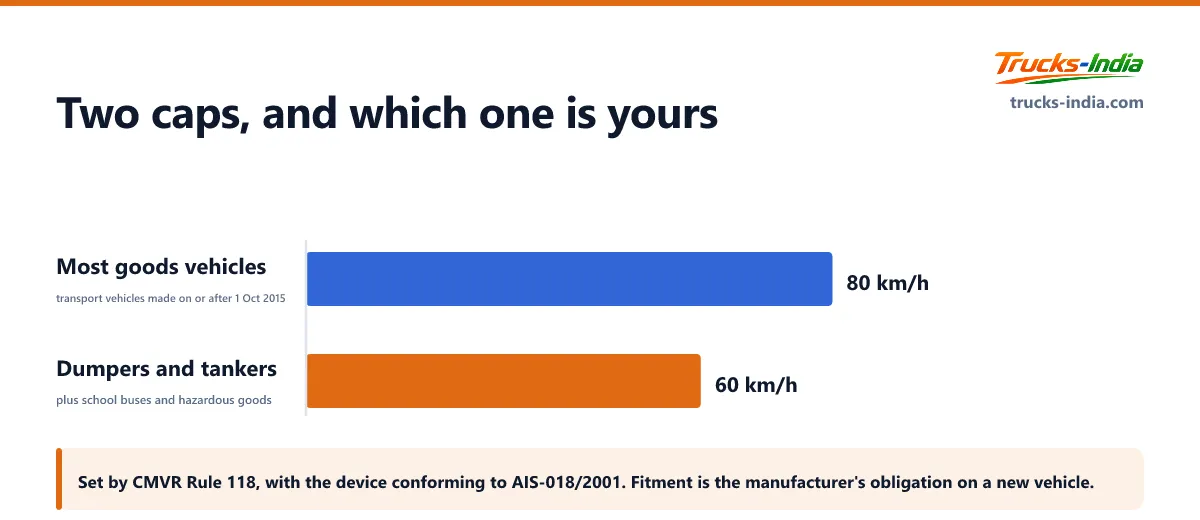
CMVR Rule 118 requires transport vehicles manufactured on or after 1 October 2015 to be fitted with a speed limiting device pre-set to a maximum of 80 kilometres per hour, conforming to the standard AIS-018/2001.
A tighter cap of 60 kilometres per hour applies to certain categories, including dumpers, tankers, school buses and vehicles carrying hazardous goods. If you run any of those, 80 is not your number.
Two things follow that are worth being precise about.
The fitment obligation sits with the manufacturer, at the manufacturing or dealership stage. A new truck arrives with the device already in place and certified; you are not expected to arrange it.
Older vehicles depend on your state. State governments have the power to notify categories of transport vehicle registered before October 2015 that must be retrofitted. So whether a 2013 truck needs one is a question for your state's notification rather than a national yes or no.
Two standards, doing two different jobs
This trips people up when buying a device or a certificate.
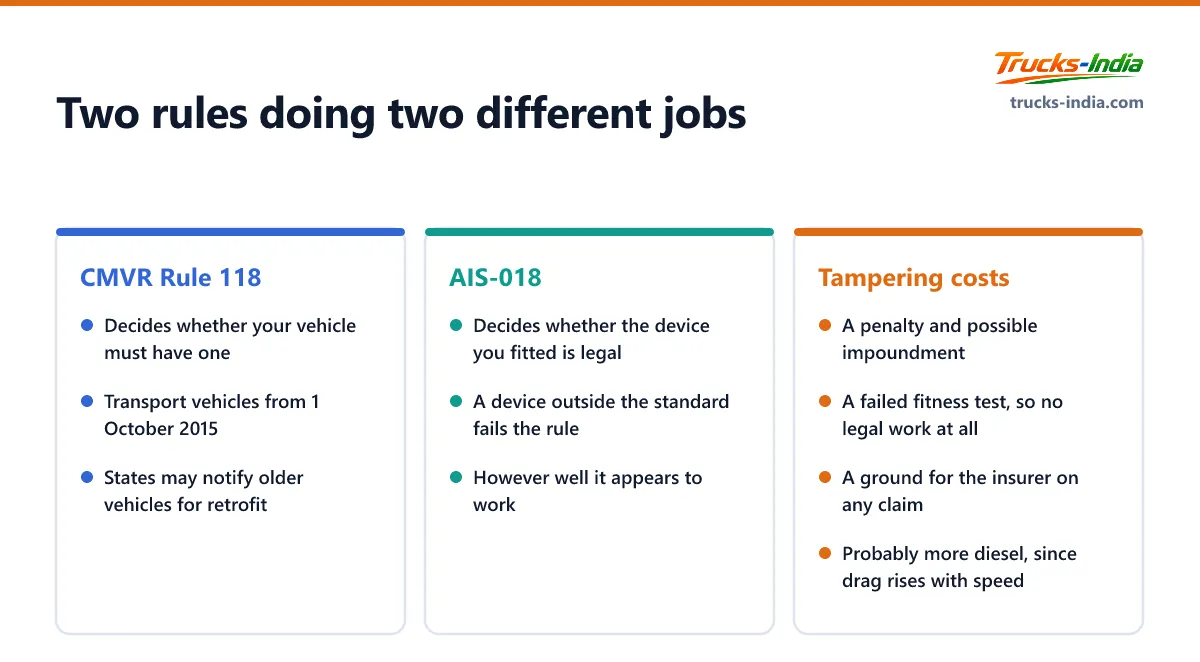
CMVR Rule 118 decides whether your vehicle must have one.
AIS-018 decides whether the device you fitted is legal. It is the technical standard the equipment must conform to, and a device that does not meet it does not satisfy the rule however well it works.
So a cheap unapproved limiter is not compliance. It is an expense that leaves you exactly where you started, with the added problem that a tampered or non conforming installation is visible at a fitness test.
The certificate
A speed governor certificate is issued when an approved device is fitted and sealed by an authorised dealer or fitment centre. It records the device, the vehicle and the preset speed.
You will be asked for it at fitness renewal and it is commonly required for permit issue and renewal. Keep it with the vehicle's papers, not in the office. The documents to carry guide covers the rest of that folder.
Note the requirement here is above 3.5 tonnes for commercial vehicles in general practice, so the smallest commercial vehicles sit outside it. Check your own category rather than assuming, because the exemptions are specific and the enforcement is not.
What it costs
The device itself is a modest cost against a truck, typically in the low thousands of rupees range for an approved unit plus fitment, though it varies by supplier and state and by whether an empanelled vendor is mandated.
On a new vehicle this is already in the price. The cost only arises on a retrofit, where your state has notified one.
Tampering, and why it is a bad trade
There is a market in disabling these devices and it is a poor idea for four separate reasons.
It is an offence. Driving without a required governor or tampering with one attracts a penalty and the vehicle can be impounded.
It fails the fitness test. The device is checked, and a failed fitness test means a vehicle that cannot legally work at all, as the fitness guide sets out.
It weakens an insurance claim. Non compliance with a statutory safety requirement at the time of an incident gives an insurer something to work with, alongside the other standard grounds in the insurance guide.
It probably costs you fuel. Which is the part nobody calculates.
The fuel argument, honestly
Aerodynamic drag rises sharply with speed, and on a large slab sided vehicle that is the dominant resistance at highway speeds. A truck at 90 is working meaningfully harder than the same truck at 80, and the extra diesel is real.
Set that against the time saved. Over a 400 km run, the difference between averaging 80 and averaging 90 is far smaller than the arithmetic suggests, because your actual average is set by traffic, towns, check posts, toll queues, loading delays and the driver's breaks, not by the top speed the engine will reach.
On most Indian freight routes, the governor is not what is making your trip slow. Loading and unloading time, empty return legs and waiting are, and those are addressed in the mileage guide and the margin guide.
If the governor is causing real problems
Occasionally a complaint is genuine rather than a wish to drive faster.
The vehicle cuts power erratically or limits below the set speed. That is a fault, not the design, and an authorised fitment centre should diagnose it. A failing speed sensor or a poor installation are the usual causes.
The seal is broken after a workshop visit. Get it resealed and recertified promptly, because a broken seal reads as tampering whatever actually happened.
You changed tyre size. The device works off wheel speed, so a significant change in rolling radius shifts the real speed at which it intervenes. That is one more reason to fit the size the vehicle was designed for, as the tyre guide covers.
Frequently asked questions
Yes. Under CMVR Rule 118, transport vehicles manufactured on or after 1 October 2015 must be fitted with a speed limiting device conforming to AIS-018/2001. The fitment obligation is on the manufacturer or dealer, and state governments may notify older vehicles for retrofitting.
80 kilometres per hour for most goods vehicles. A tighter 60 kilometres per hour applies to certain categories including dumpers, tankers, school buses and vehicles carrying hazardous goods.
Rule 118 decides whether your vehicle must have a speed limiting device. AIS-018 is the technical standard the device must conform to. A device that does not meet AIS-018 does not satisfy the rule, however well it appears to function.
A fine and possible impoundment of the vehicle. Beyond the penalty, the vehicle will fail its fitness test and an insurer gains a ground to question a claim arising while a statutory safety device was disabled.
The requirement applies to commercial vehicles above 3.5 tonnes in general practice, so the smallest commercial vehicles fall outside it. Check your own vehicle category and your state's notifications rather than assuming, because the exemptions are specific.
The opposite. Aerodynamic drag rises sharply with speed on a large slab sided vehicle, so a capped truck burns less fuel per kilometre. The time cost is also smaller than it looks, because average trip speed is set by traffic, towns, check posts and loading delays rather than by top speed.
Where this fits
The governor is one of the items a fitness test checks. See our guide to the fitness certificate.
Compliance equipment comes fitted on every new truck sold today. Trucks India lists payload, mileage and price for every model in India.
Call +91 93422 00875About the author
Lokesh R
CEO of Trucks India
Lokesh R is the founder of Trucks India, an independent heavy-vehicle marketplace and research platform operated from Chennai, Tamil Nadu, founded in 2025. Under his direction, Only Heavy publishes specifications and prices sourced from manufacturers, authorised dealer price lists and official regulatory schedules, with every model page checked by a named reviewer, prices re-verified monthly and after any GST revision, and no advertiser able to buy a rating, ranking or comparison result.


