
Heavy Vehicle Driving Licence in India
How to get an HMV licence in India: minimum age, the LMV experience rule, mandatory training, the test, fees, and the five year validity that replaced three.

Lokesh R
CEO of Trucks India
Created 12 September 2026 · 8 min read
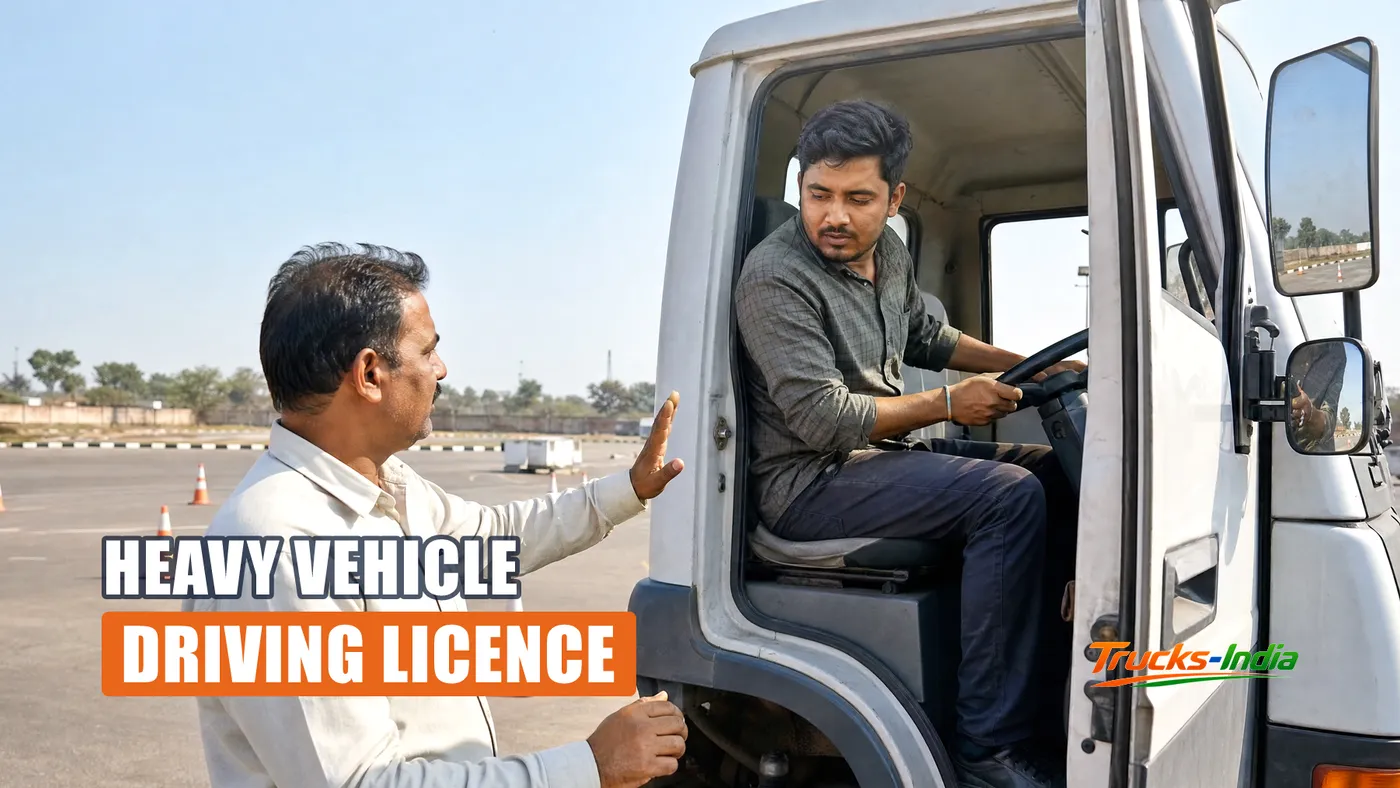
Half the pages on this topic still say a transport vehicle licence lasts three years. That stopped being true with the Motor Vehicles Amendment Act 2019, and the current period is five.
It is a small thing to get wrong and an expensive one, because a lapsed licence makes every trip illegal and hands your insurer a clean reason to reject a claim. So this guide starts with the rules as they stand now, then covers how to actually get the licence and what it costs.
What a heavy licence is
A heavy vehicle licence is the driving licence class that lets you drive a heavy goods or passenger vehicle. Indian RTO paperwork spells it heavy vehicle licence; most people type heavy vehicle license, and a fair number shorten it to heavy licence or heavy motor vehicle license. All of them mean the same document.
It is an upgrade rather than a first licence, it is issued only after training at an approved school, and it is what separates light commercial work from interstate long haul.
Heavy licence age, validity and eligibility at a glance
The three figures people look up most, in one place.
- Heavy licence age: minimum 20 years, under Section 4(2) of the Motor Vehicles Act. No transport category starts earlier.
- Heavy licence validity: five years for a transport vehicle licence, raised from three by the Motor Vehicles Amendment Act 2019. Three years where the vehicle carries dangerous or hazardous goods, raised from one.
- Heavy licence eligibility in India: hold a light motor vehicle licence, in most states for at least a year, complete training at an approved driving school, and pass a Form 1A medical.
Each of those is set out in full below.
Who can apply
Three conditions, and the second one surprises people.
Minimum age is 20. Section 4(2) of the Motor Vehicles Act 1988 bars anyone under twenty from driving a transport vehicle in a public place. This applies to every transport vehicle category without exception, unlike the private licence which starts at 18.
You must already hold a light motor vehicle licence, and in most states you must have held it for at least one year. The heavy licence is an upgrade, not a first licence. If you have no licence at all, the path starts with a learner's licence for a light vehicle and runs through a year of holding it.
You must complete training at an approved driving school. For heavy vehicles this is not a formality you can skip by being a confident driver. A certificate from a government approved or accredited school is part of the application, and courses typically run three to four weeks.
A medical fitness certificate in Form 1A, signed by a registered medical practitioner, is also required, and eyesight is the part that most often disqualifies.
Heavy licence vehicle list: what it lets you drive
The practical question behind most searches is which vehicles the licence actually covers.
A heavy motor vehicle licence covers heavy goods vehicles, meaning trucks and tippers above the medium goods threshold, and with the appropriate category, heavy passenger vehicles. It does not automatically cover an articulated combination, which needs a separate trailer endorsement, and it does not cover hazardous goods, which needs its own endorsement.
Going the other way, a light motor vehicle licence covers neither medium nor heavy goods vehicles, whatever the driver's experience.
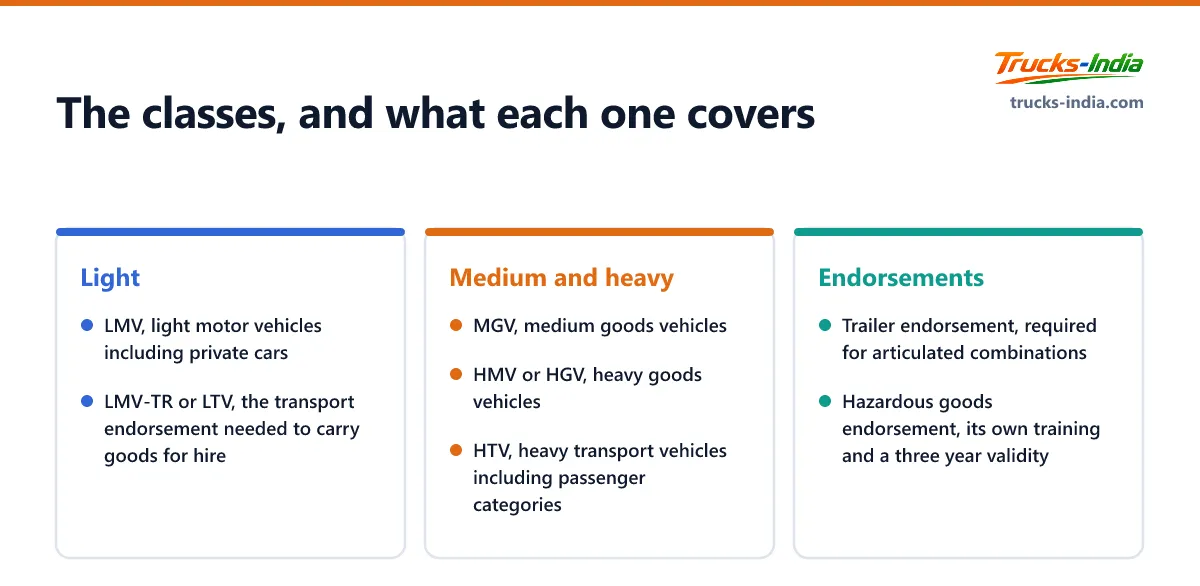
The licence classes, and what each one covers
Getting this wrong is the most common cause of a rejected insurance claim on a commercial vehicle, so it is worth being precise.
- LMV covers light motor vehicles. Private cars and light goods vehicles.
- LMV-TR or LTV is the transport endorsement on a light vehicle, needed to drive a light commercial vehicle for hire or reward.
- MGV covers medium goods vehicles.
- HMV or HGV covers heavy goods vehicles.
- HTV covers heavy transport vehicles including passenger categories.
- A trailer endorsement is separate and is required for articulated combinations.
- A hazardous goods endorsement is separate again, and requires its own training.
The rule that matters in practice: a licence for a lighter class does not cover a heavier vehicle, and no amount of experience substitutes. Employers must check the category against the vehicle, and owners who drive their own truck must check it against their own licence.
How long the licence lasts
This is the part most pages get wrong.
- A licence to drive a transport vehicle is valid for five years. The Motor Vehicles Amendment Act 2019 raised this from the previous three.
- A licence to drive a transport vehicle carrying goods of a dangerous or hazardous nature is valid for three years, raised from the previous one year, and its renewal is subject to conditions set by the central government.
Renewal within the validity period is routine. If you let it lapse, a renewal applied for within a year of expiry is generally processed without a fresh driving test. Beyond that the position hardens and you may have to test again, so a long lapse is worth avoiding.
The application process
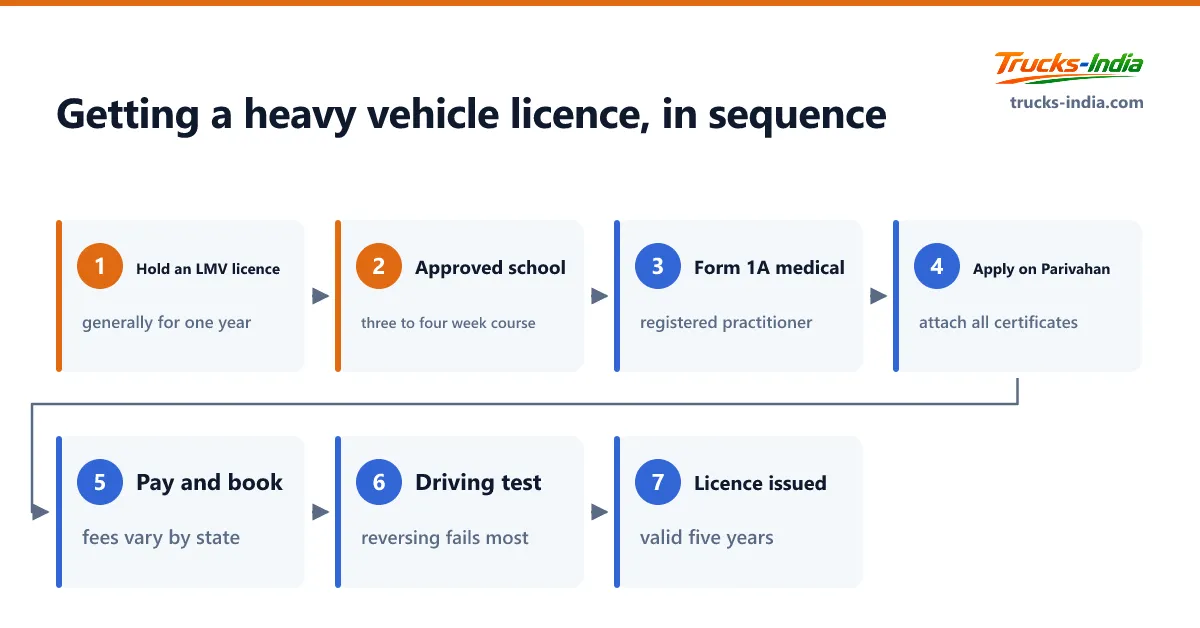
The sequence is the same across states, with the portal work done on Parivahan Sewa.
- Hold a light motor vehicle licence for the required period, generally one year.
- Enrol at an approved driving school for the heavy vehicle course and complete it.
- Obtain the Form 1A medical certificate from a registered medical practitioner.
- Apply online through Parivahan Sewa, attaching the school certificate, the medical certificate, proof of age and address, and your existing licence.
- Pay the fees and book the test slot.
- Take the driving test at the RTO on a heavy vehicle, which includes a reversing and manoeuvring component that is where most candidates fail.
- Collect the licence, usually issued within a few weeks of passing.
The documents required are ordinary: proof of age, proof of address, passport photographs, the existing licence, the medical certificate and the training school certificate.
What it costs
RTO fees for a heavy vehicle licence are modest, generally in the low hundreds to low thousands of rupees depending on the state and on whether you are adding an endorsement or issuing fresh. Renewal fees are typically in the range of a few hundred rupees.
The real cost is the training course, which is charged by the school rather than the RTO and varies widely by city and by how much wheel time the course includes. Ask specifically how many hours behind the wheel of a heavy vehicle the fee buys, because that is the difference between passing and failing the manoeuvring test.
Fees change by state and by year. Confirm the current figures on your state's transport portal before applying rather than working from any article, this one included.
For owners hiring drivers
Two checks at hiring, and one at renewal.
At hiring, confirm the licence class covers the vehicle and that the transport endorsement is present. A photograph of the licence in your records is worth having, because a claim assessor will ask for it.
At renewal time, confirm the licence has actually been renewed rather than assuming. Drivers move between operators and a licence that was valid when you hired may not be valid now.
This connects directly to your insurance. A claim arising from a trip driven on the wrong licence class is the most frequently rejected type of commercial vehicle claim, which the commercial vehicle insurance guide covers in more detail.
For drivers: what the endorsement is worth
The heavy vehicle licence is the largest single step in the pay ladder for a driver in India. It moves you from light commercial work into interstate long haul, and the driver salary guide sets out what that shift is worth in monthly terms.
The hazardous goods endorsement is the next step after it, and pays a clear premium over general freight.
Frequently asked questions
Twenty years. Section 4(2) of the Motor Vehicles Act 1988 bars anyone under twenty from driving a transport vehicle in a public place. The private light vehicle licence starts at 18, but no transport category does.
Five years for a transport vehicle licence, raised from three by the Motor Vehicles Amendment Act 2019. A licence for carrying dangerous or hazardous goods is valid for three years, raised from one. Pages still quoting three years and one year are out of date.
Yes. The heavy licence is an upgrade, and most states require you to have held a light motor vehicle licence for at least a year before applying. There is no route that starts directly at the heavy category.
Yes. A certificate from a government approved or accredited driving school is part of the application for a heavy vehicle licence, and courses typically run three to four weeks. This is not a requirement you can skip on the strength of experience.
The driving licence class that permits you to drive a heavy goods or passenger vehicle. Indian RTO paperwork spells it licence and many people search license; they are the same document. It is an upgrade on a light motor vehicle licence, requires training at an approved school, and has a minimum age of 20.
It is the largest single step in a driver's pay ladder, moving you from light commercial work into interstate long haul, which pays materially more. It also opens tanker, hazardous goods and over dimensional work once the further endorsements are added, and those pay more again.
Proof of age and address, your existing light motor vehicle licence, a Form 1A medical certificate from a registered medical practitioner, the driving school certificate, passport photographs and the application fee. The application is filed on Parivahan Sewa.
The trip is illegal, and if an incident occurs the insurer has grounds to reject the claim. A light commercial vehicle licence does not cover a heavy vehicle regardless of how much experience the driver has. This is the most common single reason commercial vehicle claims fail.
Where this fits
The licence is a prerequisite before a truck can earn. See our guide to starting a transport business.
Match the licence class to the vehicle before you buy either. Trucks India lists the gross weight, payload and price of every model sold in India.
Call +91 93422 00875About the author
Lokesh R
CEO of Trucks India
Lokesh R is the founder of Trucks India, an independent heavy-vehicle marketplace and research platform operated from Chennai, Tamil Nadu, founded in 2025. Under his direction, Only Heavy publishes specifications and prices sourced from manufacturers, authorised dealer price lists and official regulatory schedules, with every model page checked by a named reviewer, prices re-verified monthly and after any GST revision, and no advertiser able to buy a rating, ranking or comparison result.


