
Load Securing Rules for Trucks
How to secure a load on an Indian truck: what the law says about projection and dangerous loading, lashing equipment, and the checks that stop a load shifting.

Lokesh R
CEO of Trucks India
Created 14 September 2026 · 6 min read

A load that shifts does not need to fall off to cost you. It damages the consignment, it damages the body, and on a braking event it changes how the vehicle behaves at exactly the moment you need it to behave predictably.
Indian enforcement concentrates on two things you can see from outside the vehicle: whether the load is projecting beyond what is permitted, and whether anything is likely to fall onto the road. Both are offences, and both are avoidable with equipment that costs very little against a truck.
What the law actually catches
Indian rules on this are less prescriptive than the European lashing standards you may have read about. Enforcement in practice turns on three things.
Dangerous loading. Carrying a load in a manner likely to cause danger to any person is an offence in its own right. This is the catch all, and it covers an insecure load whether or not anything has actually fallen off yet.
Projection beyond permitted limits. A load extending beyond the body, particularly to the rear or the sides, is restricted. The vehicle's own dimensions are capped under CMVR Rule 93, and a load cannot be used to exceed them at will. Where a genuinely indivisible load requires it, there is a relaxation permitting limited lateral projection, but that is a defined allowance for indivisible items and not a general licence to hang cargo over the sides. The full dimension position is in the truck dimension limits guide.
Weight. Securing does not help you if the load is over the limit in the first place, and the penalties there are steeper, as the overloading rules set out.
If you carry genuinely oversized or over dimensional cargo, that is a separate regime with its own permissions and escorts, and it is a question for your RTO with the dimensions in front of them rather than something to judge at the loading point.
The physics, which is the real rule
Whatever the regulation says, the load has to survive four forces.
Braking, which throws the load forward. This is the big one, and it is why the headboard and forward restraint matter most.
Acceleration, pushing it back.
Cornering, pushing it sideways.
Road surface, bouncing it vertically. Vertical movement is what loosens straps, which is why a load that was tight at the depot is slack ninety minutes later.
A useful working assumption: under emergency braking, a load can act as though it weighs a substantial fraction of its mass pushing forward. Friction alone does not hold it. That is the whole argument for restraint rather than trusting the load to sit still because it is heavy.
The four ways to restrain a load
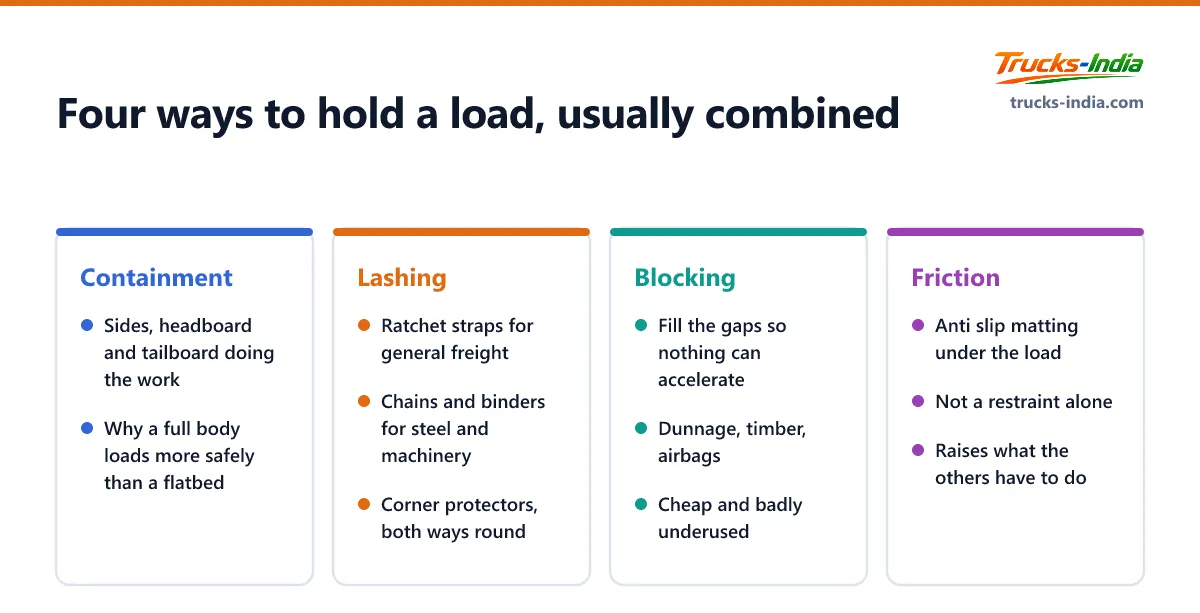
Containment. Sides, a headboard and a tailboard doing the work. The simplest method and the reason a full body is easier to load safely than a flatbed.
Lashing. Straps or chains over the load, tensioned down. Ratchet straps for general freight, chains and load binders for steel, machinery and anything with sharp edges that will cut a webbing strap.
Blocking and bracing. Filling the gaps so the load cannot move into empty space. Dunnage, timber, airbags. Cheap and underused.
Friction. Anti slip mats under the load. Not a restraint on their own, but they raise how much the other methods have to do.
Most real loads use two or three together. A single strap thrown over a pallet is decoration.
Equipment worth having on the vehicle
- Ratchet straps with a stated lashing capacity, enough of them, not the four that came with the truck
- Corner protectors, which stop straps being cut on edges and stop edges being crushed by straps
- Chains and binders if you carry steel or machinery
- Anti slip matting
- A serviceable tarpaulin and ropes for open bodies
- Dunnage, which can be timber offcuts and costs nothing
Straps wear out. A frayed or cut strap has lost most of its rating and looks fine from three metres away. Inspect them and throw away the bad ones rather than keeping them for light loads.
Loading habits that prevent the problem
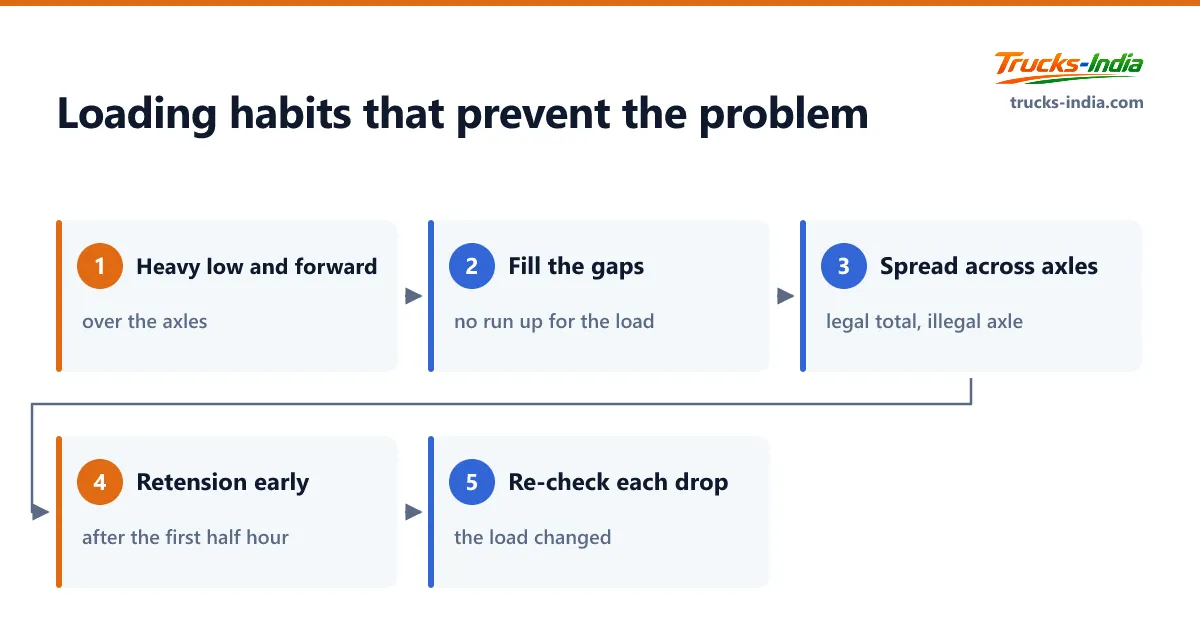
Heavy low and forward, over the axles. This keeps the centre of gravity down and the weight distribution legal. A high load is unstable and a rear biased load lightens the steering axle, which is dangerous in a way the driver feels immediately.
Fill the gaps. Empty space is where the load accelerates before it hits something.
Distribute across the axles, not into a pile in the middle. You can be within total gross weight and still be over on a single axle.
Retension after the first stretch of road. This is the single most valuable habit in the list. Vibration settles a load and slackens straps within the first half hour. Pull over, check, retighten.
Check again after every drop on a multi drop run, because removing part of a load changes everything for the rest of it.
Who carries the risk
Worth being clear, because it is often assumed to be the consignor's problem.
The person in charge of the vehicle is the one stopped, and the vehicle is the one detained. Where a shipper loaded and sealed the vehicle, the practical exposure is still substantially yours on the road.
Two protections. Say so in the contract: who loads, who secures, and who is responsible if it shifts. The contracts guide covers writing that down. And photograph the load before departure, which takes ten seconds and settles most later arguments about whether it was secured when it left.
An insurer will also look at securing after a load shift incident. Damage caused by improperly secured cargo is exactly the kind of thing that turns a claim into a dispute, alongside the other grounds in the commercial vehicle insurance guide.
Frequently asked questions
Indian rules are less prescriptive than European lashing standards. Enforcement turns on carrying a load in a manner likely to cause danger, on projection beyond permitted dimensions, and on weight limits. The practical standard is that the load must not move and must not extend beyond what the vehicle is permitted.
Vehicle dimensions are capped under CMVR Rule 93 and a load cannot be used to exceed them at will. A limited lateral projection is permitted for genuinely indivisible loads, which is a defined allowance rather than a general permission. Genuinely over dimensional cargo needs specific permissions from the RTO.
Ratchet straps with a stated lashing capacity, corner protectors, chains and binders for steel or machinery, anti slip matting, a serviceable tarpaulin and ropes for open bodies, and dunnage for filling gaps. Most real loads need two or three restraint methods together.
Vibration and vertical movement settle the load, which slackens the straps, usually within the first half hour of running. Stopping to retension after the first stretch of road is the single most valuable habit in load securing.
Heavy items low and forward, over the axles, with gaps filled so nothing can accelerate into empty space, and weight distributed across axles rather than piled centrally. A rear biased load lightens the steering axle, which the driver will feel straight away.
The person in charge of the vehicle is the one stopped and the vehicle is the one detained, so the practical exposure on the road is substantially the transporter's even where the shipper loaded and sealed. Put the split in the contract and photograph the load before departure.
Where this fits
Securing sits alongside weight. See our guide to axle load limits and overloading rules.
The body and payload you choose decide how easy the load is to secure. Trucks India lists both for every model in India.
Call +91 93422 00875About the author
Lokesh R
CEO of Trucks India
Lokesh R is the founder of Trucks India, an independent heavy-vehicle marketplace and research platform operated from Chennai, Tamil Nadu, founded in 2025. Under his direction, Only Heavy publishes specifications and prices sourced from manufacturers, authorised dealer price lists and official regulatory schedules, with every model page checked by a named reviewer, prices re-verified monthly and after any GST revision, and no advertiser able to buy a rating, ranking or comparison result.


