
Transport Business Profit Margin: How to Calculate Yours
The cost structure behind a transport business profit margin, how to work out your cost per kilometre, and why margin per trip and per month differ so much.

Lokesh R
CEO of Trucks India
Created 13 August 2026 · 6 min read
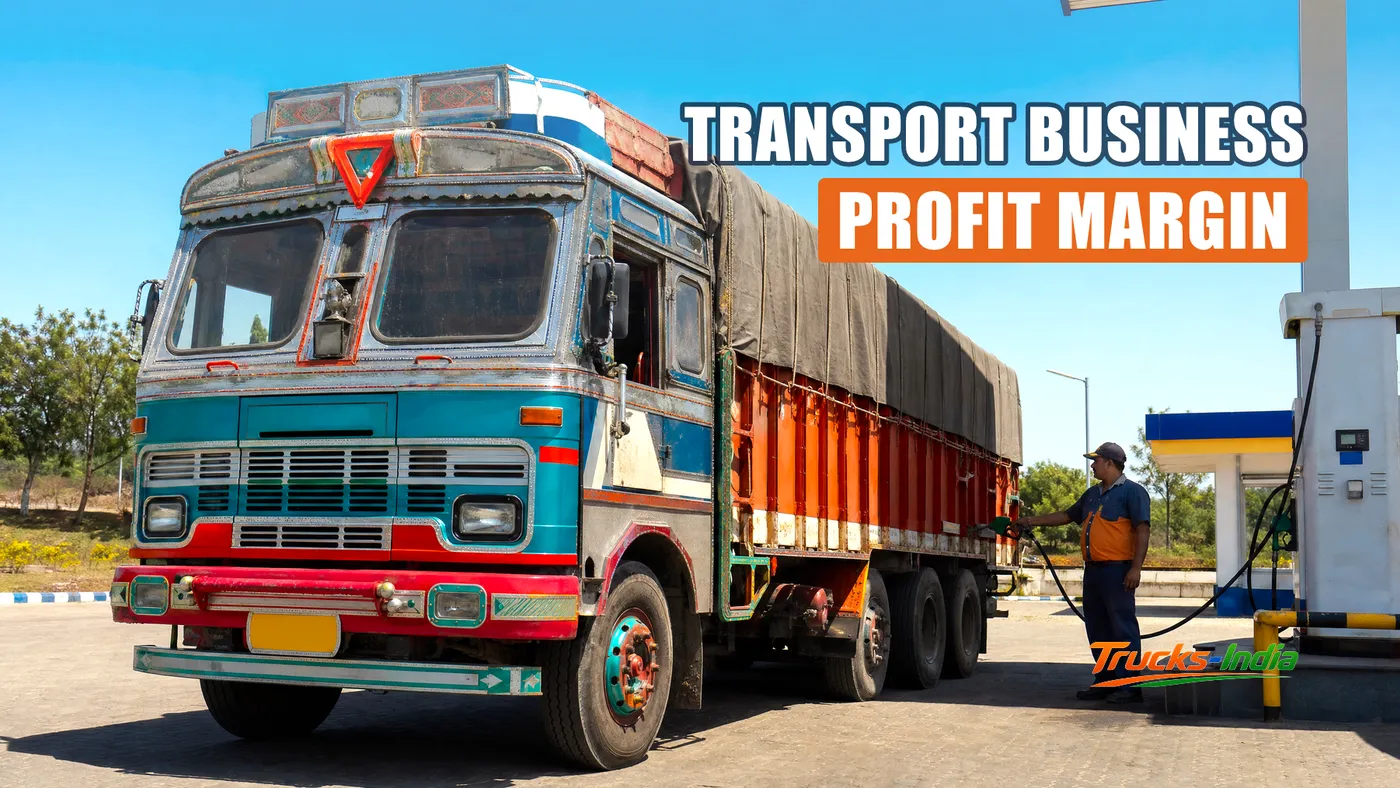
Most operators can tell you their rate per trip. Far fewer can tell you their margin, and that gap is where money quietly disappears. A rate that looks healthy on a phone call can be a loss once diesel, the driver, tolls, tyres and the EMI have taken their share.
Margin in freight is not a number you look up. It is a number you calculate, from your own route, your own vehicle and your own cost lines. What an article can usefully give you is the method and the cost structure, so you can run it against your own figures rather than someone else's.
That is what this is.
How to calculate transport business profit margin
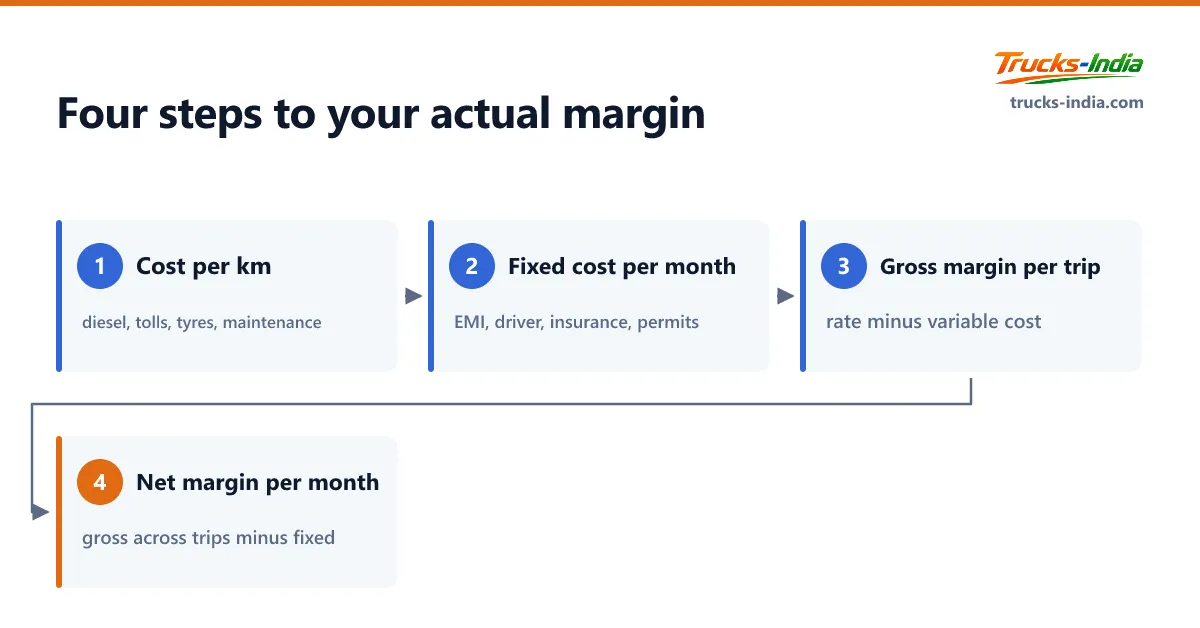
Work it in this order. Each step needs the one before it.
- Cost per kilometre, from your variable costs
- Fixed cost per month, everything that arrives whether you move or not
- Gross margin per trip, rate minus variable cost for that trip
- Net margin per month, gross margin across all trips minus fixed costs
The mistake almost everyone makes is stopping at step three. A trip that shows a healthy gross margin can still leave you with nothing at the end of the month if you did not run enough of them to cover the fixed costs.
Step one, your variable costs
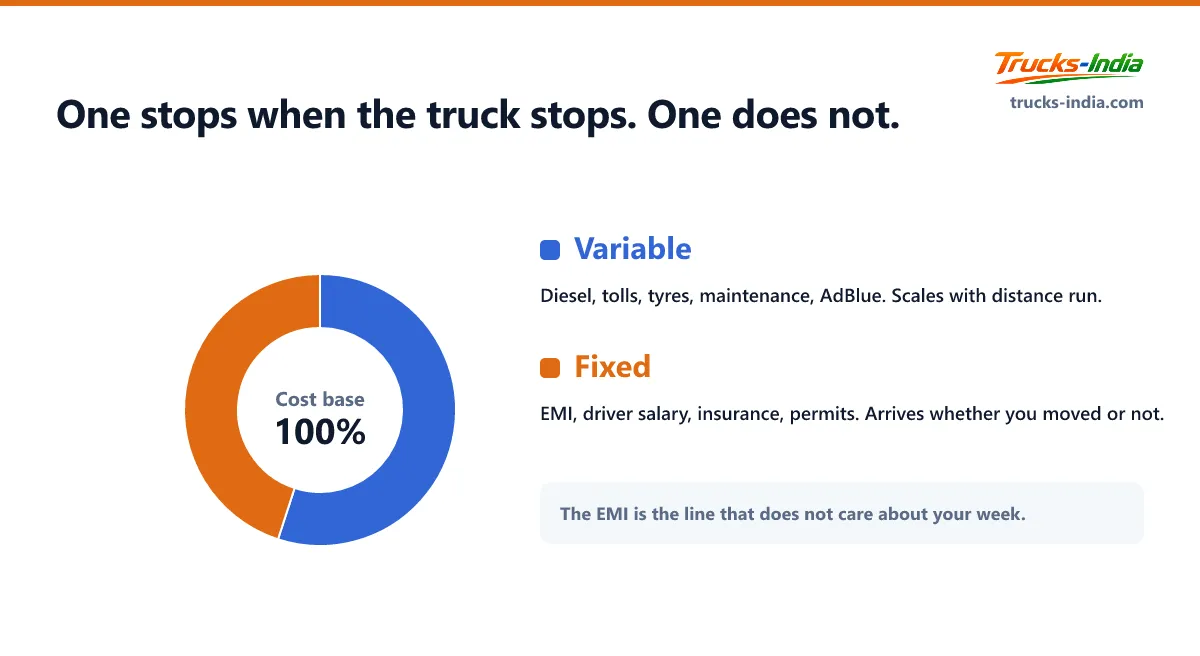
These scale with distance. They are the ones to convert into a per kilometre figure.
- Diesel. Loaded kilometres divided by real mileage, multiplied by today's rate. Start from today's fuel prices and the mileage figure on your model's page rather than the brochure number.
- Tolls. Route specific and easy to underestimate on national corridors.
- Tyres. Cost of a set divided by realistic tyre life in kilometres.
- Maintenance. Annual servicing and repair budget divided by annual kilometres.
- AdBlue, on BS6 vehicles.
- Driver allowances on the road, where you pay them per trip rather than only as salary.
Add those and divide by kilometres, and you have a cost per kilometre. This single number is the most useful thing a small operator can know, and most do not.
Step two, your fixed costs
These arrive monthly regardless of whether the truck moved.
- The EMI. The largest and least forgiving.
- Driver salary, where it is a monthly wage rather than trip based.
- Insurance, annual premium divided by twelve.
- Permit and fitness, annual costs divided by twelve. For a national permit the consolidated authorisation is 16,500 rupees a year under Rule 87(2) plus a Form 46 authorisation of around 1,000 rupees, with state charges varying.
- Parking, office and accounting, if you carry them.
Step three, gross margin per trip
For a specific trip: take the rate agreed, subtract diesel for the full distance run, tolls, and the per kilometre share of tyres and maintenance.
Two things decide whether this number is honest.
Count the return leg. If you run 400 km loaded and 400 km empty, your diesel cost for that job is 800 km of fuel, not 400. An operator who costs only the loaded leg will consistently believe they are more profitable than they are.
Count loading and waiting. Days spent waiting to load are days the truck is not earning, and they belong in the utilisation figure even though they do not show up as a cost line.
Step four, net margin per month
Add up gross margin across every trip in the month. Subtract the full fixed cost. What remains is your actual profit.
Express it as a percentage of revenue and you have your net margin. Whether that number is good depends entirely on your segment, your route and your vehicle, which is why quoting an industry average would mislead more than it helps. What matters is that you know yours, and that you know which direction it is moving.
The three things that move margin most
Utilisation. More loaded trips against the same fixed cost. This is the lever with the largest effect and the one most within your control. Owners who cannot hold it up on their own often take attachment with a logistics company instead, trading rate for a fuller month.
The return leg. Filling it converts the same fuel and the same wage into roughly twice the revenue. Posting the vehicle on the truck load booking apps that cover your corridor is the cheapest way to try.
Mileage. Diesel is usually the biggest variable cost, so the difference between two models at the same price can be worth more than the price difference itself. A vehicle 2 lakh cheaper but two kilometres per litre thirstier will cost far more over five years than it saved at purchase. Compare the Pro 2059 XP Plus mileage against the Signa 5530S specifications and the segment difference is immediately visible.
Where GST sits in the calculation
A goods transport agency chooses between 5 percent without input tax credit and 18 percent with it. That choice changes your effective costs, because input credit on diesel, tyres and maintenance is only available under the second option.
The older 12 percent forward charge slab was rationalised into 18 percent with effect from 22 September 2025, so treat any advice offering 12 percent as out of date. Which option leaves you better off depends on how much input credit you can genuinely claim, and it is exercised at the start of the financial year. That is a conversation for a chartered accountant with your actual numbers in front of them.
A margin checklist
- Do you know your cost per kilometre to within a rupee?
- Are you costing the empty return leg?
- Is the EMI in your monthly cost, not just your annual thinking?
- Are tyres and maintenance amortised per kilometre rather than treated as surprises?
- Do you know how many days last month the truck did not move, and why?
Margin sits between two other numbers worth knowing: what the truck earns per month at the top, and what actually reaches you as owner income at the bottom.
Toll is the line most often estimated rather than calculated, and on a long haul national highway run it is one of the three largest costs of the trip. The toll charges guide covers how to get the real figure for a route and how to quote it.
Trucks to compare
A few trucks for a transport business on Trucks India, with ex-showroom price and rated payload. Open one for its full price, specifications and mileage.
Browse more: Mini trucks, Light commercial vehicles, Heavy trucks, Tata Motors trucks, EKA trucks, Eicher trucks
Frequently asked questions
It varies too much by segment, route and vehicle for a single figure to be meaningful. The useful benchmark is your own trend: whether your net margin per month is improving as utilisation rises. Operators who fill the return leg and keep vehicles serviced consistently outperform those who do not.
Add diesel, tolls, tyres, maintenance and AdBlue for a period, then divide by the kilometres run in that period. Use real mileage from the model page and current fuel prices rather than brochure figures.
Yes. If the truck runs 400 km loaded and returns empty, the fuel cost of that job is 800 km. Costing only the loaded leg is the most common reason operators overestimate their margin.
Yes, as a fixed monthly cost. It is the most dangerous line in the business precisely because it arrives whether or not the truck earned anything that month.
It depends on how much input tax credit you can actually claim on fuel, tyres and maintenance. The choice is between 5 percent without credit and 18 percent with it, exercised at the start of the financial year. Take your real numbers to a chartered accountant before deciding.
Where this fits
Margin follows the truck you choose. See our guide to starting a transport business for the whole sequence.
Margin starts with mileage and payload. Trucks India lists both for every model sold in India, alongside on road price.
Call +91 93422 00875About the author
Lokesh R
CEO of Trucks India
Lokesh R is the founder of Trucks India, an independent heavy-vehicle marketplace and research platform operated from Chennai, Tamil Nadu, founded in 2025. Under his direction, Only Heavy publishes specifications and prices sourced from manufacturers, authorised dealer price lists and official regulatory schedules, with every model page checked by a named reviewer, prices re-verified monthly and after any GST revision, and no advertiser able to buy a rating, ranking or comparison result.


