
CNG Truck Running Cost in India
What a CNG truck costs to run in India, how to work out payback against the purchase premium, the payload the cylinders cost you, and when CNG is wrong.

Lokesh R
CEO of Trucks India
Created 20 September 2026 · 7 min read
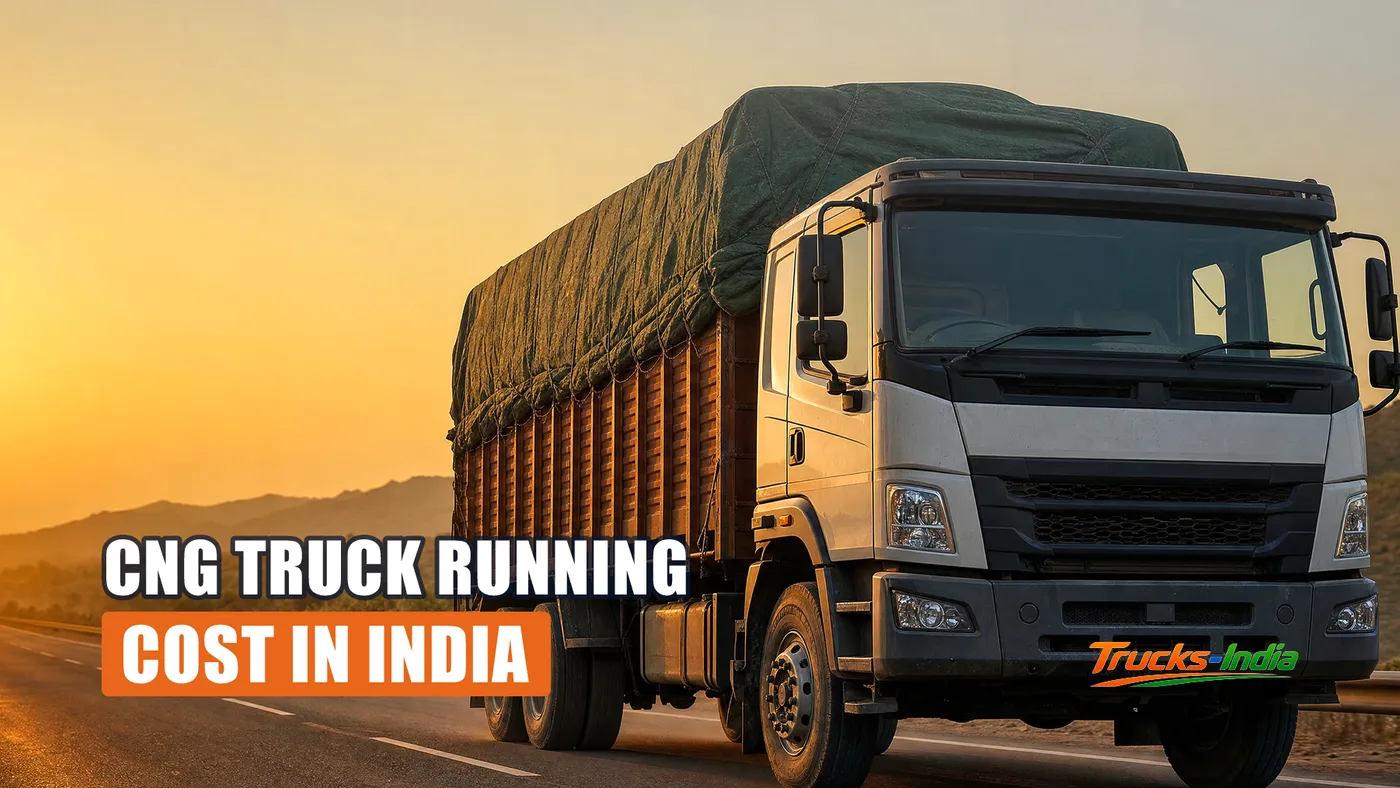
The CNG argument is always made the same way: the fuel is cheaper per unit, so the truck is cheaper to run. That is true and it is not the whole calculation.
A CNG vehicle costs more to buy, carries less because the cylinders are heavy, and only saves you money if you actually run the kilometres. Get those three into the same sum and the answer stops being a slogan and becomes a number you can check.
This guide gives you the method, the figures you need to plug into it, and the situations where CNG is the wrong answer.
The only formula that matters
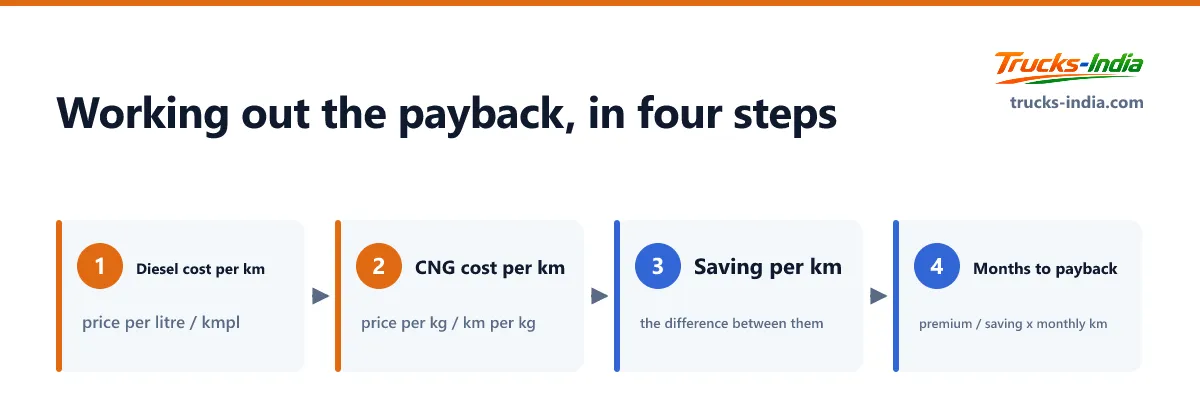
Fuel cost per kilometre is the fuel price divided by the mileage. Everything else is detail.
The trap is the units. Diesel is sold per litre and CNG per kilogram, and a kilogram of CNG carries more energy than a litre of diesel does. So a CNG vehicle's figure in km per kg is not directly comparable to a diesel figure in kilometres per litre, and comparing the two numbers without dividing by their prices tells you nothing at all.
Do the division. Then you have two numbers in rupees per kilometre, which are comparable.
The prices to plug in
Diesel varies enormously by state because state taxes differ. Across the 36 states and union territories it currently runs from about Rs 82 to Rs 104 a litre, with the middle of the range near Rs 96. That spread is wider than most people assume, and it means a calculation done for Delhi does not hold in Andhra Pradesh. Take your own state's figure from today's fuel prices rather than a national average.
CNG is priced per kilogram and also varies by city, set by the gas distribution company holding the licence for that area rather than by a national rate. There is no single national CNG price, and the gap against diesel has narrowed in recent years, so an article from three years ago overstates the saving.
Get both numbers for your own city on the day you are deciding. This is the one calculation where a stale input produces a confidently wrong answer.
What CNG vehicles actually return
In the small commercial vehicle segment where CNG is most widely offered, a CNG variant typically returns somewhere around 20 to 22 kilometres per kilogram, against a diesel equivalent in the high teens to low twenties in kilometres per litre.
Two honest cautions about those figures. Manufacturer numbers are obtained under test conditions and real world results run below them, more so on a loaded vehicle in city traffic. And CNG mileage falls off faster than diesel under heavy load, because the engine is working harder against a fuel with a different combustion character.
Use your own observed figures once you have a month of running. Until then, discount the brochure.
The purchase premium, and the payback
A CNG variant costs more than the diesel version of the same model. That premium is the investment you are recovering.
Run it honestly and two things become obvious.
Kilometres decide everything. A vehicle running 4,000 km a month recovers a premium in roughly half the time of one running 2,000. If your utilisation is low or irregular, the fuel saving never catches the premium and the diesel variant is simply the cheaper vehicle.
A small saving per kilometre is not nothing at scale. Even a modest gap becomes a real annual figure across high mileage, which is why CNG is common in intra city distribution fleets and rare among owners doing occasional work.
If the payback lands beyond the period you intend to keep the vehicle, the calculation has answered you.
The payload you give up
This is the cost nobody puts in the comparison, and on a light commercial vehicle it is material.
CNG cylinders are heavy. They are steel pressure vessels, and they sit on the vehicle permanently. Gross vehicle weight does not increase to accommodate them, so their weight comes directly out of your payload, on every trip, for the life of the truck.
On a small vehicle where payload is already tight, losing that capacity can mean an extra trip, and an extra trip costs more than the fuel saved on the trips you did make. Check the unladen weight of the CNG variant against the diesel one on the registration certificate, not the brochure, and work out what the difference is worth on your typical load.
Range, refuelling and the station map
Three practical constraints that decide the matter as often as the arithmetic does.
Range between fills is shorter on CNG than on a full diesel tank. For a vehicle that returns to the same depot every night this is irrelevant. For long haul it is a route planning problem.
Refuelling takes longer and the queues at CNG stations are frequently long, particularly at peak hours in the larger cities. Driver time waiting in a queue is a real cost that never appears in a fuel comparison.
The station network is uneven. It is dense in and around the major metros and along some corridors, and thin elsewhere. A CNG truck on a route without stations is a truck that cannot work.
Bi-fuel variants, which run CNG with a petrol reserve, exist partly to soften this. They are a hedge rather than a solution, because the reserve is small and petrol is expensive.
When CNG is the right answer, and when it is not
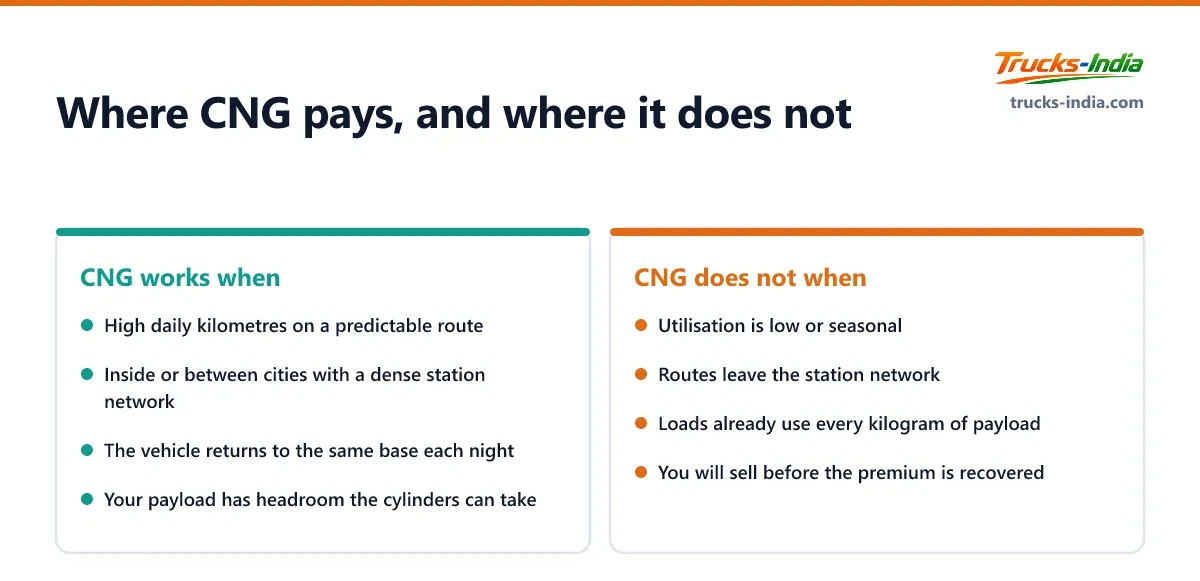
CNG works when you run high daily kilometres on a predictable route, inside or between cities with a dense station network, on a vehicle that returns to the same base, and where your payload has headroom to spare.
CNG does not work when utilisation is low or seasonal, when your routes leave the station network, when your loads already use all the payload the vehicle has, or when you intend to sell the vehicle before the premium is recovered.
If you are weighing the third option as well, the electric truck running cost guide runs the same arithmetic against a battery vehicle and the PM E-DRIVE subsidy.
Neither answer is universal. Run the payback on your own kilometres, your own city's two fuel prices, and the actual weight of the cylinders, and the vehicle will tell you which it is. The margin guide covers where fuel sits against your other costs, and the maintenance guide covers the rest of the running cost sheet.
Trucks to compare
A few CNG trucks on Trucks India, with ex-showroom price and rated payload. Open one for its full price, specifications and mileage.
Browse more: CNG trucks, Eicher trucks, Mahindra trucks, SML ISUZU trucks, Tata Motors trucks
Frequently asked questions
Divide the CNG price per kilogram by the vehicle's kilometres per kilogram to get rupees per kilometre. Do the same for diesel using price per litre and kilometres per litre. Only compare the two rupees per kilometre figures, never the mileage numbers directly, because the fuels are sold in different units.
Usually yes per kilometre, but the purchase premium and the lost payload have to be recovered before it is cheaper overall. The deciding variable is how many kilometres you actually run each month. At low utilisation the diesel variant is the cheaper vehicle.
In the small commercial vehicle segment, typically around 20 to 22 kilometres per kilogram on manufacturer figures, with real world results below that and falling further under heavy load. Use your own observed mileage after a month rather than the brochure.
Yes. They are steel pressure vessels carried permanently, and gross vehicle weight does not rise to accommodate them, so their weight comes out of your carrying capacity on every trip. Compare the unladen weight of the CNG and diesel variants on the registration certificate.
Generally not, because range between fills is shorter, refuelling is slower and often queued, and the station network thins out away from the metros and main corridors. CNG suits intra city and regional work on predictable routes with a depot to return to.
Divide the purchase premium over the diesel variant by your monthly saving, which is the saving per kilometre multiplied by monthly kilometres. If the answer runs past how long you intend to keep the vehicle, buy the diesel one.
Where this fits
Fuel is the largest running cost in the sheet. See our guide to transport business profit margin.
The payback depends on the price gap between the CNG and diesel variant of the same model. Trucks India lists both for every model sold in India.
Call +91 93422 00875About the author
Lokesh R
CEO of Trucks India
Lokesh R is the founder of Trucks India, an independent heavy-vehicle marketplace and research platform operated from Chennai, Tamil Nadu, founded in 2025. Under his direction, Only Heavy publishes specifications and prices sourced from manufacturers, authorised dealer price lists and official regulatory schedules, with every model page checked by a named reviewer, prices re-verified monthly and after any GST revision, and no advertiser able to buy a rating, ranking or comparison result.


