
Electric Truck Running Cost in India
What an electric truck costs to run in India, the PM E-DRIVE subsidy of up to Rs 9.6 lakh, the 5 percent GST, and the daily kilometres that decide the payback.

Lokesh R
CEO of Trucks India
Created 21 September 2026 · 7 min read
An electric truck costs more to buy and much less to run. Whether that is a good trade depends almost entirely on one number: how many kilometres the vehicle covers in a day.
That is the honest version of the argument. The rest of it, the range worry, the charging question, the resale uncertainty, are real but secondary. Get the kilometres right and the rest falls into place or rules the vehicle out.
This guide covers the purchase side including the subsidy most buyers do not know they qualify for, the running cost method, and the constraints that decide it.
Two things that narrow the purchase gap
The sticker difference between an electric truck and a diesel one is smaller than it looks, for two reasons most buyers do not have in front of them.
GST on electric goods vehicles is 5 percent. Standard diesel goods vehicles are at 18 percent, reduced from 28 percent in September 2025. That ten to thirteen point difference on the vehicle price is a real reduction in the gap before any subsidy.
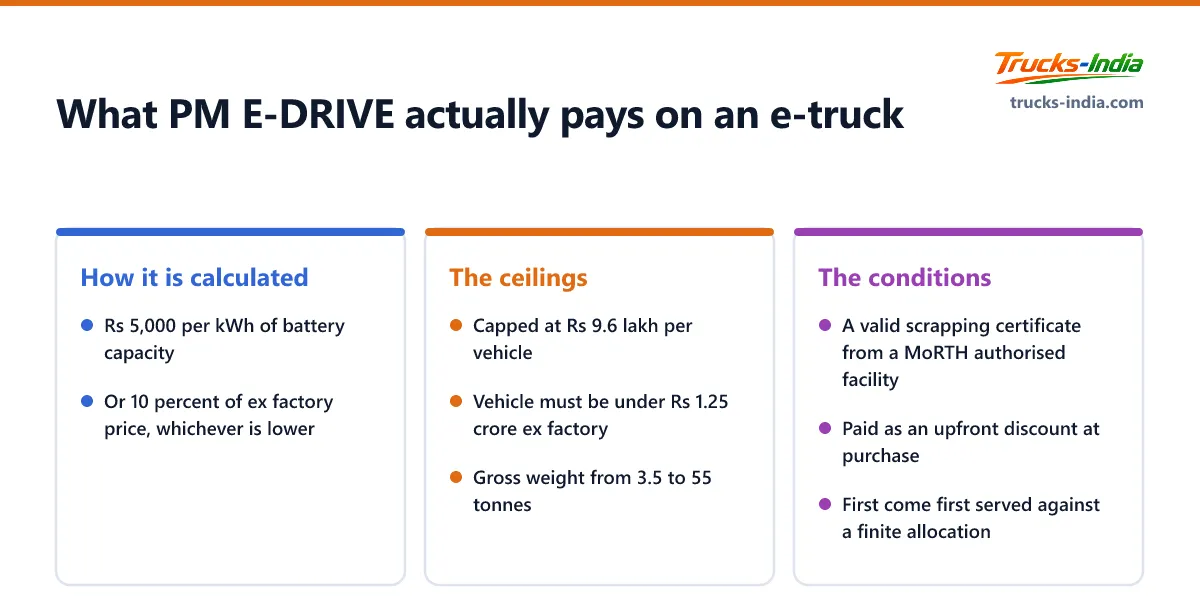
PM E-DRIVE pays a direct subsidy on electric trucks. The scheme runs under the Ministry of Heavy Industries with a total outlay of Rs 10,900 crore, of which Rs 500 crore is allocated specifically to e-trucks. The terms, as notified:
- Eligible for vehicles with gross vehicle weight from 3.5 tonnes to 55 tonnes
- Calculated at Rs 5,000 per kWh of battery capacity, or 10 percent of the ex-factory price, whichever is lower
- Capped at Rs 9.6 lakh per vehicle
- Maximum eligible ex-factory price of Rs 1.25 crore
- Paid as an upfront discount at purchase and reimbursed to the manufacturer, on a first come first served basis
There is a condition worth planning around. The incentive requires a valid scrapping certificate from a MoRTH authorised facility. If you are replacing an ageing vehicle, that certificate is worth real money here on top of the scrappage benefits it already carries, which the scrappage policy guide sets out. If you have nothing to scrap, this route is closed to you.
Funding is finite and allocated first come first served, and the scheme window has been revised more than once. Confirm the current position and remaining allocation with the dealer before you build it into a budget, rather than assuming what was true last year still holds.
Working out the running cost
The method mirrors the diesel one.
Both come out in rupees per kilometre, which is the only fair comparison.
The diesel side you can read off directly. Across India's 36 states and union territories, diesel currently runs from roughly Rs 82 to Rs 104 a litre, with the middle near Rs 96. That spread matters: an electric vehicle looks considerably better against Bihar diesel than against Andhra Pradesh diesel. Take your own state's number from today's fuel prices.
The electric side turns on your tariff, and this is where operators go wrong. There is not one electricity price, there are at least three:
- Depot charging on a commercial connection, which is the cheapest and is the case the payback should be built on
- Public fast charging, which is substantially dearer and frequently carries its own service margin
- Depot charging on a time of day tariff, where charging overnight in the off peak window can be cheaper again
A payback modelled on depot charging and then run on public fast charging will not deliver. Decide where the vehicle actually charges before you calculate anything.
The gap is large, and that is the whole case
Even allowing for tariff variation, cost per kilometre on electricity comes out well below diesel. That is not marginal and it is not disputed. It is the reason the vehicles exist commercially.
Maintenance widens the gap further. An electric driveline has no engine oil, no fuel filters, no clutch in the conventional sense, no diesel particulate filter and no AdBlue, so several of the recurring items in the maintenance schedule simply do not apply. Regenerative braking also extends brake lining life.
What replaces them is a smaller number of much larger risks, which is the next section.
The battery is the vehicle
The battery is the single most expensive component and its condition is the vehicle's value.
Three things to establish before signing, in writing:
The warranty term and what it guarantees. A good battery warranty specifies a retained capacity at a stated year or kilometre count, not merely that the battery will function.
What degradation does to your range. A battery at 80 percent of original capacity is a truck with 80 percent of its original range. If your route only just fits the new vehicle's range, it will stop fitting.
What a replacement costs and who supplies it. If nobody will quote you, that is your answer about how the resale market will treat this vehicle in year six.
Resale is the genuine unknown. The used market for electric commercial vehicles in India is thin and has no established pricing history, so residual value is a guess in a way that a diesel truck's is not. Build your payback on the ownership period, not on what you hope to sell it for.
Range, charging time and payload
Range is the constraint that decides suitability. PM E-DRIVE itself sets a minimum eligible range of 80 to 100 km depending on gross vehicle weight, which tells you what segment the policy expects these vehicles to serve. Electric trucks today suit fixed, predictable, return to base routes.
Charging time is the hidden one. A vehicle charging is a vehicle not earning. This costs nothing if it charges overnight at your depot and costs a great deal if it has to stop mid shift.
Payload. Battery packs are heavy, and unlike some countries India does not currently grant an additional gross vehicle weight allowance to offset that weight. So the battery comes out of your payload, exactly as CNG cylinders do. Check the unladen weight on the registration certificate against the diesel equivalent before assuming the two vehicles carry the same load.
Where it works today
Electric works for intra city and last mile distribution, on fixed daily routes inside the vehicle's range, with high daily utilisation, depot charging on a commercial connection, and an old vehicle available to scrap for the subsidy.
Electric does not work yet for long haul, for irregular or unpredictable routes, for low utilisation, where you have no depot and must rely on public charging, or where your loads already use every kilogram of payload.
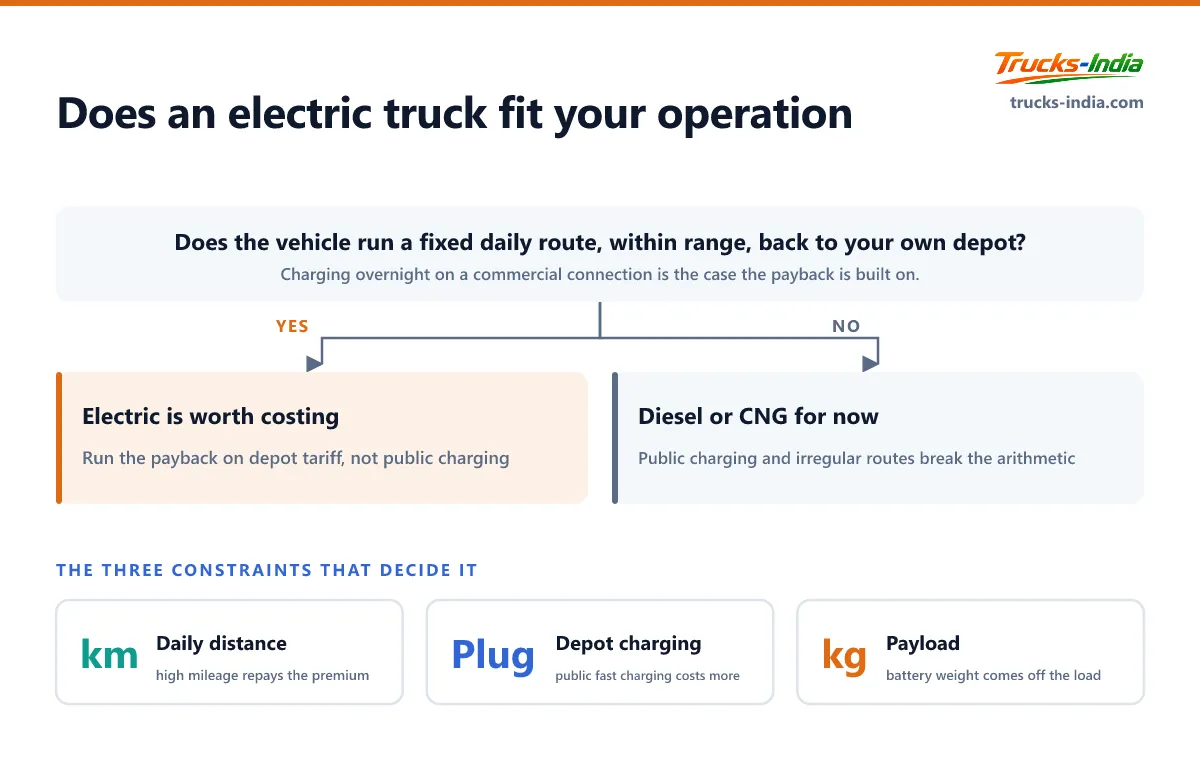
The deciding number remains daily kilometres. High mileage on a fixed route makes the arithmetic work comfortably. Anything else and a diesel or CNG vehicle is the cheaper answer for now. Browse what is actually available as electric commercial vehicles before deciding in the abstract.
Trucks to compare
A few electric trucks on Trucks India, with ex-showroom price and rated payload. Open one for its full price, specifications and mileage.
Browse more: Electric trucks, Euler EV trucks, Jupiter Electric Mobility trucks, Propel trucks, Tata Motors trucks
Frequently asked questions
Divide your electricity tariff per kWh by the vehicle's kilometres per kWh to get rupees per kilometre, then compare that against diesel price per litre divided by kmpl. The electric figure comes out well below diesel, but only if you model the tariff you will actually pay: depot charging on a commercial connection is far cheaper than public fast charging.
Yes. PM E-DRIVE covers electric trucks from 3.5 to 55 tonnes gross vehicle weight at Rs 5,000 per kWh or 10 percent of ex-factory price, whichever is lower, capped at Rs 9.6 lakh per vehicle and limited to vehicles priced up to Rs 1.25 crore ex-factory. It requires a valid scrapping certificate from a MoRTH authorised facility and is allocated first come first served.
5 percent, against 18 percent for standard diesel goods vehicles. That difference narrows the purchase gap before any subsidy is applied.
Usually yes, because battery packs are heavy and India does not currently grant an additional gross vehicle weight allowance to offset battery weight. Compare unladen weight on the registration certificates rather than assuming equivalent payload.
Yes, materially. There is no engine oil, no fuel filter, no conventional clutch, no particulate filter and no AdBlue, and regenerative braking extends lining life. The trade is that the battery is a single very large risk in place of many small ones.
Not yet in most cases. Range, charging time and the thin public charging network make long haul difficult. Electric currently suits fixed intra city and regional routes with high daily kilometres and depot charging.
Where this fits
Electric is one of three fuel choices at purchase. See our guide to types of trucks in India.
The payback turns on the price gap between the electric and diesel version of the same class. Trucks India lists both for every model sold in India.
Call +91 93422 00875About the author
Lokesh R
CEO of Trucks India
Lokesh R is the founder of Trucks India, an independent heavy-vehicle marketplace and research platform operated from Chennai, Tamil Nadu, founded in 2025. Under his direction, Only Heavy publishes specifications and prices sourced from manufacturers, authorised dealer price lists and official regulatory schedules, with every model page checked by a named reviewer, prices re-verified monthly and after any GST revision, and no advertiser able to buy a rating, ranking or comparison result.


