
Truck Business Investment: What You Actually Need to Start
What a truck business really costs to start: down payment, registration and permits, and the working capital most first time owners forget to budget for.

Lokesh R
CEO of Trucks India
Created 7 August 2026 · 6 min read
Ask what a truck business costs and you will usually be told the price of a truck. That answer has sunk more first time operators than any other single piece of advice, because the truck is the part you finance. The parts you cannot finance are what decide whether you survive the first six months.
Your real investment splits three ways: the down payment on the vehicle, the one time costs of putting it legally on the road, and the working capital that carries you until clients actually pay. Most people budget carefully for the first, roughly for the second, and not at all for the third.
Here is how to size all three.
The truck business investment required, in three parts
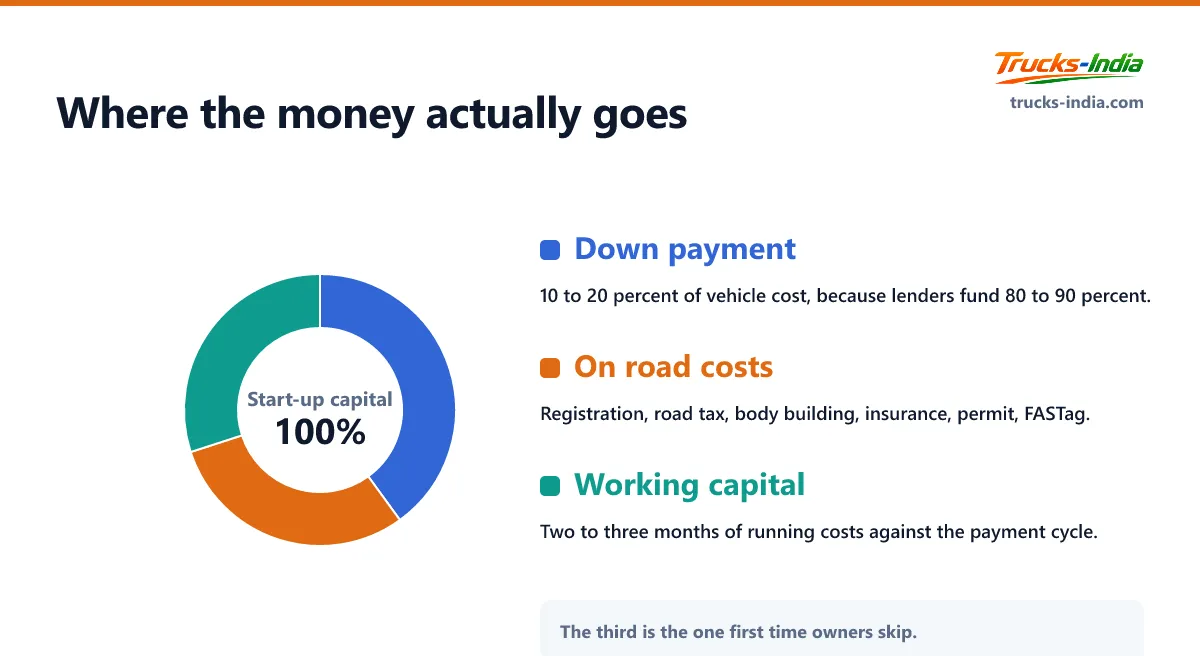
- Down payment. Typically 10 to 20 percent of vehicle cost, because lenders fund 80 to 90 percent over three to five years.
- On road costs. Registration, road tax, body building, insurance, permit and FASTag. Paid once, at the start, and not financed.
- Working capital. Two to three months of diesel, driver wages and EMI, held in reserve against the payment cycle.
Only the first of these scales down if you buy a cheaper truck. The third is set by how long your clients take to pay, which has nothing to do with what you drive.
Start from the segment, not the budget
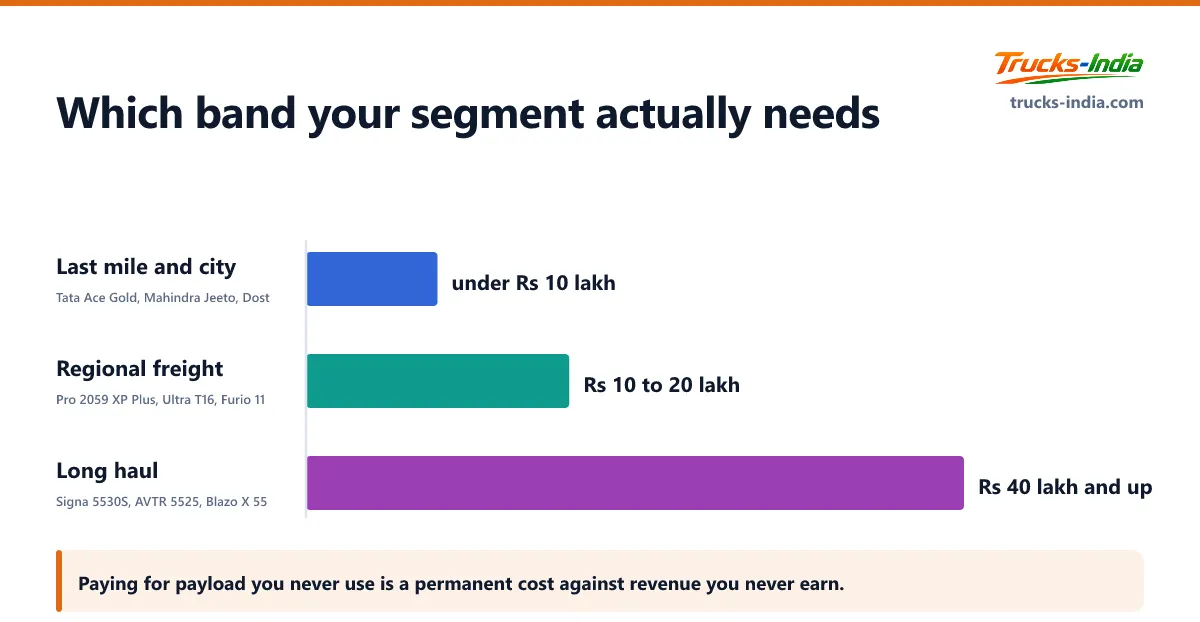
The vehicle band you need is decided by the loads you can actually win, not by what you can afford. Sizing down to fit a budget is fine. Sizing down below the loads available to you means running at a loss per trip.
- Last mile and city work sits in the under 10 lakh band. Think Tata Ace Gold, Mahindra Jeeto or Ashok Leyland Dost.
- Regional freight sits in the 10 to 20 lakh band, the ground held by the Eicher Pro 2059 XP Plus, Tata Ultra T16 and Mahindra Furio 11.
- Long haul begins around the 40 to 50 lakh band with tractor trailers such as the Tata Signa 5530S or Ashok Leyland AVTR 5525.
Prices move, so check the live figure on the model page rather than working from a number in an article.
The down payment, and why paying the minimum is a trap
Lenders typically fund 80 to 90 percent of vehicle cost, over three to five years, at rates that move with your credit profile, the lender and whether you have run a fleet before. Gather at least three quotes rather than accepting the dealership's first offer.
The temptation is to put down the minimum and keep cash in hand. Sometimes that is right, because the cash becomes your working capital buffer. Often it is not, because a larger down payment means a smaller EMI, and the EMI is the fixed cost that does not care whether you found a load this week.
If you are using the collateral free route, the Pradhan Mantri Mudra Yojana lends in four tiers: Shishu up to 50,000 rupees, Kishor from 50,000 to 5 lakh, Tarun from 5 to 10 lakh, and Tarun Plus from 10 to 20 lakh. Read that last tier carefully. Tarun Plus is open only to borrowers who have already taken and fully repaid a Tarun loan, so a first time applicant caps at 10 lakh. Details are on the Mudra site.
On road costs, the ones that are not financed
These are paid in cash at the start and are frequently underestimated.
- RTO commercial registration and road tax, charged on vehicle cost and varying by state. This is usually the largest item after the vehicle itself.
- Body building, if you are buying a chassis rather than a fully built vehicle. Flatbed, container, tipper and tanker bodies differ enormously in cost.
- First year insurance. Comprehensive rather than third party on a financed truck.
- Permit and fitness fees. For a national permit, the consolidated authorisation is 16,500 rupees a year under Rule 87(2) plus a Form 46 authorisation of about 1,000 rupees, with state charges varying.
- FASTag and an opening toll balance.
- Professional fees, if a chartered accountant handles your registrations.
Working capital, the part that decides survival
Freight payment cycles run 30 to 60 days, sometimes longer. You will pay for diesel, driver wages, tolls and the EMI weeks before your first invoice clears.
Budget two to three months of running costs in reserve. That means diesel at today's rate for your expected monthly kilometres, driver salary, tolls, and the full EMI. Check today's fuel prices and the mileage figure on the model page you are considering, and the diesel number takes about two minutes to calculate.
A business that cannot survive a 60 day payment gap does not survive at all, regardless of how good the rate per trip looks.
A quick way to sanity check the whole plan
Take the truck you are considering and work through four numbers before you commit.
- Monthly EMI, from the loan amount, rate and tenure your lender actually quotes.
- Monthly diesel, from expected loaded kilometres divided by the model's real mileage, multiplied by today's price.
- Fixed monthly costs, driver salary plus insurance and permits spread across twelve months.
- Realistic monthly revenue, trips you can genuinely win multiplied by the going rate on your route, with the return leg counted honestly.
If four does not comfortably exceed one, two and three combined, the problem is the plan rather than the truck.
Where the investment goes wrong
- Budgeting the ex-showroom price and being surprised by road tax
- Buying a chassis without pricing the body
- Putting down the minimum and having no reserve
- Assuming the return leg will be loaded
- Choosing on price rather than on price plus running cost, when a truck that is cheaper to buy and thirstier to run costs far more across five years
Investment is only half the question. Whether the money comes back depends on what the truck earns each month and on whether the business is profitable at all on your route. The full guide to starting a transport business covers the whole sequence.
Trucks to compare
A few trucks for a transport business on Trucks India, with ex-showroom price and rated payload. Open one for its full price, specifications and mileage.
Browse more: Mini trucks, Light commercial vehicles, Heavy trucks, Tata Motors trucks, Ashok Leyland trucks, Mahindra trucks
Frequently asked questions
It depends entirely on the segment. The vehicle is the largest number and sits anywhere from the under 10 lakh band for a mini truck to above 40 lakh for multi axle haulage. On top of that, budget the down payment of 10 to 20 percent, registration and road tax, body building where applicable, insurance, permits, and two to three months of running costs in reserve.
Possibly, as a down payment on an entry level vehicle rather than as the whole cost. Remember that registration, road tax, insurance, permits and a working capital reserve all come out of the same pocket, so the truck cannot absorb the full amount.
Usually 10 to 20 percent of vehicle cost, since lenders typically fund 80 to 90 percent. A larger down payment lowers the EMI, which is what protects you in a slow month.
For a first time borrower the practical ceiling is 10 lakh under the Tarun tier, which reaches the mini truck and small pickup segment. Tarun Plus, from 10 to 20 lakh, requires that you have already repaid a Tarun loan.
Diesel, driver wages, tolls, maintenance and tyres, insurance and permits spread monthly, and the EMI. Diesel is usually the largest single line, which is why mileage matters more than sticker price over the life of the vehicle.
Where this fits
Sizing the investment is step two of eight. See the full sequence in our guide to starting a transport business.
Size the EMI against the load before you sign anything. Trucks India lists on road price, payload and mileage for every model sold in India.
Call +91 93422 00875About the author
Lokesh R
CEO of Trucks India
Lokesh R is the founder of Trucks India, an independent heavy-vehicle marketplace and research platform operated from Chennai, Tamil Nadu, founded in 2025. Under his direction, Only Heavy publishes specifications and prices sourced from manufacturers, authorised dealer price lists and official regulatory schedules, with every model page checked by a named reviewer, prices re-verified monthly and after any GST revision, and no advertiser able to buy a rating, ranking or comparison result.


