
Truck Modification Rules in India
What you may legally alter on an Indian truck under Section 52, which changes need RTO endorsement, and the modifications that will fail a fitness test.

Lokesh R
CEO of Trucks India
Created 23 September 2026 · 6 min read

The governing principle is short and most owners have never read it. Section 52 of the Motor Vehicles Act says an owner must not alter a vehicle so that the particulars in the registration certificate differ from what the manufacturer originally specified.
That is a wide rule, and taken literally it catches a great deal of what is done to Indian trucks as a matter of routine. What makes it workable is the set of approved exceptions, and knowing which side of that line a change sits on before you spend money on it.
The rule in one line
You may not alter a vehicle so that it no longer matches its registration certificate.
The registration certificate records what the vehicle is: its engine, its dimensions, its unladen weight, its gross vehicle weight, its seating and body type. Change any of those in reality and the document is now wrong, and a document that is wrong is the problem, not the workmanship.
Two consequences follow immediately.
A change that alters a recorded particular needs the RTO to endorse the new particular, not just a good workshop.
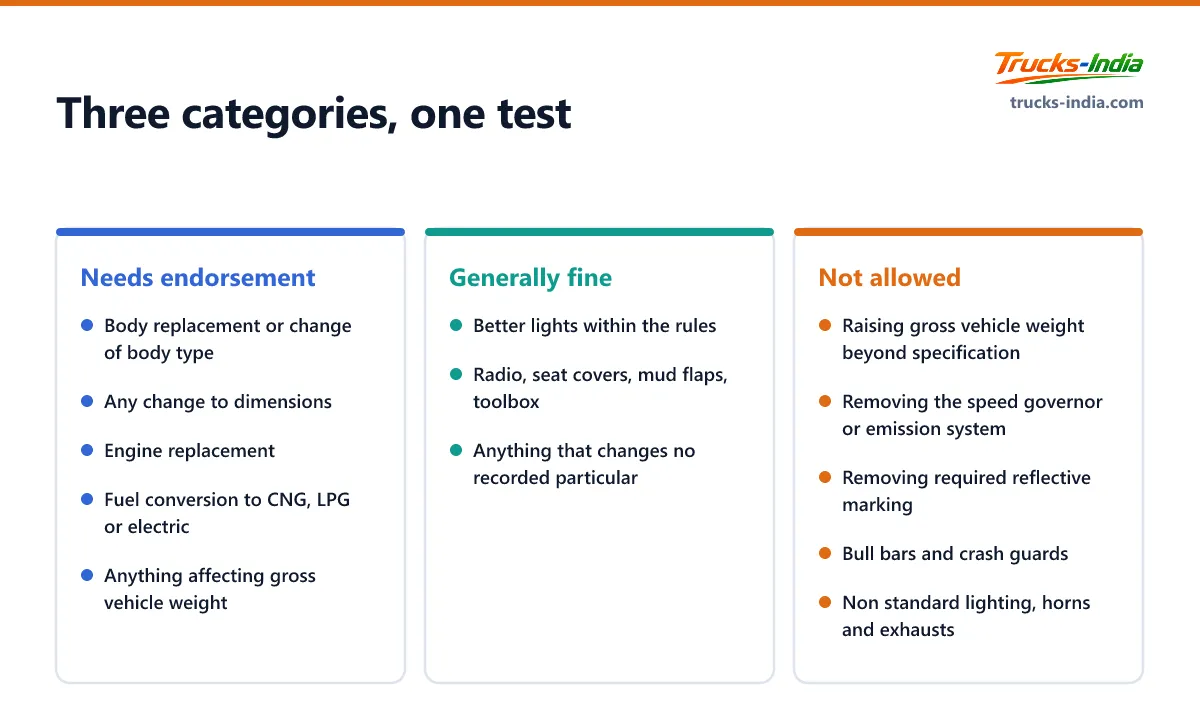
A change that alters nothing on the certificate is generally fine. Better lights, a radio, seat covers, mud flaps, a toolbox. Nobody is coming for your seat covers.
What generally needs approval
Body replacement or a change of body type. Turning an open body into a container, or fitting a tipper body to a flatbed chassis. This changes unladen weight and body type, both recorded. The body itself is a large decision covered in the body building guide; the paperwork is that the RC must reflect the vehicle as built.
Any change to dimensions. Extending a body, raising the height, adding side extensions. Beyond the endorsement, the vehicle still has to sit inside the legal maxima, which the dimension limits guide covers.
Engine replacement or a change of engine number. Recorded, and therefore a documentation exercise as much as a mechanical one.
Fuel conversion, such as retro fitment to CNG or LPG, or conversion to electric. These are permitted where the kit and the fitment are of an approved type, and they must be endorsed on the registration certificate.
Axle changes or any alteration affecting gross vehicle weight. This is a serious one: gross weight determines your permit category, your road tax band and your legal payload.
What is straightforwardly not allowed
Anything that increases gross vehicle weight beyond the manufacturer's specification. You cannot build your way to a higher payload. Strengthening the body does not raise the legal limit, it only makes a truck that will be overloaded more comfortable about it, and the penalty is unchanged, as the axle load guide explains.
Removing or disabling mandatory safety equipment. The speed governor, covered in the speed governor guide, and the emission control system on a BS6 vehicle, covered in the BS6 guide. Both are offences and both fail a fitness test.
Removing required reflective marking, which fabricators do routinely during body work and do not always restore, as the reflective tape guide covers.
Bull bars and crash guards. Protective front bars have been the subject of advisories against their fitment, on the grounds that they interfere with the vehicle's designed crash behaviour and its airbag and structural performance, and they are treated as an unapproved alteration in enforcement. Common on Indian roads is not the same as legal.
Non standard lighting. Extra high intensity lamps, coloured lamps and flashing lamps are restricted, and the restrictions are enforced more than owners expect.
Loud or modified horns and non standard exhausts, both of which are separately regulated.
The three costs of getting it wrong
Fitness. An unapproved alteration is one of the standard reasons a vehicle fails its fitness test. That means re-presenting the vehicle, which is downtime rather than a fine.
Insurance. An undeclared modification gives an insurer a straightforward argument on a claim, and on a heavy vehicle that is a large sum to be arguing about. Declare anything material and get it noted on the policy.
Resale. A vehicle whose physical specification does not match its registration certificate is harder to sell and harder to transfer, because the buyer's own check will surface it, as the RC check guide shows.
Doing it properly
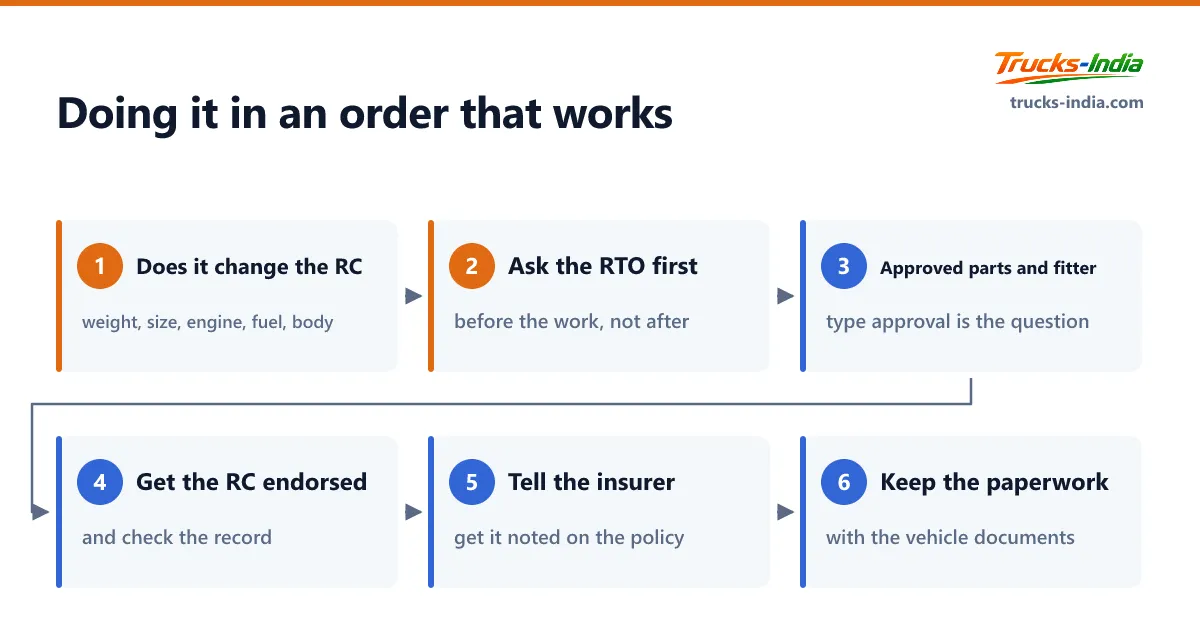
- Establish whether the change touches a recorded particular. If it changes dimensions, weight, engine, fuel or body type, it does.
- Ask the RTO before the work, not after. An endorsement refused on a completed conversion is an expensive conversation.
- Use approved components and an approved fitter, particularly for fuel conversions, where the type approval of the kit is the whole question.
- Get the RC endorsed and confirm the change appears on the record.
- Tell your insurer and get it noted on the policy.
- Keep the paperwork with the vehicle documents.
The cheaper answer
Most modification spending in Indian trucking is an attempt to make the wrong vehicle into the right one.
A body extended for length, a chassis strengthened for weight it was not designed to carry, a conversion to a fuel the vehicle was not built for. Each one costs money, carries regulatory risk, and produces something worse than the correct vehicle would have been.
Buying the right specification at the outset is almost always cheaper. Payload, body length and gross weight are published for every model, and choosing on those is the subject of the truck types guide.
Frequently asked questions
That an owner must not alter a vehicle so that the particulars in the registration certificate differ from those originally specified by the manufacturer. In practice, a change that alters a recorded particular such as dimensions, weight, engine, fuel or body type needs RTO endorsement, and a change that alters none of them is generally fine.
Yes, with approval. Replacing a body or changing body type alters unladen weight and body type, both of which are recorded, so the registration certificate must be endorsed to reflect the vehicle as built. Doing the work without the endorsement is what causes the problem, not the work itself.
They have been the subject of advisories against fitment because they interfere with the vehicle's designed crash behaviour, and in enforcement they are treated as an unapproved alteration. Their being common on Indian roads does not make them approved.
No. Gross vehicle weight is a manufacturer specification recorded on the registration certificate, and no amount of fabrication raises the legal limit. Strengthening makes an overloaded truck more tolerant of being overloaded; it does not make the load legal or the penalty smaller.
Yes, for anything material. An undeclared modification gives the insurer a clean argument on a claim, and on a heavy commercial vehicle that is a large amount of money to be disputing. Get material changes noted on the policy.
Retro fitment to CNG or LPG and conversion to electric are permitted where the kit and the fitment are of an approved type, and the change must be endorsed on the registration certificate. Use an approved fitter, because the type approval of the kit is the whole question.
Where this fits
An unapproved alteration fails a fitness test. See our guide to the fitness certificate.
The cheapest modification is buying the right specification first. Trucks India lists payload, gross weight and body options for every model in India.
Call +91 93422 00875About the author
Lokesh R
CEO of Trucks India
Lokesh R is the founder of Trucks India, an independent heavy-vehicle marketplace and research platform operated from Chennai, Tamil Nadu, founded in 2025. Under his direction, Only Heavy publishes specifications and prices sourced from manufacturers, authorised dealer price lists and official regulatory schedules, with every model page checked by a named reviewer, prices re-verified monthly and after any GST revision, and no advertiser able to buy a rating, ranking or comparison result.


