
Retro Reflective Tape Rules for Trucks
Reflective tape rules for Indian trucks under CMVR Rule 104 and AIS-090: white front, red rear, the 20 mm and 50 mm widths, and contour marking on N3.

Lokesh R
CEO of Trucks India
Created 11 September 2026 · 7 min read
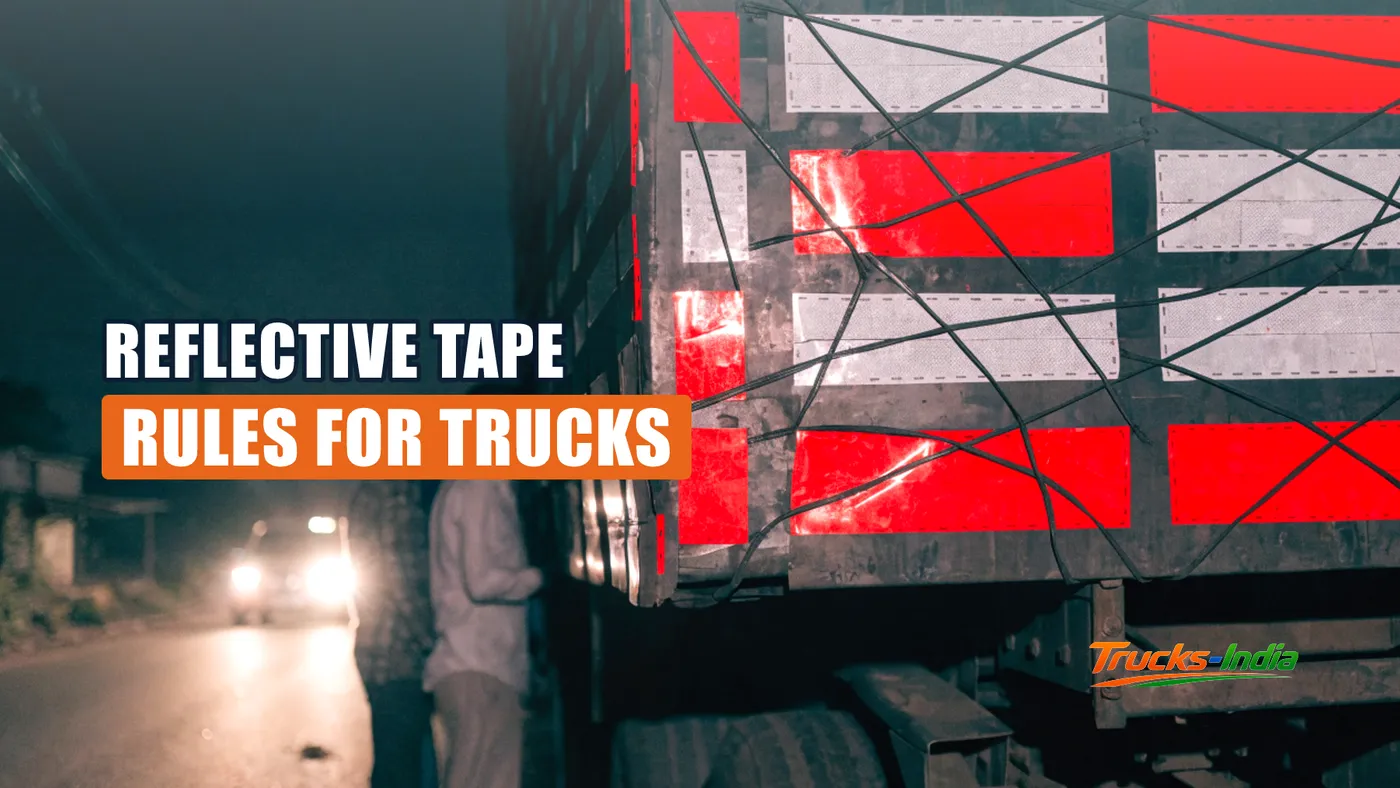
This is the cheapest compliance item on a truck and one of the most commonly fined. A strip of tape costs very little. Being stopped for missing or peeling tape costs a challan and an argument at the roadside.
It is also the item most often got wrong rather than ignored, because the rule specifies colours, positions and minimum widths that differ by vehicle category, and a lot of trucks carry tape that is the wrong colour in the wrong place.
The rule and the standard
Two references do the work here.
CMVR Rule 104 of the Central Motor Vehicles Rules requires retro reflective marking on motor vehicles and sets out what goes where.
AIS-090 is the technical standard the tape itself must meet. Rule 104 requires conformity to Annexures 4, 5 and 6 of AIS:090-2005, and adds that this stands until the corresponding BIS specifications are notified under the Bureau of Indian Standards Act.
Two points on that, because both are widely muddled.
No BIS specification has superseded it. That transitional wording is still in the rule, so AIS-090 remains the operative standard. You may see certification pages claiming IS/ISO 6742-2 applies here. It does not: that standard covers retro-reflective devices for cycles, and has nothing to do with truck conspicuity marking.
The standard itself has moved on, even though the rule text has not. AIS-090 was revised in July 2018 as AIS-090 (Rev 1), and retitled from Heavy and Long Vehicles to Motor Vehicles, their Trailers and Semi-Trailers, broadening its scope. The rule still names the 2005 version, so a supplier quoting either is answering the rule, but current product should be built to Rev 1. Ask which one they mean.
So there are two ways to fail. Tape in the wrong place, and tape that is not to standard. Ordinary reflective tape bought loose is very often the second.
What goes where, by category
The requirement differs by vehicle category, which is a function of gross vehicle weight.
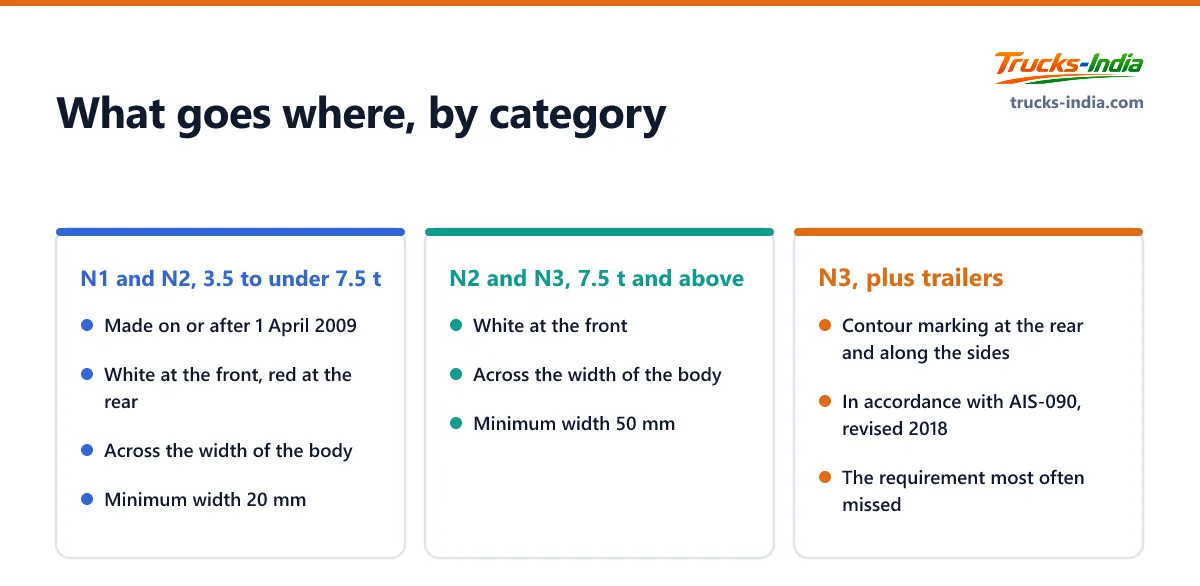
Category N1 and N2 goods vehicles from 3.5 tonnes up to but below 7.5 tonnes, manufactured on or after 1 April 2009:
- White retro reflective tape at the front
- Red retro reflective tape at the rear
- Both running across the width of the body
- Minimum width 20 mm
Category N2 and N3 goods vehicles of 7.5 tonnes and above:
- White retro reflective tape at the front, running across the width of the body
- Minimum width 50 mm
Category N3 vehicles, including trailers and semi trailers, additionally require retro reflective contour marking at the rear and along the sides, in accordance with AIS:090-2005.
Read that last line carefully, because it is the one most often missed. On the largest vehicles and on trailers, front and rear strips are not enough. Contour marking outlines the vehicle, which is the entire point: at night an oncoming driver needs to see the shape and the width of what is in front of them, not two dots.
If you are unsure which category your vehicle is, the gross vehicle weight on the registration certificate decides it.
Why this rule exists
Rear end collisions with stationary or slow moving trucks at night are a well known and lethal pattern on Indian highways. A dark unlit trailer parked on a shoulder is close to invisible until headlights are on top of it.
Contour marking is the countermeasure. It makes the vehicle's outline readable from a distance, which buys the following driver the seconds that decide the outcome.
Worth keeping in mind when a driver says the tape looks untidy. It is the cheapest safety equipment on the vehicle by a wide margin.
Where operators actually go wrong
Five recurring failures.
Peeled or missing sections. Tape degrades, and site work, loading damage and pressure washing strip it. A partially marked vehicle is a non compliant vehicle.
Wrong colour in the wrong place. Red at the front is not a decorative choice, it is a failure, because it tells an oncoming driver they are looking at the back of a vehicle.
Non standard tape. Tape that reflects is not the same as tape conforming to AIS-090. The cheap roll from the accessories shop usually is not.
Covered by the load or the body. A marking obscured by a tarpaulin, a tail board or an overhanging load is not doing its job and is not compliance.
Contour marking absent on a trailer. Very common, and the most consequential of the five.
The fine, and the larger exposure
A missing or defective reflective marking is a straightforward roadside challan, and it is one of the easiest things for an officer to see from outside the vehicle. You will not argue your way past it.
Two things cost more than the fine.
It is a fitness item. Reflective marking is checked at the fitness test, and a failure there means re-presenting the vehicle, which is a day of downtime rather than a small penalty, as the fitness guide sets out.
It is an insurance factor. In a night time rear end collision, the condition of your reflective marking becomes part of how liability is assessed. A vehicle that was legally marked and a vehicle that was not are in very different positions, whatever else happened.
The practical routine
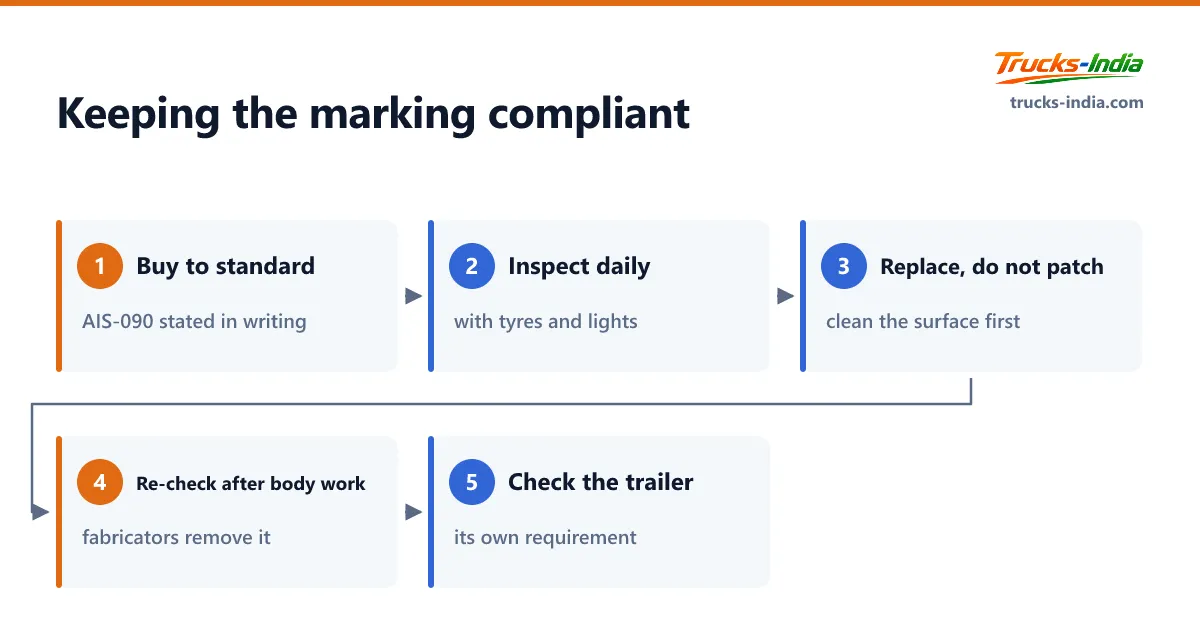
Buy tape that states AIS-090 conformity, from a supplier who can say so in writing. The price difference against unmarked tape is trivial.
Inspect it as part of the daily walk around, alongside tyres and lights. It takes ten seconds and it is in the daily checklist in the maintenance guide.
Replace sections rather than patching over them. Clean the surface properly, because tape applied over dirt or old adhesive lifts within weeks.
Re-check after any body work, since fabricators routinely remove marking and do not always put it back, which is worth raising when the body is built, as the body building guide covers.
Check the trailer separately. It is a different vehicle with its own marking requirement, and it is the one that gets forgotten.
Frequently asked questions
Yes, under CMVR Rule 104, with the tape required to conform to Annexures 4, 5 and 6 of AIS:090-2005. What is required differs by vehicle category and gross vehicle weight.
White at the front and red at the rear, both running across the width of the body. For N1 and N2 vehicles from 3.5 up to below 7.5 tonnes manufactured on or after 1 April 2009 the minimum width is 20 mm. For N2 and N3 vehicles of 7.5 tonnes and above the front marking has a minimum width of 50 mm.
Contour marking outlines the shape of the vehicle rather than marking two edges. Category N3 vehicles, including trailers and semi trailers, require retro reflective contour marking at the rear and along the sides in accordance with AIS:090-2005. It is the most commonly missed requirement.
No. Tape that reflects is not automatically tape that conforms to AIS-090, and the rule requires conformity. Buy from a supplier who will state the standard in writing; the price difference is negligible against the risk.
Not as of now. Rule 104 still says AIS-090 applies until the corresponding BIS specifications are notified, and that wording remains in force. IS/ISO 6742-2, which some certification pages cite, covers retro-reflective devices for cycles and is not the relevant standard. AIS-090 was however revised in July 2018 as AIS-090 (Rev 1), so current product should be built to that revision even though the rule text still names the 2005 version.
A roadside challan, and it is among the easiest violations for an officer to spot from outside the vehicle. The bigger costs are failing the fitness test, which means a day of downtime, and weakening your position in a night time rear end collision.
Yes. A trailer or semi trailer is marked in its own right, and N3 combinations require contour marking at the rear and along the sides. Trailers are the most frequently overlooked part of this rule.
Where this fits
Reflective marking is checked at fitness. See our guide to the fitness certificate for commercial vehicles.
The rule that applies follows your vehicle's category and gross weight. Trucks India lists both for every model sold in India.
Call +91 93422 00875About the author
Lokesh R
CEO of Trucks India
Lokesh R is the founder of Trucks India, an independent heavy-vehicle marketplace and research platform operated from Chennai, Tamil Nadu, founded in 2025. Under his direction, Only Heavy publishes specifications and prices sourced from manufacturers, authorised dealer price lists and official regulatory schedules, with every model page checked by a named reviewer, prices re-verified monthly and after any GST revision, and no advertiser able to buy a rating, ranking or comparison result.


