
Truck Dimension Limits in India
The legal maximum dimensions for Indian goods vehicles under CMVR Rule 93 as amended in 2020, the 18.75 m trailer limit, and the projection allowance.

Lokesh R
CEO of Trucks India
Created 23 September 2026 · 6 min read

There are two different questions that get confused here. How big is a particular truck, which is a specification you look up. And how big is a truck allowed to be, which is a legal ceiling set by rule.
This is the second one. The limits were substantially revised in 2020 to bring Indian vehicles closer to international norms, and the revision let trucks carry more volume within the same weight, which is exactly what a country moving light bulky freight needed.
The rule
Dimensions of motor vehicles are set by Rule 93 of the Central Motor Vehicles Rules 1989.
That rule was amended by GSR 414(E), dated 26 June 2020, which standardised vehicle dimensions in line with international practice. The stated purpose was logistics efficiency: allowing more carrying capacity within the existing weight limits, and in particular raising permitted heights for goods vehicles to encourage containerised transport.
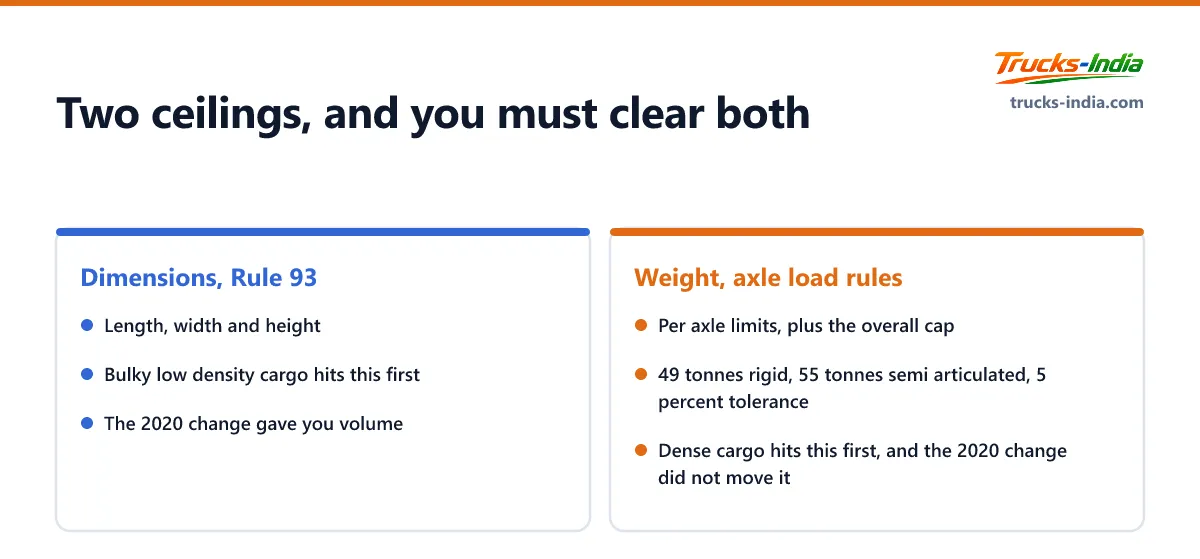
Read that purpose carefully, because it explains the whole logic. The 2020 change gave you volume, not weight. Your axle loads and gross vehicle weight did not move, and they remain the binding constraint on anything dense, as the axle load rules for each configuration set out.
What the limits are
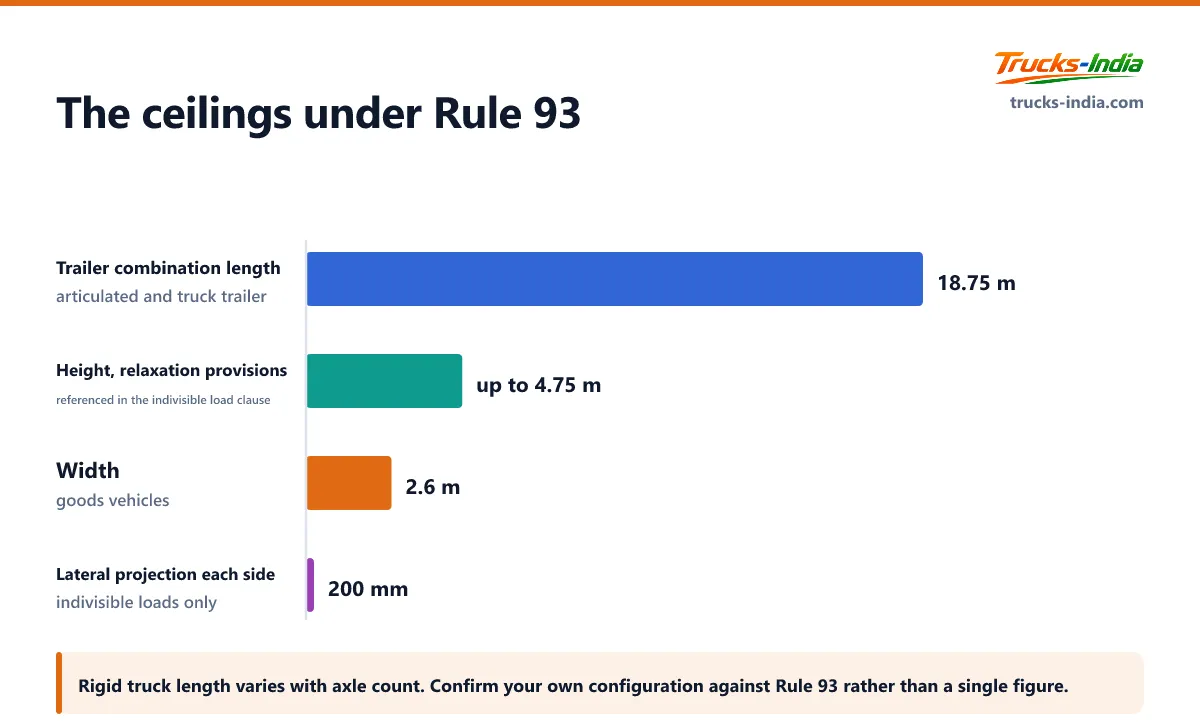
Trailer combinations are permitted to a maximum overall length of 18.75 metres. This is the figure that governs articulated and truck trailer operation and it is the one most often quoted.
Width is capped at 2.6 metres for goods vehicles, which is the reference width used in the projection allowance below.
Height was raised in the 2020 amendment, in line with UNECE norms and specifically to support containerised movement. The permitted height differs by vehicle category, and the relaxation provisions reference heights up to 4.75 metres in defined circumstances.
For rigid trucks, permitted overall length varies by the number of axles, which is the sensible approach: a two axle rigid and a multi axle rigid are not the same vehicle.
Check Rule 93 for your own configuration before you commit to a body length. The rule sets different maxima for different vehicle types and axle counts, and a summary article is the wrong place to settle a number you are about to build to. Your RTO or the notification itself is the authority.
Projection, and the indivisible load allowance
Two separate ideas that get conflated.
Ordinary loading. A load should sit within the vehicle. You cannot use cargo to make the vehicle wider or longer than the rule permits, and a projecting load is a common roadside stop, as the load securing guide covers.
Indivisible loads. For items that genuinely cannot be broken down, a relaxation permits limited lateral projection, specified as up to 200 mm on each lateral side for motor vehicles of 2.6 metre actual width, subject to a height limit up to 4.75 metres.
The operative word is indivisible. This exists for machinery, structures and similar items that cannot be split into two loads. It is not a general permission to let cargo hang over the sides because it did not quite fit.
Genuinely over dimensional cargo, beyond even these allowances, is a separate regime requiring specific permissions and often escorts. That is a conversation with your RTO with the actual dimensions in front of them.
Why the limits matter commercially
Three practical consequences.
Body length decides your revenue per trip on light freight. For bulky low density cargo you fill the volume long before you reach the weight limit. That is why 19, 22 and 24 foot bodies exist, and why the 2020 height increase mattered to anybody moving parcels, white goods or packaging.
Length decides where you can actually go. A vehicle at the legal maximum is legal on a highway and awkward in a market lane, at a narrow gate or on a hill route with tight hairpins. The limit is a ceiling, not a recommendation.
Height decides what you pass under. Legal maximum height does not guarantee clearance at every underpass, foot overbridge, cable crossing or tree on your route. Bridge strikes happen to legal vehicles.
The height mistake that costs bodies
Worth stating plainly because it is a recurring and expensive error.
Your loaded height is not your vehicle's listed height. A container body, a raised deck, a roof carrier or a tarpaulin over a high load all add to it, and the number that matters is the height of the highest point when loaded.
Measure it. Write it on a sticker inside the cab where the driver can see it. Then check it against the low clearances on your regular routes.
A driver who knows the vehicle is 4.1 metres and sees a 4.0 metre clearance sign stops. A driver who does not know finds out.
Dimensions against weight
The two limits operate independently and you must satisfy both.
A vehicle can be within its dimensions and overloaded, which is the common case with dense cargo like steel or cement.
A vehicle can be within its weight and over its dimensions, which is the common case with bulky cargo, packaging or an over long body.
Neither excuses the other. The dimension rule is Rule 93; the weight rules are the axle load limits and gross vehicle weight caps, currently 49 tonnes for rigid trucks and 55 tonnes for semi articulated combinations with a 5 percent tolerance.
Frequently asked questions
Trailer combinations are permitted up to an overall length of 18.75 metres. For rigid trucks the permitted length varies with the number of axles, so check Rule 93 for your specific configuration rather than working from a single figure.
2.6 metres, which is also the reference width used in the indivisible load projection allowance.
Permitted height differs by vehicle category, and it was raised in the 2020 amendment in line with UNECE norms specifically to encourage containerised transport. The relaxation provisions reference heights up to 4.75 metres in defined circumstances. Confirm the figure for your category against Rule 93.
Rule 93 of the Central Motor Vehicles Rules 1989, as amended by GSR 414(E) dated 26 June 2020, which standardised dimensions in line with international norms to improve logistics efficiency.
For genuinely indivisible loads, a relaxation permits up to 200 mm of lateral projection on each side for vehicles of 2.6 metre actual width, subject to a height up to 4.75 metres. This applies to items that cannot be broken down; it is not general permission for cargo that did not fit.
It increased volume, not weight. Axle load limits and gross vehicle weight were unchanged, so the benefit goes to bulky low density freight. For dense cargo, weight remains the binding constraint.
Where this fits
Dimensions and weight are separate limits. See our guide to axle load limits and overloading rules.
Legal maxima are one thing, the vehicle you buy is another. Trucks India lists real dimensions for every model in India.
Call +91 93422 00875About the author
Lokesh R
CEO of Trucks India
Lokesh R is the founder of Trucks India, an independent heavy-vehicle marketplace and research platform operated from Chennai, Tamil Nadu, founded in 2025. Under his direction, Only Heavy publishes specifications and prices sourced from manufacturers, authorised dealer price lists and official regulatory schedules, with every model page checked by a named reviewer, prices re-verified monthly and after any GST revision, and no advertiser able to buy a rating, ranking or comparison result.


