
Commercial Vehicle Insurance in India
Truck insurance in India: third party versus comprehensive, what IDV decides, goods in transit cover, the add ons worth it and why claims get rejected.

Lokesh R
CEO of Trucks India
Created 8 September 2026 · 7 min read
There are three different things people mean by truck insurance, and buying the wrong one is how owners discover, at the worst possible moment, that they were never covered for the thing that went wrong.
One is compulsory and protects other people. One is optional and protects your vehicle. One covers the goods on the back and is a completely separate policy that most first time owners have never heard of.
This guide separates them, then covers the part that decides whether a claim gets paid.
The three covers, and which ones you must have
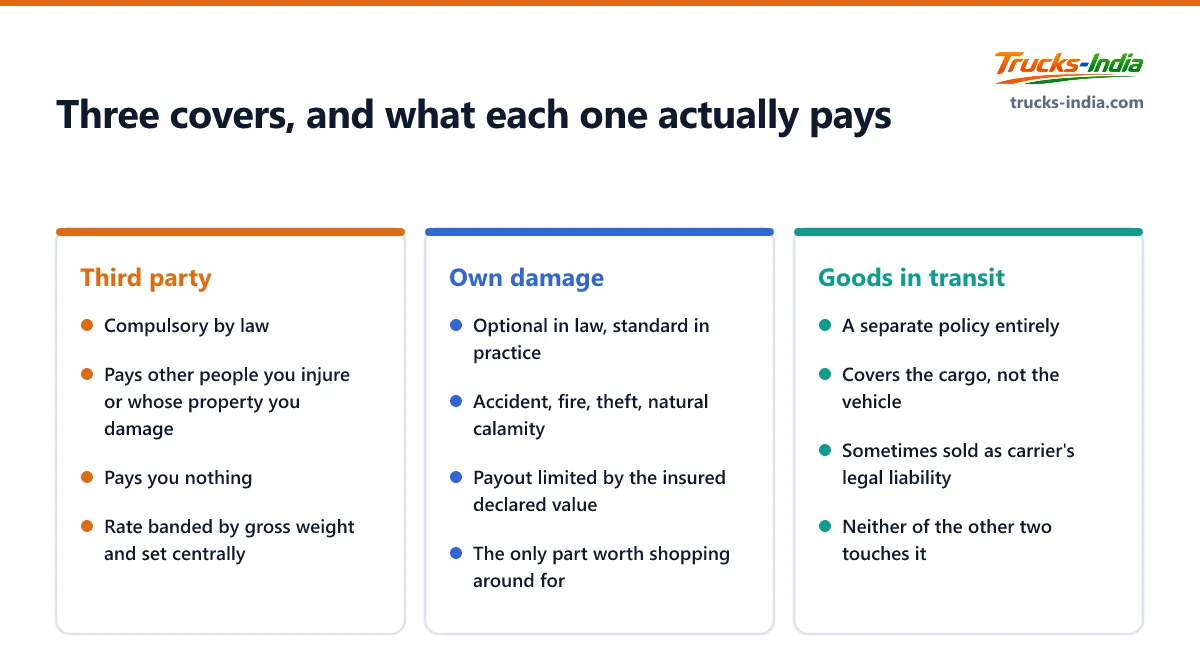
Third party liability is compulsory. Driving a goods vehicle without it is an offence, and it is the cover the traffic police check. It pays other people when you injure them or damage their property. It pays you nothing.
Own damage, sold together with third party as a comprehensive or package policy, covers your own vehicle: accident, fire, theft, natural calamity. It is optional in law and close to essential in practice, because a heavy vehicle is the largest asset most operators own and it is on the road all day.
Goods in transit, sometimes sold as carrier's legal liability, covers the cargo. It is a separate policy from a separate part of the market, and neither third party nor comprehensive touches it. If a consignment is damaged or stolen off your truck, your motor policy is not the document that helps you.
The gap between the second and the third is where new operators get hurt. A comprehensive policy on the truck says nothing about your liability for the load, and for a transporter issuing consignment notes that liability is real.
What third party costs, and why you cannot shop for it
Third party premium for a goods carrying vehicle is banded by gross vehicle weight and set centrally rather than by the insurer. Every company charges the same for the same weight class, so comparing third party quotes is a waste of an afternoon.
Two things about these rates are worth knowing in 2026.
First, the notified rates have gone a long stretch without revision, and a hike in the range of 10 to 25 percent has been under review, with commercial vehicles expected at the steeper end because the segment has run loss making for insurers for years. Budget for an increase rather than assuming this year's premium repeats.
Second, and in your favour, GST on third party insurance for goods carriage vehicles was cut from 12 percent to 5 percent in September 2025. If you are working from a quote or a guide written before that, the tax component is wrong.
Because the base rate is fixed, the only part of a package policy you can actually negotiate is the own damage side and the add ons.
IDV is the number that decides your claim
Insured declared value is what the insurer pays if the truck is stolen or written off. It is not what you paid for the vehicle and it is not what you would get selling it.
IDV is the manufacturer's listed price less depreciation for age, and it is the single most consequential figure on the policy. Owners routinely accept a low IDV because it lowers the premium, then discover after a total loss that the payout does not clear the outstanding loan.
Two practical points:
- A low IDV is a discount you take today and pay for once. Set it close to the real replacement value.
- Body building is often excluded unless you declare it. A container or tipper body is a large share of what you spent, and if it is not on the policy it is not in the payout.
Add ons worth the money on a truck
Most add ons are sold indiscriminately. On a commercial vehicle a few of them earn their premium.
- Legal liability to paid driver. If you employ a driver, this is not optional in any practical sense. Without it, an injury claim from your own driver lands on you personally.
- Engine protection. Covers water ingress and lubricating oil leakage, both of which are exclusions on a standard policy and both of which destroy engines.
- Consumables cover. Oils, coolant and similar are excluded by default and add up on a heavy vehicle repair.
- Roadside assistance. Worth it on long haul work, where a breakdown far from your base costs you more in downtime than the add on costs for a year.
Zero depreciation is the one most heavily pushed and the least useful here. Insurers usually restrict it by vehicle age, and the plastic and paint parts it protects matter less on a goods vehicle than on a car.
Why claims get rejected
Insurers decline commercial vehicle claims for a short and repetitive list of reasons. Almost all of them are avoidable.
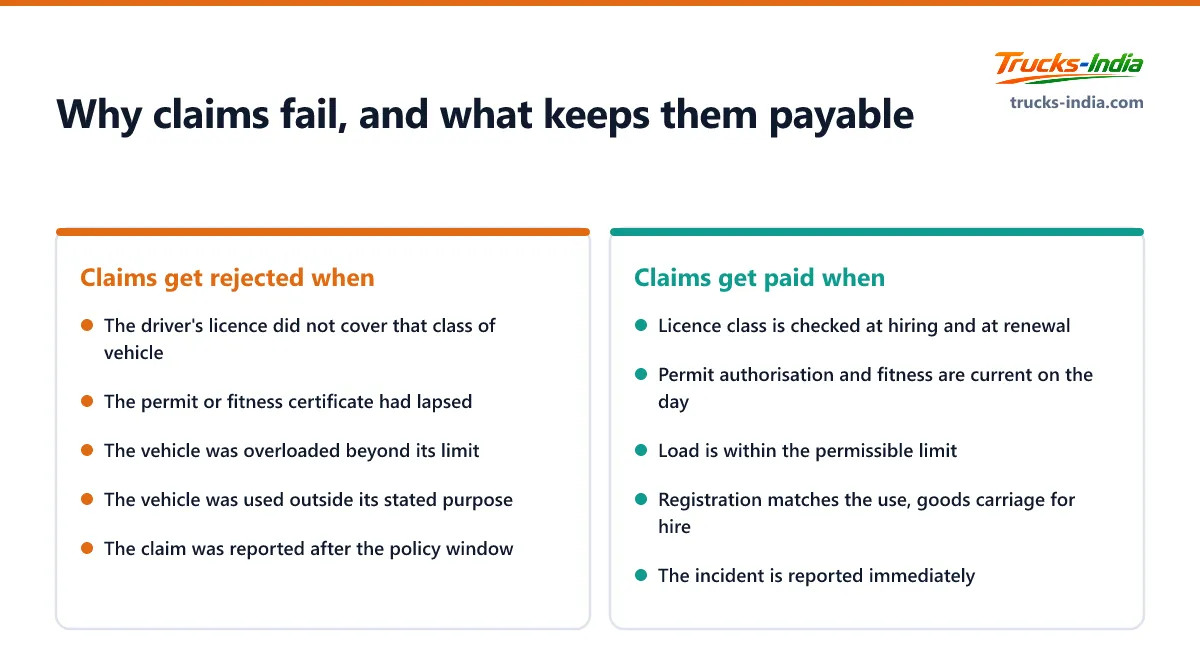
- The driver did not hold a valid licence for that class of vehicle. A licence covering a light commercial vehicle does not cover a heavy one, and this is the most common single reason a claim fails. The heavy vehicle licence classes are worth checking at hiring rather than at claim time.
- The permit or fitness certificate had lapsed at the time of the incident.
- The vehicle was overloaded beyond its permissible limit.
- The vehicle was used outside its stated purpose, for instance a private registration carrying goods for hire.
- The claim was reported late, past the window the policy specifies.
What to actually do in the hour after an incident, and the order that protects both the injured person and the claim, is set out in the truck accident procedure guide.
Notice that four of the five are paperwork, not driving. The renewals calendar is an insurance matter as much as a compliance one, which is why the documents guide treats them together.
Renewal, and the cost of a lapse
Let a policy lapse and three things happen at once. The vehicle is illegal to drive, you carry the full liability of any incident yourself, and you lose the no claim bonus you have accumulated on the own damage side.
A no claim bonus builds year on year for claim free renewals and is a genuine discount on the own damage premium. It survives a change of vehicle if you transfer it, and it does not survive a gap in cover.
Put the renewal date in the same calendar as the fitness certificate, the permit authorisation and the pollution certificate. On a single vehicle that is a handful of dates. On six vehicles it is roughly thirty a year, which is the point at which a calendar stops being optional.
What this means for a new owner
If you are buying your first truck, the order that works is:
- Take the compulsory third party cover, which the dealer will arrange at registration
- Add own damage unless the vehicle is old enough that the IDV no longer justifies it
- Declare the body building so it is inside the IDV
- Add legal liability to paid driver the day you hire a driver
- Buy goods in transit cover separately if you are issuing consignment notes
The premium tracks the vehicle's weight class and value, so it is decided when you choose the model. Compare what you are considering on payload and on road price before the insurance conversation, not after it.
The margin calculation guide shows where the premium sits against your other fixed costs, and the guide to what the business costs to start covers the first year total.
Trucks to compare
A few popular trucks on Trucks India, with ex-showroom price and rated payload. Open one for its full price, specifications and mileage.
Browse more: Mini trucks, Light commercial vehicles, Heavy trucks, Tata Motors trucks, EKA trucks, Ashok Leyland trucks, Force Motors trucks
Frequently asked questions
Third party liability cover is compulsory and driving without it is an offence. Own damage cover, sold as part of a comprehensive policy, is optional in law but covers the vehicle itself and is standard practice for anything with a loan against it.
The third party portion is banded by gross vehicle weight and set centrally, so it is the same at every insurer for a given weight class. The own damage portion varies with the insured declared value, the vehicle's age and the add ons you choose, and that is the only part worth shopping around for.
No. Neither third party nor comprehensive motor insurance covers the cargo. Goods in transit cover, sometimes sold as carrier's legal liability, is a separate policy and is the one that responds when a consignment is damaged or stolen.
Insured declared value, the amount paid if the vehicle is stolen or written off. It is the listed price less depreciation for age. Setting it low reduces the premium and reduces the payout, so keep it close to real replacement value and make sure the body building is declared.
Most often because the driver did not hold a licence valid for that class of vehicle, the permit or fitness certificate had lapsed, the vehicle was overloaded, it was used outside its stated purpose, or the claim was filed late. Four of those five are paperwork rather than driving.
Yes. GST on third party insurance for goods carriage vehicles was reduced from 12 percent to 5 percent in September 2025. Quotes and guides written before that date carry the old tax component.
Where this fits
Insurance is one of the renewals that keeps a truck legal. See our guide to starting a transport business.
Your premium tracks the vehicle's value and weight class, so the model decides the cost before the insurer does. Trucks India lists on road price, payload and mileage for every model sold in India.
Call +91 93422 00875About the author
Lokesh R
CEO of Trucks India
Lokesh R is the founder of Trucks India, an independent heavy-vehicle marketplace and research platform operated from Chennai, Tamil Nadu, founded in 2025. Under his direction, Only Heavy publishes specifications and prices sourced from manufacturers, authorised dealer price lists and official regulatory schedules, with every model page checked by a named reviewer, prices re-verified monthly and after any GST revision, and no advertiser able to buy a rating, ranking or comparison result.


