
How to Start a Fleet Business in India
How to scale from one truck to a fleet in India: when to add the second vehicle, staggering EMIs, hiring drivers, maintenance systems and the cash flow trap.

Lokesh R
CEO of Trucks India
Created 6 September 2026 · 6 min read
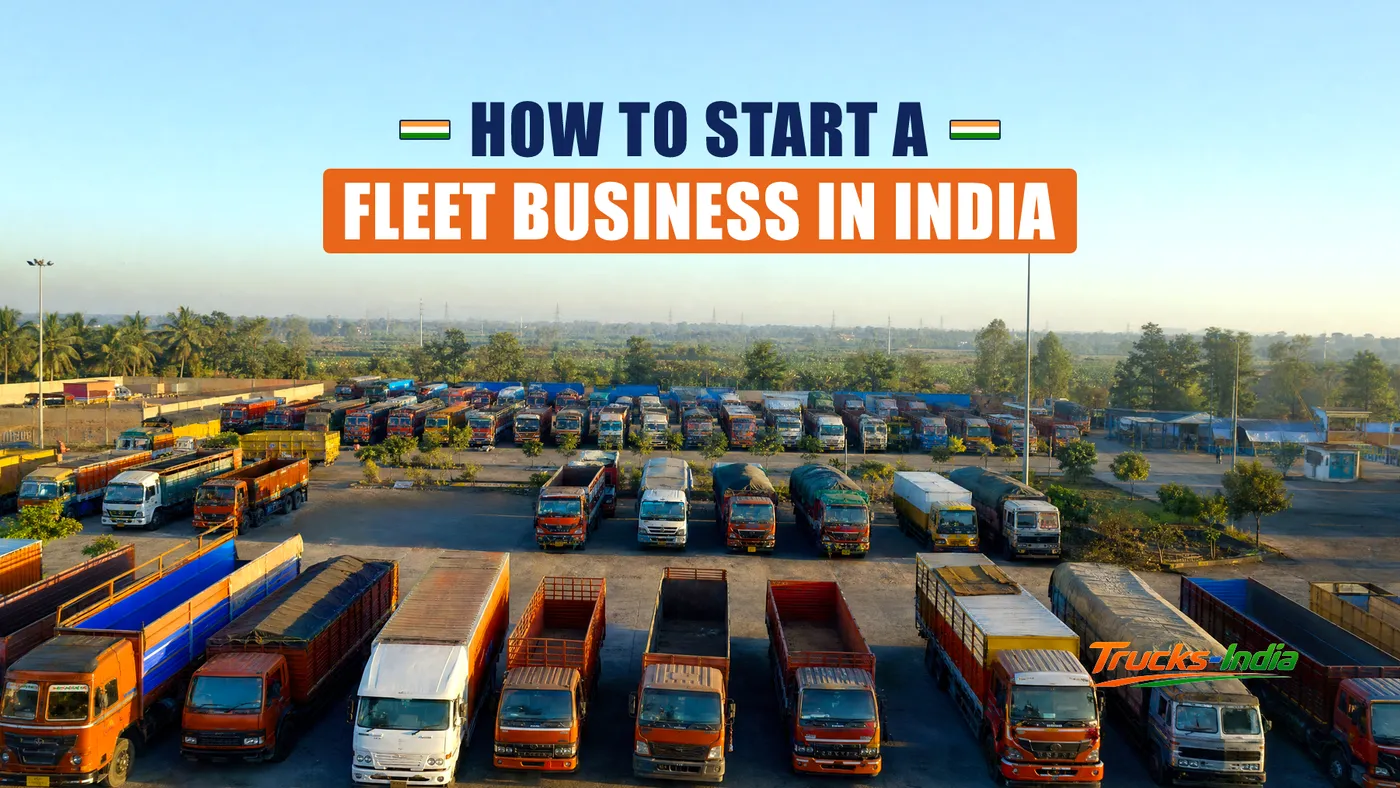
Going from one truck to several is not the same business getting bigger. It is a different business.
With one vehicle you are an operator. With six you are a manager, and the things that decide whether you make money change accordingly: hiring and keeping drivers, maintenance scheduling, cash flow across staggered EMIs, and knowing the cost per kilometre of each vehicle rather than a general sense of how things are going.
Plenty of successful single truck owners have lost money expanding, not because the idea was wrong but because they scaled the trucks without scaling the systems.
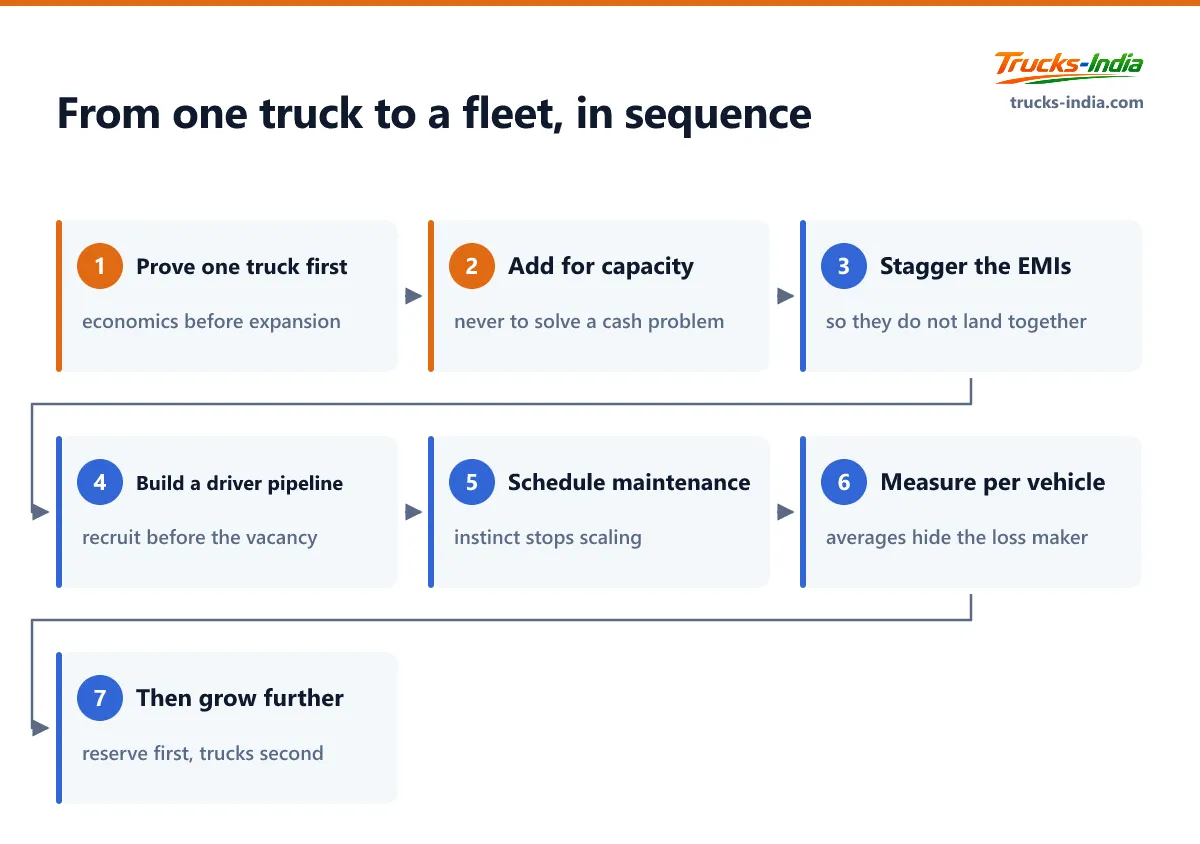
How to start a fleet business, in order
- Prove the single truck economics first
- Add the second vehicle for a capacity reason, never a cash reason
- Stagger the EMIs so they do not all land together
- Build the driver pipeline before you need it
- Put maintenance on a schedule rather than on instinct
- Measure each vehicle separately
- Only then think about vehicles four, five and six
The order is not decorative. Skipping step one is the most common way fleets fail, and skipping step two is the second.
When to add the second truck
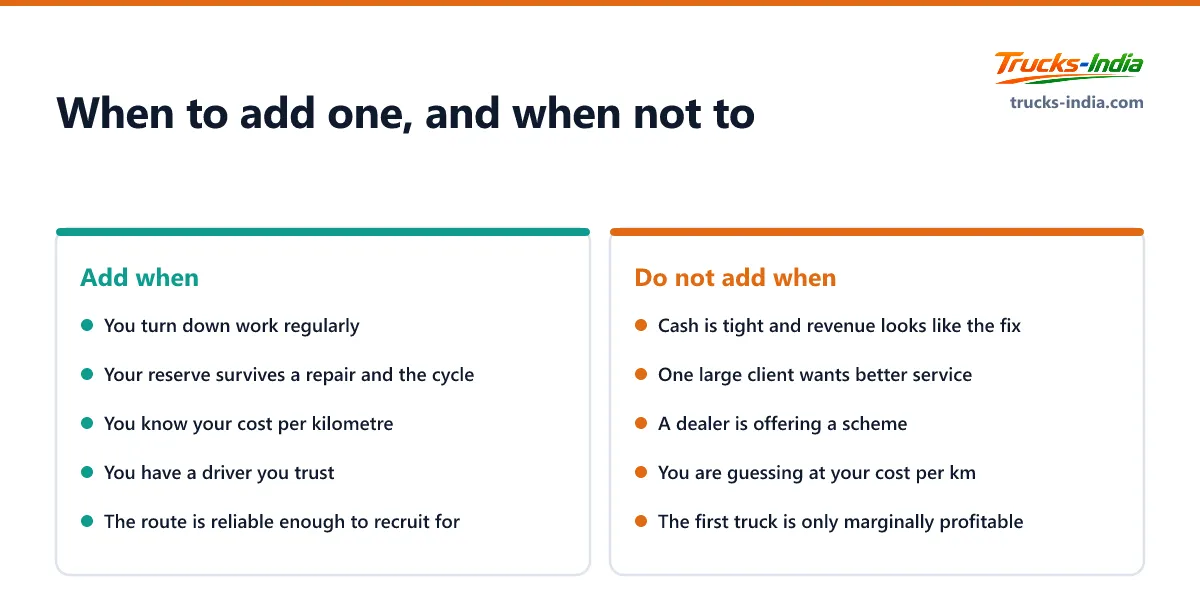
The signals are clear enough to be worth stating plainly.
Add when:
- You are regularly turning down work, not occasionally
- Your reserve survives both the payment cycle and a major repair, and it is intact
- You know your cost per kilometre precisely rather than approximately
- You have a driver you trust, or a route reliable enough to recruit for
Do not add when:
- Cash is tight and a second truck looks like more revenue
- You have one large client and want to serve them better
- A dealer is offering an attractive scheme
That first "do not" is how most expansions go wrong. Adding a truck to solve a cash problem gives you two EMIs and the same shortage of loads. A second vehicle multiplies whatever your existing economics are. If the first truck is marginal, the second makes the problem larger, not smaller.
Stagger the EMIs
This is a small piece of planning with a disproportionate effect.
If you buy vehicles close together on similar tenures, their EMIs land in the same week every month and mature at the same time. A quiet month then hits every loan at once, and years later every vehicle needs replacing at once.
Spacing purchases means spacing the obligations, and it means that when one loan closes, the freed cash flow can support the next vehicle rather than arriving alongside three other closures.
Drivers are the constraint
Almost every fleet operator in India will tell you the binding constraint is not trucks or loads. It is drivers.
A truck without a driver earns nothing and still owes its EMI, which makes driver availability a direct financial issue rather than an HR one.
What actually helps:
- Pay on time, every time. This matters more than the amount.
- Predictable routes and predictable home time.
- Handle documentation properly, including licence class. A licence covering a light commercial vehicle does not cover a heavy one.
- Recruit before the vacancy, not after.
- Treat retention as cheaper than recruitment, because it is.
Once you employ more than a handful of people, provident fund, state insurance and the Motor Transport Workers Act hours start to apply, and the PF and ESI guide covers where those thresholds sit.
Maintenance becomes a system
With one truck you notice when something sounds wrong. With six you cannot, and instinct stops scaling.
Move to scheduled preventive servicing by kilometres, tracked per vehicle. Keep a simple service history for each truck. Track tyre life and replace on a schedule rather than on failure. Watch fuel efficiency per vehicle, because a sudden drop is usually the first sign of a mechanical problem or a driving problem, and both are cheaper to catch early.
Downtime is the cost that does not appear on any invoice. A truck in a workshop earns nothing while the EMI, the insurance and often the driver's wage continue.
Standardise where you sensibly can
Running one or two models across the fleet rather than six different ones has real advantages: mechanics who know the vehicle, common spares, drivers who can move between trucks, and predictable fuel efficiency you can actually benchmark.
The counterargument is that different work needs different vehicles, which is fair. The practical answer is to standardise within a segment. If your work is regional freight, running several of the Eicher Pro 2059 XP Plus or Tata Ultra T16 class is easier to run than one of each across the market. Compare within your band, whether that is 10 to 20 lakh or 40 to 50 lakh.
Measure each vehicle separately
A fleet average hides the truck that is losing money. Track per vehicle: kilometres run, loaded versus empty, fuel efficiency, maintenance spend, revenue, and days out of service.
The pattern that emerges is almost always the same. One or two vehicles carry the operation, one is quietly a problem, and until you measure separately you cannot tell which is which.
Cash flow is the thing that kills fleets
A single truck's payment cycle is a nuisance. Six trucks' payment cycles are a serious working capital requirement, because you are now funding six vehicles' diesel, wages and EMIs for 30 to 60 days before any of that month's invoices clear.
Fleets rarely fail because the trucks were unprofitable. They fail because the business grew faster than the working capital behind it. Every additional vehicle increases the reserve you need, and the reserve must grow before the fleet does, not after.
Compliance multiplies
Each vehicle carries its own registration, permit, fitness certificate, insurance and pollution certificate, each with its own renewal date. Six vehicles means roughly thirty renewal dates a year.
Put them in one calendar with reminders. A lapsed national permit authorisation makes a vehicle legally unauthorised for interstate work, and discovering that mid trip is expensive.
A fleet starts with one truck done properly. The economics of a single truck business is the prerequisite reading, and the full guide to starting a transport business covers the ground before that.
Trucks to compare
A few trucks for a transport business on Trucks India, with ex-showroom price and rated payload. Open one for its full price, specifications and mileage.
Browse more: Mini trucks, Light commercial vehicles, Heavy trucks, Tata Motors trucks, Mahindra trucks, Ashok Leyland trucks
Frequently asked questions
There is no threshold number. What matters is whether each vehicle covers its own costs and whether working capital has grown alongside the fleet. Three well utilised trucks beat six poorly utilised ones.
When you are consistently turning down work, your cash reserve is intact and covers both the payment cycle and a repair, you know your cost per kilometre, and you have a driver you trust. Not when cash is tight.
Drivers, for most operators. A truck without a driver earns nothing while its EMI continues, which makes availability and retention a financial issue rather than an administrative one.
Standardising within a segment helps: shared spares, mechanics who know the vehicle, drivers who can move between trucks, and comparable fuel benchmarks. Different work still needs different vehicles, so standardise within a band rather than across the whole fleet.
More than proportionally more than a single truck, because you fund every vehicle's diesel, wages and EMI for the full 30 to 60 day payment cycle. The reserve should grow before the fleet does.
Where this fits
A fleet starts with one truck done properly. See our guide to starting a transport business.
Standardising the fleet starts with comparing models properly. Trucks India lists payload, mileage and on road price for every model sold in India.
Call +91 93422 00875About the author
Lokesh R
CEO of Trucks India
Lokesh R is the founder of Trucks India, an independent heavy-vehicle marketplace and research platform operated from Chennai, Tamil Nadu, founded in 2025. Under his direction, Only Heavy publishes specifications and prices sourced from manufacturers, authorised dealer price lists and official regulatory schedules, with every model page checked by a named reviewer, prices re-verified monthly and after any GST revision, and no advertiser able to buy a rating, ranking or comparison result.


