
E-Way Bill for Transporters
The e-way bill from the transporter's side: filling in Part B, the transporter ID, validity by distance, and the 2026 changes including bill closure now.

Lokesh R
CEO of Trucks India
Created 1 September 2026 · 7 min read
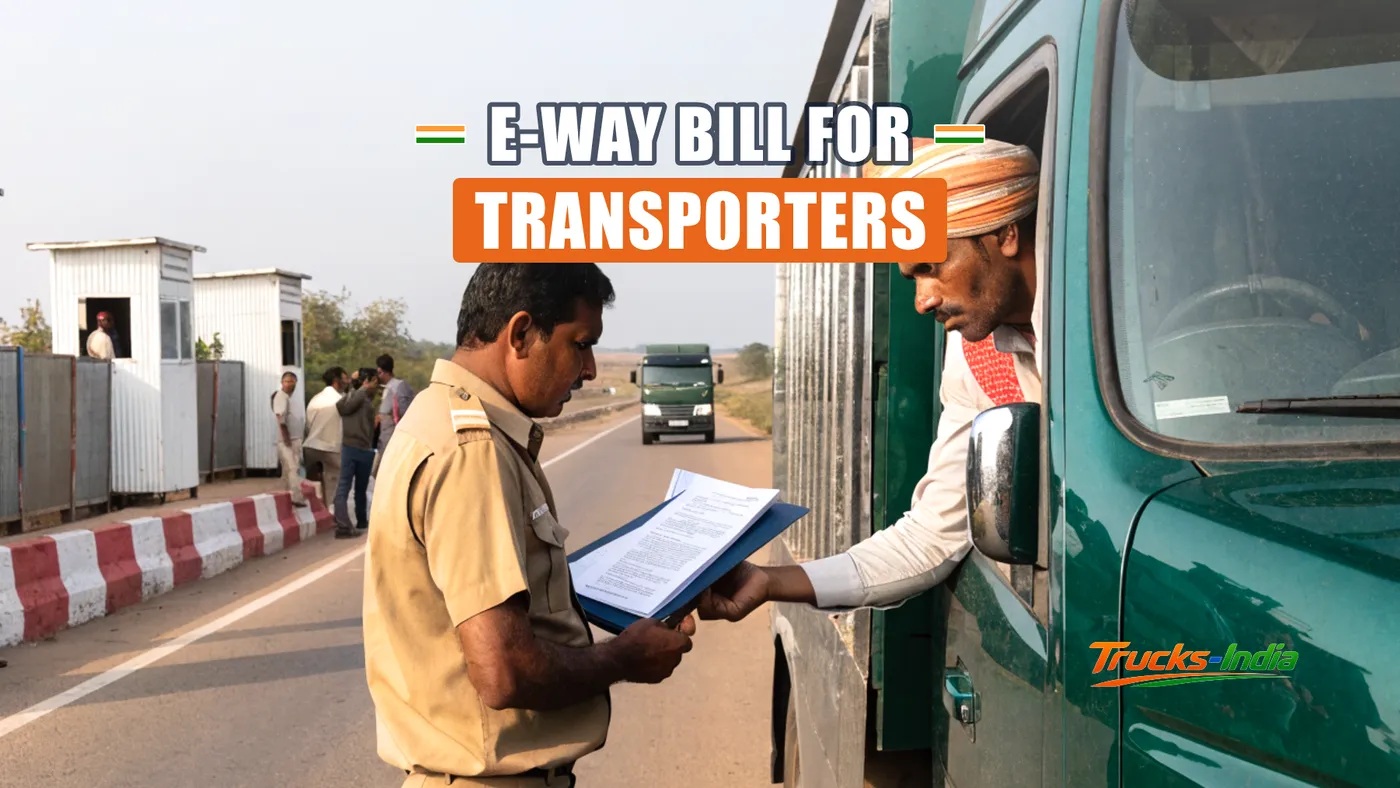
Almost everything written about the e-way bill is written for the person raising the invoice. This is written for the person carrying the goods, which is a different job with different obligations and a different set of ways to get it wrong.
The transporter's exposure is real. If the consignor has not filled Part B, you are the one at the check post with an incomplete document. If the validity expires mid trip, the vehicle stops. And two changes landing in 2026 affect the transporter directly, including one that finally lets you close a delivered e-way bill instead of leaving it open.
What the transporter is actually responsible for
An e-way bill has two parts and the split decides who is liable.
Part A holds the consignment details: the GSTIN of both parties, the place of dispatch and delivery, the invoice number and date, the value, the HSN code and the reason for transport. It is normally filled by the supplier.
Part B holds the vehicle number and the transporter's details. This is the transporter's part, and a bill without Part B is not a valid e-way bill for movement.
That single fact is where most transporter trouble starts. A consignor who generates Part A and hands you the number has not finished the job. Until Part B carries your vehicle number, the goods are moving on an incomplete document, and the vehicle in front of the officer is yours.
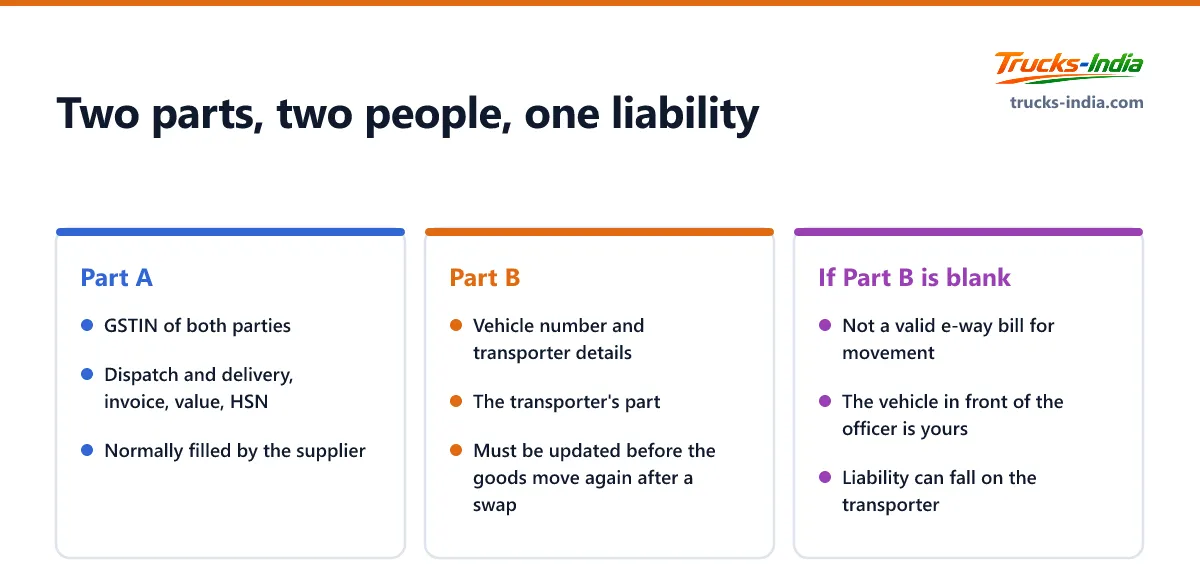
The other thing worth knowing: if the consignor has not generated the bill at all, the liability can fall on the transporter when goods are handed over for movement. Ask before you load, not after.
Transporter ID, and why you want one
A transporter who is not registered under GST cannot have a GSTIN, but still has to appear on the document. The answer is a transporter ID, sometimes called a TRANSIN, which is a 15 digit identifier obtained by enrolling on the e-way bill portal.
Get one if you carry for others. It lets you be named on the bill, lets you update Part B, and lets clients assign consignments to you properly rather than improvising. Enrolment is free and is done once.
If you are GST registered, your GSTIN performs the same function and you do not need a separate ID.
Validity, and the part that strands vehicles
Validity is calculated from distance, not from goodwill, and it runs from the time Part B is first entered.
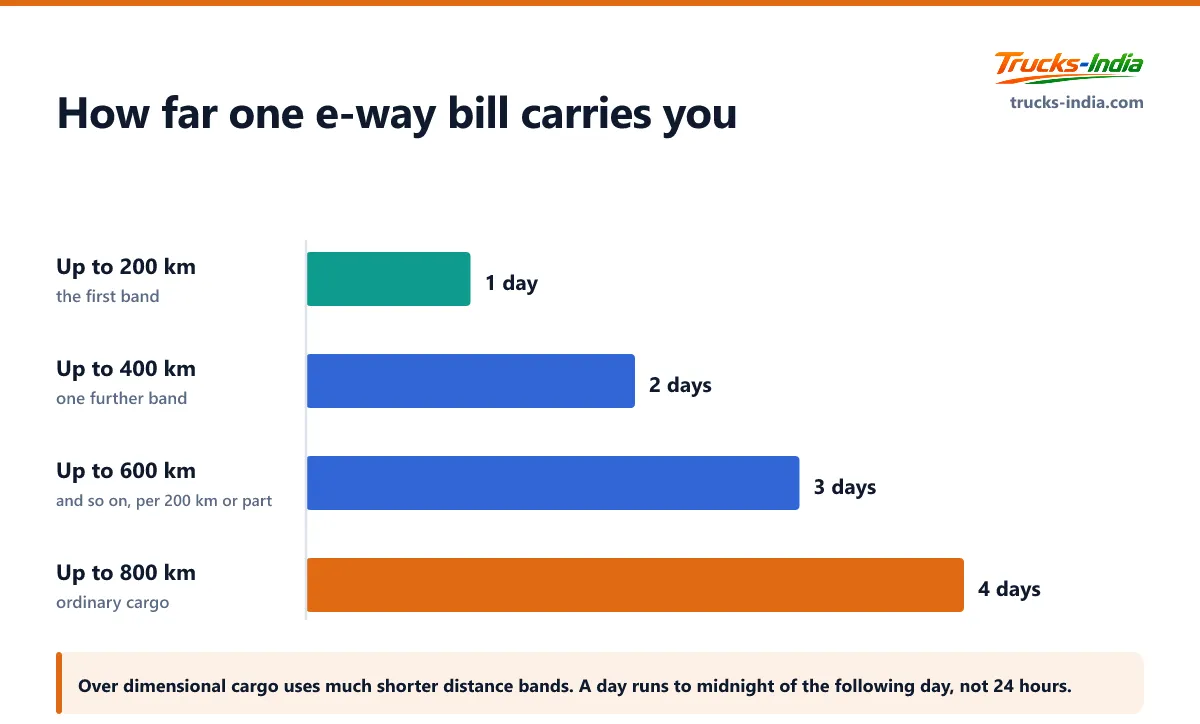
For ordinary cargo the rule is one day for the first 200 km, and one additional day for every 200 km or part thereof after that. For over dimensional cargo the distance band is much shorter.
Two practical consequences.
A day means until midnight of the following day, not 24 hours from generation, which is a distinction that catches people at the margin.
If the vehicle is delayed by a breakdown, a natural calamity or a transhipment, the bill can be extended, but the extension has to be done within the window around expiry rather than days later. Under the current portal rules there is also a cap on how far an e-way bill can be extended in total, so an indefinitely delayed consignment eventually needs a fresh document rather than another extension.
A bill that has expired in transit is the single most common reason a loaded truck is detained. Diary the expiry the way you would diary a permit renewal.
Changing the vehicle mid journey
This happens constantly and there is a correct way to do it.
If the goods move to a different vehicle, because of a breakdown, a transhipment or a route change, update Part B with the new vehicle number before the goods move again. The e-way bill number stays the same; only the conveyance details change.
Carrying goods in a vehicle whose number does not match Part B is treated as moving without a valid e-way bill, whatever the reason for the swap.
What changed in 2026
Three things, and the first two matter to you directly.
E-way bill closure. You can now formally close an e-way bill once the goods have been delivered. Under the portal rules the supplier, the recipient, the transporter, or a driver or authorised person whose mobile number is on the document can close it. This is genuinely useful: it ends the open document rather than leaving it to expire, and it removes the ambiguity about whether a consignment is still in transit.
Ship-To GSTIN became mandatory. From 1 August 2026, the Ship-To GSTIN field must be filled when generating an e-way bill for a Bill-To / Ship-To transaction, where the goods go to a GST registered location different from the billing party. The change was originally scheduled for 15 June 2026 and was deferred. It sits on the generation side rather than yours, but it is the most common reason a client's bill is now rejected, and a client who cannot generate is a client whose load you cannot move.
E-Way Bill 2.0 portal. GSTN runs a second portal alongside the original to reduce downtime, with data syncing between the two. If the main portal is unreachable, the other one is worth trying before you assume the system is down. Multi factor authentication on login is also now in force.
The documents that travel with the bill
The e-way bill does not travel alone. The person in charge of the vehicle should have the invoice or delivery challan, and the e-way bill number in a form that can be produced, whether that is a printout, the number itself or a device showing it.
The wider set of papers that belongs in the cab, from the registration certificate to the permit and the fitness certificate, is covered in the documents to carry in a truck guide.
Where transporters actually get caught
Five recurring failures, all avoidable.
- Part B never filled, because everybody assumed the other side had done it
- Validity expired in transit, usually on a trip that was delayed a day
- Vehicle number does not match after an unrecorded transhipment
- No e-way bill at all on a consignment above the threshold, because the consignor said it was not needed
- Details that do not match the invoice, particularly value and place of delivery
None of these is a judgement call. All five are a check before the wheels turn.
If you are unsure whether a specific consignment needs a bill at all, that is a question for the consignor's accountant with the invoice in front of them, not something to settle at the loading point.
Frequently asked questions
Part B carries the vehicle number and transporter details and is normally the transporter's responsibility. An e-way bill without Part B is not valid for movement, so a consignor who generates Part A and hands over the number has not completed the document.
A 15 digit identifier for transporters who are not registered under GST and therefore have no GSTIN. You enrol once on the e-way bill portal, free of charge, and the ID lets you be named on bills and update Part B. GST registered transporters use their GSTIN instead.
For ordinary cargo, one day for the first 200 km and one further day for every additional 200 km or part thereof, counted from when Part B is first entered. Over dimensional cargo uses much shorter distance bands. A day runs to midnight of the following day rather than a rolling 24 hours.
Yes, for reasons such as a breakdown, natural calamity or transhipment, but the extension must be done within the window around expiry rather than afterwards, and the portal caps how far a bill can be extended in total. A long delayed consignment eventually needs a fresh document.
Three changes. E-way bills can now be formally closed after delivery, by the supplier, recipient, transporter or the driver whose mobile number is on the document. Ship-To GSTIN became mandatory for Bill-To / Ship-To transactions from 1 August 2026, deferred from 15 June. And the E-Way Bill 2.0 portal now runs alongside the original with synced data, with multi factor authentication at login.
Update Part B with the new vehicle number before the goods move again. The e-way bill number itself stays the same. Carrying goods in a vehicle that does not match Part B is treated as moving without a valid e-way bill, regardless of why the vehicle was swapped.
Where this fits
The e-way bill is one of the papers that has to travel with the load. See our guide to documents to carry in a truck.
Compliance follows the vehicle you run. Trucks India lists payload, gross weight and price for every model sold in India.
Call +91 93422 00875About the author
Lokesh R
CEO of Trucks India
Lokesh R is the founder of Trucks India, an independent heavy-vehicle marketplace and research platform operated from Chennai, Tamil Nadu, founded in 2025. Under his direction, Only Heavy publishes specifications and prices sourced from manufacturers, authorised dealer price lists and official regulatory schedules, with every model page checked by a named reviewer, prices re-verified monthly and after any GST revision, and no advertiser able to buy a rating, ranking or comparison result.


