
What to Do if a Truck Breaks Down on Highway
The order of actions after a truck breaks down on an Indian highway: warning devices, the 1033 helpline, towing costs, and what to keep in the cab ready.

Lokesh R
CEO of Trucks India
Created 27 September 2026 · 6 min read
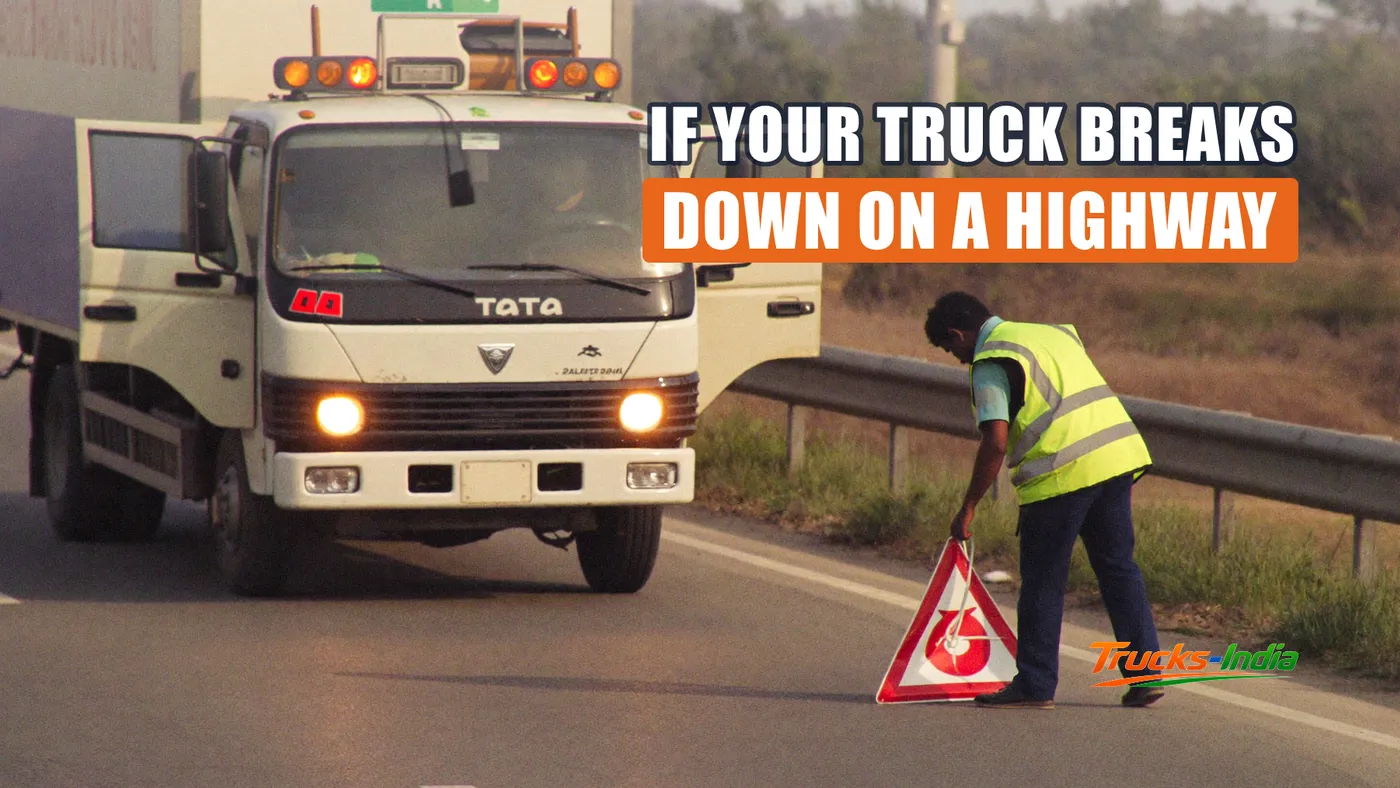
The dangerous part of a highway breakdown is not the mechanical failure. It is the twenty minutes after it, with a large stationary object on a live carriageway and traffic arriving at speed.
Rear end collisions with stopped trucks are a recognised and lethal pattern on Indian highways, and they are worst at night. The sequence below is ordered accordingly: make yourself visible, then make yourself safe, then worry about the vehicle.
The first five minutes
Order matters here and it is not the order instinct suggests.
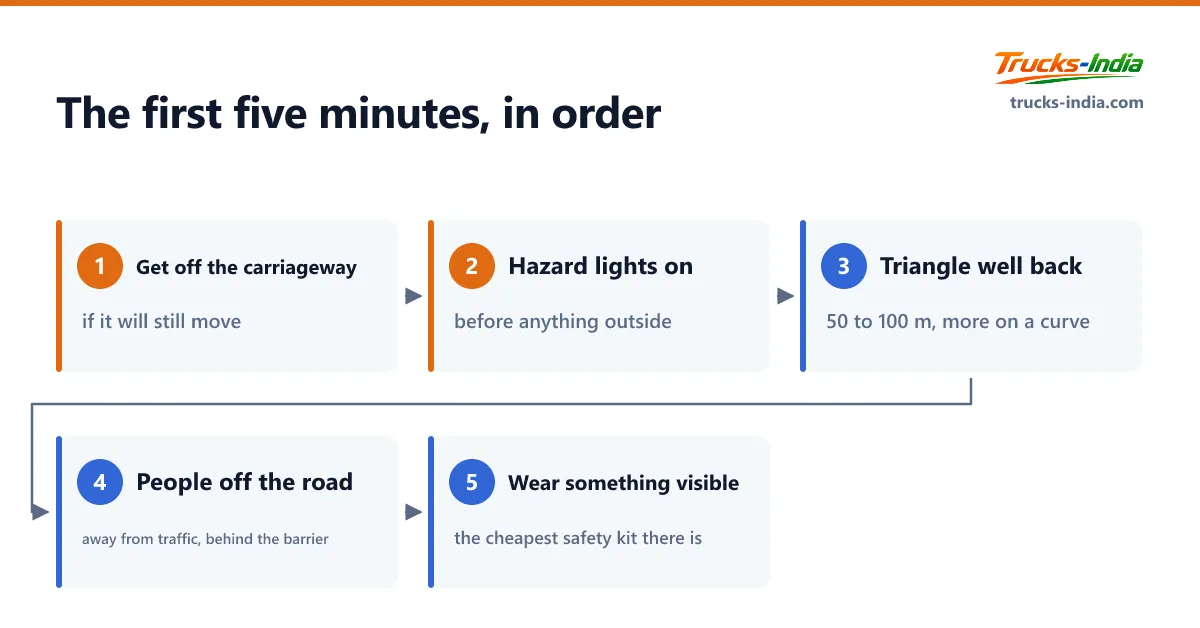
Get the vehicle off the carriageway if it will still move. Even a slow crawl onto a shoulder or a side road is better than stopping in a lane. If it has stopped dead in a lane, accept that and move to the next step rather than trying to push it.
Hazard lights on immediately, before anything else you do outside the cab.
Place warning devices well back. A reflective triangle, cones, or in the older practice branches, but placed far enough back that a driver at highway speed has time to react. Fifty to a hundred metres, further on a curve or a crest where you cannot be seen until late. Placing a triangle three metres behind the truck is a common and useless habit.
Get people out of the vehicle and off the road, on the side away from traffic, behind the barrier if there is one. Sitting in a stationary cab on a live carriageway is the single most dangerous choice available.
Wear something visible. A reflective jacket in the cab costs very little and is the cheapest safety equipment you will ever buy.
Only once all of that is done should anyone look at the engine.
Who to call
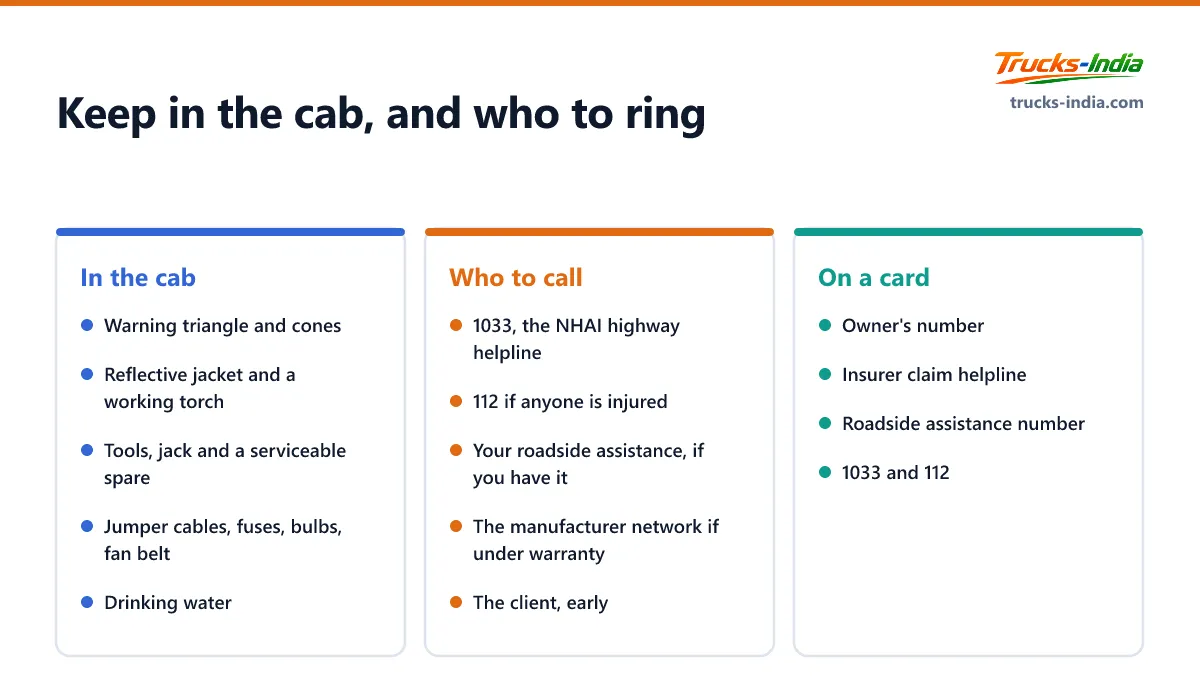
1033 is the NHAI highway helpline, and it is the number for an incident on a national highway: emergency assistance, ambulance, crane and recovery support.
112 is the national emergency number if anyone is injured or the situation is unsafe.
Then, in whatever order fits:
Your own roadside assistance, if the vehicle is under a manufacturer programme or your insurance includes it. Many owners are paying for this and forget they have it, which is worth checking before you need it, as the warranty and AMC guide explains.
The manufacturer's service network, if the vehicle is under warranty. Getting it repaired outside can affect the cover.
Your own mechanic, who will often diagnose the problem from a phone description faster than anybody else.
The client, early. A load arriving late with notice is a very different conversation from a load arriving late without it.
What to keep in the cab
This list costs almost nothing and decides how the next two hours go.
- Reflective warning triangle, and ideally cones
- A reflective jacket
- A torch with working batteries
- Basic tools, a jack and a functioning spare wheel
- Jumper cables
- Spare fuses, bulbs and fan belt
- Drinking water
- A card with the owner's number, the insurer's claim helpline, the roadside assistance number and 1033
The card matters more than it sounds. A driver under pressure at night should not be scrolling for a number, and a relief driver may not have them at all. The rest of the document folder is covered in the documents to carry guide.
Towing, and what it costs
If the vehicle cannot be repaired roadside, it has to be recovered.
Costs vary widely with distance, the size of the vehicle and how much of a recovery job it is, and heavy vehicle recovery is genuinely expensive. Three practical points.
Agree the charge before the crane hooks up, not afterwards. Negotiating while your truck is suspended is not negotiating.
Ask where it is being taken. A workshop chosen by the crane operator is not necessarily the one you want, and moving the vehicle again costs a second recovery.
Check whether your policy covers it. Some comprehensive policies and most roadside assistance add ons include towing up to a limit. This is one of the few add ons that clearly earns its place on long haul work, as the guide to what a truck policy covers covers.
The load is a separate problem
The vehicle and the consignment need separate decisions.
Do not abandon a loaded vehicle with a driver's belongings and no supervision. If the driver must leave, arrange for someone to stay with it.
Transhipment. If the load moves to another vehicle, the e-way bill Part B has to be updated with the new vehicle number before it moves again. Carrying goods in a vehicle that does not match Part B is treated as moving without a valid e-way bill, whatever the reason, as the e-way bill guide explains.
Validity. A breakdown is a recognised reason to extend an e-way bill, but the extension has to be done within the window around expiry rather than days later.
Tell the client in writing, so the delay is documented rather than argued about later. If the breakdown involved a collision rather than a mechanical failure, the sequence is different and is set out in the accident procedure guide.
Most breakdowns were scheduled
The uncomfortable part.
The failures that strand trucks on highways are overwhelmingly the predictable ones: tyres, battery, belts, hoses, air system, clutch and overheating. Almost all of them announce themselves first, either at a daily check or as a change in how the vehicle drives, and almost all of them are in the preventive schedule.
A ten minute walk around before the first trip, covering oil, coolant, tyre pressure, brakes, lights, visible leaks and the AdBlue level on a BS6 vehicle, removes a large share of this. That checklist and the intervals behind it are in the maintenance cost and schedule guide.
Worth one more thought at purchase, too. Service network reach is a buying factor, and it is invisible until the day you are stranded on a corridor where your manufacturer has no presence.
Trucks to compare
A few popular trucks on Trucks India, with ex-showroom price and rated payload. Open one for its full price, specifications and mileage.
Browse more: Mini trucks, Light commercial vehicles, Heavy trucks, Tata Motors trucks, Ashok Leyland trucks, Mahindra trucks
Frequently asked questions
Move the vehicle off the carriageway if it will still move, put the hazard lights on, place a warning triangle well back, fifty to a hundred metres and further on a curve or crest, and get everybody out of the vehicle and off the road on the side away from traffic. Look at the engine only after that.
1033 is the NHAI helpline for national highways, covering emergency assistance, ambulance and crane support. Use 112 if anyone is injured or the situation is unsafe.
It varies widely with distance, vehicle size and how much of a recovery job it is, and heavy vehicle recovery is expensive. Agree the charge before the crane hooks up, confirm where the vehicle is being taken, and check whether your policy or roadside assistance add on already covers it.
A reflective warning triangle and cones, a reflective jacket, a torch, basic tools with a jack and a serviceable spare, jumper cables, spare fuses, bulbs and a fan belt, drinking water, and a card carrying the owner's number, the insurer's claim helpline, the roadside assistance number and 1033.
A breakdown is a recognised reason to extend an e-way bill, but the extension must be done within the window around expiry. If the load moves to another vehicle, Part B must be updated with the new vehicle number before it moves, or it counts as moving without a valid e-way bill.
Not unattended. Arrange for somebody to stay with the vehicle and the load. Beyond the theft risk, an unlit stationary truck is the hazard that causes the rear end collisions this whole sequence is designed to avoid.
Where this fits
Most breakdowns are deferred maintenance. See our guide to truck maintenance cost and schedule.
Parts availability and service reach differ by manufacturer, and both show up in downtime. Trucks India lists every model sold in India.
Call +91 93422 00875About the author
Lokesh R
CEO of Trucks India
Lokesh R is the founder of Trucks India, an independent heavy-vehicle marketplace and research platform operated from Chennai, Tamil Nadu, founded in 2025. Under his direction, Only Heavy publishes specifications and prices sourced from manufacturers, authorised dealer price lists and official regulatory schedules, with every model page checked by a named reviewer, prices re-verified monthly and after any GST revision, and no advertiser able to buy a rating, ranking or comparison result.


