
Pollution Certificate for Commercial Vehicle
The PUC for a commercial vehicle in India: how long it lasts, what the test measures, the Rs 10,000 penalty under Section 190(2), and the insurance link.

Lokesh R
CEO of Trucks India
Created 2 September 2026 · 6 min read

The PUC is the cheapest document your truck carries and the one with the worst ratio of cost to consequence. A test costs a token amount. Driving without a valid certificate carries a fine of up to ten thousand rupees, and it can take your insurance renewal down with it.
It is also the document most often forgotten, because its validity is short and it does not arrive with a reminder the way a loan instalment does.
What the certificate actually is
A pollution under control certificate records that your vehicle's exhaust emissions were measured at an authorised centre and found within the limits for its category and emission standard.
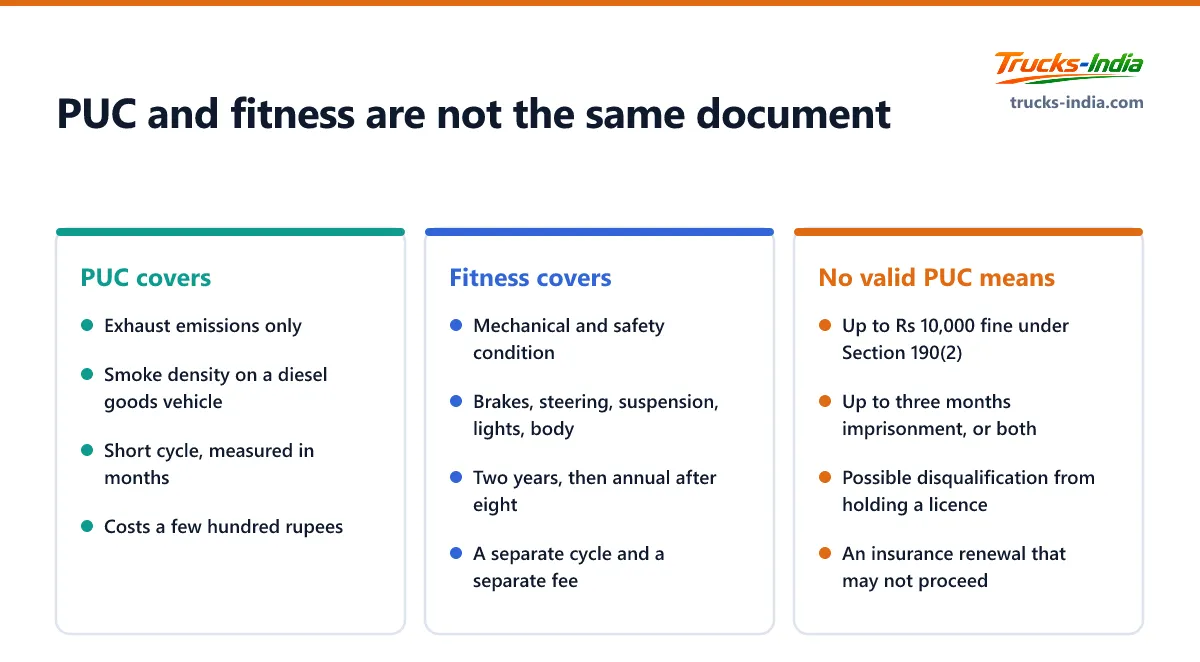
It is not a general roadworthiness check. It measures emissions and nothing else. The mechanical condition of the vehicle is the fitness certificate's job, which is a separate document with a separate cycle, covered in the fitness certificate guide.
For a diesel goods vehicle the test measures smoke density, the opacity of the exhaust under a free acceleration test, rather than the gas composition measured on a petrol vehicle.
How long it lasts
A new vehicle comes with a longer initial period from the date of registration. After that, the certificate runs on a short renewal cycle, typically measured in months rather than years, and commercial vehicles are tested more frequently than private ones.
The renewal period is set by rule rather than by the centre, and it can differ by state and by vehicle category. Two practical points that hold everywhere:
The expiry is printed on the certificate. It is the only date that matters and it is not negotiable at the roadside.
A failed vehicle gets no certificate. You are given the reading and sent to fix the problem. There is no grace period for a truck that failed, which is why leaving the test to the last week is a bad habit.
What it costs
Very little. A PUC test at an authorised centre is one of the cheapest statutory items in truck operation, in the range of a few hundred rupees at most, varying by state and fuel type.
Set against a penalty of up to ten thousand rupees, the economics are not close. Nobody skips a PUC to save money; they skip it because they forgot.
The penalty
Driving without a valid pollution certificate is an offence under Section 190(2) of the Motor Vehicles Act, and the penalty is a fine of up to ten thousand rupees, imprisonment of up to three months, or both, along with possible disqualification from holding a licence.
Two things follow that people underrate.
It is checked electronically now. PUC records sit in the central vehicle database, so an expired certificate can be picked up without anyone looking at your paperwork, which the challan guide covers.
It can block other things. In several states insurers will not issue or renew a policy without a valid PUC on record, so a lapsed certificate can quietly stall an insurance renewal, and an insurance lapse is a far larger problem than the PUC was.
BS6 vehicles and the emission system
A BS6 truck is engineered to pass, provided its emission system is intact and working.
Which means a PUC failure on a BS6 vehicle is usually telling you something specific: the AdBlue system, the diesel particulate filter or the injection system needs attention. Treat a marginal reading as a diagnostic result rather than an administrative nuisance.
It also means the obvious shortcut is a very bad idea. Devices that disable SCR or remove the DPF will make the vehicle fail emission testing, and a vehicle that cannot get a PUC cannot legally work. The BS6 guide covers what is on the vehicle and why tampering costs more than it saves.
Getting and checking one
The process is short. Take the vehicle to an authorised PUC centre, which are commonly attached to fuel stations and workshops. The operator records the registration number, runs the test, and issues the certificate with its expiry.
Bring the registration certificate or at least the registration number. Nothing else is needed.
You can verify or download a PUC record on the Parivahan portal using the registration number, which is useful when you have taken over a vehicle and do not know its status, and useful when the paper copy has disappeared into a cab. The same portal is where you can check the vehicle's other RC details.
The practical routine
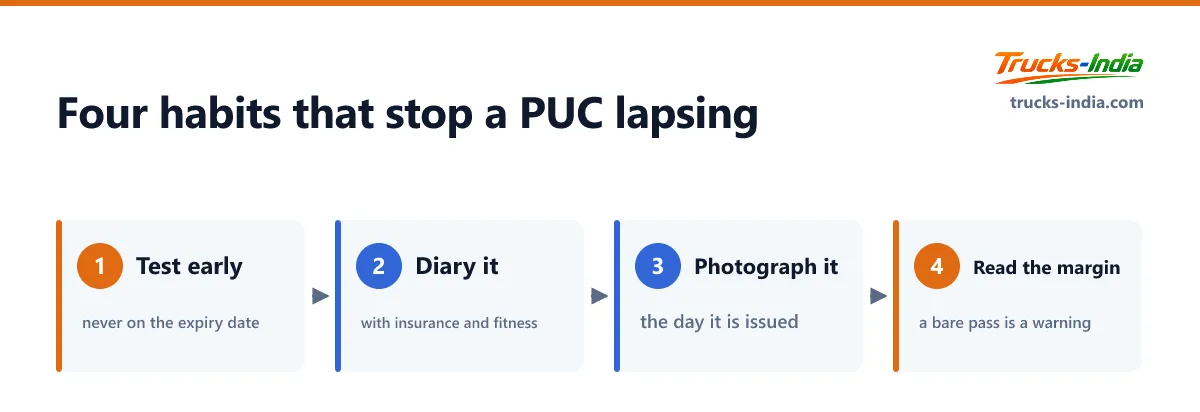
Test early, not on the expiry date. A failure on the last day means an unavailable vehicle, not just a rescheduled appointment.
Diary it with everything else. PUC, insurance, fitness and permit authorisation belong in one calendar. On a single vehicle that is a handful of dates a year; on a fleet it is the difference between managed and lucky.
Photograph the certificate the day it is issued, so the expiry is recoverable when the paper is not.
Treat a marginal pass as a warning. A reading that only just cleared this time will not clear next time, and on a BS6 vehicle it is pointing at a component.
Frequently asked questions
New vehicles get a longer initial period from registration, after which the certificate runs on a short cycle measured in months, with commercial vehicles tested more frequently than private ones. The exact period is set by rule and can vary by state and category, so the expiry printed on your certificate is the figure to work from.
Under Section 190(2) of the Motor Vehicles Act, a fine of up to ten thousand rupees, imprisonment of up to three months, or both, with possible disqualification from holding a licence.
Very little, generally a few hundred rupees at an authorised centre, varying by state and fuel type. It is among the cheapest statutory items in truck operation, which is why the penalty is so disproportionate.
In several states insurers will not issue or renew a policy without a valid PUC on record. A lapsed certificate can therefore stall an insurance renewal, which is a much larger problem than the PUC itself.
Because something in the emission system needs attention, usually the AdBlue system, the diesel particulate filter or the injection system. A BS6 vehicle is built to pass comfortably when intact, so a marginal or failed reading is a diagnostic result rather than an administrative problem.
On the Parivahan portal, using the registration number. This is the quickest way to establish the position on a vehicle you have just acquired, or when the paper certificate has gone missing.
Where this fits
The PUC is one of the papers that must be in the cab. See our guide to documents to carry in a truck.
Emission compliance is built into every new truck sold today. Trucks India lists payload, mileage and price for every model in India.
Call +91 93422 00875About the author
Lokesh R
CEO of Trucks India
Lokesh R is the founder of Trucks India, an independent heavy-vehicle marketplace and research platform operated from Chennai, Tamil Nadu, founded in 2025. Under his direction, Only Heavy publishes specifications and prices sourced from manufacturers, authorised dealer price lists and official regulatory schedules, with every model page checked by a named reviewer, prices re-verified monthly and after any GST revision, and no advertiser able to buy a rating, ranking or comparison result.


