
Truck Accident Procedure in India
What to do after a truck accident in India: the duty to help the injured, the FIR, the evidence to collect, and the claim steps that decide whether it is paid.

Lokesh R
CEO of Trucks India
Created 27 September 2026 · 7 min read

The decisions taken in the first hour after a truck accident shape everything that follows: the injured person's outcome, the criminal position, and whether the insurance claim is paid or argued about for a year.
Most of those decisions are made by a driver who is shaken, alone and a long way from home. Which is why the sequence should be agreed and written down before it is ever needed, not worked out at the roadside.
The order of priority
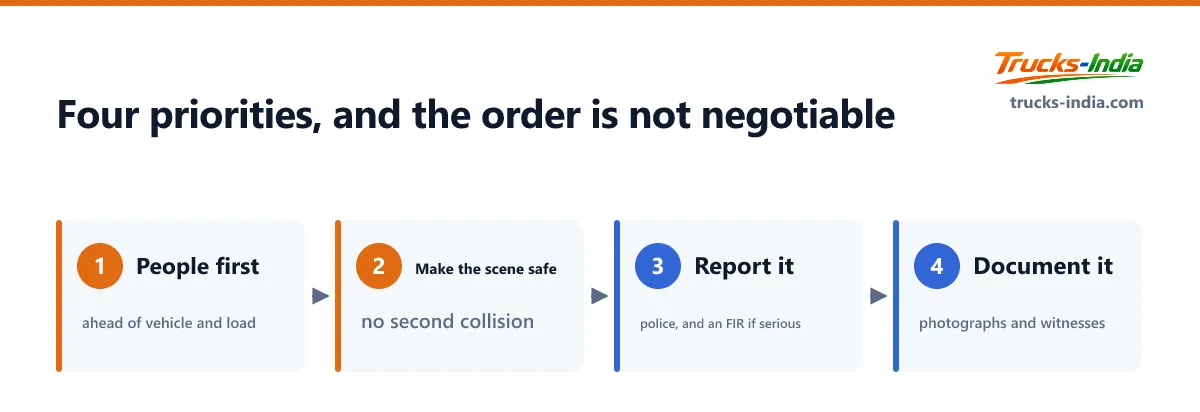
Four things, in this order, and the order is not negotiable.
People first. Anyone injured is the immediate priority, ahead of the vehicle, the load and the paperwork.
Make the scene safe, so a second collision does not happen. Hazard lights, warning triangle well back, and people off the carriageway. The same sequence applies to a breakdown on a highway, where the stopped vehicle is itself the hazard.
Report it.
Document it.
Insurance comes fourth. It matters enormously, and it still comes fourth.
The legal duty to help
This is the part drivers most need to hear, because fear of the crowd drives the wrong decision.
Under the Motor Vehicles Act, the driver has a statutory duty to take all reasonable steps to secure medical attention for an injured person, and to report the accident to the police. Failing to stop is an offence in its own right and it converts a defensible situation into an indefensible one.
The law also protects the person who helps. Good Samaritan protections exist specifically so that anyone who takes an injured person to hospital is not subjected to harassment, detention or repeated questioning, and cannot be compelled to disclose their identity. Hospitals are required to provide immediate treatment.
The golden hour is the reason all this exists. Getting an injured person to care quickly is the single largest factor in survival, and no consideration about liability outranks it.
112 for emergency services, 1033 on a national highway.
When the crowd is a problem
It has to be said plainly, because it is the real situation on Indian roads and pretending otherwise is not useful advice.
If remaining at the scene is genuinely unsafe for the driver, the correct action is to go directly to the nearest police station and report immediately, not to disappear. Leaving and reporting is a defensible sequence. Leaving and not reporting is not, and it removes every protection the driver has.
Instruct drivers accordingly, in advance, in plain words. A driver who knows the rule will act on it; a driver improvising under fear will not.
Reporting and the FIR
Report to the police. In a serious accident, particularly one involving injury or death, an FIR will be registered.
Two things owners get wrong.
Do not treat the FIR as something to avoid. For an insurance claim involving injury, death or third party damage, the police record is usually essential. A claim without it is a much harder claim.
Get a copy, and note the FIR number, the police station and the officer's details.
For a minor incident with no injury and only your own vehicle damaged, a police report may not be required, but your insurer's own requirements still apply. Ring the insurer and ask before deciding it does not matter.
What to collect at the scene
If it is safe to do so, and only then. Photographs take a minute and settle disputes that otherwise take a year.
- The scene from several angles, before vehicles move, showing positions on the road
- Damage to all vehicles involved
- Registration plates of every vehicle
- Road conditions, signage, lighting, weather, any skid marks
- The other party's details: name, phone, licence, registration, insurer and policy number
- Witnesses, names and phone numbers, which are almost impossible to obtain later
- Your own load, if it shifted or was damaged
If the vehicle carries a tracking device, the record of speed and position before the incident is evidence, and it is as likely to help you as to hurt you. The AIS-140 guide covers what the device actually holds.
The insurance sequence
Inform the insurer immediately. Most policies require prompt notification and late reporting is one of the standard grounds for declining a claim.
Do not start repairs before the surveyor has inspected, unless the insurer authorises it. A repaired vehicle is an uninspectable vehicle.
Assemble the documents: policy, registration certificate, driving licence of the person driving, FIR copy, fitness certificate, permit, and photographs.
Cooperate with the surveyor, who assesses the loss on the insurer's behalf.
Then the part that decides the outcome.
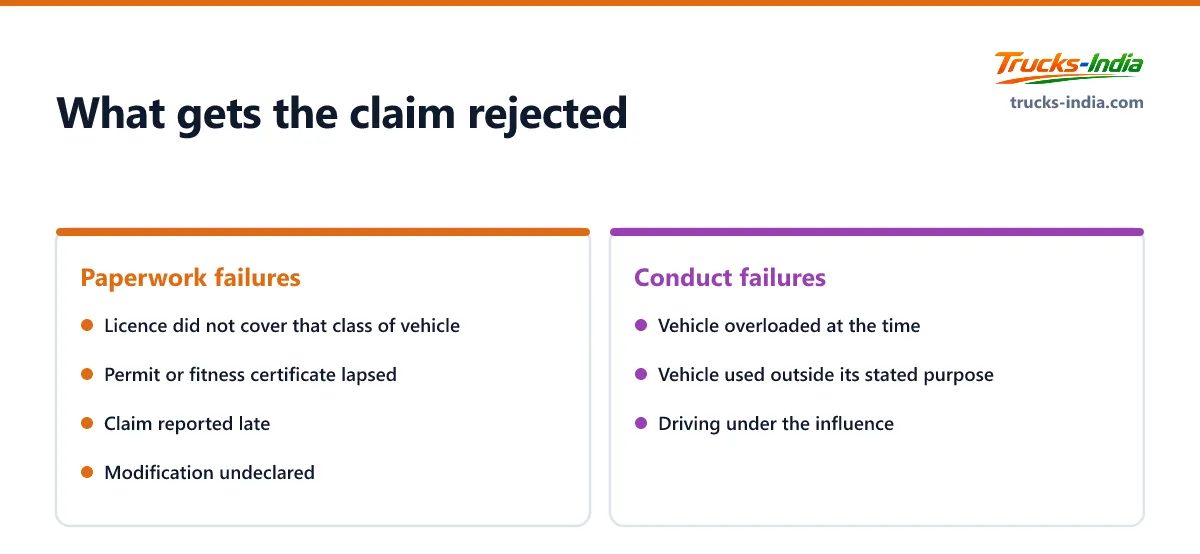
What gets a truck accident claim rejected
Look at this list before an incident, not after. Every item is avoidable.
- The driver's licence did not cover that class of vehicle. The most common single reason a commercial vehicle claim fails, and it is entirely preventable by checking at hiring, as the guide to heavy vehicle licence classes explains.
- The permit or fitness certificate had lapsed at the time of the incident.
- The vehicle was overloaded, which the axle load guide covers.
- The vehicle was used outside its stated purpose.
- The claim was reported late.
- Driving under the influence.
- An undeclared modification, as the modification guide sets out.
Notice that most of these are paperwork rather than driving. The renewals calendar is not administrative housekeeping; it is what stands between you and an unpaid claim on the worst day of your year. The full picture is in the truck insurance guide.
Third party claims take years, and that is the point of cover
A claim by an injured third party goes to a Motor Accident Claims Tribunal, and those proceedings run for a long time.
This is precisely why third party cover is compulsory and why letting it lapse is the most dangerous economy in trucking. An uninsured vehicle in a serious injury case is a personal liability with no ceiling, and it does not go away.
If you employ a driver, legal liability to paid driver on the policy is the equivalent protection for an injury to your own driver. Without it, that claim lands on you personally.
Write the procedure down
One page in the cab, alongside the document folder.
The order of priority, the emergency numbers, the insurer's claim helpline, the owner's number, what to photograph, and the instruction about going straight to the police station if the scene is unsafe.
It costs nothing. It is read exactly once, by somebody who needs it.
Trucks to compare
A few popular trucks on Trucks India, with ex-showroom price and rated payload. Open one for its full price, specifications and mileage.
Browse more: Mini trucks, Light commercial vehicles, Heavy trucks, Tata Motors trucks, Ashok Leyland trucks, Mahindra trucks
Frequently asked questions
Attend to anyone injured, then make the scene safe with hazard lights and a warning triangle placed well back, then report to the police, then document the scene. Insurance comes fourth. There is a statutory duty to take reasonable steps to secure medical attention for an injured person.
For a serious accident involving injury, death or third party damage, the police record is usually essential and a claim without it is much harder. For a minor incident with only your own vehicle damaged it may not be required, but confirm with your insurer rather than assuming.
Go directly to the nearest police station and report immediately. Leaving and reporting is defensible; leaving and not reporting is an offence and removes every protection the driver has. Instruct drivers on this in advance, in plain words.
Photographs of the scene from several angles before vehicles move, damage to all vehicles, registration plates, road and weather conditions, the other party's name, phone, licence, registration and insurer, and witness names and numbers, which cannot be obtained later.
Most commonly because the driver's licence did not cover that class of vehicle, the permit or fitness certificate had lapsed, the vehicle was overloaded or used outside its stated purpose, the claim was reported late, the driver was under the influence, or a modification was undeclared. Most of these are paperwork rather than driving.
A claim by an injured third party goes to a Motor Accident Claims Tribunal and proceedings run for a long time. That is exactly why third party cover is compulsory: an uninsured vehicle in a serious injury case is a personal liability with no ceiling.
Where this fits
The claim that follows depends on your cover. See our guide to commercial vehicle insurance.
Cover, compliance and the vehicle itself all decide the outcome. Trucks India lists every model sold in India with payload, mileage and price.
Call +91 93422 00875About the author
Lokesh R
CEO of Trucks India
Lokesh R is the founder of Trucks India, an independent heavy-vehicle marketplace and research platform operated from Chennai, Tamil Nadu, founded in 2025. Under his direction, Only Heavy publishes specifications and prices sourced from manufacturers, authorised dealer price lists and official regulatory schedules, with every model page checked by a named reviewer, prices re-verified monthly and after any GST revision, and no advertiser able to buy a rating, ranking or comparison result.


