
How to Get a Contract for Your Truck
How to win committed freight contracts in India: who awards them, the vendor onboarding documents, how to price a contract rate, and the terms that matter.

Lokesh R
CEO of Trucks India
Created 31 August 2026 · 6 min read

Spot loads keep a truck busy. Contracts keep it planned.
The difference matters more than it sounds. A spot load is a single job at whatever the market pays today, found again from scratch next week. A contract is committed volume over a period at an agreed rate, which turns an unpredictable business into one you can budget, staff and finance against.
Contracts are also harder to win, and the reasons operators fail to win them are consistent enough to be worth naming.
How to get a contract for your truck
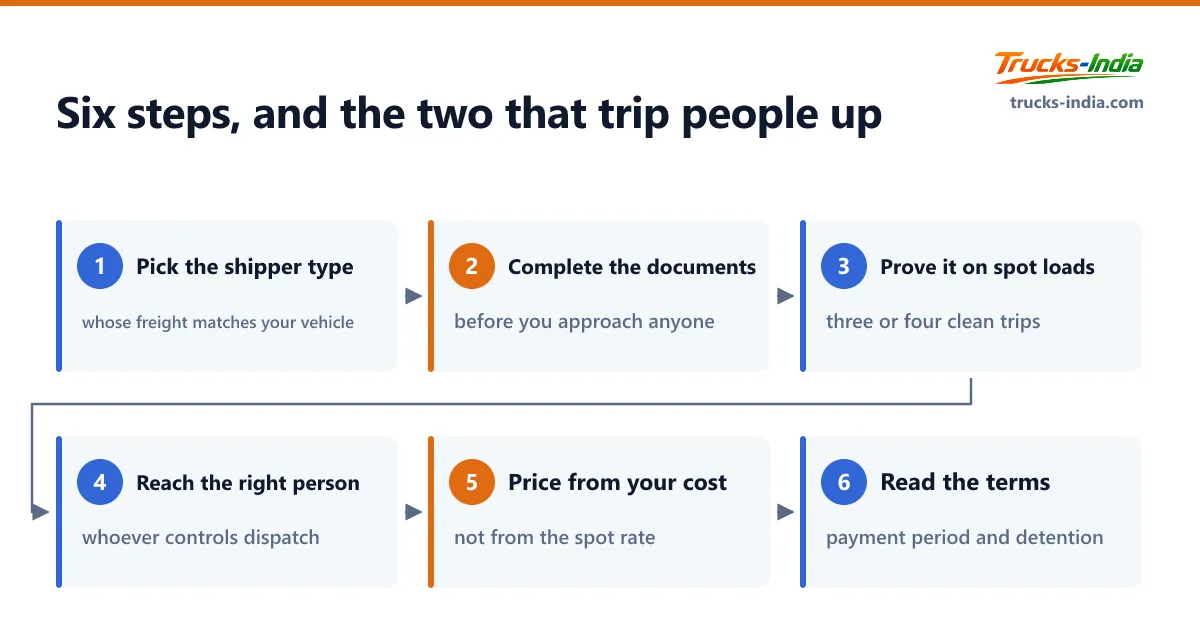
The path is fairly consistent regardless of who you approach.
- Pick a shipper type whose freight matches your vehicle
- Get your documentation complete before you approach anyone
- Prove reliability on spot loads first
- Approach the right person, which is rarely the front desk
- Price the contract against your real cost per kilometre
- Read the terms, particularly payment and detention
Most first attempts fail at step two or step five.
Who actually awards freight contracts
Manufacturers and processing units. Regular outbound movement to distributors or ports. Volume is predictable, which is exactly what makes a contract possible.
Distributors and wholesalers. Shorter, repeated routes. Often more accessible to a small operator than a manufacturer.
Construction and infrastructure firms. Tipper and bulk work, project based, with volume tied to site activity. Specialised vehicles like the AVTR 3520 8x4 tipper or a transit mixer such as the Blazo X 28 are what these contracts want.
Logistics and courier companies. They subcontract heavily, and this is often the most realistic first contract for a single truck owner.
E-commerce and retail. High volume, demanding service standards, extensive onboarding.
Agricultural buyers and mandis. Seasonal, which cuts both ways: reliable while the season runs, absent when it does not.
Get the documents ready first
Vendor onboarding stalls on paperwork more often than on price. Have clean scans of all of this before your first conversation.
- GST registration certificate
- PAN, and the entity's incorporation or partnership documents where applicable
- Cancelled cheque and bank details matching the GST name exactly
- Vehicle registration certificate
- Goods carriage permit
- Fitness certificate
- Commercial vehicle insurance
- Driver's commercial licence
- Udyam registration, frequently asked for
The name on your invoice, your GST registration and your bank account must match. Mismatches are the single most common reason a vendor file sits unprocessed.
Larger companies add their own vendor form and sometimes bank verification. Being the transporter whose file is complete on the first submission puts you ahead of most of the competition before rates are even discussed.
Reliability is the actual qualification
Nobody awards committed volume to an unknown. The realistic route is to carry that shipper's spot loads first, through a broker, a truck booking app or directly, and be conspicuously easy to work with: arriving when promised, communicating delays before they are noticed, delivering cargo undamaged, invoicing correctly.
Three or four clean trips is a stronger argument than any pitch. Shippers award contracts to reduce their own risk, so the operator who has demonstrably not created problems is the one they choose.
Price the contract properly
A contract locks a rate for a period. That is its value and its danger.
Work from your cost per kilometre, not from the spot rate. Take real mileage from your model's page against today's fuel prices, add tolls for the specific route, the per kilometre share of tyres and maintenance, then your fixed costs spread across the committed volume.
Then account for three things spot pricing lets you ignore.
The return leg. If the contract route runs one way and returns empty, the contract must carry the cost of both legs. This is the most common pricing mistake.
Fuel movement. Over a year, diesel prices move. Ask for a fuel escalation clause tied to a published rate. Many shippers will agree if you raise it; almost none will offer it.
Committed capacity. If your truck is reserved for this contract, you cannot take a better paying spot load. That option has value, and giving it up should be priced.
Tipper contracts are awarded differently
If you run a tipper, the freight contract advice above only half applies.
Tipper work comes from construction, mining, infrastructure projects and material suppliers rather than from shippers moving finished goods. That changes who you approach: site contractors, quarry and crusher operators, ready mix concrete plants, road project contractors and the civil contractors working under them.
Three things are different in practice. Payment is often per trip or per tonne against a fixed lead distance, not per kilometre. Work is tied to a project, so it arrives in bursts and ends when the project does, which makes a single large contract riskier than it looks. And site conditions destroy vehicles faster than highway work, so a rate that looks good against a haulage benchmark may not be once you price tyres and suspension properly.
The way in is usually local and direct. Registering with the civil contractors working in your district, and being available reliably at short notice, wins tipper work far more often than a formal vendor onboarding process does.
The terms that matter
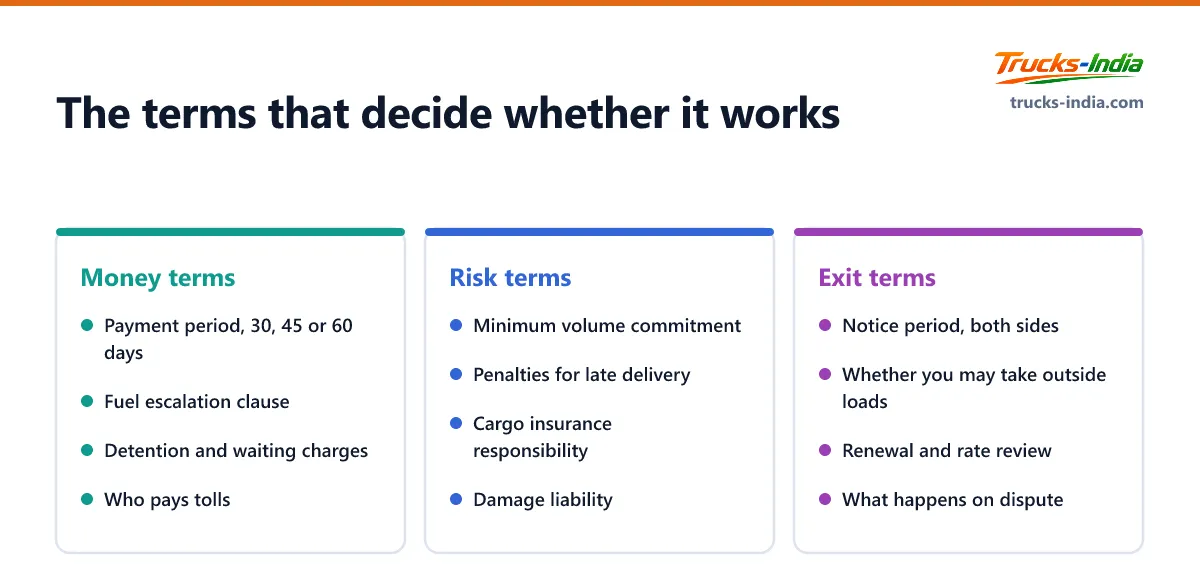
- Payment period. 30, 45 or 60 days changes your working capital requirement fundamentally. It is more important than a small difference in rate.
- Detention and waiting charges. What happens when their loading bay holds your truck for a day. Without this clause you absorb the cost of their delays.
- Minimum volume commitment. A contract with no volume floor is a rate card, not a contract.
- Fuel escalation.
- Penalties. Understand what late delivery or damage costs you before signing.
- Notice period on either side.
A realistic first contract
For a single truck owner, the most achievable first contract is usually with a local distributor or a logistics company subcontracting a regular route, rather than a manufacturer running formal procurement. Smaller shippers decide faster, onboard more simply, and are more willing to work with an operator who has one vehicle and a good record.
Attachment with a logistics company is a related option worth considering: steady volume and predictable payment, at fixed rates and with less control over routing.
Contracts are one of six ways to keep a truck loaded. See the full range of load channels, and compare a contract against attachment with a company, which trades rate for steadier utilisation.
Trucks to compare
A few trucks for a transport business on Trucks India, with ex-showroom price and rated payload. Open one for its full price, specifications and mileage.
Browse more: Mini trucks, Light commercial vehicles, Heavy trucks, Premier Motors trucks, Maruti Suzuki trucks, Tata Motors trucks
Frequently asked questions
Match your vehicle to a shipper type, complete your documentation, prove reliability on their spot loads first, approach the person who actually controls dispatch, and price the contract from your own cost per kilometre rather than from the spot rate.
GST certificate, PAN, entity documents, a cancelled cheque with matching name, vehicle registration, permit, fitness certificate, insurance and the driver's commercial licence. Udyam registration is often requested too.
Sometimes. A contract trades rate for certainty, which reduces idle days and makes cash flow predictable. It only works if the committed rate covers your full cost including the return leg, and if the payment period suits your reserve.
It adjusts your contract rate as diesel prices move, usually against a published rate. On any contract running several months it protects you from absorbing fuel increases. Shippers rarely offer it, so ask.
Approach the work rather than the shippers. Tipper contracts come from civil contractors, quarry and crusher operators, ready mix concrete plants and road project contractors, and are usually awarded locally to operators who are registered with them and reliably available at short notice, rather than through a formal vendor onboarding process.
Not quite. Attachment usually means running a company's loads on their terms and rate card, with steadier utilisation but less control over routing. A contract is a negotiated agreement between you and a shipper for defined volume.
Where this fits
Contracts are one of six load channels. See our guide to getting loads for your truck.
A contract is only worth signing if the truck can serve it profitably. Trucks India lists payload, mileage and on road price for every model sold in India.
Call +91 93422 00875About the author
Lokesh R
CEO of Trucks India
Lokesh R is the founder of Trucks India, an independent heavy-vehicle marketplace and research platform operated from Chennai, Tamil Nadu, founded in 2025. Under his direction, Only Heavy publishes specifications and prices sourced from manufacturers, authorised dealer price lists and official regulatory schedules, with every model page checked by a named reviewer, prices re-verified monthly and after any GST revision, and no advertiser able to buy a rating, ranking or comparison result.


