
Truck Loan Foreclosure Charges
Foreclosure and prepayment charges on a commercial vehicle loan, the RBI 2025 Directions applying from January 2026, and the NOC you must collect after closing.

Lokesh R
CEO of Trucks India
Created 26 September 2026 · 6 min read

If you are thinking about paying off a truck loan early, one regulatory change should be the first thing you check.
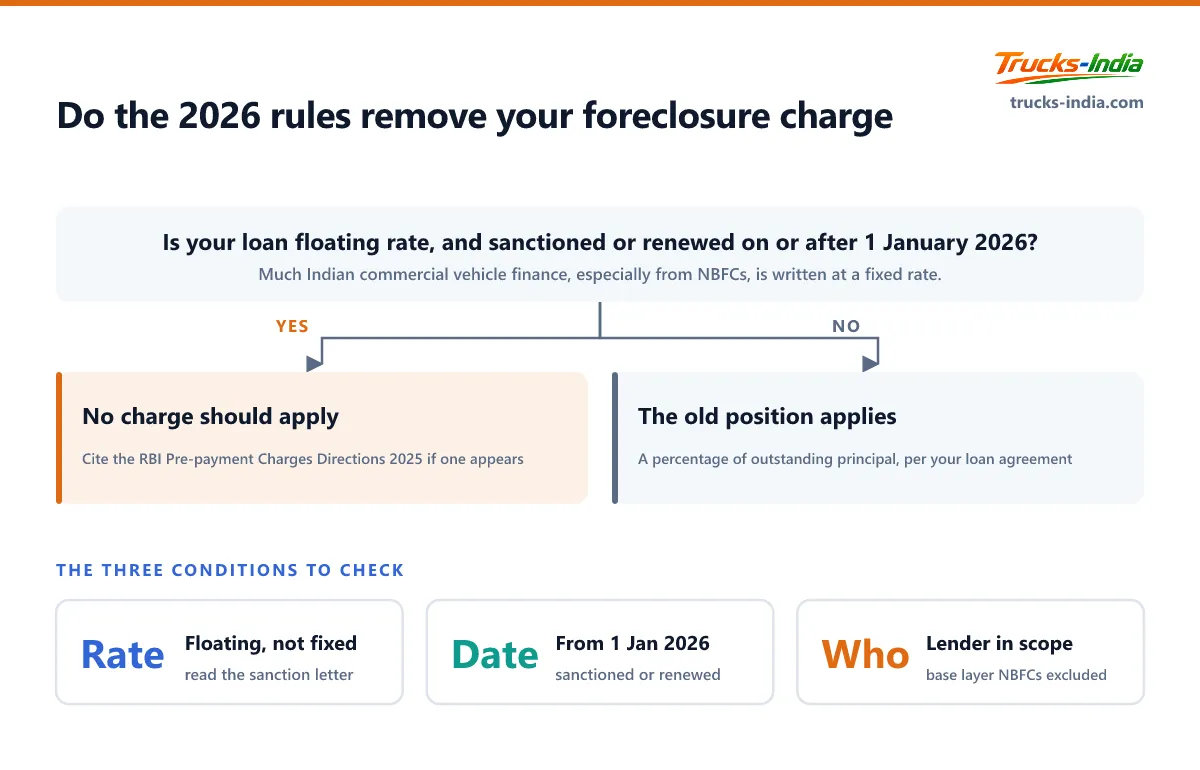
The Reserve Bank of India (Pre-payment Charges on Loans) Directions, 2025 apply to loans sanctioned or renewed on or after 1 January 2026, and they bar lenders from charging prepayment or foreclosure penalties on floating rate loans to individuals and to micro and small enterprises, up to a threshold of ₹7.5 crore for MSE borrowers.
Most truck owners are individuals or micro enterprises. Whether the rule helps you turns on one thing: whether your loan is floating rate.
What the RBI Directions actually say
The RBI (Pre-payment Charges on Loans) Directions, 2025, issued in July 2025, apply to loans and advances sanctioned or renewed on or after 1 January 2026.
The substance, in the parts that matter to a truck owner:
- On floating rate loans granted to individuals for purposes other than business, lenders may not levy prepayment charges, with or without co-obligants.
- On floating rate loans for business purposes to individuals and to micro and small enterprises, lenders may not levy any charge or penalty on foreclosure or prepayment. The threshold for MSE borrowers is ₹7.5 crore.
- Certain smaller lenders are outside this, specifically Tier-I and Tier-II primary urban co-operative banks and base layer NBFCs.
- No undisclosed, retrospective or previously waived charge may be reinstated at the time of prepayment.
The stated reason was that inconsistent prepayment charges were deterring borrowers from refinancing or switching lenders.
The condition that decides whether it helps you
Floating rate.
The Directions address floating rate loans. A very large share of Indian commercial vehicle finance, particularly from NBFCs, is written at a fixed rate, and fixed rate loans are not covered in the same way.
So before you assume the charge has gone:
- Read your sanction letter. Is the rate fixed or floating?
- Check the sanction or renewal date. Was the loan sanctioned or renewed on or after 1 January 2026?
- Check who your lender is. A base layer NBFC or a smaller co-operative bank may sit outside the restriction.
If all three line up in your favour, there should be no foreclosure charge and you should say so, citing the Directions, if one appears on a statement.
If your loan is fixed rate or predates the cutoff, the old position applies and a charge is likely, typically expressed as a percentage of the outstanding principal, with the exact figure in your loan agreement. That is the document to read, not a general article.
Is early closure worth it at all
Even with no penalty, this is an arithmetic question rather than an obvious yes.
What you save is the remaining interest on the amount you repay early, which on a truck loan several years into its term is smaller than people expect, because most interest is paid in the earlier years.
What you give up is the cash. For a transport business that is the serious side of the ledger. A reserve that covers a major repair, a client paying at 60 days instead of 30, and a slow month is what keeps a single vehicle operation alive, as the profit margin guide sets out.
A useful test: if clearing the loan leaves you without a reserve that survives both a payment cycle and a major repair, do not clear the loan. An operator with no debt and no cash is more fragile than one with an instalment and a cushion.
Part prepayment is often the better answer, reducing either the instalment or the tenure while keeping some cash. Ask which of the two the reduction applies to, because lenders differ and it changes the effect considerably.
The step people forget
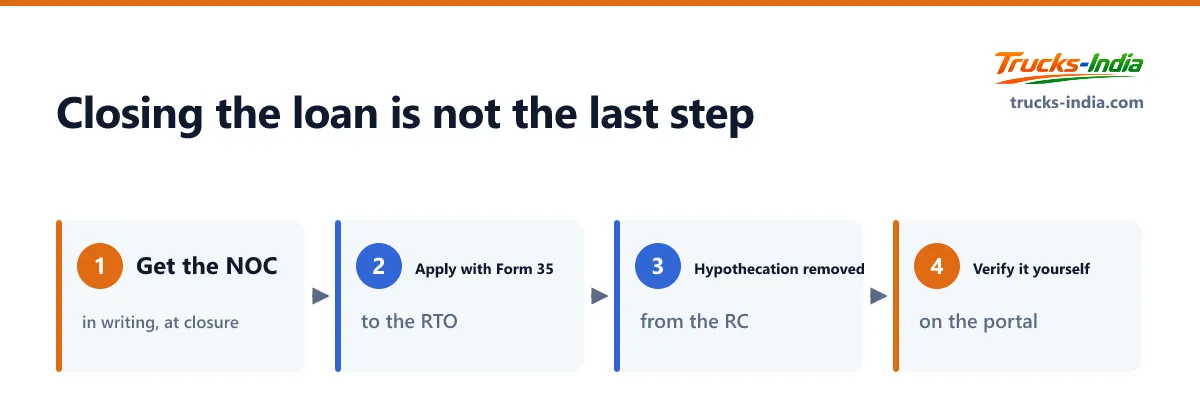
Closing the loan is not the end. Three things must follow, and the vehicle is not properly yours until they do.
Get the No Objection Certificate. The NOC from the lender confirming the loan is closed and they have no further claim. Ask for it in writing at closure, not later.
Get the hypothecation removed from the registration certificate. This is a separate application to the RTO with the NOC, Form 35 and the required documents. Until it is done, the RC still shows the lender's charge.
Verify it on the record yourself. Pull the vehicle up on the portal and confirm the hypothecation entry has gone, as the RC check guide explains. A photograph of an NOC is not the same thing as a clean record.
Skip these and the problem surfaces when you try to sell. A buyer's first check is the RC, a live hypothecation entry stops the sale, and chasing a lender for an NOC on a loan closed four years ago is genuinely difficult.
A cleared loan also helps the next one
Worth knowing if the plan is a second vehicle.
A cleanly repaid commercial vehicle loan is the strongest thing you can show a lender. It moves you out of the first time user category, which is the single biggest determinant of your rate, as the loan guide explains. The second vehicle is almost always cheaper to finance than the first, and a clean closure is why.
That argues for closing properly and keeping the paperwork rather than simply stopping payments when the balance runs out.
Trucks to compare
A few popular trucks on Trucks India, with ex-showroom price and rated payload. Open one for its full price, specifications and mileage.
Browse more: Mini trucks, Light commercial vehicles, Heavy trucks, Eicher trucks, Ashok Leyland trucks, Mahindra trucks, Euler EV trucks
Frequently asked questions
For floating rate loans to individuals and to micro and small enterprises, sanctioned or renewed on or after 1 January 2026, yes, under the RBI (Pre-payment Charges on Loans) Directions, 2025, with a ₹7.5 crore threshold for MSE borrowers. Tier-I and Tier-II urban co-operative banks and base layer NBFCs sit outside it.
The Directions address floating rate loans. A large share of Indian commercial vehicle finance, especially from NBFCs, is fixed rate, and those are not covered in the same way. Read your sanction letter to establish which you have.
Where they still apply, typically a percentage of the outstanding principal, with the exact figure set out in your loan agreement. That agreement is the document to check rather than a general figure.
Only if you retain a reserve that survives both your client payment cycle and a major repair. The interest saved late in a loan term is smaller than people expect, while the cash given up is what keeps a single vehicle operation solvent. Part prepayment is often the better compromise.
The lender's written confirmation that the loan is closed and they have no further claim. You need it to apply to the RTO, with Form 35, to remove the hypothecation entry from the registration certificate. Ask for it at closure rather than later.
The registration certificate continues to show the lender's charge, and the problem surfaces when you try to sell, because a live hypothecation entry stops the sale. Chasing an NOC years after closure is genuinely difficult, so verify the record yourself once the removal is done.
Where this fits
Closing a loan is the other end of taking one. See our guide to commercial vehicle loans.
Freed up cash flow is how a second vehicle gets funded. Trucks India lists price, payload and mileage for every model in India.
Call +91 93422 00875About the author
Lokesh R
CEO of Trucks India
Lokesh R is the founder of Trucks India, an independent heavy-vehicle marketplace and research platform operated from Chennai, Tamil Nadu, founded in 2025. Under his direction, Only Heavy publishes specifications and prices sourced from manufacturers, authorised dealer price lists and official regulatory schedules, with every model page checked by a named reviewer, prices re-verified monthly and after any GST revision, and no advertiser able to buy a rating, ranking or comparison result.


