
Documents Required to Start a Transport Business in India
The full document checklist for an Indian transport business, grouped by stage: business setup, vehicle purchase, going on road, and the annual renewals.

Lokesh R
CEO of Trucks India
Created 4 August 2026 · 6 min read
Nobody enjoys assembling paperwork, and in transport the list is longer than most first time owners expect. The frustrating part is that the documents arrive in waves. Some you need before you can register anything, some only exist after you buy the vehicle, and a few have to be renewed every single year for as long as the truck works.
This is the full list, grouped by when you actually need each one, so you are not chasing a certificate on the day a load is waiting.
Documents required to start a transport business
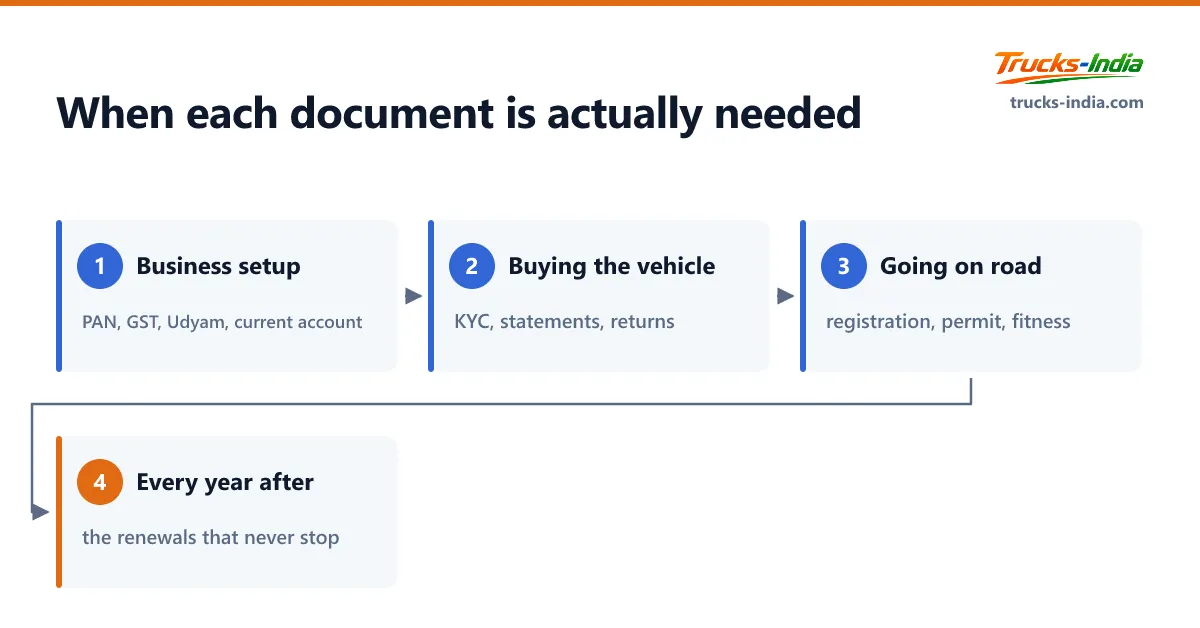
The list splits into four stages. Work through them in order and nothing blocks anything else.
- Stage one, business setup. Identity, entity and tax registrations.
- Stage two, buying the vehicle. What the dealer and the lender ask for.
- Stage three, going on road. What makes it legal to carry goods for money.
- Stage four, every year after. The renewals that keep the truck working.
Stage one, business setup
- PAN card, yours for a proprietorship or the entity's for any other structure
- Aadhaar, used for most online registrations and e-KYC
- Address proof for the business premises, an electricity bill or rent agreement with a no objection letter from the owner
- Entity proof, which depends on your structure: nothing extra for a proprietorship, a partnership deed for a firm, or the incorporation certificate for an LLP or private limited company
- TAN, once you deduct tax at source
- Current account in the business name, plus a cancelled cheque
- GST registration certificate
- Udyam registration, free and worth doing because lenders often ask for the number
- Passport size photographs, still requested at several counters
One point worth care: the name on your invoice, your GST registration and your bank account should match exactly. Mismatches are the most common reason freight payments stall.
Stage two, buying the vehicle
Dealers and lenders ask for broadly the same file.
- KYC for the applicant, PAN and Aadhaar
- Business proof, your GST certificate and Udyam registration
- Bank statements, usually six to twelve months
- Income tax returns, typically two years where available
- Proof of business address
- Existing fleet documents, if you already run vehicles
- Guarantor documents, where the lender asks for one
Lenders typically fund 80 to 90 percent of vehicle cost over three to five years, leaving a down payment of 10 to 20 percent. If you are going the collateral free route, the Pradhan Mantri Mudra Yojana lends up to 10 lakh rupees to a first time borrower under its Tarun tier. The higher Tarun Plus tier of 10 to 20 lakh is open only to borrowers who have already repaid a Tarun loan, which is a detail widely misreported and worth knowing before you plan around it.
Stage three, going on road
These come into existence after the purchase and are what a checkpoint will ask to see.
- Commercial registration certificate. The RTO registers the vehicle commercially and road tax is charged at that point, calculated on vehicle cost and varying by state.
- Goods carriage permit. A state permit covers work inside your own state. A national permit is required the moment you carry goods for hire across a state border.
- Fitness certificate. Confirms the vehicle is roadworthy, renewed periodically after its initial validity.
- Commercial vehicle insurance. Third party is the legal minimum. Comprehensive is the sane choice on a financed truck.
- Pollution under control certificate.
- Commercial driving licence. For heavy vehicles this means an HMV endorsement for whoever drives.
- FASTag, with an opening balance.
On the permit, note the structure. The national permit document runs five years, but the authorisation that lets you cross state lines is annual and must be renewed every year. The consolidated authorisation fee is 16,500 rupees a year under Rule 87(2) of the Central Motor Vehicles Rules, paid through the Parivahan portal, plus a Form 46 authorisation of about 1,000 rupees a year to your home state. Amounts vary by state and vehicle, and lapsed renewals attract a daily late fee.
Stage four, the annual renewals
This is the list to put in a calendar rather than a drawer.
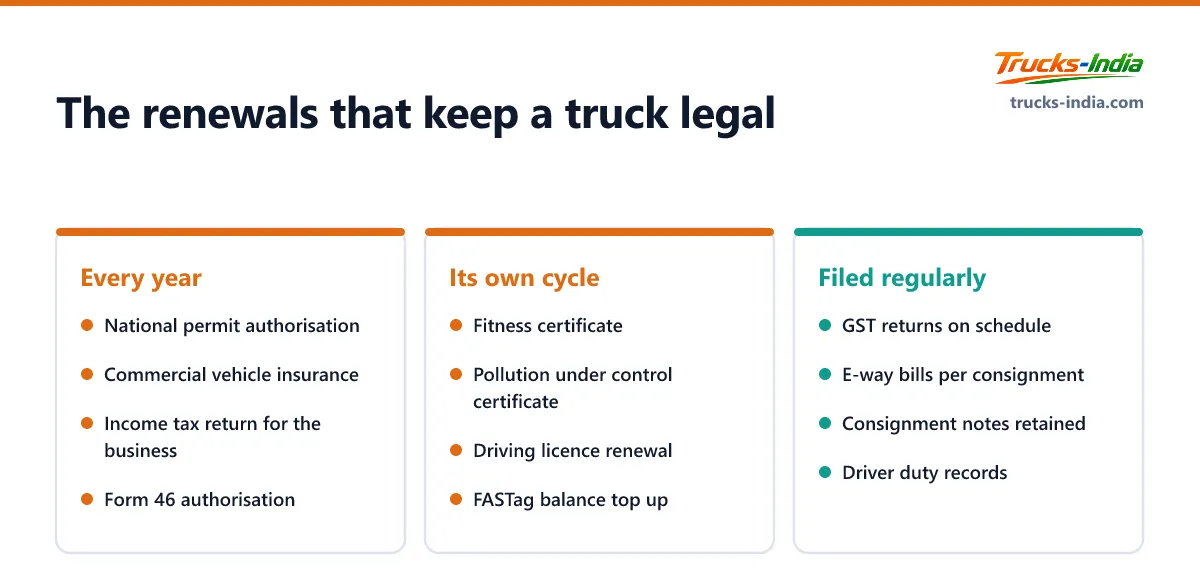
- National permit authorisation, every year
- Insurance, every year
- Pollution under control certificate, on its own short cycle
- Fitness certificate, on its renewal cycle
- GST returns, on their filing schedule
- Income tax return for the business
A missed authorisation renewal does not just risk a fine. It makes the vehicle legally unauthorised for interstate goods carriage, which is a much more expensive problem when it surfaces mid trip.
Documents your clients will ask for
Separate from the regulator, shippers onboarding you as a vendor typically want your GST certificate, PAN, cancelled cheque, vehicle registration and insurance copies, and often the driver's licence. Larger companies add a vendor form and sometimes a bank verification. Keeping a single folder with clean scans of all of these shortens onboarding from weeks to days.
What people forget
- Road tax budgeting. It is charged on vehicle cost at registration and varies by state. It is not small and it is not included in the ex-showroom price.
- Name consistency across invoice, GST and bank account.
- The annual authorisation, mistaken for something the five year permit already covers.
- Driver licence class. A licence that covers a light commercial vehicle does not cover a heavy one.
If you are still deciding what to buy, the price bands make the comparison quick: trucks under 10 lakh, 10 to 20 lakh and 40 to 50 lakh.
Documents are stage three of eight. The full guide to starting a transport business puts them in sequence, and the registration process explains the structure choice that determines which entity documents you actually need.
Trucks to compare
A few trucks for a transport business on Trucks India, with ex-showroom price and rated payload. Open one for its full price, specifications and mileage.
Browse more: Mini trucks, Light commercial vehicles, Heavy trucks, Ashok Leyland trucks, Mahindra trucks, Jupiter Electric Mobility trucks, Euler EV trucks
Frequently asked questions
KYC documents, PAN and Aadhaar, business proof in the form of GST and Udyam registration, six to twelve months of bank statements, and usually two years of income tax returns. Lenders may also ask for a guarantor.
Yes. Registration records who owns the vehicle and that it is commercial. The permit is separate and grants the right to carry goods for hire, either within your state or nationally.
The registration certificate, permit, fitness certificate, insurance, pollution certificate and the driver's commercial licence, plus the consignment note or e-way bill for the load being carried.
It is strongly advisable. Buying before the entity and GST registration exist means the invoice arrives in the wrong name, which complicates both the loan and any input credit you were planning to claim.
Insurance and the national permit authorisation are annual. The pollution certificate runs on a shorter cycle, and the fitness certificate on its own schedule. The permit document itself lasts five years.
Where this fits
Paperwork is only step three of eight. See the whole sequence in our guide to starting a transport business.
Paperwork sorted? The next decision is which truck the work actually pays for. Trucks India lists on road price, payload and mileage for every model sold in India.
Call +91 93422 00875About the author
Lokesh R
CEO of Trucks India
Lokesh R is the founder of Trucks India, an independent heavy-vehicle marketplace and research platform operated from Chennai, Tamil Nadu, founded in 2025. Under his direction, Only Heavy publishes specifications and prices sourced from manufacturers, authorised dealer price lists and official regulatory schedules, with every model page checked by a named reviewer, prices re-verified monthly and after any GST revision, and no advertiser able to buy a rating, ranking or comparison result.


