
Truck Tyre Pressure Chart: PSI by Tyre Size and Load
Use this truck tyre pressure chart to find the psi for 10.00 R20, 295/80 R22.5 and LT sizes, read single vs dual columns, and check lorry tyres the right way.

Lokesh R
CEO of Trucks India
Created 28 September 2026 · 9 min read

Key takeaways
- MRF rates a 10.00 R20 16PR radial at 3,000 kg single at 8.25 kg/sq cm (about 117 psi) and 2,630 kg dual at 7.6 kg/sq cm (about 108 psi).
- A chart pressure is the pressure at which the tyre carries its maximum rated load, so the vehicle maker's figure for your axle load comes first.
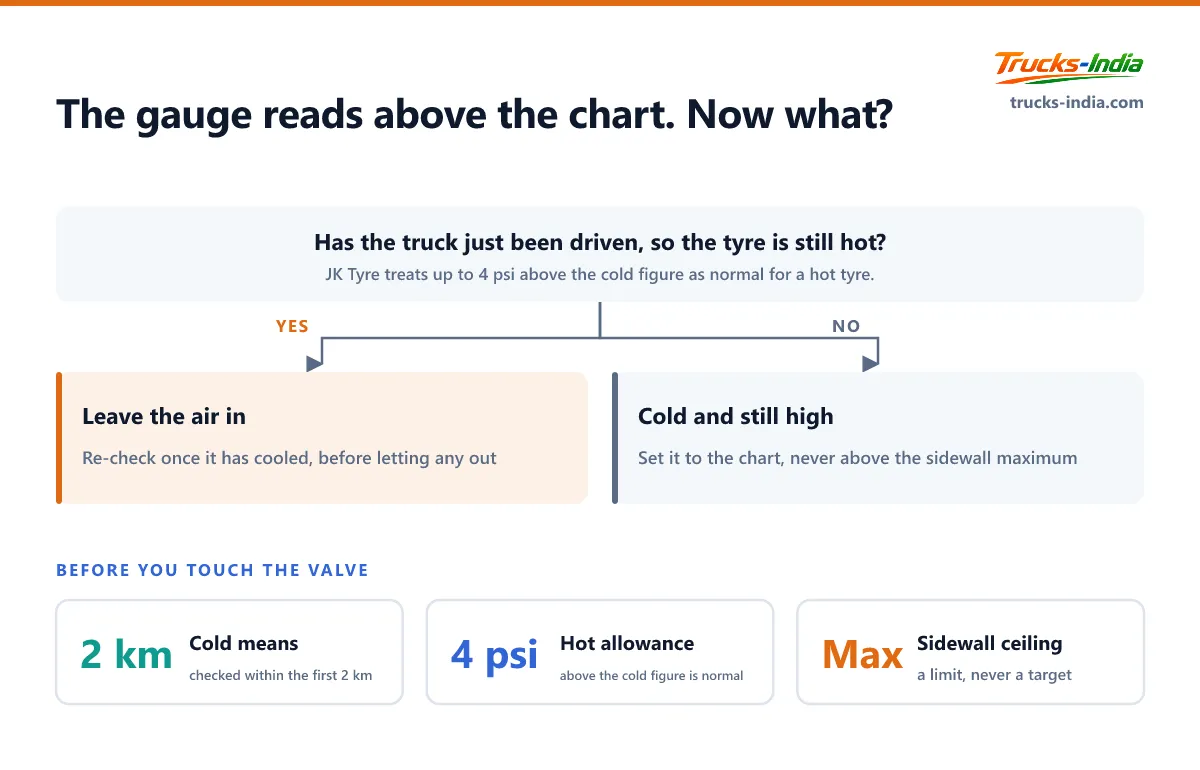
- Check pressure cold, within the first 2 km; JK Tyre treats a hot reading up to 4 psi above the cold figure as normal.
- Never bleed air from a hot tyre, and never inflate beyond the maximum moulded on the sidewall.
- More air does not add legal carrying capacity. Overloading stays overloading at any pressure.
A truck tyre pressure chart only helps if you read the right line. The same 10.00 R20 tyre wants one pressure on a single front wheel and a different one on a rear dual pair, and the printed figure assumes the tyre is carrying its full rated load.
This guide gives the pressures Indian tyre makers publish for the common lorry sizes, from a pickup's 14 inch radial to a 22.5 inch tubeless on a multi axle truck, converted into psi. It also shows how to check them cold, why you never let air out of a hot tyre, and where the final number for your own truck comes from.
Truck tyre pressure chart by tyre size
The figures below come from MRF's published tyre data book, which lists each size with its maximum load and the cold inflation pressure needed to carry it. MRF states pressure in kg/sq cm. One kg/sq cm is about 14.2 psi, so each figure is converted and rounded.
Read the single figure for a wheel that runs alone, such as a front steer wheel. Use the dual figure for each tyre in a rear twin pair.
Pickups and mini trucks
- LT 185 R14 8PR: 850 kg single, 800 kg dual, both at 4.6 kg/sq cm, about 65 psi
- LT 195 R15 8PR: 950 kg single at 4.6 kg/sq cm, about 65 psi
- 7.00-16 8PR cross ply: 966 kg single at 4.20 kg/sq cm, about 60 psi
Light commercial vehicles on 16 inch rims
- LT 7.00 R16 10PR: 1,100 kg single, 965 kg dual, at 5.6 kg/sq cm, about 80 psi
- LT 7.50 R16 14PR: 1,495 kg single, 1,315 kg dual, at 7.40 kg/sq cm, about 105 psi
- 8.25-16 16PR: 1,845 kg single, 1,755 kg dual, at 6.70 kg/sq cm, about 95 psi
Medium and heavy trucks on 20 inch rims
- 8.25-20 14PR: 2,230 kg single at 8.15 (about 116 psi), 1,960 kg dual at 7.40 (about 105 psi)
- 9.00-20 16PR: 2,650 kg single at 8.15 (about 116 psi), 2,325 kg dual at 7.40 (about 105 psi)
- 10.00-20 16PR cross ply: 3,000 kg single at 8.15 (about 116 psi), 2,630 kg dual at 7.40 (about 105 psi)
- 10.00 R20 16PR radial: 3,000 kg single at 8.25 (about 117 psi), 2,630 kg dual at 7.6 (about 108 psi)
- 11.00 R20 16PR radial: 3,265 kg single at 8.25 (about 117 psi), 2,865 kg dual at 7.6 (about 108 psi)
Multi axle trucks on 22.5 inch tubeless rims
- 295/80 R22.5 16PR: 3,550 kg single and 3,150 kg dual, both at 8.8 kg/sq cm, about 125 psi
Other makers publish their own tables, and a different pattern in the same size can carry a slightly different figure. Treat this list as a reference point, then confirm against the data for the exact tyre on your truck.
What a chart number actually tells you
Three things move the pressure on any truck tyre air pressure list, and most mistakes come from ignoring one of them.
It is the pressure for the maximum load. The chart says, in effect, "at this pressure the tyre can carry this much". A tyre working well below its rated load may be specified a lower pressure by the vehicle maker. At its limit, the tyre needs the full figure.
Single and dual are different jobs. A dual tyre is rated for less load than the same tyre running alone, because two tyres side by side never share a load perfectly on a cambered Indian road. That is why the dual column shows both a lower load and, on most sizes, a lower pressure.
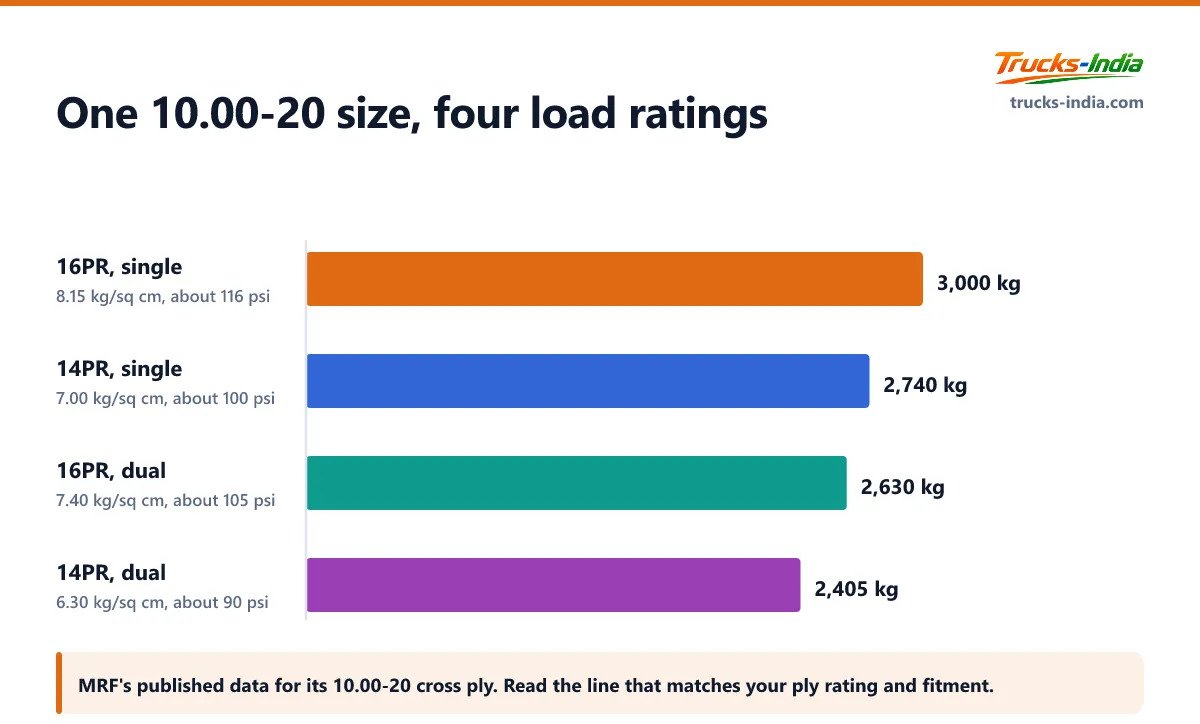
Ply rating changes the answer. A tougher casing is built to hold more air and carry more weight. MRF's 10.00-20 cross ply shows it clearly: the 14PR version carries 2,740 kg single at 7.00 kg/sq cm (about 100 psi) and 2,405 kg dual at 6.30 kg/sq cm (about 90 psi), while the 16PR version carries 3,000 kg at about 116 psi. Two tyres with the same size on the sidewall can need different pressures.
Where the right lorry tyre air pressure comes from
Work through three sources, in this order.
- The vehicle maker's recommendation, in the owner's manual or on the label or plate on the vehicle. It is set for that model's axle loads and is the first number to use.
- The tyre maker's load and inflation table, for when you fit a different size or ply rating, or run consistently light or heavy.
- The maximum pressure moulded on the sidewall. This is a ceiling, never a target.
To use a table yourself, divide the axle load by the number of tyres on that axle. For example, a rear axle carrying 10,000 kg on four tyres puts 2,500 kg on each one. On a 10.00 R20 16PR radial that sits just under the 2,630 kg dual rating, so the full dual pressure of about 108 psi is the right setting.
Front steer tyres run as singles, so read the single column for them. That is why front and rear pressures on the same truck often differ.
Converting kg/sq cm, bar, psi and kPa
Indian tyre data often uses kg/sq cm, most pump gauges read psi, and imported trucks quote bar or kPa. The conversions are simple:
- 1 kg/sq cm is about 14.2 psi, about 0.98 bar and about 98 kPa.
- 8.25 kg/sq cm, the 10.00 R20 single figure, is about 117 psi or 809 kPa.
- 8.8 kg/sq cm, the 295/80 R22.5 figure, is about 125 psi or 863 kPa.
- 4.6 kg/sq cm, the light truck figure, is about 65 psi or 451 kPa.
Bar and kg/sq cm are close enough that a gauge in either unit gives a usable reading. Psi is where people go wrong, because a figure such as 8 read off a chart is not 8 psi.
How to check truck tyre air pressure in psi
Pressure checks are only useful when they are done the same way every time.
- Check cold. JK Tyre's tyre care guidance says to measure before the vehicle has run 2 km, or after it has stood.
- Expect a hot tyre to read higher. The same guidance treats a reading up to 4 psi above the recommended cold figure as normal for a hot tyre.
- Never bleed a hot tyre. Releasing air from a hot tyre leaves it under inflated once it cools, and it then runs hotter still.
- Check every tyre, including the inner duals and the spare. Inner duals are the ones that go unchecked, and a soft inner tyre hands its load to its partner.
- Check often. JK Tyre advises at least once a fortnight and before any long trip or heavy load. A weekly check suits a truck on daily highway work.
- Use a gauge you trust. A cheap pencil gauge or a worn pump dial can be out by several psi, which matters on a tyre running at 117.
On nitrogen, JK Tyre notes that it leaks through the tyre more slowly than air, so pressure holds for longer. It does not replace the checks.
What wrong pressure costs
Under inflation is the expensive one. A soft tyre flexes more, builds heat in the sidewall and wears its shoulders. Heat damage to the casing also costs you the retreads that casing would have given, which is often where a truck tyre's value lies. The guide to the best tyre brand for trucks covers tyre life and cost per kilometre in more depth.
A mismatched dual pair wears out both tyres. If one tyre in a pair is softer, the fuller one carries more than its share and runs hot.
Over inflation wears the centre of the tread, shrinks the contact patch so grip falls, and makes the tyre easier to cut on broken roads.
Fuel follows pressure. A soft tyre resists rolling, so the engine works harder over every kilometre. Correct pressure is one of the free fixes in the guide to increasing truck mileage.
Reading the tread for pressure problems
The tyre itself tells you when pressure has been wrong for a while.
- Both shoulders worn faster than the centre points to running under inflated.
- The centre worn faster than the shoulders points to running over inflated.
- One tyre of a dual pair worn more than its partner points to unequal pressure, or two tyres of different size or wear fitted together.
Wear like this builds over thousands of kilometres, so treat it as a sign to tighten the checking routine, not just to rotate the tyre.
More air does not make overloading legal
Some operators pump tyres beyond the chart to carry an overloaded truck. That does not change the legal limit. Axle and gross weight limits apply whatever the tyre pressure, as the axle load limit guide explains. Inflating past the sidewall maximum also stresses a casing that was never built for it.
Worn, damaged or mismatched tyres are also a common reason a truck fails its fitness certificate test, so tyre condition and pressure are worth checking before the test date as well.
Keep the right truck tyre pressure chart for your sizes in the cab, mark the single and dual figures for each axle, and make the cold check a fixed weekly job rather than something done when a tyre looks low.
Frequently asked questions
It depends on the tyre size, ply rating and position. On MRF's published data, heavy truck sizes such as 10.00 R20 16PR run at about 117 psi single and 108 psi dual at full load, light truck 16 inch sizes at roughly 80 to 105 psi, and pickup sizes at about 60 to 65 psi. Your vehicle maker's figure comes first.
For a 16PR radial, MRF lists 3,000 kg single at 8.25 kg/sq cm, about 117 psi, and 2,630 kg dual at 7.6 kg/sq cm, about 108 psi. A 14PR tyre in a similar size is rated at a lower pressure and load, so check the ply rating on your sidewall.
MRF rates its 295/80 R22.5 16PR at 3,550 kg single and 3,150 kg dual, both at 8.8 kg/sq cm, which is about 125 psi. Other brands and patterns differ slightly, so confirm with the data for the exact tyre fitted.
Not usually. Front steer tyres run as singles and rear tyres usually as duals, and tyre makers rate the two fitments differently. Follow the vehicle maker's figure for each axle, which reflects the load that axle carries.
Cold, before the truck has run about 2 km. A hot tyre reads higher, and JK Tyre treats up to 4 psi above the cold figure as normal. Never let air out of a hot tyre to bring it down.
JK Tyre says nitrogen permeates the tyre more slowly than the oxygen in air, so pressure holds for longer and the tyre runs a little cooler. It still needs regular checks, and a tyre filled with ordinary air at the correct pressure is far better than a nitrogen tyre left to run soft.
Where this fits
Pressure decides how long a tyre lasts. Our guide to the best tyre brand for trucks in India covers which brands and patterns hold up longest.
Tyre size and load rating follow from the vehicle you choose. Trucks India lists GVW, payload and tyre count for every truck model sold in India.
Call +91 93422 00875About the author
Lokesh R
CEO of Trucks India
Lokesh R is the founder of Trucks India, an independent heavy-vehicle marketplace and research platform operated from Chennai, Tamil Nadu, founded in 2025. Under his direction, Only Heavy publishes specifications and prices sourced from manufacturers, authorised dealer price lists and official regulatory schedules, with every model page checked by a named reviewer, prices re-verified monthly and after any GST revision, and no advertiser able to buy a rating, ranking or comparison result.


