
Truck Attachment With a Company: How It Works
How truck attachment works in India, who runs it, how payment and running costs are usually split, and the terms to check before committing your vehicle.

Lokesh R
CEO of Trucks India
Created 3 September 2026 · 7 min read
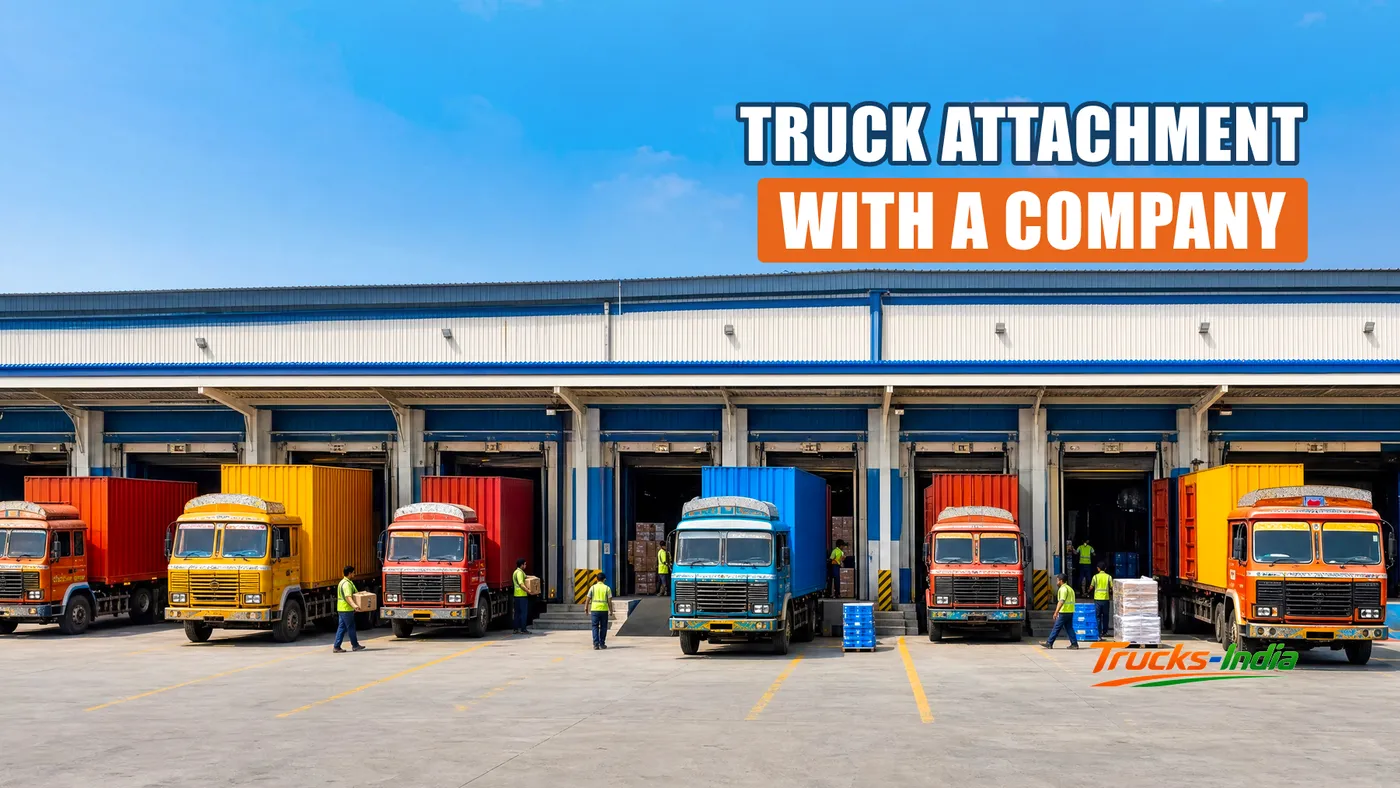
Attachment is one of the most common arrangements in Indian road transport and one of the least clearly explained. You own the truck. A larger logistics, courier or transport company runs loads on it, usually on a defined rate card, and handles finding the freight.
For an owner who does not want to spend every day hunting loads and chasing payments, that trade is often worth making. For an owner who wants to build rates and client relationships of their own, it can be a cage. Which one it turns out to be depends almost entirely on the terms, and the terms vary enormously between companies.
Here is how the arrangement actually works and what to check before committing a vehicle to it.
What truck attachment means
You keep ownership, registration, insurance and the loan. The company provides the loads and, in most arrangements, the client relationship and the billing.
The arrangement goes by several names and they all describe the same thing. Truck attachment in company, truck attachment with a company, vehicle attachment in logistics company, attaching a truck to a transporter: one vehicle, one operator's network, an agreed rate. Nothing about the commercial substance changes with the wording, so do not assume a different name means a different deal.
In practice it usually looks like this:
- Your vehicle is registered with the company and dedicated to their work, wholly or mostly
- Loads come from their network rather than from your own effort
- Payment follows their cycle, typically monthly or per trip against a rate card
- The driver is usually yours, occasionally theirs
- Running costs are split according to the agreement, and this is where arrangements differ most
Who runs attachment arrangements
Courier and parcel companies attaching vehicles to line haul routes between hubs.
E-commerce logistics operators, often on fixed daily or monthly deployment for last mile and mid mile work.
Traditional transport companies with more freight than trucks.
Fleet aggregators and logistics platforms running managed capacity for large shippers.
Construction and industrial contractors attaching tippers and specialised vehicles for the duration of a project.
The vehicle they want varies accordingly. Last mile deployment suits the Tata Ace Gold or Mahindra Jeeto class. Mid mile and regional line haul wants something like a Tata Ultra T16 or Eicher Pro 2059 XP Plus. Long haul line haul runs on tractor trailers such as the Tata Signa 5530S.
How payment is usually structured
Three broad models exist, and knowing which you are being offered is essential.
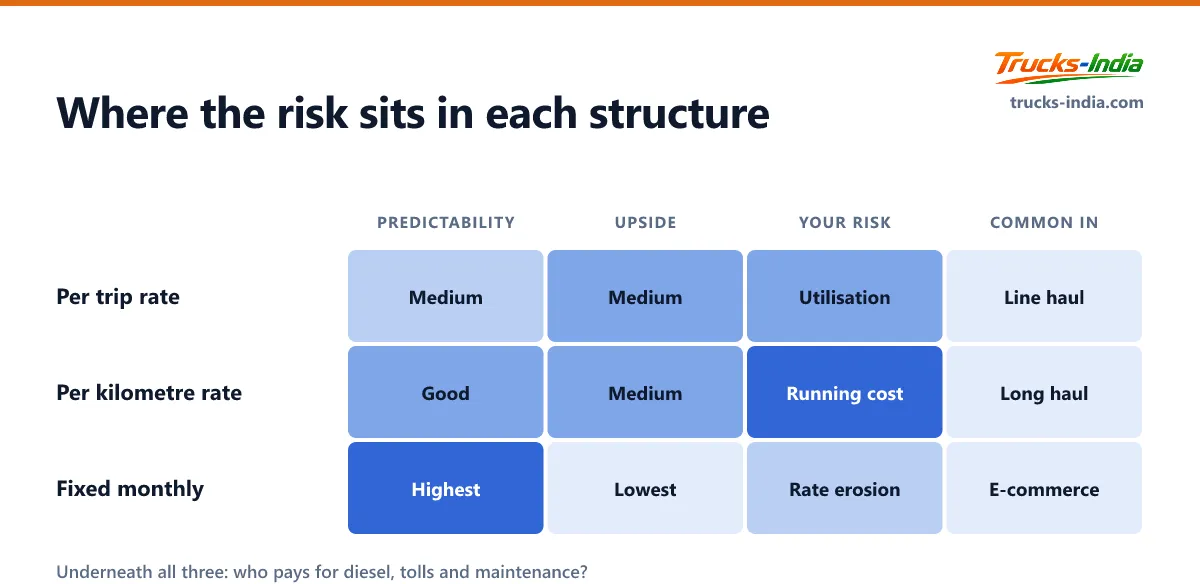
Per trip rate. A fixed amount per route. Simple, and your risk is utilisation: if they give you fewer trips, you earn less against the same EMI.
Per kilometre rate. Common on line haul. Your risk is the rate against your actual running cost, which is why knowing your cost per kilometre matters before signing.
Fixed monthly deployment. The vehicle is reserved for them for a fixed monthly sum, common in e-commerce. The most predictable, and usually the lowest ceiling.
Underneath all three sits the question that decides whether the number is good: who pays for diesel, tolls and maintenance? An attractive looking per trip rate where you fund all running costs can be worse than a lower rate where diesel and tolls are reimbursed. Never compare headline rates between offers without normalising for this.
The genuine advantages
Utilisation without the hunt. You stop spending your days looking for loads, and the empty return leg often becomes their problem rather than yours. The alternative is doing that hunting yourself, through brokers and the truck load booking apps.
More predictable payment. Established companies generally pay on a defined cycle, which is easier to plan around than chasing individual shippers across 30 to 60 days.
Lower commercial overhead. No client acquisition, less invoicing, less credit risk spread across many small counterparties.
A record. A year of clean attachment work with a known company is useful evidence when you later approach shippers directly or apply for finance on a second vehicle.
The real costs
Rates are set, not negotiated. You take the card. On a good corridor you will usually earn less than you would have on the open market.
Volume is not always guaranteed. Unless the agreement specifies a minimum, quiet weeks are your problem while the EMI continues.
Little control over routing. You go where the network needs the vehicle.
You build their client relationship, not yours. After three years of attachment you have a track record but no book of your own clients.
Deductions. Understand every deduction in advance: damages, delays, fuel adjustments, administrative charges. These are where an apparently reasonable rate quietly erodes.
What to check before signing
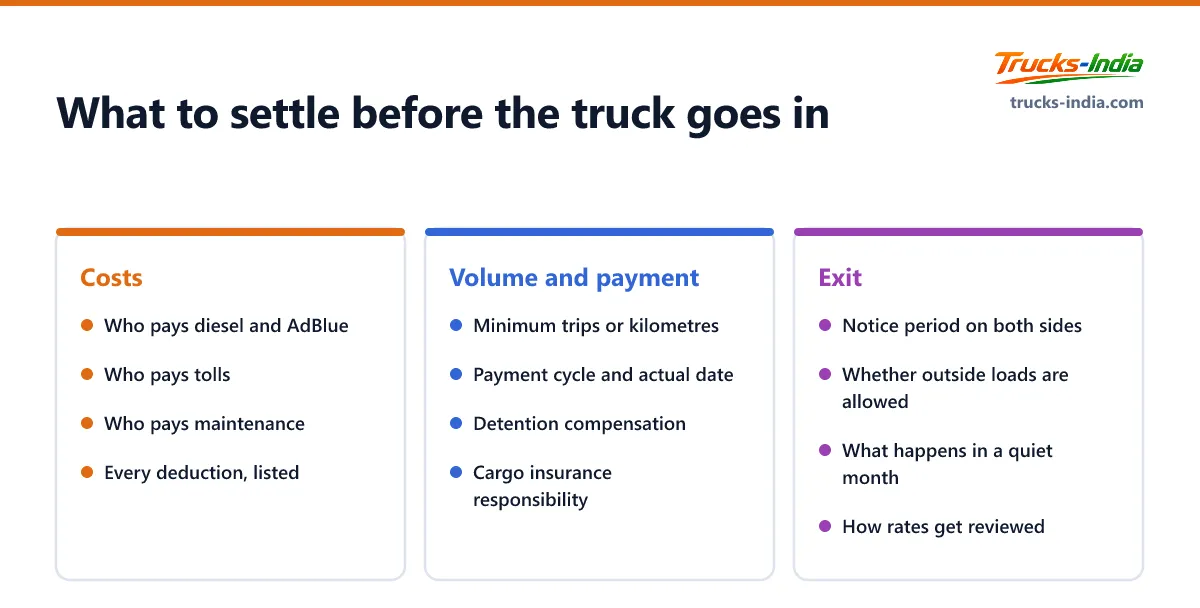
- Who pays diesel, tolls, AdBlue and maintenance, in writing
- Minimum guaranteed trips or kilometres, or explicit acknowledgement that there is none
- Payment cycle and the actual date money reaches your account
- Detention and waiting compensation when their operation holds your truck
- Deductions, listed exhaustively
- Insurance responsibility for cargo as distinct from the vehicle
- Exit terms and notice period on both sides
- Whether you may take outside loads when their volume is low
That last point matters more than most owners realise. An exclusive arrangement with no volume guarantee is the worst combination available: you cannot fill the gap and they are not obliged to.
Is attachment right for you?
It suits an owner who wants steady utilisation without commercial work, someone new to a corridor who needs a base of volume, or an owner driver who would rather drive than negotiate.
It suits less well an operator who already has client relationships worth more than the rate card, or one building towards a fleet who needs their own book of clients to grow into.
Many operators use it as a phase rather than a destination: attach to stabilise cash flow and learn the corridor, then move to direct clients once they have a record and a reserve.
Before you commit, run the numbers
Take the rate offered and test it against your real costs. Diesel from your model's actual mileage at today's fuel prices, tolls for their routes, the per kilometre share of tyres and maintenance, plus your fixed costs including the EMI.
If the arrangement only works at full utilisation and there is no minimum volume clause, that is not a rate problem, it is a risk you are being asked to carry alone.
Attachment is one option among several. The full guide to getting loads covers the alternatives, and winning your own contract is usually the next step for owners who outgrow a rate card.
Trucks to compare
A few trucks for a transport business on Trucks India, with ex-showroom price and rated payload. Open one for its full price, specifications and mileage.
Browse more: Mini trucks, Light commercial vehicles, Heavy trucks, Ashok Leyland trucks, Mahindra trucks, Euler EV trucks, Switch Mobility trucks
Frequently asked questions
You retain ownership of the vehicle while a larger logistics or transport company supplies the loads, usually on a fixed rate card. They handle finding freight and often the client billing, you handle the truck.
An arrangement where you keep the truck and someone else supplies the work. Your vehicle is registered with the company and runs their loads, they handle the client and usually the billing, and you are paid per trip, per kilometre or as a fixed monthly amount. Vehicle attachment with a logistics company means the same thing.
It can be, when the rate covers your full running cost and utilisation is genuinely steady. Rates are lower than the open market, so the arrangement earns its keep through reduced idle time and predictable payment rather than through a high rate per trip.
It varies by company and is the single most important thing to establish in writing. Some reimburse diesel and tolls, others expect the owner to absorb them. A headline rate is meaningless until you know which.
Only if the agreement allows it. Exclusive arrangements with no minimum volume guarantee are the riskiest combination, because you cannot fill quiet periods while the EMI continues.
It trades rate and control for steadiness and simplicity. It suits owners who want utilisation without commercial work. Operators building towards a fleet usually need their own client relationships eventually.
Where this fits
Attachment is one of six ways to keep a truck loaded. See our guide to getting loads for your truck.
Attachment rates only work if the vehicle suits them. Trucks India lists payload, mileage and on road price for every model sold in India.
Call +91 93422 00875About the author
Lokesh R
CEO of Trucks India
Lokesh R is the founder of Trucks India, an independent heavy-vehicle marketplace and research platform operated from Chennai, Tamil Nadu, founded in 2025. Under his direction, Only Heavy publishes specifications and prices sourced from manufacturers, authorised dealer price lists and official regulatory schedules, with every model page checked by a named reviewer, prices re-verified monthly and after any GST revision, and no advertiser able to buy a rating, ranking or comparison result.


