
Vehicle Scrappage Policy for Commercial Vehicles
India's scrappage policy for trucks: the 15 year fitness test, what a Certificate of Deposit is worth, the rebates, and how to decide what to do next.

Lokesh R
CEO of Trucks India
Created 18 September 2026 · 6 min read
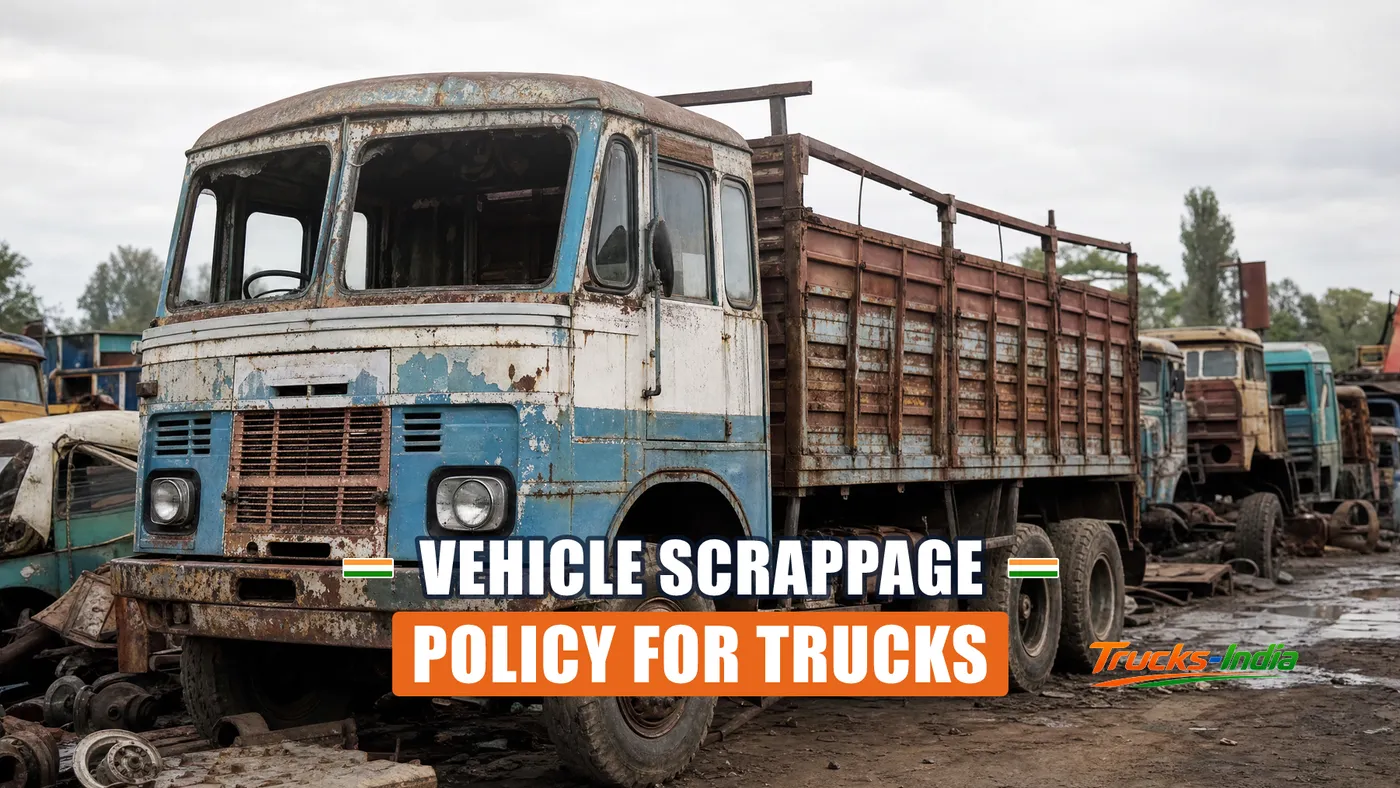
A commercial vehicle in India does not have an expiry date. It has a test.
That distinction is the whole policy, and most summaries get it wrong by saying trucks must be scrapped at fifteen years. They must be tested at fifteen years. A vehicle that passes keeps working. A vehicle that fails has reached the end, and the question then becomes whether to scrap it formally and claim what that is worth, or let it sit.
This guide covers the test, what scrapping through the official route actually pays, and how to decide between scrapping, selling and running on.
The fifteen year rule, stated correctly
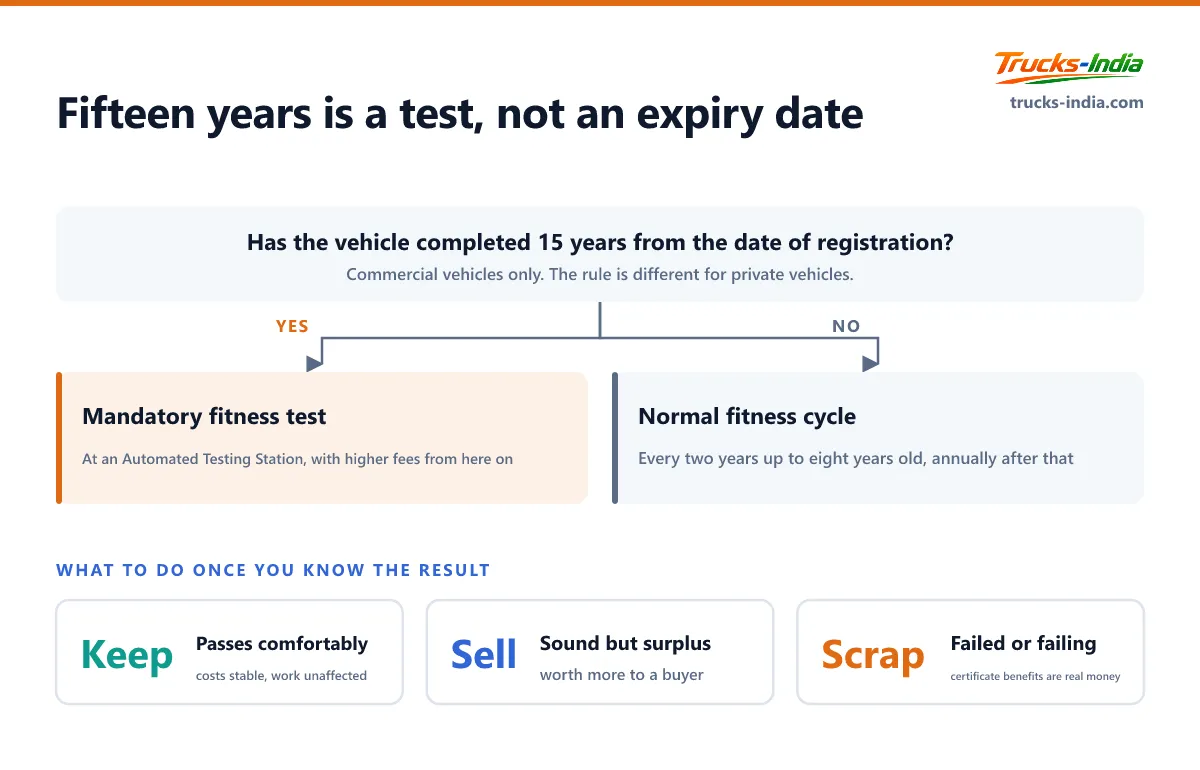
A commercial vehicle that completes fifteen years from the date of registration must undergo a mandatory fitness test at an Automated Testing Station in order to keep its registration valid.
Pass it and the vehicle continues to operate. Fail it and the vehicle is deemed an end of life vehicle and must be scrapped.
Two things about the regime make continuing an old truck progressively less attractive even when it passes.
Fitness renewal gets more frequent with age. A transport vehicle up to eight years old renews fitness every two years. After eight years it renews annually. So an older truck goes through the process more often.
Fees rise after fifteen years by design. Increased fitness test and certificate fees apply to commercial vehicles from fifteen years onward, and that is deliberate policy rather than an administrative accident. The intent is to make keeping a very old vehicle on the road cost more than it used to.
The policy took effect for commercial vehicles in April 2022.
What scrapping through the official route pays
Scrapping at a Registered Vehicle Scrapping Facility, an RVSF, produces a Certificate of Deposit. That certificate is the instrument that carries the benefits, and it is the reason to scrap formally rather than sell the vehicle to an unregistered yard for its metal.
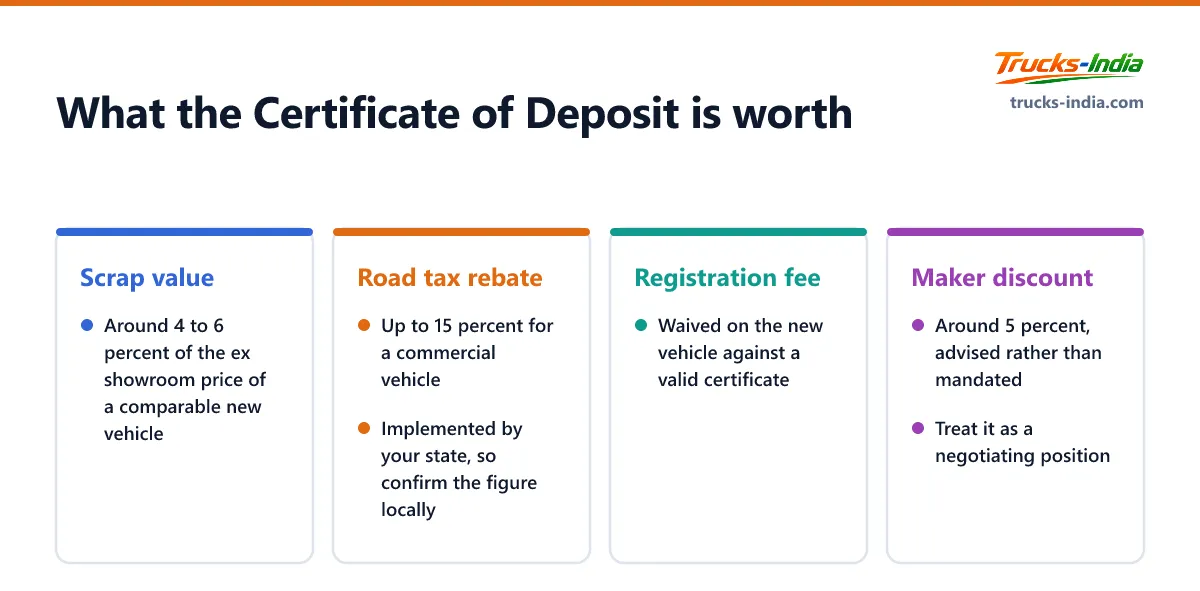
What the certificate is worth, in four parts:
- Scrap value, commonly cited at around 4 to 6 percent of the ex showroom price of a comparable new vehicle.
- A road tax rebate on the new vehicle, up to 15 percent for a commercial vehicle. Personal vehicles get up to 25 percent.
- Registration fee waiver on the new vehicle when a valid Certificate of Deposit is produced.
- A manufacturer discount, with vehicle makers advised to offer around 5 percent against a valid certificate.
The certificate is also transferable, which matters if the person scrapping is not the person buying the replacement.
Two cautions. Road tax is a state subject, so the rebate is implemented by your state and the percentage and conditions vary. Confirm with your own RTO rather than assuming the national figure applies unchanged. And the manufacturer discount is an advisory rather than a statutory entitlement, so treat it as a negotiating position at the dealership.
A proposal to raise the road tax rebate substantially has been under discussion in 2026. Until it is notified it is a proposal, and it should not be part of a decision you are making this month.
How the scrapping process works
- Check the vehicle's status. Any outstanding loan must be cleared and the hypothecation removed, and any pending challans settled.
- Choose a registered facility. Only an RVSF can issue a Certificate of Deposit. An unregistered scrap dealer pays you for metal and gives you nothing else.
- Hand over the vehicle and the documents, meaning the registration certificate, insurance papers and owner identification.
- The facility deregisters the vehicle and cancels the registration on the Vahan system.
- Collect the Certificate of Deposit.
- Use it at the RTO and the dealership when registering and buying the replacement.
Step four is the one that protects you. Until the registration is formally cancelled, the vehicle remains yours on record, and so does anything that happens under that number.
Scrap, sell, or keep running
This is the actual decision, and it is not the same for every vehicle.
Keep running when the truck passes fitness comfortably, maintenance cost per kilometre is stable, and it does the work you need. An old vehicle with no instalment against it and predictable costs can be the most profitable thing in a small fleet.
Sell when the vehicle still has years of fitness in it and is worth more to a buyer than the Certificate of Deposit would be worth to you. A truck that is sound but surplus to your work is usually worth more sold than scrapped.
Scrap when the vehicle has failed fitness or is clearly going to, when maintenance cost per kilometre has started climbing steadily, or when downtime is affecting the work you can accept. At that point the certificate benefits are real money against a replacement, and continuing to run it is a slow loss.
The signal to watch is not the vehicle's age. It is maintenance cost per kilometre together with days out of service, tracked per vehicle. Both are covered in the maintenance guide, and both start rising well before a vehicle actually fails a test.
Planning the replacement
If the old truck is going, the replacement is a fresh investment decision rather than a like for like swap. Work and routes change over fifteen years, and the vehicle that suited the business then is often not the one that suits it now.
Start from the load you actually carry today, then payload, then mileage, then price. The investment guide covers what a replacement costs to put on the road once registration, body and insurance are counted, and the commercial vehicle loan guide covers financing it, which is usually easier the second time because you now have a repayment record.
Compare within the band the business can service, whether that is 10 to 20 lakh or 20 to 30 lakh.
Frequently asked questions
No. It must pass a mandatory fitness test at an Automated Testing Station once it completes fifteen years from registration. A vehicle that passes continues to operate. A vehicle that fails is treated as an end of life vehicle and must be scrapped.
The document issued when a vehicle is scrapped at a Registered Vehicle Scrapping Facility. It carries the benefits: the scrap value, a road tax rebate of up to 15 percent on a new commercial vehicle, a registration fee waiver, and a manufacturer discount of around 5 percent. It is transferable.
Scrap value is commonly cited at around 4 to 6 percent of the ex showroom price of a comparable new vehicle, and the road tax rebate, registration fee waiver and manufacturer discount sit on top of that. Road tax is a state subject, so confirm your state's rebate with the RTO.
Transport vehicles up to eight years old renew fitness every two years, and annually after that. From fifteen years the test moves to an Automated Testing Station and higher fees apply, which is a deliberate disincentive to keeping very old vehicles on the road.
Yes, and often you should. A vehicle that still has years of fitness left is usually worth more to a buyer than the Certificate of Deposit would be worth to you. Scrapping makes sense once the vehicle has failed fitness or is clearly heading that way.
Only at a Registered Vehicle Scrapping Facility, an RVSF, which is authorised to deregister the vehicle and issue the Certificate of Deposit. An unregistered scrap dealer pays for the metal and leaves the vehicle registered in your name, which carries ongoing risk.
Where this fits
Replacing an ageing truck is a fresh investment decision. See our guide to truck business investment.
If the fitness test has ended a vehicle's working life, the replacement decision starts with payload, mileage and price. Trucks India lists all three for every model sold in India.
Call +91 93422 00875About the author
Lokesh R
CEO of Trucks India
Lokesh R is the founder of Trucks India, an independent heavy-vehicle marketplace and research platform operated from Chennai, Tamil Nadu, founded in 2025. Under his direction, Only Heavy publishes specifications and prices sourced from manufacturers, authorised dealer price lists and official regulatory schedules, with every model page checked by a named reviewer, prices re-verified monthly and after any GST revision, and no advertiser able to buy a rating, ranking or comparison result.


