
Truck Tyre Size Meaning: How to Read 10.00 R20, 295/80 R22.5 and LT Codes
Learn truck tyre size meaning: decode 10.00 R20, 295/80 R22.5 and 195 R15 LT 8PR codes, load index and speed symbol, with a size list for real Indian trucks.

Lokesh R
CEO of Trucks India
Created 28 September 2026 · 9 min read

Key takeaways
- In 10.00 R20, 10.00 is the nominal width in inches, R means radial and 20 is the rim diameter in inches; a dash instead of R means cross ply.
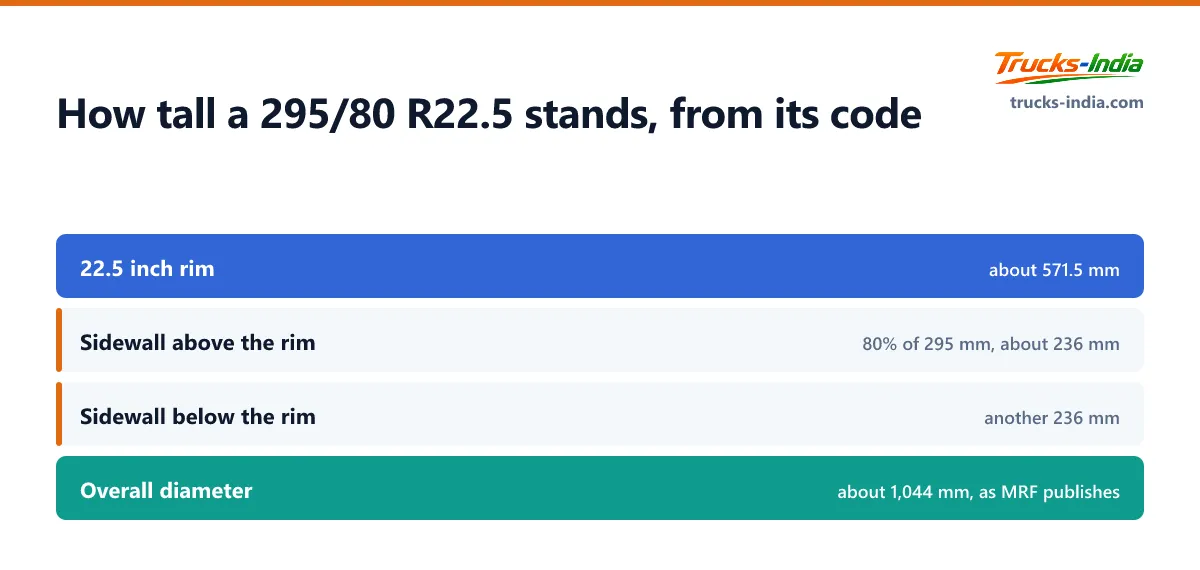
- In 295/80 R22.5, the tyre is 295 mm wide with a sidewall 80 percent of that width, about 236 mm, on a 22.5 inch rim.
- A pair such as 146/143 is the load index for single and dual fitment: 3,000 kg and 2,725 kg per tyre.
- PR is a strength rating, not a count of layers, and LT or C marks a tyre built for light commercial loads.
- Tata's heavy Signa range runs 295/90R20, and BharatBenz offers 295/80R22.5 as an option on the 4832R.
Truck tyre size meaning is simpler than the sidewall makes it look. Every code tells you three things, the width, the build and the rim, and most add a load and speed rating that matters more than the size itself.
This guide decodes the three formats you will see on Indian trucks: inch codes such as 10.00 R20, metric codes such as 295/80 R22.5, and light truck codes such as 195 R15 LT 8PR. It then lists which sizes real models run, so you can match a tyre to a truck before you buy.
Truck tyre size meaning, part by part
Indian trucks use three styles of size code. Each one is read left to right.
- Inch codes, such as 10.00 R20 or 9.00 R20. Common on medium and heavy trucks.
- Metric codes, such as 295/80 R22.5 or 295/90 R20. Common on newer multi axle trucks.
- Light truck codes, such as 195 R15 LT 8PR or 145 R12 LT. Used on pickups, mini trucks and smaller LCVs.
All three share the same core: a width, a construction letter, and a rim diameter in inches.
1000 R20 tyre size meaning
The size people search most is 10.00 R20, often written 1000 R20 or 1000-20.
- 10.00 is the nominal section width in inches.
- R means radial construction.
- 20 is the rim diameter in inches.
A dash in place of the R, as in 10.00-20, means a cross ply (bias) tyre. Both fit the same rim, but they are built differently and carry different pressures.
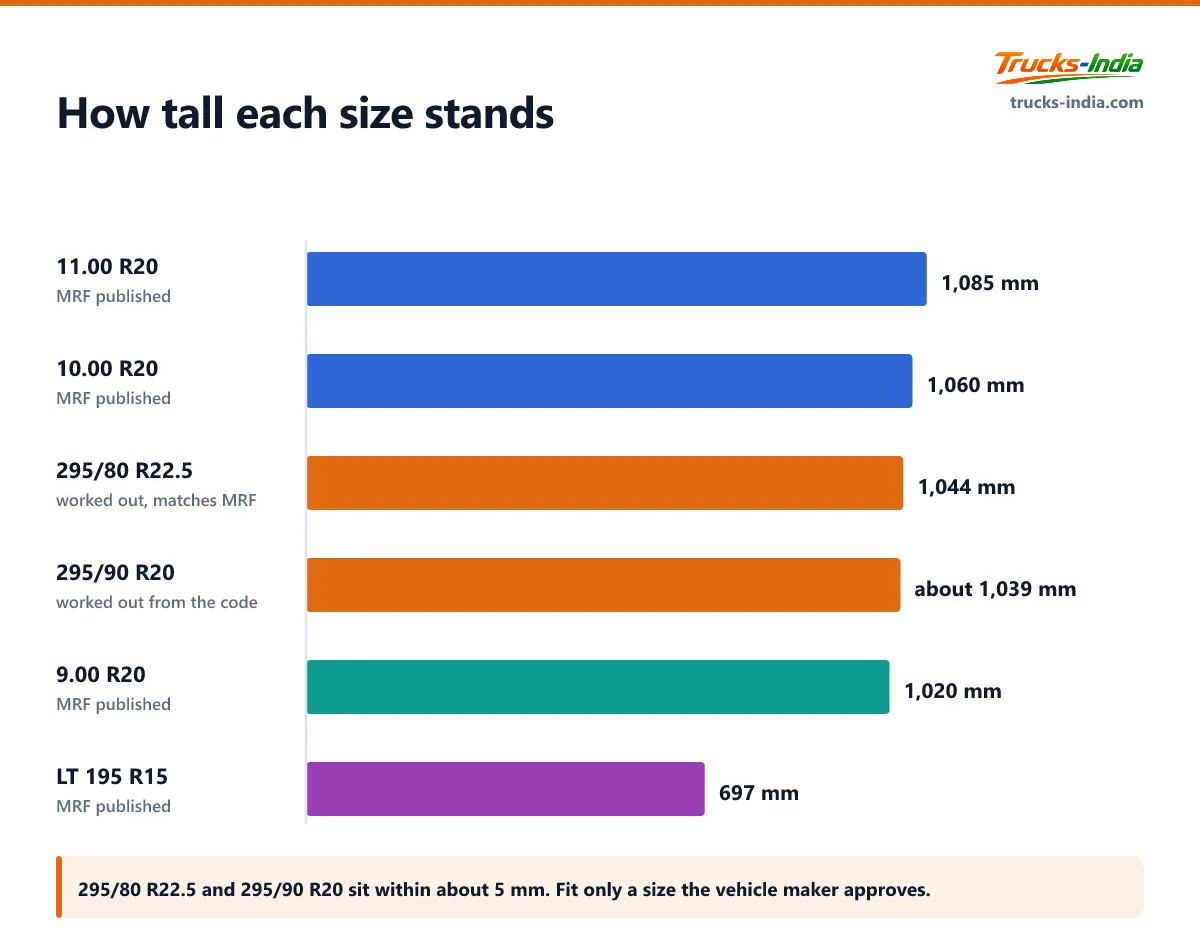
There is no aspect ratio in an inch code because these tyres have a tall sidewall roughly equal to their width. MRF's published dimensions show it. A 10.00 R20 radial in its tyre data book measures 275 mm wide with an overall diameter of 1,060 mm. Take away the 508 mm rim and each sidewall is about 276 mm tall, almost exactly the width. The same book lists the 11.00 R20 at 1,085 mm overall and the 9.00 R20 at 1,020 mm.
The same logic covers 11.00 R20 and 11R20, which are 11 inch tyres for 20 inch rims. BharatBenz lists 11R20 on its 2828C tipper, fitted to an 8x20 wheel rim, on its official specification page.
295/80 R22.5 explained
Metric codes add one number.
- 295 is the section width in millimetres.
- 80 is the aspect ratio: the sidewall is 80 percent of the width, about 236 mm.
- R means radial.
- 22.5 is the rim diameter in inches, which is about 571.5 mm.
Put those together and the tyre stands about 1,044 mm tall, which matches the overall diameter MRF publishes for its 295/80 R22.5. Rims in the 22.5 inch family are made for tubeless tyres.
295/90 R20 works the same way, with a taller sidewall of 90 percent, about 265.5 mm, on a 20 inch rim. That gives an overall diameter of roughly 1,039 mm, very close to the 22.5 inch tyre.
LT, C and PR on light truck tyres
Smaller commercial tyres carry extra letters.
LT means light truck. It marks a tyre built to carry commercial loads at higher pressure than a car tyre of the same size. C, as in the 195R15C that Tata lists for the Ultra T.6, is the commercial marking used on many European style sizes, and does the same job.
No aspect ratio on a code such as 195 R15 LT means a standard profile. MRF lists its LT 195 R15 at 697 mm overall, which works out to a sidewall about 81 percent of the width.
PR is ply rating. It is a strength rating that tells you how much pressure and load the casing is built for. It is not a count of the layers inside, and a radial carcass may have far fewer actual plies. An 8PR tyre is built for less pressure and load than a 16PR tyre of the same size.
Radial or cross ply: what the R changes
The letter in the middle of the code is a construction choice, and it changes more than the label.
A radial tyre has its casing cords running straight across from bead to bead, with steel belts under the tread. In a cross ply, the cords are laid diagonally in crossing layers. On the road, a radial's tread flexes less as it rolls, which is why radials have taken over most highway fitments. Cross ply tyres are still sold in the common sizes, often for rough site work and at a lower price.
MRF's data shows how close the two can be on paper. Its 10.00-20 cross ply carries 3,000 kg single at 8.15 kg/sq cm, and its 10.00 R20 radial carries the same 3,000 kg at 8.25 kg/sq cm. The load is identical; the build and the pressure differ.
Never mix the two on one axle, and never in a dual pair. Two tyres that deflect differently under the same load will not share it evenly.
The rim code
Tyre data books also give a recommended rim width. MRF lists a 7.5 inch rim for its 10.00 R20 radial and 8.25 for its 11 R22.5. A wheel code such as the 8x20 BharatBenz quotes for the 2828C means a rim 8 inches wide and 20 inches across. Fit a tyre to a rim of the width its maker lists, or the sidewall is pinched or splayed.
Load index and speed symbol
The code after the size is often the part that matters most. Tata's brochure for the Ace Gold diesel lists its tyre as 145 R12 LT 86/84 R 8PR.
- 86/84 is the load index for single and dual fitment. On the standard index table, 86 means 530 kg per tyre and 84 means 500 kg.
- R after the load index is the speed symbol, here 170 km/h.
On heavy tyres the same idea appears as 146/143K on a 10.00 R20 16PR: 146 is 3,000 kg single, 143 is 2,725 kg dual, and K is 110 km/h. A 295/80 R22.5 marked 152/148 carries 3,550 kg single and 3,150 kg dual, the same figures MRF publishes for that size.
Speed symbols on truck tyres usually sit well above the 80 km/h at which speed governors cap most goods vehicles. Load index is the figure to check, because a tyre rated below your axle load is the real risk.
Other markings worth reading
- TT or TL: tube type or tubeless.
- A four digit date code, such as 2425, which most makers use for the week and year of manufacture. Old stock ages on the shelf.
- The ISI mark, showing certification to the Bureau of Indian Standards specification for commercial vehicle tyres, IS 15636.
- The maximum pressure and load, moulded near the bead on many tyres.
- Tread wear indicators, small raised bars in the grooves that show when the tread is worn down.
Truck and lorry tyre size list for real Indian models
Whether you call it a truck or a lorry, the tyre size follows the vehicle's axle loads and rims. These sizes come from the makers' own specification pages.
- Mini truck: Tata Ace Gold diesel, 145 R12 LT 8PR radial tubeless
- Light truck: Tata Ultra T.6, 195R15C on six tyres
- Intermediate trucks: Tata LPT 1109g and LPT 1216, 8.25R16
- Medium truck: BharatBenz 1217R, 8.25R20 radial, or 255/70R22.5 tubeless
- Heavy two axle: Tata LPT 1916 and Ultra T.16, 9.00R20
- Tipper: BharatBenz 2828C, 11R20
- Multi axle haulage: Tata Signa 3525.T, Signa 4830.T and Signa 5530.S, 295/90R20
- Multi axle with an option: BharatBenz 4832R, 295/90R20, with 295/80R22.5 listed as optional
That last entry shows why overall diameter matters. A 295/80 R22.5 and a 295/90 R20 stand within about 5 mm of each other, so a maker can offer one in place of the other on a different rim. Only fit a size the vehicle maker approves for your model, because a change in tyre or rim can affect the vehicle's recorded particulars, as the modification rules guide explains.
Using the size code when you buy
A lorry tyre size printed on the sidewall is the only reliable starting point at the tyre shop, so read it off the tyre you are replacing rather than going by the model name. Then check three things against the tyre on your truck, not just the size.
- The size itself, including R or dash. A cross ply and a radial of the same size are not interchangeable in a dual pair.
- The ply rating or load index, at or above the original. A lower rating saves money and costs casings.
- Tube type or tubeless, matched to your rim.
Brand choice and tyre life are a separate question, covered in the guide to the best tyre brand for trucks in India. Pressure for each size is set by the load and inflation table for that exact tyre.
Read the sidewall once with this guide beside you and truck tyre size meaning stops being a puzzle: width, build, rim, then the load and speed rating that decides whether the tyre suits your axle.
Frequently asked questions
It means a tyre with a nominal section width of 10 inches, radial construction, for a 20 inch rim. MRF's 10.00 R20 measures about 275 mm wide and 1,060 mm in overall diameter. Written 10.00-20, with a dash, it is a cross ply tyre of the same size.
The dash means cross ply construction and the R means radial. They fit the same rim size, but a radial has a different casing, runs cooler and is usually specified at a slightly different pressure. Do not mix the two in a dual pair.
PR stands for ply rating. It is a measure of casing strength, telling you how much pressure and load the tyre is built for. The figure is not the actual number of layers inside. An 8PR tyre carries less than a 16PR tyre of the same size.
LT means light truck. It marks a tyre built to carry commercial loads at higher pressure than a passenger tyre of the same size, as on pickups and mini trucks. Some commercial tyres use C, for commercial, instead.
It is the load index for single and dual fitment. On the standard table, 146 means 3,000 kg per tyre running alone and 143 means 2,725 kg per tyre in a dual pair. The letter that follows, such as K, is the speed symbol.
Only if the vehicle maker lists it as an approved size for your model. The 22.5 inch tyre needs a different, tubeless rim, and its overall diameter differs from a 10.00 R20. BharatBenz, for example, offers 295/80R22.5 as an option on the 4832R in place of 295/90R20.
Where this fits
Once you know the size, the next question is which brand. Our guide to the best tyre brand for trucks in India compares the main makers.
The right tyre size follows from the truck. Trucks India lists every model sold in India with GVW, payload and tyre count, so you can check before you buy.
Call +91 93422 00875About the author
Lokesh R
CEO of Trucks India
Lokesh R is the founder of Trucks India, an independent heavy-vehicle marketplace and research platform operated from Chennai, Tamil Nadu, founded in 2025. Under his direction, Only Heavy publishes specifications and prices sourced from manufacturers, authorised dealer price lists and official regulatory schedules, with every model page checked by a named reviewer, prices re-verified monthly and after any GST revision, and no advertiser able to buy a rating, ranking or comparison result.


