
Truck Owner Income Per Month: What Actually Reaches You
The gap between what a truck earns and what its owner actually keeps: every deduction in order, owner driver versus hired driver, and the payment cycle.

Lokesh R
CEO of Trucks India
Created 19 August 2026 · 6 min read

There is a large gap between what a truck earns and what its owner takes home, and most people planning to buy one have only ever thought about the first number.
Revenue is what the truck bills. Income is what is left after the diesel, the driver, the tolls, the tyres, the insurance and the lender have all taken their share, and after the payment cycle has decided when any of it actually arrives in your account. Those are very different quantities, and the distance between them is where new owners get caught out.
This is about the second number.
Truck owner income per month, from revenue down
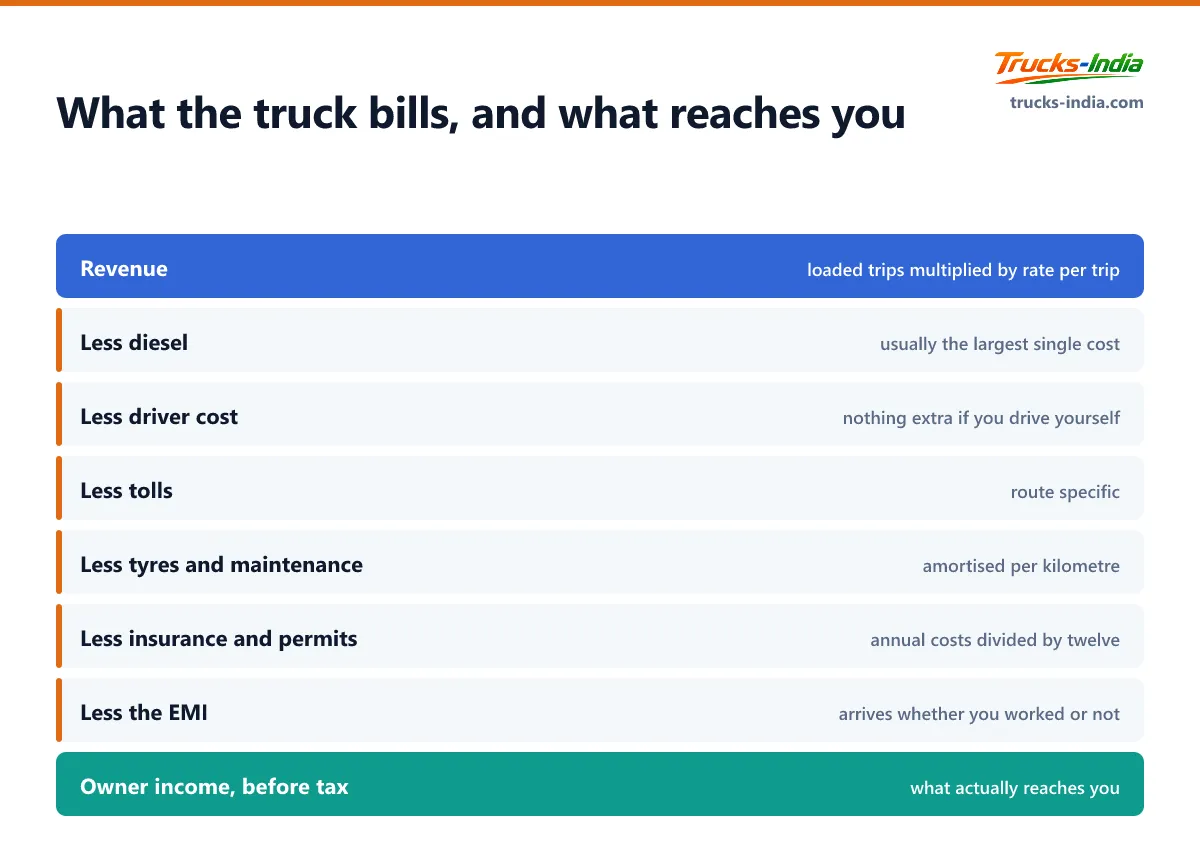
Work down the list in this order and what remains at the bottom is yours.
- Revenue. Loaded trips multiplied by rate per trip.
- Less diesel. Usually the largest single cost, and set by your vehicle's real mileage.
- Less driver cost. A salary, or nothing extra if you drive yourself.
- Less tolls.
- Less tyres and maintenance, amortised per kilometre rather than treated as surprises.
- Less insurance and permits, annual costs divided by twelve.
- Less the EMI.
- Equals your income, before tax.
The order matters because it shows where the money goes. Most owners are surprised by how much of it never reaches step eight.
Owner driver or hired driver
This is the biggest structural choice a single truck owner makes, and it changes the income figure more than almost anything else.
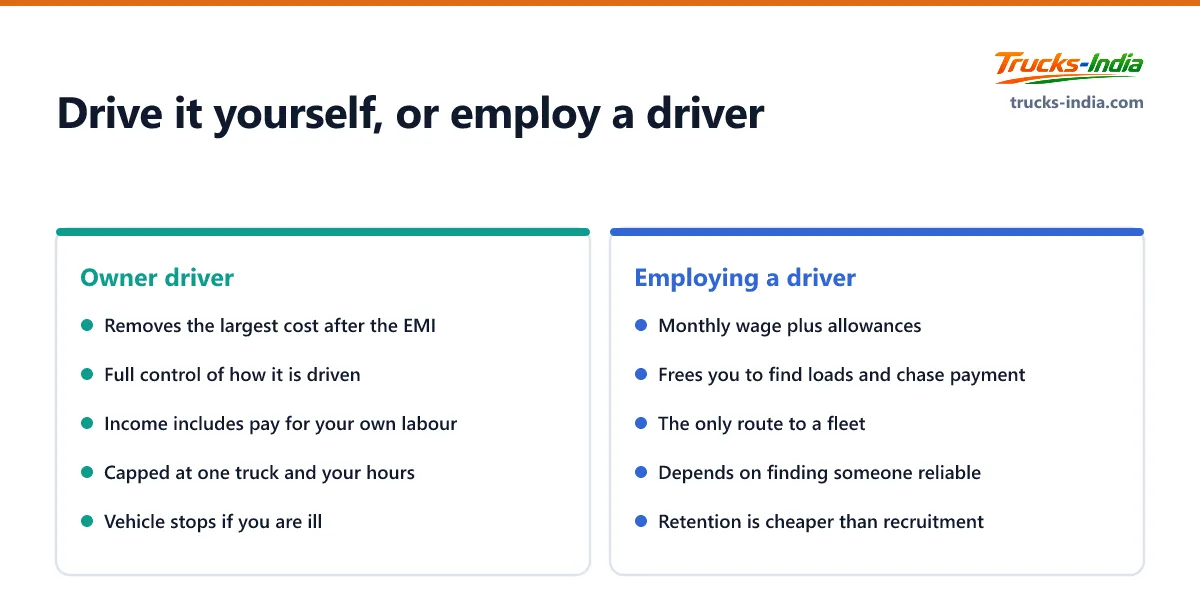
Driving yourself removes the driver's salary from the cost list entirely. On a single truck that is a substantial share of monthly costs, and it is the main reason owner drivers can make a single vehicle work where an owner employing a driver cannot.
The trade is real though. Your income now includes payment for your own labour, which means comparing it to a driver's wage is the honest benchmark rather than comparing it to pure profit. You are also limited to one truck's worth of hours, you cannot easily scale, and if you are ill the vehicle stops.
Employing a driver frees you to find loads, chase payments and eventually add vehicles. It costs a monthly wage plus allowances, and it introduces the problems of finding and keeping someone reliable. It is the only route to a fleet.
Neither is wrong. But an income projection that quietly assumes you will drive yourself, while also assuming you will spend your days winning contracts, is projecting two people's work.
Why the payment cycle changes the shape of your income
Freight clients typically pay 30 to 60 days after the trip, sometimes longer. Diesel, wages and the EMI are paid immediately.
The practical effect is that your income is real but delayed, and the delay is not a one time problem at the start. It is permanent. Every month you are funding this month's running costs from money earned two months ago.
This is why a reserve of two to three months of running costs is not caution, it is the working structure of the business. Owners who skip it are not running a leaner operation, they are running one trip away from a missed EMI.
The lines owners most often underestimate
Diesel, because they used the brochure mileage. Real mileage is what matters. Take the figure from the model page and put it against today's fuel prices for your monthly kilometres.
Tyres, because they arrive as a lump. A set is a large single payment. Divided across the kilometres it lasts, it is a routine per kilometre cost. Treating it as a surprise is how a good month becomes a bad one.
Maintenance, because it is deferred. Deferred maintenance is borrowed money at a poor rate. The breakdown costs more than the service, and it costs a load as well.
Empty running, because only the loaded leg gets costed. If you run 400 km loaded and 400 km back empty, that job burned 800 km of fuel.
Choosing the truck changes the income
Two vehicles at the same price can produce very different owner income, because the running cost differs. A truck that is cheaper to buy but two kilometres per litre thirstier will erase its purchase saving well before the loan is over.
Payload matters the same way in the other direction. Paying for capacity you never use is a permanent cost against no additional revenue, which is why sizing to your actual loads is an income decision rather than an ego one.
Compare within your segment. City and last mile work sits with the Tata Ace Gold and Ashok Leyland Dost. Regional freight runs on the Mahindra Furio 11 or Tata Ultra T16. Long haul begins with tractor trailers like the Ashok Leyland AVTR 5525.
Tax, briefly
Your income from the business is taxable, and the structure you registered under decides how it is assessed. A goods transport agency also has GST obligations, choosing between 5 percent without input tax credit and 18 percent with it, a choice exercised at the start of the financial year. The older 12 percent slab was rationalised into 18 percent from 22 September 2025.
Depreciation on the vehicle is a genuine and often overlooked deduction. This is worth an hour with a chartered accountant in your first year rather than your third.
A realistic way to project your income
Build it from the bottom rather than the top. Establish your cost per kilometre and your fixed monthly costs first, because those you can know precisely. Then ask what revenue you would need to clear them, and only then ask whether the trips and rates available on your route can deliver it.
Projections built the other way round, starting with an optimistic revenue figure, almost always survive contact with reality badly.
If you are running a single vehicle, the economics of a one truck business are worth reading alongside this, and the margin calculation shows where each deduction comes from.
Trucks to compare
A few trucks for a transport business on Trucks India, with ex-showroom price and rated payload. Open one for its full price, specifications and mileage.
Browse more: Mini trucks, Light commercial vehicles, Heavy trucks, Tata Motors trucks, Montra Electric trucks, Mahindra trucks
Frequently asked questions
It depends on segment, route, utilisation and whether the owner drives. Rather than a benchmark, work down from your own revenue through diesel, driver cost, tolls, tyres, maintenance, insurance, permits and the EMI. What remains is income, and it is usually a much smaller share of revenue than expected.
Financially, for a single truck, driving yourself removes the largest fixed cost after the EMI and is often what makes the vehicle viable. It limits you to one truck and to your own available hours, so it is a different business from building a fleet.
The payment cycle. Freight is paid 30 to 60 days after the trip while costs are paid immediately, so a profitable business still needs two to three months of running costs in reserve to function.
Revenue is what the truck bills. Income is what remains after diesel, driver, tolls, tyres, maintenance, insurance, permits and the EMI. The gap between them is large, and it is the number that actually matters.
Only if the extra payload earns work you can actually win. Otherwise the higher EMI and running cost reduce income. Match the vehicle to the loads available on your route.
Where this fits
Income depends on the truck you buy and the loads it suits. See our guide to starting a transport business.
What reaches you depends on what the truck drinks. Trucks India lists mileage, payload and on road price for every model sold in India.
Call +91 93422 00875About the author
Lokesh R
CEO of Trucks India
Lokesh R is the founder of Trucks India, an independent heavy-vehicle marketplace and research platform operated from Chennai, Tamil Nadu, founded in 2025. Under his direction, Only Heavy publishes specifications and prices sourced from manufacturers, authorised dealer price lists and official regulatory schedules, with every model page checked by a named reviewer, prices re-verified monthly and after any GST revision, and no advertiser able to buy a rating, ranking or comparison result.


