
Is the Truck Business Profitable in India?
What actually decides whether a truck makes money in India: utilisation, the return leg, payment cycles and downtime, and the conditions where it does not work.

Lokesh R
CEO of Trucks India
Created 10 August 2026 · 6 min read
The honest answer is that it can be, and that the question is usually asked the wrong way round. Profitability in freight is not a property of the industry. It is a property of how a specific truck is used on a specific route, and two operators running identical vehicles on the same corridor can end a year in completely different places.
That is not a dodge. It means the useful question is not whether trucking is profitable, but what separates the operators who make money from the ones who hand it all to the diesel pump and the lender.
Here is what actually decides it.
Is the truck business profitable in India?
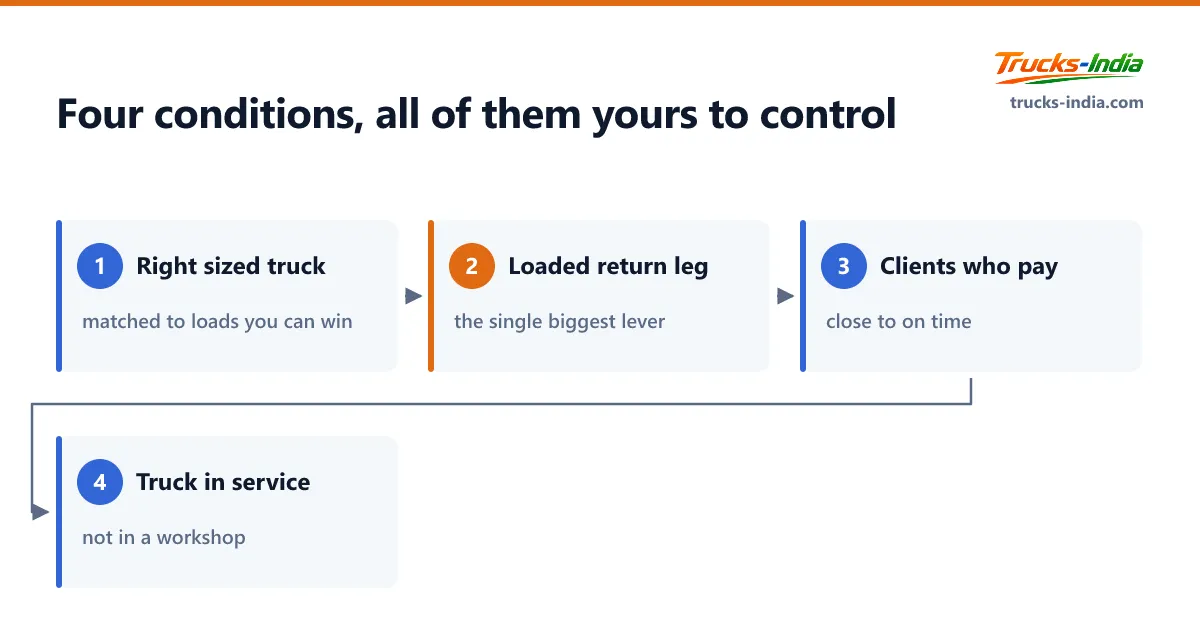
It is profitable when four conditions hold, and it is not when they do not.
- The truck is sized to loads you can actually win
- The return leg is loaded more often than not
- Clients pay close to on time
- The vehicle is in service rather than in a workshop
Notice that none of those are about the rate per trip. Rates matter, but they are set by the market and you have limited influence over them. The four conditions above are things you control, and they are where the margin actually comes from.
Why margin comes from utilisation, not rates
Freight revenue is trips multiplied by rate. Costs are relentless and mostly fixed or per kilometre: diesel, driver wages, tolls, maintenance and tyres, insurance and permits spread monthly, and the EMI.
The EMI is the important one. It arrives whether the truck moved or not. So does the driver's salary in most arrangements. That means every additional loaded trip in a month spreads the same fixed cost across more revenue, and every idle week concentrates it.
This is why two operators with the same truck diverge. One runs 20 loaded trips a month, the other 12, and the second is not making two thirds of the first's profit. After fixed costs, they may be making none at all.
The return leg is the single biggest lever
A truck that earns on the outbound leg and runs empty on the way back has roughly halved its revenue while burning much the same fuel and paying the same wage. Return freight comes from three places: your own clients, a broker, or the load booking apps that list freight on your corridor.
Nothing else available to a small operator moves the number this much. Not a better rate, not a cheaper truck, not fuel saving driving habits, useful as those are. Finding return loads is the difference between a route that works and one that quietly loses money.
For a single truck owner this usually means building relationships at both ends of your main corridor rather than at one, and using load boards to fill the gap when relationships do not. It is work, and it is the work that pays best.
Payment cycles turn paper profit into a cash problem
Freight payment runs 30 to 60 days, sometimes longer. Diesel, wages and the EMI do not wait.
An operator can be genuinely profitable on paper and still fail, because the reserve ran out before the invoices cleared. This is why two to three months of running costs in reserve is not conservative advice, it is the minimum viable structure for the business.
Downtime costs twice
A truck in a workshop earns nothing and still owes its EMI. Preventive servicing on schedule is cheaper than the breakdown that strands a load, damages a client relationship and costs a week.
The same logic applies to buying decisions. A vehicle that is 2 lakh cheaper but two kilometres per litre thirstier will cost you far more than the saving across five years. Compare the mileage figure on the model page against today's fuel prices before you decide, because that comparison is usually more consequential than the sticker price.
Where the truck business is not profitable
It is worth being direct about the failure cases.
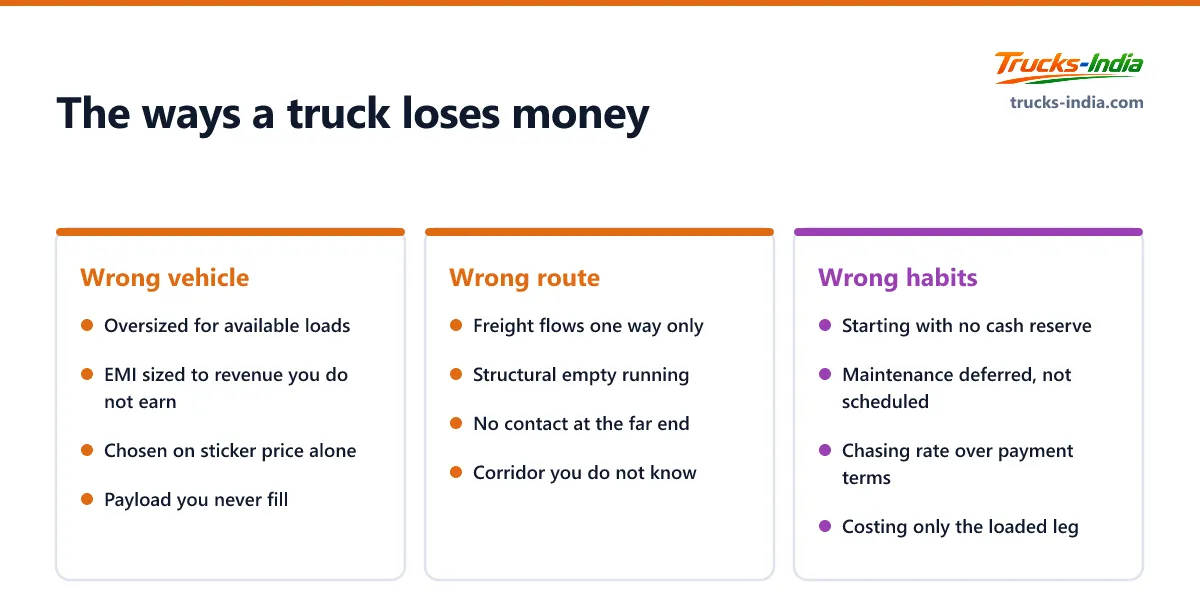
- Oversized vehicle, undersized loads. Buying a 55 tonne tractor trailer to carry loads that a 16 tonne truck would handle. The EMI is sized to a revenue you are not earning.
- One direction routes. Corridors where freight flows heavily one way and barely returns. These exist, and they are where empty running is structural rather than a planning failure.
- No reserve. Starting with nothing behind you and a 60 day payment cycle ahead.
- Deferred maintenance. Treating servicing as an expense to postpone rather than a schedule to keep.
- Rate chasing. Taking the highest quoted rate without checking whether the client pays, and when.
What good looks like
The operators who do well tend to share a few habits rather than a secret. They know their cost per kilometre precisely rather than approximately. They fill the return leg. They keep a reserve. They service on schedule. And they picked a vehicle matched to the work available on their route rather than to their ambition.
Those are unglamorous and they are the whole game.
Before you buy
Run four numbers against the specific truck you are considering: the EMI your lender actually quotes, monthly diesel from real mileage and today's price, fixed monthly costs including driver and spread insurance, and realistic monthly revenue with the return leg counted honestly. If revenue does not comfortably clear the other three, the plan needs changing before the purchase does.
Start from the segment you can win work in: under 10 lakh for city work, 10 to 20 lakh for regional freight, or 40 to 50 lakh where multi axle haulage begins.
Profitability is a calculation rather than an opinion. Work through how to calculate your profit margin, then compare it against what a truck actually earns per month. If you have not bought yet, start with the full guide to starting a transport business.
Profitability rests on costs you can actually control. The two largest are fuel, covered in the guide to increasing truck mileage, and the maintenance and tyre spend set out in the truck maintenance cost guide.
Trucks to compare
A few trucks for a transport business on Trucks India, with ex-showroom price and rated payload. Open one for its full price, specifications and mileage.
Browse more: Mini trucks, Light commercial vehicles, Heavy trucks, Ashok Leyland trucks, Mahindra trucks
Frequently asked questions
Yes, for operators who keep utilisation high, fill the return leg, get paid reasonably on time and keep vehicles serviced. It is not profitable for those who buy more truck than their loads justify or start without a cash reserve.
Diesel is usually the largest single running cost, which is why mileage matters more than sticker price across the life of the vehicle. The EMI is the most dangerous cost, because it is fixed and arrives whether the truck worked or not.
That depends on utilisation and the payment cycle rather than on a fixed period. The practical constraint is that invoices clear 30 to 60 days behind the costs, so the business needs a reserve to bridge that gap before it can be judged.
It can be, particularly for an owner driver who saves the driver's wage. The economics are tighter than a small fleet because there is no other vehicle to absorb a breakdown, so downtime hurts more.
Not reliably. A cheaper vehicle with worse mileage often costs more across five years than the purchase saving. Compare running cost and payload against the loads you actually carry, not just the price.
Where this fits
Profitability starts with buying the right truck for the loads you can win. See our guide to starting a transport business.
Profit starts with matching the truck to the route. Trucks India lists on road price, payload and mileage for every model sold in India.
Call +91 93422 00875About the author
Lokesh R
CEO of Trucks India
Lokesh R is the founder of Trucks India, an independent heavy-vehicle marketplace and research platform operated from Chennai, Tamil Nadu, founded in 2025. Under his direction, Only Heavy publishes specifications and prices sourced from manufacturers, authorised dealer price lists and official regulatory schedules, with every model page checked by a named reviewer, prices re-verified monthly and after any GST revision, and no advertiser able to buy a rating, ranking or comparison result.


