
How Much Does a Truck Earn Per Month in India?
How monthly truck revenue is actually built in India: trips, rate, payload and the return leg, with the method to work out the number for your own route.

Lokesh R
CEO of Trucks India
Created 16 August 2026 · 6 min read
This is the question everyone asks first, and the one that is hardest to answer honestly, because the number depends almost entirely on things that vary: your segment, your route, how many loaded trips you run, and whether the truck comes back full.
What can be answered honestly is the structure of the number. Once you understand how monthly revenue is built, you can put your own route into it and get a figure that is actually yours, which is worth considerably more than someone else's average.
How much a truck earns per month, and how to work out yours
Monthly revenue comes down to one line:
Loaded trips in the month, multiplied by the rate per trip.
Everything else is detail feeding those two terms. So the useful work is understanding what sets each one for your situation.
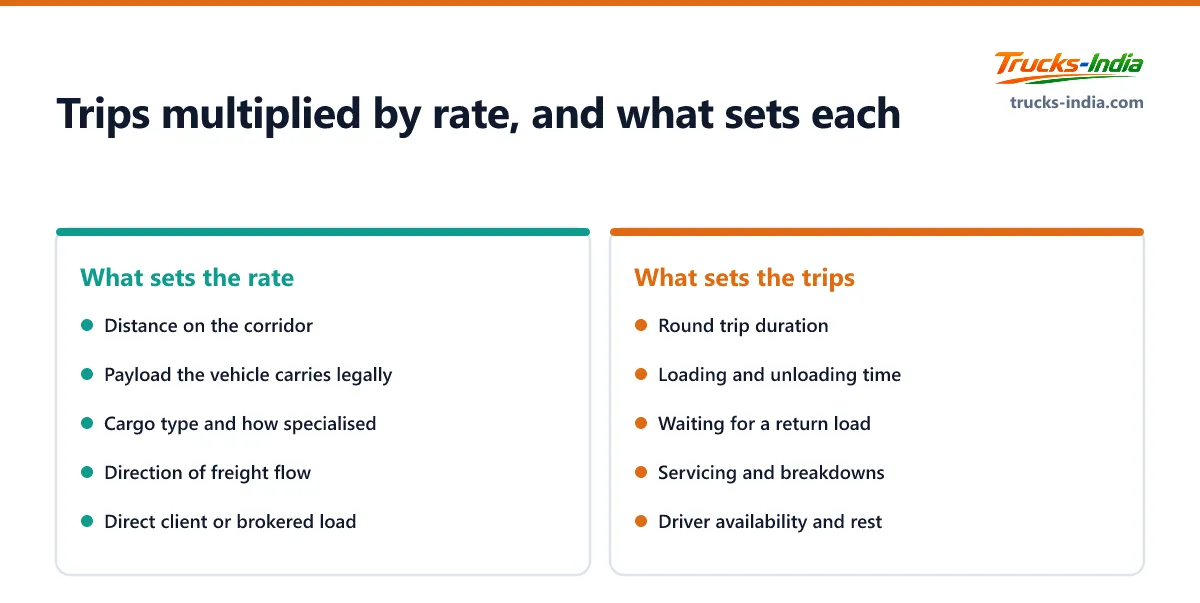
What sets the rate per trip
Distance. Rates are usually quoted per trip on a corridor or per tonne, and both scale with distance.
Payload. A vehicle that legally carries more earns more per trip on the same route. This is why sizing the truck to your loads matters so much: paying for payload you never use is pure cost, and running short of payload means turning work away.
Cargo type. Specialised freight pays better because the vehicle is not interchangeable. A tipper on construction work or a transit mixer on concrete commands rates a flatbed cannot, at the price of narrower demand.
Route direction. Corridors have imbalances. Freight flowing heavily one way pays well outbound and poorly, or not at all, on the return.
Who you carry for. Direct clients pay more than brokered loads, and take longer to win.
What sets the number of trips
This is where most of the variation lives, and it is more within your control than the rate.
- Trip duration, driven by route length, road quality and border crossings
- Loading and unloading time, often the largest hidden drag on a month
- Waiting for a return load, the single biggest determinant for many operators
- Downtime, whether scheduled servicing or a breakdown
- Driver availability, including rest requirements and leave
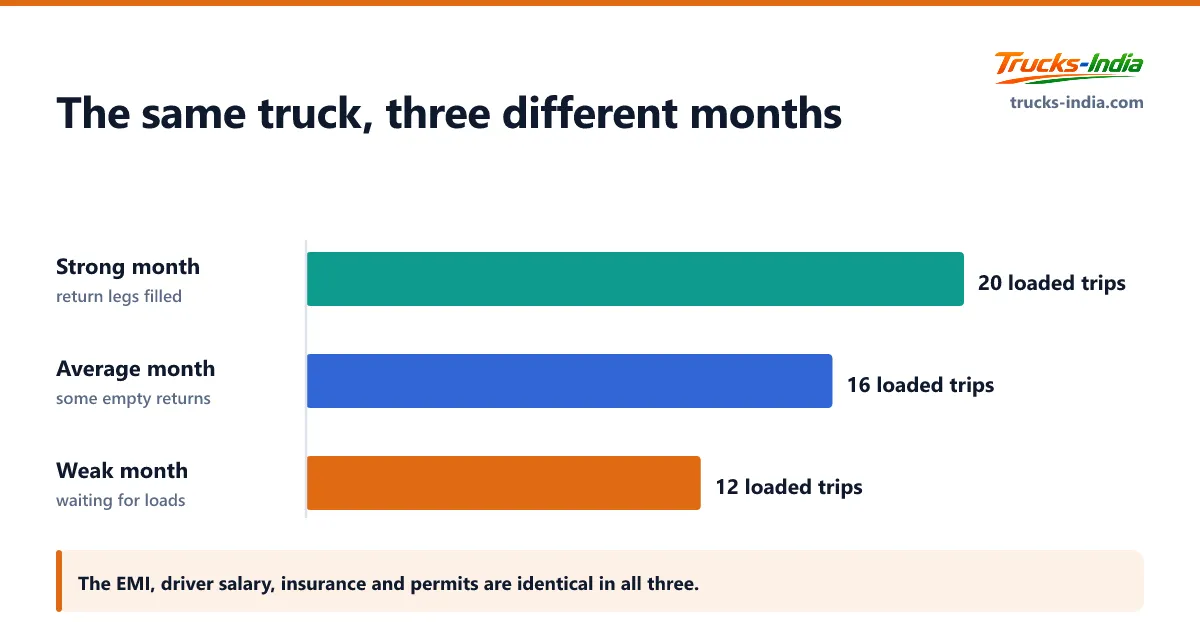
A truck that could theoretically run 20 trips a month and actually runs 12 is not underperforming by a third. After fixed costs, that gap can be the entire profit. Most of it is time spent waiting for a return load, which is what the truck booking apps exist to compress, and it is usually what separates a truck business that is profitable from one that is not.
Revenue differs sharply by segment
Comparing across segments only makes sense when you compare the whole picture, because higher revenue arrives with higher costs.
Last mile and city work. Short trips, many of them, lower revenue each. Vehicles like the Tata Ace Gold or Mahindra Jeeto. Low entry cost, high trip count, heavy competition on rates.
Regional freight. Fewer, longer trips at better rates. The Eicher Pro 2059 XP Plus or Tata Ultra T16 class. Loads tend to be more predictable than city work.
Long haul. Highest revenue per trip and highest cost per trip, with tractor trailers such as the Tata Signa 5530S. This is the segment where an empty return leg hurts most.
Specialised. Tippers and transit mixers earn well when the work is there and idle expensively when it is not.
Work out your own number
Four steps, using figures you can actually get.
- Trips per month. Be realistic. Take your route's round trip time, add loading, unloading and waiting, and divide the working days in a month by that. Then subtract for servicing.
- Rate per trip. Ask two or three operators or brokers on your actual corridor. This is the only reliable source, because published averages hide enormous local variation.
- Return leg. Estimate honestly what fraction of return trips you will fill. If you do not know, assume the pessimistic figure until you have data.
- Multiply. Trips times rate, adjusted for the return leg.
That gives revenue. What you keep is a separate calculation: subtract diesel from real mileage at today's fuel prices, driver wages, tolls, tyres and maintenance, insurance and permits spread monthly, and the EMI.
Revenue is not income
A truck earning well can leave its owner with very little, for three reasons.
The EMI. Fixed, monthly, indifferent to whether you found work.
Diesel. Usually the largest running cost, and directly tied to the mileage of the vehicle you chose. A truck that is cheaper to buy and thirstier to run reverses its saving quickly.
The payment cycle. Freight clients pay in 30 to 60 days. Revenue earned in August is often cash received in October, while diesel and wages were paid in August.
Why an average would mislead you
Published monthly earnings figures for Indian trucks vary so widely that quoting one would be close to meaningless. The same 16 tonne truck can earn very differently in two adjacent states, on two corridors, in two hands.
The number that matters is the one built from your route, your rate and your realistic trip count. Every input above is obtainable in an afternoon of phone calls, and doing that work before buying is worth more than any benchmark.
Revenue is not income. Once you have this figure, run it through the margin calculation and then through what reaches the owner, because the three numbers are very different.
Truck business profit per month, from one truck
Two phrasings of the same question come up constantly, and they want slightly different numbers.
Truck business profit per month is what the business keeps after every cost, which is revenue minus diesel, driver, maintenance, tyres, toll, insurance, permit and the instalment. It is the figure that matters and it is far below the freight billed.
One truck income per month usually means the same thing to the person asking, but it is worth being precise: income to the owner is profit, and profit is only the owner's income once the instalment is paid and a reserve is put aside.
Work both out on your own numbers rather than on an average. The method is in the profit margin guide, and what an owner actually takes home after the instalment is covered in truck owner income per month.
Trucks to compare
A few trucks for a transport business on Trucks India, with ex-showroom price and rated payload. Open one for its full price, specifications and mileage.
Browse more: Mini trucks, Light commercial vehicles, Heavy trucks, Ashok Leyland trucks, Mahindra trucks, Euler EV trucks, Switch Mobility trucks
Frequently asked questions
It varies too widely by segment, route and utilisation for a single figure to be useful. Revenue is loaded trips multiplied by rate per trip, so the reliable approach is to get the going rate on your own corridor from operators running it, and multiply by a realistic trip count.
More per trip, yes, because it carries more payload. Whether it earns more in profit depends on whether loads of that size are actually available to you and whether the higher EMI and fuel cost are covered.
That depends on route length, loading and unloading time, waiting for return loads, and servicing. Working out your realistic figure, rather than the theoretical maximum, is the most important input in any earnings estimate.
Usually the payment cycle. Freight is typically paid 30 to 60 days after the trip while diesel, wages and the EMI are paid immediately. This is why two to three months of running costs in reserve is essential.
Yes. A truck that earns on the outbound leg and returns empty has roughly halved its revenue on nearly the same fuel and wage bill. For most small operators it is the largest single lever on monthly earnings.
Where this fits
Earnings follow the segment you choose. See our guide to starting a transport business for how to pick one.
Revenue starts with payload and the route it suits. Trucks India lists payload, mileage and on road price for every model sold in India.
Call +91 93422 00875About the author
Lokesh R
CEO of Trucks India
Lokesh R is the founder of Trucks India, an independent heavy-vehicle marketplace and research platform operated from Chennai, Tamil Nadu, founded in 2025. Under his direction, Only Heavy publishes specifications and prices sourced from manufacturers, authorised dealer price lists and official regulatory schedules, with every model page checked by a named reviewer, prices re-verified monthly and after any GST revision, and no advertiser able to buy a rating, ranking or comparison result.


