
CBC Truck Meaning: CBC vs FBV vs Cowl Chassis, and What Each Price Includes
Understand the CBC truck meaning, how it differs from FBV and cowl chassis, what each listed price includes, and which one suits your load and budget.

Lokesh R
CEO of Trucks India
Created 1 October 2026 · 8 min read
Key takeaways
- CBC means cab with chassis: the cab is finished, but there is no load body, so the listed price does not include one.
- A cowl chassis has only the front end structure, so both the cab and the load body still have to be built.
- FBV means fully built vehicle: the truck is sold ready to load, with the body already fitted.
- Since 1 October 2025, a medium or heavy truck sold as a drive away chassis must come with a type approved air conditioning kit for the body builder to fit.
- Compare a CBC price with an FBV price only after adding the body cost, the fitting time and the paperwork to the CBC figure.
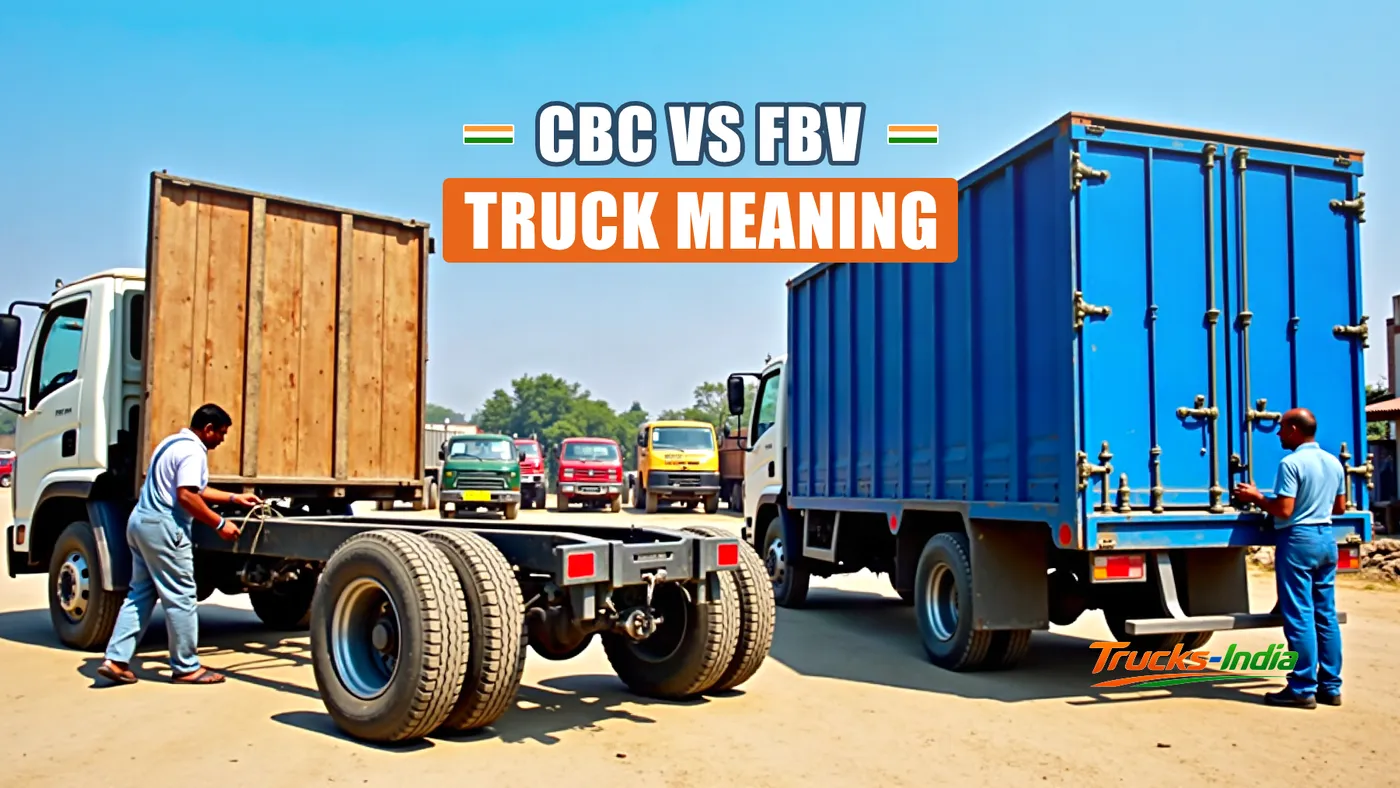
Two trucks with the same badge can carry prices lakhs apart on the same listing page. Usually the difference is three letters after the model name: CBC, FBV or cowl. Those letters say how much of the vehicle the factory has actually built, and therefore how much you still have to pay for after delivery.
This guide gives the CBC truck meaning in plain terms, sets it beside FBV and cowl chassis using the official definitions, and explains how Indian listings use the terms so you compare like with like before you sign.
CBC truck meaning: cab with chassis
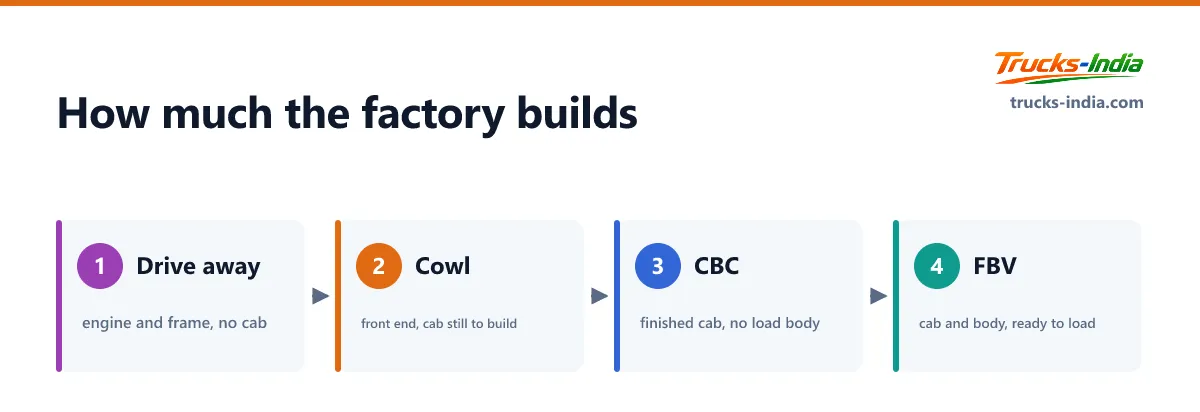
CBC stands for cab with chassis, sometimes written as cabin with chassis or cab and chassis. The truck leaves the factory with its engine, frame, axles and a complete driver's cab, but no load body behind it.
The AIS-093 code for truck cabs and truck bodies, the standard that governs truck body building under the Central Motor Vehicles Rules, defines it precisely. A cab and chassis is "an incomplete vehicle, with a completed occupant compartment", needing only the cargo carrying parts to do its job.
So when someone asks what is CBC in truck terms, the short answer is this: everything behind the cab is your job. You choose the body, a body builder fits it, and the truck is ready for work only after that.
Makers use the term on their own spec sheets. Tata Motors, for example, lists "CBC" as the load body type on some of its truck pages. On an Indian listing, a model name followed by CBC almost always means the price shown is for the truck without a body.
Cowl chassis truck: only the front end
A step further back is the cowl chassis. AIS-093 defines it as an incomplete vehicle with a front end structure, with or without the windshield, that still needs the complete cab and the cargo carrying parts built on it.
In practice a cowl chassis truck arrives with the bonnet area, dashboard, steering and controls, and little else. A body builder then builds the cab and the load body. For decades this was the normal way to buy a heavy lorry in India, because it was cheaper and let operators choose a local cab design.
Two rules have made cowl buying more formal than it used to be:
- Cabs built by body builders must meet AIS-093. The code covers trucks above 3.5 tonnes gross vehicle weight, and body builders who build cabs on these chassis are responsible for compliance.
- Air conditioned cabins. Under G.S.R. 886(E) of 8 December 2023, N2 and N3 trucks made on or after 1 October 2025 must have an air conditioned cabin. When such a truck is sold as a drive away chassis, the chassis maker must supply a type approved air conditioning kit for the body builder to install.
The bare drive away chassis, with no cab at all, is the least complete form of the three. AIS-093 describes it as the operating vehicle, engine, frame and mechanical parts, without the cab or body.
FBV truck meaning: fully built vehicle
FBV stands for fully built vehicle. The truck is sold complete, with cab and load body already fitted, and it is ready to load once it is registered.
The body on an FBV is typically built by the maker or by a body builder working to the maker's approved design. That gives a few practical advantages:
- One price and one invoice for the whole vehicle, which simplifies finance and insurance.
- No waiting at a body builder's yard, which can take weeks in busy seasons.
- A body designed for the chassis, with weight, mounting and dimensions already worked out.
The trade off is choice. An FBV comes in the body types the maker offers, usually a standard high sided cargo body or a common tipper body. If you need a reefer box, a tanker, a car carrier or a custom length, a CBC or cowl chassis is still the route.
Tata's own Signa range shows how the labels sit side by side on the same truck. The Tata Signa 3518 FBV and the Tata Signa 3518.T are both 35,000 kg gross vehicle weight trucks with a 26,000 kg payload listed in our catalogue.
How CBC and FBV pricing works on Indian listings
This is where buyers go wrong. The prices on listing pages, ours included, are only comparable once you know what each one includes.
From the Trucks India catalogue:
- Tata Signa 3518.T: listed at Rs 31 to 38 lakh
- Tata Signa 3518 FBV: listed at Rs 40 to 59 lakh
- Tata Signa 2818.T: listed at Rs 31 to 34 lakh
- Tata Signa 2818 FBV: listed at Rs 34 to 51 lakh
The gap is not pure profit for anyone. Most of it is the load body, plus the spread of variants and body lengths inside each listing. To compare fairly, add to the CBC or cowl price:
- The body cost, which depends on type, length and material. The truck body building cost guide gives the ranges.
- For a cowl, the cab as well, which is a substantial extra job.
- The waiting time at the body builder, which is time the truck is not earning.
- Registration on the final body, since the vehicle is registered as built.
Then compare on road prices, not ex-showroom figures. The on road price guide shows how the extras stack up.
How the body changes your payload
One more number moves when a CBC or cowl truck gets its body: the payload. The gross vehicle weight is fixed by the maker and registered on the RC. The payload is what is left after the weight of the truck itself, including its body and cab.
So a heavier body means a lighter legal load. A thick steel high sided body, a long body or a cab built with heavy local fittings all eat into the payload the truck can carry on every single trip, for its whole life.
The rules make this visible. Under the AIS-065 standard for statutory plates, a vehicle completed by a body builder on an incomplete chassis must carry a body builder's plate showing the builder's name, the unladen weight and the payload after body building. An FBV arrives with those figures already settled. With a CBC or cowl, they depend on the body you order, so ask the body builder for the finished unladen weight in writing before work starts.
Half body, full body and other body words
Listings and dealers also use body type codes after a model name. AIS-093 lists the main ones:
- HSD: high side deck body
- FSD: fixed side deck, also called half body
- DSD: drop side deck body, where the sides fold down
- FB: flat bed, or fully open body
- CLB: closed body, and container bodies in steel or aluminium
One trap is worth knowing. In everyday lorry trade talk, "full body" usually means a high sided body, while in the code a "fully open body" is a flat bed. They are opposite things. When a quote says full body, ask for the side height in writing.
The Eicher Pro 2055T DSD is an example of a listing that carries its body code in the name. For a wider view of how body style matches the job, see the types of trucks guide.
CBC pickup meaning
The same logic runs down to small vehicles. A CBC pickup is a pickup sold with its cab but without the standard cargo deck, so a body builder can fit something else: a closed container, an insulated box, a small tipper or a canopy.
Our catalogue shows the pattern with the Maruti Suzuki Super Carry, which is listed both as a standard deck version and as a separate Super Carry Petrol Chassis, at a 1,600 kg gross vehicle weight. If your load is ordinary cargo, the standard deck is usually cheaper than a chassis plus a custom body.
CBC or FBV: which should you buy?
The choice comes down to the job and how fast the truck has to earn.
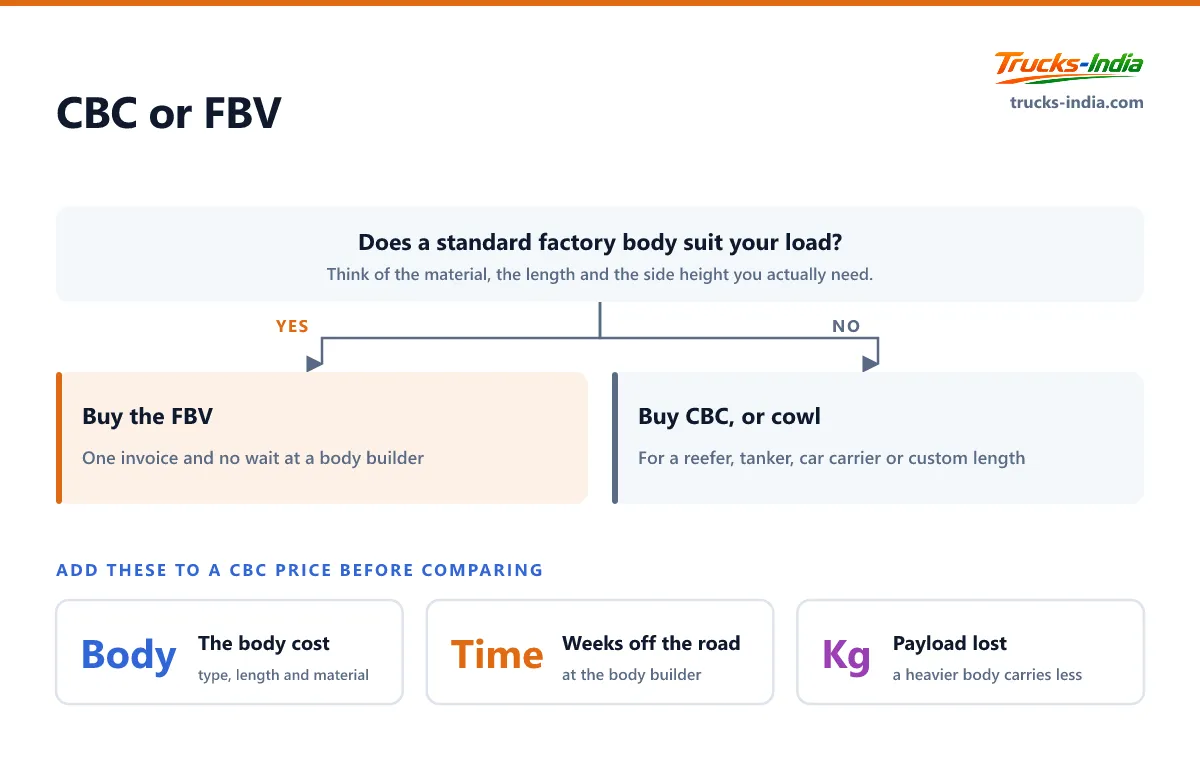
Pick an FBV when a standard body suits the load and every week off the road costs money. Pick a CBC when the load needs a special body or a specific length. Choose a cowl chassis only when you have a body builder you trust for the cab as well, and confirm the cab meets AIS-093 before you take delivery.
Whatever you choose, the body becomes part of the vehicle's record. Changing it later to a different type is a modification the RTO has to endorse, as the modification rules guide explains.
Once the CBC truck meaning is clear, the three letters on a listing stop being jargon and start telling you exactly what is left to buy.
Trucks to compare
A few popular trucks on Trucks India, with ex-showroom price and rated payload. Open one for its full price, specifications and mileage.
Browse more: Mini trucks, Light commercial vehicles, Heavy trucks, Ashok Leyland trucks, Mahindra trucks, Force Motors trucks, Tata Motors trucks
Frequently asked questions
CBC means cab with chassis, also written cabin with chassis. The truck comes with its engine, frame and a finished driver's cab, but without a load body. The body is built and fitted separately, usually by a body builder of the buyer's choice.
FBV means fully built vehicle. The truck is sold complete with cab and load body already fitted, so it can start work once registered. It typically costs more than the CBC version of the same truck because the body is included in the price.
A cowl chassis truck has only the front end structure, with or without a windshield. The full cab and the load body both have to be built by a body builder. It was long the usual way to buy heavy trucks in India.
A CBC has a finished cab but no load body; an FBV has both. A CBC lets you choose a special body, while an FBV saves waiting time and comes as one invoice. Compare them only after adding the body cost to the CBC price.
No. A CBC price covers the truck with its cab, and the load body is extra. The body cost depends on type, length and material, and it can add several lakh rupees to a heavy truck.
It means the pickup comes with its cab but without the standard cargo deck, so a body builder can fit a container, insulated box or other special body. For ordinary cargo, the standard deck version is usually the cheaper choice.
Where this fits
A CBC or cowl truck still needs a body. Our guide to truck body building cost in India covers what that body costs by type and size.
Know what each price includes before you compare. Trucks India lists every truck model sold in India with payload, mileage and price.
Call +91 93422 00875About the author
Lokesh R
CEO of Trucks India
Lokesh R is the founder of Trucks India, an independent heavy-vehicle marketplace and research platform operated from Chennai, Tamil Nadu, founded in 2025. Under his direction, Only Heavy publishes specifications and prices sourced from manufacturers, authorised dealer price lists and official regulatory schedules, with every model page checked by a named reviewer, prices re-verified monthly and after any GST revision, and no advertiser able to buy a rating, ranking or comparison result.


