
Truck Dashboard Warning Lights Meaning: What Each Light Asks You to Do
Learn the truck dashboard warning lights meaning by colour, which lights mean stop now, and how BS6 AdBlue, DPF and engine fault lamps escalate if ignored.

Lokesh R
CEO of Trucks India
Created 30 September 2026 · 9 min read

Key takeaways
- Colour sets the urgency: red means stop safely and switch off, amber means drive on carefully and get it checked, green and blue are information only.
- On a BS6 truck the AdBlue warning must come on when the tank falls below 10 percent, and the truck loses about a quarter of its torque below 2.5 percent.
- An empty AdBlue tank on a BS6 truck ends in creep mode, a 20 km/h speed limit, under the AIS-137 rules every maker must meet.
- The engine fault lamp on a BS6 truck is a yellow or amber engine symbol, and it is separate from the AdBlue warning.
- Exact symbols vary by make and model, so the owner's manual for your truck is the final word on any light.
A warning light is the truck telling the driver something specific, and the colour of that light says how urgent it is. This guide explains the truck dashboard warning lights meaning by colour and by system, from the red lights that mean stop now to the BS6 lights for AdBlue, the particulate filter and the engine fault lamp.
It also covers what happens on a BS6 lorry if a warning is ignored, because the newer trucks do not just complain. They cut power and, in the end, slow the vehicle to a crawl.
Truck dashboard warning lights meaning: read the colour first
Every truck maker in India draws its symbols from the same international catalogue, ISO 2575, the road vehicle standard for control and tell-tale symbols. The drawings differ a little between brands. The colour logic, however, is shared, and it is the fastest way to decide what to do.
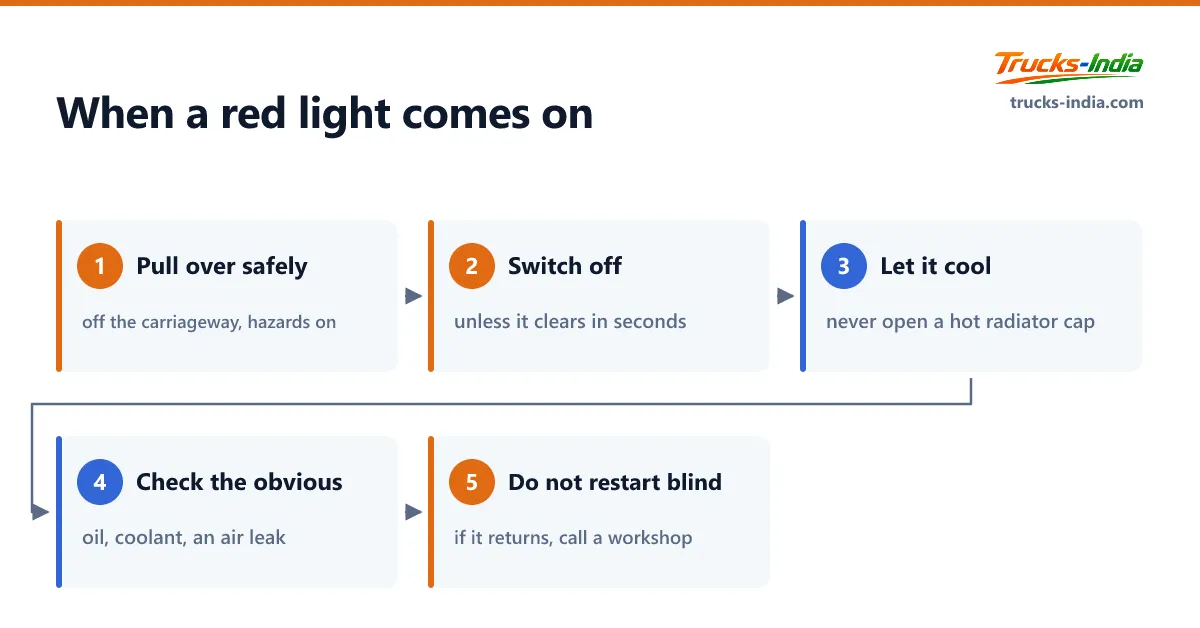
- Red: a fault that can damage the engine or make the truck unsafe. Stop where it is safe, and switch off unless the light clears within seconds.
- Amber or yellow: something is outside normal limits or needs service. Keep driving gently and get it checked soon.
- Green: a system is switched on, such as indicators or the exhaust brake.
- Blue: high beam is on.
A light that flashes is usually more urgent than the same light glowing steady. A light that comes on with a buzzer is the truck asking for the driver's attention now, not at the next service.
Every light should also come on briefly when the key is turned, as a bulb check. A warning lamp that never lights at all during that check is a fault in itself.
Red truck warning lights: stop the truck safely
These are the lights where carrying on to the next dhaba is the expensive choice.
Engine oil pressure
The oil can symbol means the engine has lost oil pressure. Stop and switch off at once. A diesel engine can seize within minutes without oil pressure, and that turns a cheap repair into an engine rebuild. Check the oil level only after the truck is parked safely and the engine has stopped.
Coolant temperature
A thermometer in liquid means the engine is overheating. Pull over, let the engine idle for a minute if the gauge is not in the red zone, then switch off. Never open a hot radiator cap, because the coolant is under pressure and scalds.
Brake system and low air pressure
Most medium and heavy trucks in India use air brakes. The low air pressure warning, often a lamp with a buzzer, means there is not enough pressure in the tanks to brake properly. Do not move off until the warning clears, and if it comes on while driving, stop safely and find the leak. A red brake symbol can also mean the parking brake is on or the brake fluid is low on hydraulically braked light trucks.
Battery and charging
A battery symbol means the alternator is not charging. The truck will run on the battery for a while, then stop. On a BS6 truck, low voltage can also upset the electronics, so treat it as red even though the engine still runs.
Amber truck warning lights: drive on, then fix it
Amber lights rarely mean danger in the next minute. They do mean a problem that grows if it is left.
The engine fault lamp, or check engine light
On a BS6 truck the malfunction indicator lamp is the one that matters most. The AIS-137 Part 4 emission standard listed by the Ministry of Road Transport and Highways requires it to be a yellow or amber engine symbol, the ISO 7000 symbol 0640, visible from the driver's seat in all light. It means the on board diagnostics have found a fault that may raise emissions.
How long it stays lit tells you more. Under the standard, a lamp that stays on the whole time the engine runs marks a fault in the most serious class. A lamp that lights for about 15 seconds after start and then goes out marks a lesser fault that is stored but not yet critical. Either way, the fault code is saved, and a technician with a scan tool can read it.
ABS
An amber ABS lamp that stays on after start means the anti lock system has switched itself off. Normal braking still works, but the wheels can lock under hard braking on a wet or loaded downhill run. Drive with more distance in hand.
Water in fuel
Many diesel trucks carry a water separator with its own lamp. If it lights, drain the separator as the manual describes. Water reaching a common rail fuel system damages injectors, which are among the costliest parts on the engine.
The BS6 lights every lorry driver must know
A BS6 truck has an exhaust after treatment system, and that system brings its own lights. The full picture of what BS6 changed is in the BS6 emission norms guide, which also covers AdBlue cost and quality. Here is what the lorry dashboard warning lights for that system mean in practice.
The AdBlue or DEF warning, and what happens if you ignore it
AdBlue, also called diesel exhaust fluid or DEF, has its own gauge close to the fuel gauge. The rules are written into AIS-137 Part 4, so every make follows the same ladder even if the symbols differ.
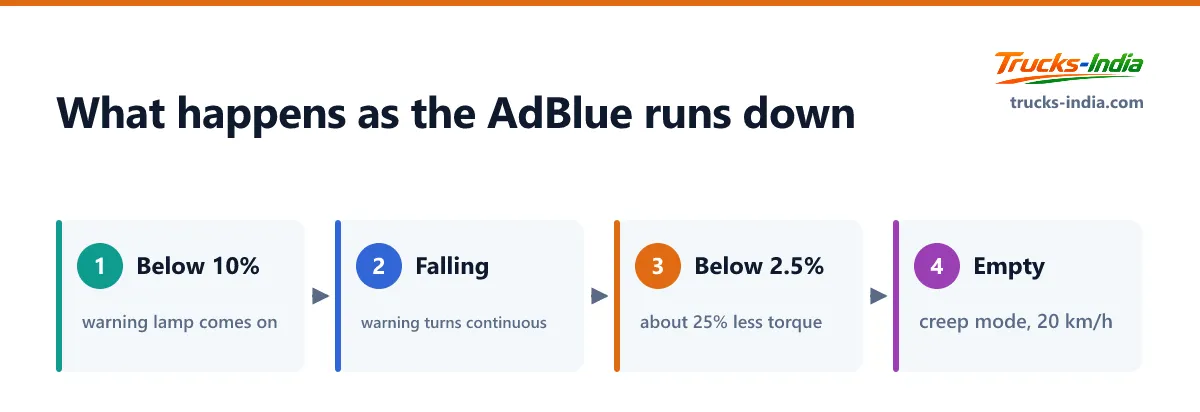
The AdBlue warning must come on below 10 percent of tank capacity, or earlier if the maker chooses, and it grows more insistent as the level falls. It cannot be switched off with a scan tool while the cause remains. Below 2.5 percent, the truck cuts about 25 percent of its engine torque from the next time it stops. When the tank is empty, it is held to 20 km/h, which drivers know as creep mode.
The same ladder applies to wrong or diluted fluid, a dosing fault or tampering. Topping up with watered down AdBlue does not fool the sensor; it starts the same countdown. Note also that the AdBlue warning is a separate lamp from the engine fault lamp. The standard forbids using the same light for both.
DPF and regeneration lamps
BS6 trucks carry a diesel particulate filter that traps soot and burns it off from time to time, which is called regeneration. On many trucks a steady DPF lamp means the filter is filling and needs a long, steady run or a parked regeneration. A flashing DPF lamp usually means it is urgent. Short city trips with frequent stops are the usual cause, because the exhaust never gets hot enough to clean the filter by itself.
High exhaust temperature
Some makers show a lamp while a regeneration is running, because the exhaust is very hot. It is normally information rather than a fault. Do not park over dry grass or stacked cartons while it is lit.
Exact symbols, colours and the parked regeneration routine vary by maker, so read this section of your owner's manual once, before you need it.
Tata truck dashboard warning lights and other brands
Owners often search for one brand's symbols, and Tata trucks are the most common example. The newer Tata Motors models such as the Signa and Ultra ranges combine classic lamps with a display that shows short text messages, for example a low AdBlue alert. Ashok Leyland, Eicher, BharatBenz and Mahindra do much the same.
So the honest answer to any brand specific question is this: the symbol shape follows ISO 2575, the colour logic is universal, and the owner's manual for your exact model is authoritative. Keep the manual in the cab, not in the office. If a lamp is not in the manual, the dealer's service team can read the stored fault code.
Green and blue lights you can ignore
Information lights only confirm something is switched on.
- Indicators and hazard lights
- Exhaust brake or retarder active
- Headlamps on, and blue for high beam
- Power take off engaged, on tippers and other trucks that run equipment
None of these needs action, except remembering to switch the PTO off before driving away.
What a warning light costs if you ignore it
Most expensive truck repairs start as a light someone saw and decided to watch. A low oil pressure lamp ignored for ten kilometres can cost an engine. An AdBlue warning ignored for two days can cost a delivery slot when the truck slows to creep mode on the highway, and a breakdown on a highway is the most dangerous place to be stuck.
The cheap habit is a daily walk round plus a glance at the cluster at start up. Put warning light faults into the same log as the service schedule, as the truck maintenance schedule guide suggests, so a recurring amber lamp is spotted as a pattern rather than as a surprise.
Once drivers know the truck dashboard warning lights meaning by colour, and know the BS6 ladder for AdBlue, most roadside surprises become planned workshop visits instead.
Trucks to compare
A few popular trucks on Trucks India, with ex-showroom price and rated payload. Open one for its full price, specifications and mileage.
Browse more: Mini trucks, Light commercial vehicles, Heavy trucks, Force Motors trucks, Mahindra trucks, Euler EV trucks, Switch Mobility trucks
Frequently asked questions
Red means a fault that can damage the engine or make the truck unsafe, such as low oil pressure, overheating, low brake air pressure or a charging failure. Stop where it is safe and switch off unless the light clears within a few seconds.
Usually yes, gently and as far as a workshop, because the amber engine lamp signals an emissions related fault stored by the on board diagnostics. A lamp that stays on the whole time the engine runs marks the most serious class of fault, so get it checked the same day rather than at the next service.
The warning comes on below 10 percent of tank capacity. Below 2.5 percent the engine loses about 25 percent of its torque, and when the tank is empty the truck is limited to 20 km/h, called creep mode, until the tank is refilled with correct fluid.
It means the diesel particulate filter is filling with soot and needs to regenerate. On many trucks a steady lamp asks for a long steady run or a parked regeneration, and a flashing lamp means it is urgent. Check your owner's manual for the exact routine.
It means the air brake tanks do not hold enough pressure to brake safely. Wait for the pressure to build and the warning to clear before moving off. If it comes on while driving, stop safely and look for an air leak.
In the owner's manual for your exact model, which lists every lamp and message. The colour logic is the same across brands, and a Tata dealer can read stored fault codes if a lamp is not explained in the manual.
Where this fits
Most of the newer lights belong to the BS6 exhaust system. Our guide to BS6 emission norms for trucks explains what that system does and what it costs to run.
A truck that warns early is cheaper to keep. Trucks India lists every model sold in India with payload, mileage and price, so you can compare before you buy.
Call +91 93422 00875About the author
Lokesh R
CEO of Trucks India
Lokesh R is the founder of Trucks India, an independent heavy-vehicle marketplace and research platform operated from Chennai, Tamil Nadu, founded in 2025. Under his direction, Only Heavy publishes specifications and prices sourced from manufacturers, authorised dealer price lists and official regulatory schedules, with every model page checked by a named reviewer, prices re-verified monthly and after any GST revision, and no advertiser able to buy a rating, ranking or comparison result.


