
Tipper Capacity in Cubic Meter: Body Sizes, CFT, Brass and the Weight That Really Limits You
Find tipper capacity in cubic meter for light and heavy tippers, convert it to cft and brass, and see why legal payload, not body volume, decides the load.

Lokesh R
CEO of Trucks India
Created 1 October 2026 · 9 min read
Key takeaways
- One cubic metre is 35.31 cft, and one brass is 100 cft, or about 2.83 cubic metres.
- A 28 tonne, 10 wheel tipper usually carries a 14 cubic metre rock body or a 16 to 22 cubic metre box, while Tata's 16 wheel Signa 4825.TK takes a 29 cubic metre box.
- A 16 cubic metre box filled level with dry sand weighs about 25.6 tonnes, well above the 20 tonne payload listed for a 28 tonne tipper.
- For dense loads, the legal payload runs out before the body is full, so plan loads in tonnes and use volume only as a check.
Ask a contractor how big a tipper is and you will hear cubic metres, cft or brass, depending on the state and the material. Ask the RTO or a weighbridge and you will hear tonnes. Both are describing the same truck, and the gap between the two numbers is where most overloading happens.
This guide gives the tipper capacity in cubic meter for each class of tipper sold in India, converts it to cft and brass, and then shows with worked numbers why a level-full box of sand is often heavier than the truck is allowed to carry.
Tipper capacity in cubic meter, by tipper class
A tipper's volume is the size of its steel body, usually measured level to the top of the sides. Makers offer more than one body on the same chassis, so the same truck can appear with two or three different figures. Here is how the sizes fall across the main classes.
Light tippers, 9 to 10 tonne GVW
The six tyre light tippers used for town construction and short sand runs typically carry a body of around 5 cubic metres. The Tata LPK 912 is a common example, listed in our catalogue at a 9,950 kg gross vehicle weight with a 6,300 kg payload.
Ten wheel tippers, 25 to 28 tonne GVW
This is the workhorse class, the ten wheel lorry most people mean by "one dumper". Body options sit in a narrow band:
- Mahindra's official specification for the Blazo 28 tipper lists a 16 cubic metre box and a 14 cubic metre rock body.
- Tata Motors lists its Signa 2832.K short rock tipper with 16, 18 and 22 cubic metre box bodies and a 14 cubic metre scoop.
So a 28 tonne tipper usually carries 14 to 22 cubic metres, with 16 the most common box.
Sixteen wheel tippers, 47.5 tonne GVW
At the top end, Tata's launch release for the Signa 4825.TK describes a 47.5 tonne, 16 wheel tipper with a 29 cubic metre box body. That is the largest tata tipper capacity in cubic meter terms, and our catalogue lists the Signa 4825.TK at the same 47,500 kg gross vehicle weight.
Tata also describes an 18 cubic metre body option for the same truck. The smaller body is not a cut down version. It suits dense material such as stone, where the truck reaches its weight limit long before a 29 cubic metre box would be full, a point the worked example below makes with numbers.
Twelve and fourteen wheel tippers sit between these, and body options vary widely by variant, so read the maker's sheet for the exact figure.
How to measure a tipper body yourself
Spec sheets give the volume, but a used tipper or a locally built body may have no paperwork at all. Measuring it takes a tape and five minutes.
- Measure the inside length of the body floor, from headboard to tailgate, in metres.
- Measure the inside width between the side walls.
- Measure the inside depth from the floor to the top of the sides.
- Multiply the three. A body 5.0 m long, 2.3 m wide and 1.4 m deep holds about 16.1 cubic metres when filled level.
If the sides taper or the rear slopes, as on a scoop body, measure the depth at a few points and use the average. The answer will be close enough for planning.
This figure is the level, or struck, capacity. A load heaped above the sides holds more volume, but that extra is exactly where overloading and spillage on the road come from, which the load securing rules guide treats as a safety issue in its own right. Plan on the level figure.
Dumper capacity in cubic meter: box, rock and scoop bodies
The words dumper and tipper are used interchangeably on Indian sites, and the dumper capacity in cubic meter works the same way. What changes the number is the body type.
- Box body: straight sides and the largest volume, for sand, aggregate, soil and coal.
- Rock body: a smaller, heavily built body for boulders and blasted rock, which batter the floor.
- Scoop body: a sloping rear that helps sticky material slide out.
That is why the same 28 tonne chassis appears as 14 cubic metres in rock form and 16 to 22 in box form. A smaller body on the same truck is not a worse truck. It is a body sized for a denser, harder material.
Converting tipper capacity: cubic metres, cft and brass
Three units are in daily use, and the conversions are simple.
- 1 cubic metre = 35.31 cft
- 1 brass = 100 cft, the trade unit for sand and aggregate in Maharashtra and neighbouring states
- 1 brass = about 2.83 cubic metres
Tipper capacity in cft
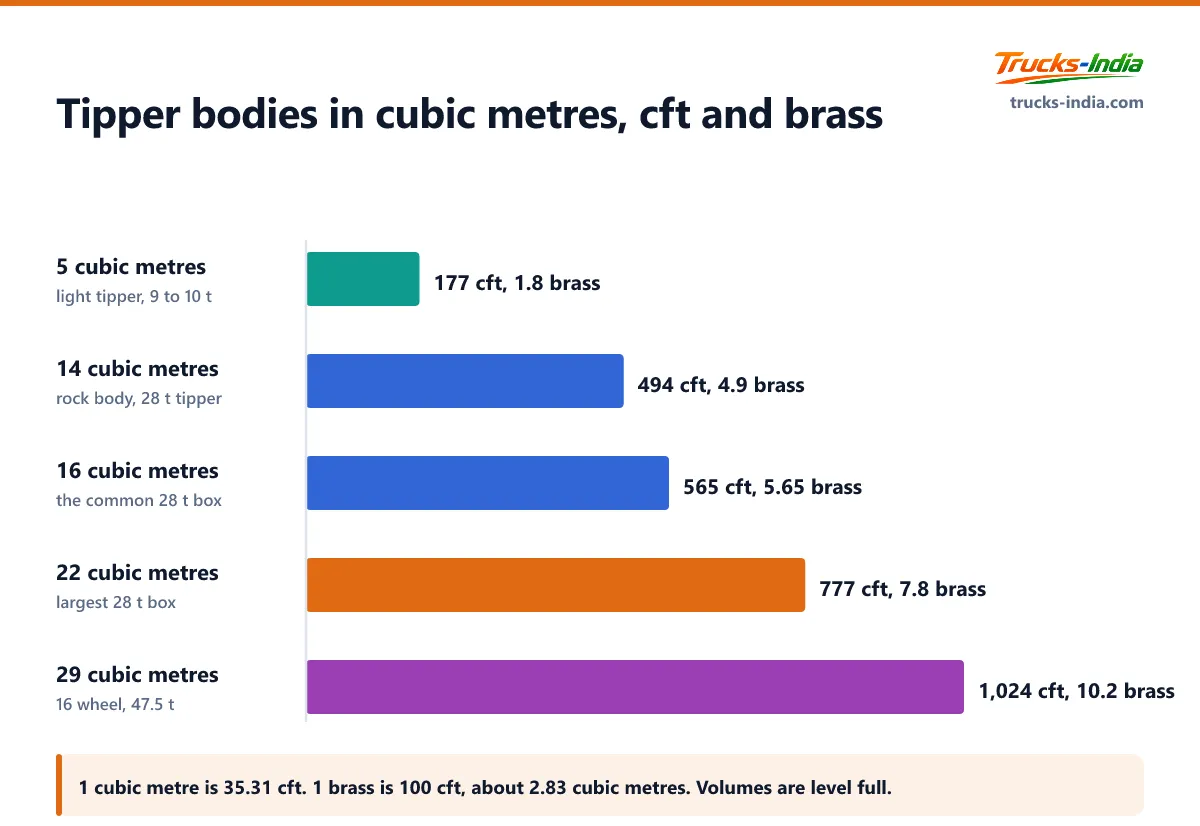
Multiply cubic metres by 35.31. A 16 cubic metre box is about 565 cft, and a 29 cubic metre box is about 1,024 cft.
One dumper capacity in brass
Divide the cft by 100. A 16 cubic metre box therefore holds about 5.65 brass when filled level. At the small end, a 5 cubic metre light tipper body is about 177 cft or 1.8 brass, and a 14 cubic metre rock body about 494 cft or 4.9 brass. At the large end, a 22 cubic metre box is about 777 cft or 7.8 brass, and a 29 cubic metre box about 10.2 brass.
That is the volume answer. As the next section shows, it is not the legal answer for heavy material.
Why legal payload, not volume, decides the load
Every tipper has a gross vehicle weight set at registration, and its payload is that weight minus the truck's own weight with its body. Fill the body with a dense material and the payload runs out long before the body is full.
The densities come from IS 875 Part 1, the Bureau of Indian Standards table of unit weights:
- Dry, clean sand: 1,540 to 1,600 kg per cubic metre
- Wet sand: 1,760 to 2,000 kg per cubic metre
- Broken stone ballast: from about 1,600 kg per cubic metre dry, and up to 2,240 kg when perfectly wet
A worked example
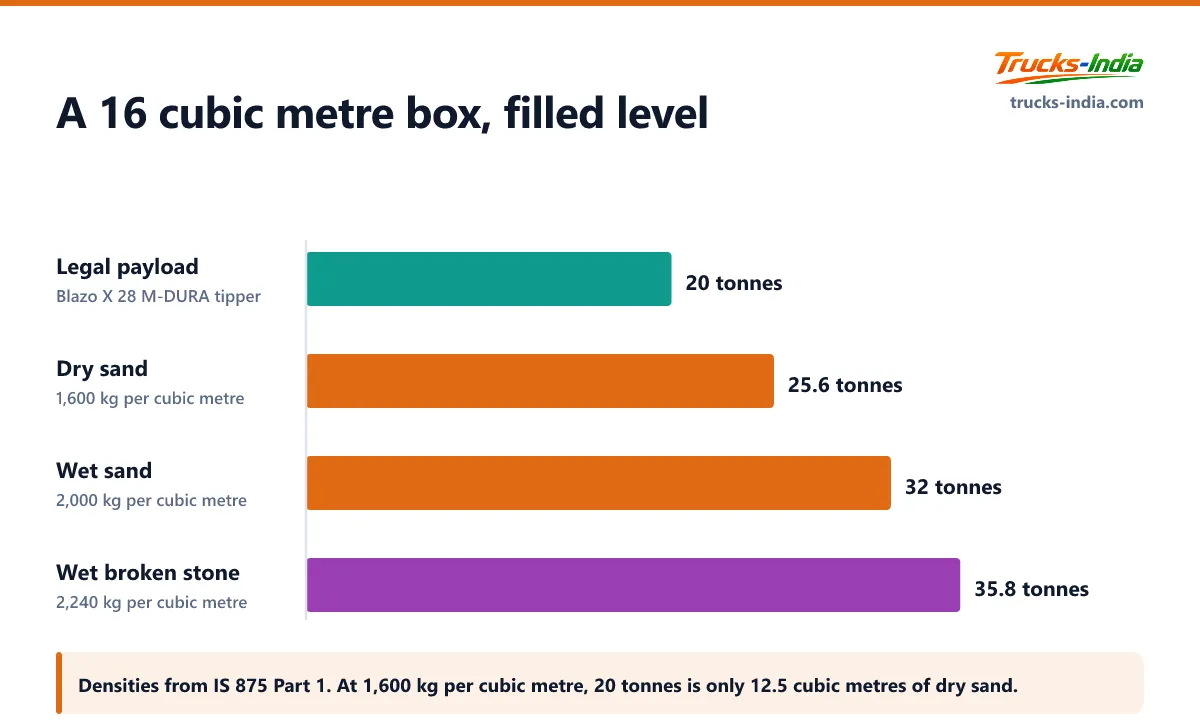
Take the Mahindra Blazo X 28 M-DURA tipper, listed in our catalogue at 28,000 kg GVW with a 20,000 kg payload, carrying the common 16 cubic metre box.
Filled level with dry sand at 1,600 kg per cubic metre, that box holds 25.6 tonnes, which is 5.6 tonnes over the payload before anyone heaps it. With wet sand at 2,000 kg per cubic metre the same box weighs 32 tonnes, and with wet broken stone at 2,240 kg it reaches about 35.8 tonnes, nearly 80 percent more than the truck may carry.
Work it backwards instead. At 1,600 kg per cubic metre, a 20,000 kg payload allows 12.5 cubic metres of dry sand. That is about 441 cft, or 4.4 brass, not the 5.65 brass the box can physically hold.
Heaping the load above the sides adds still more weight. Overloading is checked at weighbridges and at toll plazas with weighing equipment, and the penalties, axle limits and tolerances are set out in the axle load and overloading guide.
How much a lorry tipper can legally carry, model by model
The quickest planning figure is the payload from the catalogue, divided by the density of what you carry. For dry sand at 1,600 kg per cubic metre:
- Tata LPK 912, 9,950 kg GVW, 6,300 kg payload: about 3.9 cubic metres
- Ashok Leyland AVTR 2820 6x4 tipper, 28,000 kg GVW, 17,500 kg payload: about 10.9 cubic metres
- Mahindra Blazo X 28 M-DURA tipper, 28,000 kg GVW, 20,000 kg payload: 12.5 cubic metres
- Mahindra Blazo X 35 M-DURA tipper, 35,000 kg GVW, 22,000 kg payload: about 13.8 cubic metres
- Ashok Leyland AVTR 4220 10x4 tipper, 42,000 kg GVW, 27,000 kg payload: about 16.9 cubic metres
Payload here is the catalogue figure for the listed body; a heavier body or added fittings reduce it. Use the payload printed on your own RC and body builder's plate for real planning.
Choosing a body size for the material
The point is not that big bodies are wrong. It is that the body should match the material.
- Light bulky loads, such as coal or loose fill, fill a body before they reach the weight limit. A larger box earns more per trip.
- Dense loads, such as sand, aggregate and stone, reach the weight limit first. A bigger box only makes overloading easier.
- Mixed work suits the common 16 cubic metre box on a 28 tonne chassis, loaded by weight.
Price quotes in brass or cft are fine for the buyer of the sand. For the truck, keep the conversation in tonnes. A weighbridge slip is the only number the law reads.
So treat the tipper capacity in cubic meter as the size of the body, and the payload as the size of the load. You can browse every tipper truck on Trucks India with its GVW and payload side by side.
Trucks to compare
A few tippers and heavy trucks on Trucks India, with ex-showroom price and rated payload. Open one for its full price, specifications and mileage.
Browse more: Tippers, Heavy trucks, Ashok Leyland trucks, Mahindra trucks
Frequently asked questions
It depends on the class. Light tippers of 9 to 10 tonne GVW carry about 5 cubic metres, 28 tonne ten wheel tippers carry 14 to 22 cubic metres with 16 the most common box, and Tata's 47.5 tonne Signa 4825.TK carries a 29 cubic metre box.
One cubic metre equals 35.31 cft. So a 16 cubic metre tipper body holds about 565 cft when filled level, and a 29 cubic metre body holds about 1,024 cft.
By volume, a common 16 cubic metre box holds about 5.65 brass, since one brass is 100 cft or about 2.83 cubic metres. With dry sand, the legal payload of a typical 28 tonne tipper allows only about 4.4 brass.
One brass is 100 cft, which is about 2.83 cubic metres. To convert brass to cubic metres, multiply by 2.83; to convert cubic metres to brass, multiply by 35.31 and divide by 100.
Often not legally. Dry sand weighs 1,540 to 1,600 kg per cubic metre, so a 16 cubic metre box filled level weighs about 25.6 tonnes, more than the 20 tonne payload of a typical 28 tonne tipper. Load to the payload, not the rim.
A box body has straight sides and the largest volume, for sand, soil and aggregate. A rock body is smaller and more heavily built, for boulders that would damage a thinner floor. On a 28 tonne tipper, a rock body is typically 14 cubic metres against 16 or more for a box.
Where this fits
Loading to volume rather than weight is the fastest way to overload a tipper. Our guide to axle load limits and overloading rules covers the penalties and how weight is checked.
Pick the tipper for the material, not just the box. Trucks India lists every tipper sold in India with GVW, payload and price.
Call +91 93422 00875About the author
Lokesh R
CEO of Trucks India
Lokesh R is the founder of Trucks India, an independent heavy-vehicle marketplace and research platform operated from Chennai, Tamil Nadu, founded in 2025. Under his direction, Only Heavy publishes specifications and prices sourced from manufacturers, authorised dealer price lists and official regulatory schedules, with every model page checked by a named reviewer, prices re-verified monthly and after any GST revision, and no advertiser able to buy a rating, ranking or comparison result.


