
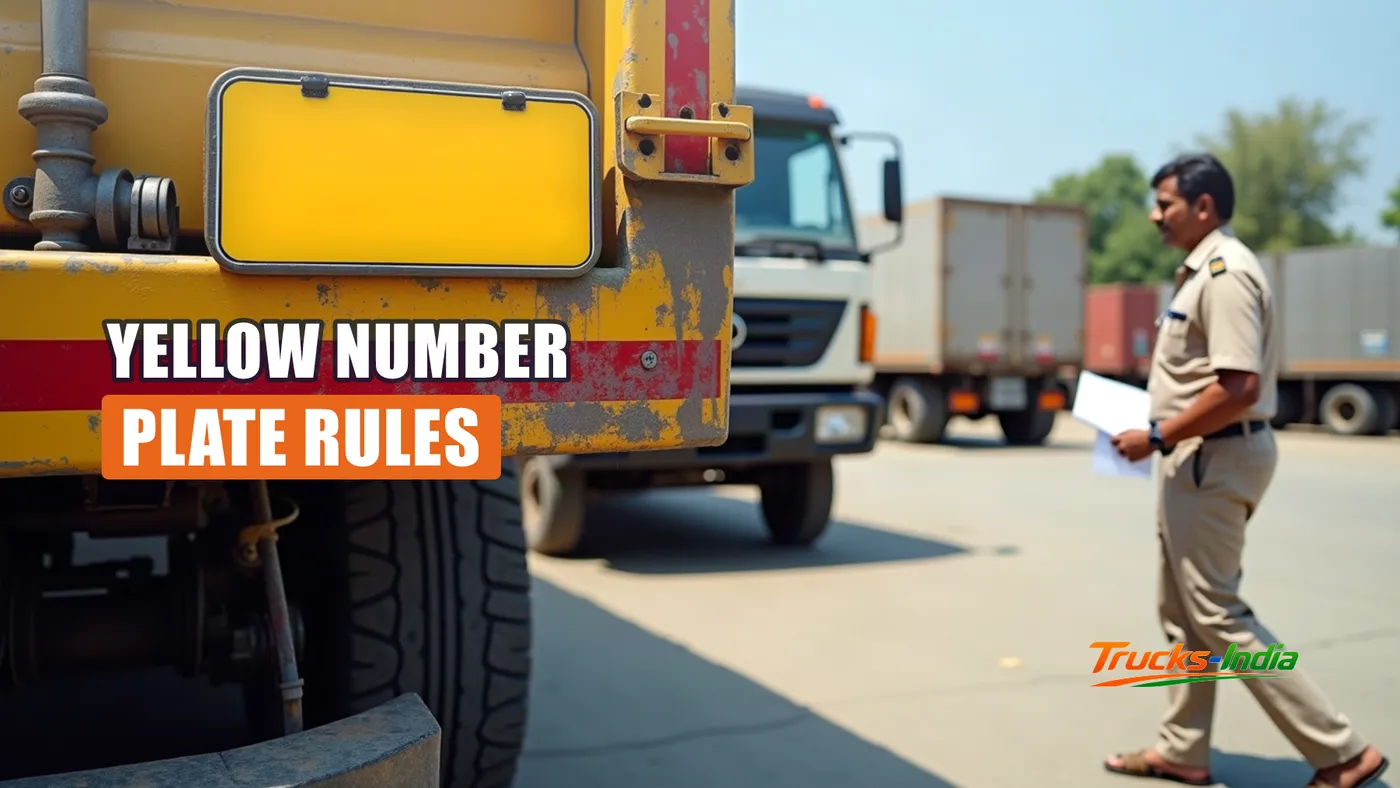
Yellow Number Plate Rules: Every Plate Colour for Commercial Vehicles
Read the yellow number plate rules for India: who uses black on yellow, the green plate for electric goods vehicles, rental and temporary plates, and the law.

Lokesh R
CEO of Trucks India
Created 2 October 2026 · 8 min read
Key takeaways
- Transport vehicles, which include every goods carriage, display black letters on a yellow background.
- Battery operated transport vehicles use yellow letters on a green background, under G.S.R. 749(E) of 7 August 2018.
- Rent a cab vehicles use yellow on black, temporary registrations red on yellow, and dealer trade plates white on red.
- A goods carriage is a transport vehicle by definition, so a company carrying only its own goods still needs the yellow plate.
- Battery operated goods vehicles are exempt from the permit requirement for seven years from July 2026, provided they carry an AIS-140 tracking device.
A yellow plate tells every traffic officer, toll booth and insurer one thing before they read a single character: this vehicle is registered to carry goods or paying passengers. Get the colour wrong and the vehicle is wrong on paper, whatever the paperwork in the cab says.
This guide sets out the yellow number plate rules as notified by the Ministry of Road Transport and Highways, the full set of colours for commercial vehicles including electric and rental ones, and what to do when a vehicle changes category.
Yellow number plate rules: what the law says
Plate colours in India come from the registration mark notification issued under Section 41(6) of the Motor Vehicles Act, read with Rule 50 of the Central Motor Vehicles Rules. The base notification dates from 1989, an amendment in November 1992 set colours for different classes of vehicle, and the Ministry consolidated the whole scheme into one table in July 2020.
That July 2020 notification, S.O. 2339(E) of 14 July 2020, did not change any colour. The Ministry's announcement of it described it as a clarification that removed ambiguities by tabulating each class against its letter and background colour.
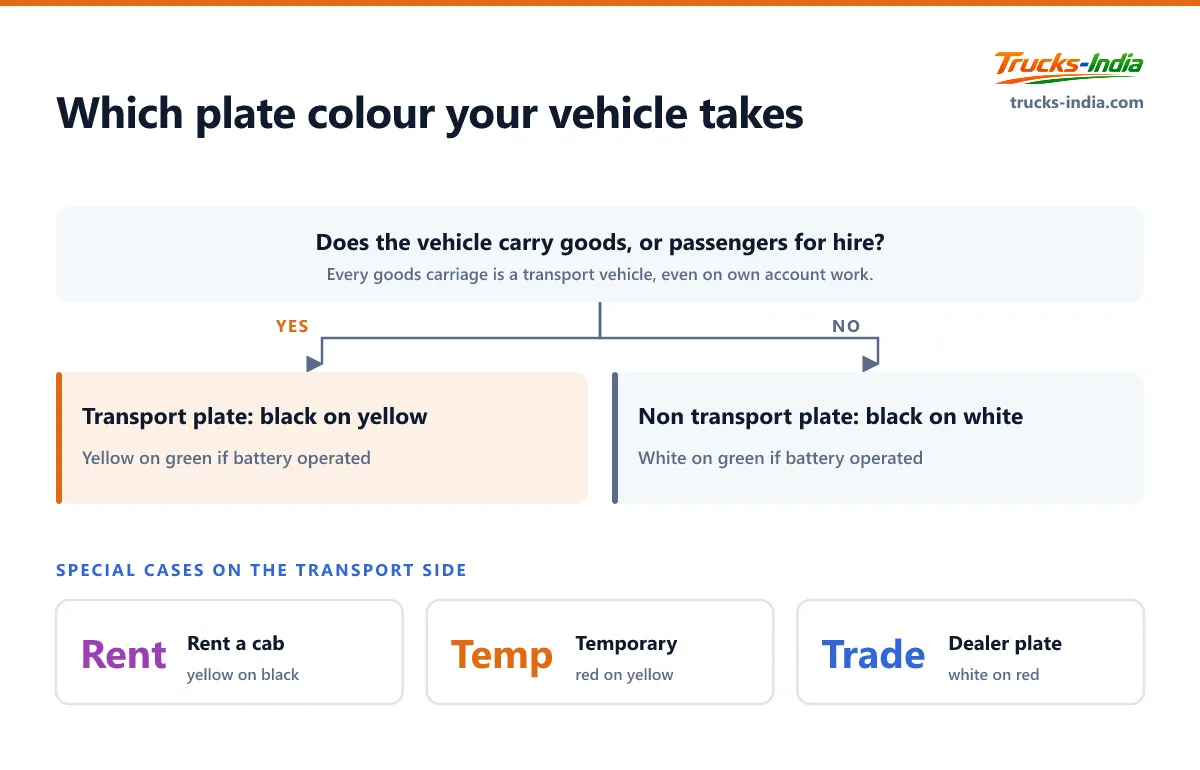
The rule for commercial vehicles is simple. A transport vehicle displays black letters and numerals on a yellow background. That is the plate drivers call a yellow board.
Who counts as a transport vehicle
Under the Motor Vehicles Act, a transport vehicle means a public service vehicle, a goods carriage, an educational institution bus or a private service vehicle. So every goods carriage is a transport vehicle by definition.
That catches people out. A manufacturer that runs its own trucks to carry only its own products still operates goods carriages, so those trucks take the yellow plate too. There is no white plate route for a goods vehicle.
Number plate colour for commercial vehicle, by category
The 2020 table covers eleven categories. These are the ones a transport business meets:
- Transport vehicle, diesel, petrol or CNG: black on yellow
- Transport vehicle, battery operated: yellow on green
- Rent a cab transport vehicle: yellow on black
- Rent a cab, battery operated: black on green
- Temporary registration: red on yellow
- Vehicle in a dealer's possession, on trade certificate: white on red
For comparison, a private non transport vehicle shows black on white, and a private battery operated vehicle shows white on green.
Notice that the battery categories keep a visible link to the fuel driven ones. A commercial EV keeps yellow letters, so a glance still tells an officer it is a transport vehicle; the green background tells them it runs on a battery.
Commercial vehicle yellow number plate: when a truck gets one
A new goods vehicle receives its registration mark at registration, and the plate is fitted by the dealer before delivery in the high security format. You do not choose the colour. The RTO's record of the vehicle class decides it, and the plate follows the record.
A used truck keeps its yellow plate through ownership transfer, because the vehicle class does not change. If a used vehicle you are buying shows a white plate while the RC says goods carriage, treat it as a warning sign and confirm the record with an online RC check before paying anything.
Yellow board lorry vs white board: why it matters
A lorry on a white plate carrying paid loads is, in effect, a private vehicle doing commercial work. That has three consequences.
- Permit and tax: commercial use needs a goods permit and commercial road tax. A white plate vehicle has neither for that purpose, which the national permit guide explains for long haul work.
- Fitness: transport vehicles need a fitness certificate on a fixed cycle, two years when new and then every two years to eight years, then annually. A misclassified vehicle skips that system entirely.
- Insurance: a policy written for private use does not cover commercial use. An insurer can decline a claim where the vehicle was used outside its stated purpose.
Each of those is a paperwork problem that turns into a money problem on the day something goes wrong.
Green plates for electric goods vehicles
Battery operated transport vehicles take yellow letters on a green background. The Ministry notified this through G.S.R. 749(E) dated 7 August 2018, setting yellow on green for battery operated transport vehicles and white on green for all others, as its statement on EV promotion measures records.
The green plate comes with a practical benefit. Battery operated transport vehicles were first exempted from the permit requirement in October 2018, and the Ministry renewed that exemption through S.O. 3679(E) of 6 July 2026, published in the Gazette of India on 7 July 2026. It runs for seven years and covers vehicles on battery, methanol, ethanol and hydrogen, on condition that each is fitted with a vehicle location tracking device to AIS-140. The AIS-140 guide covers what that device must do.
Electric goods vehicles in the Trucks India catalogue include the Ashok Leyland Boss 1218 HB EV at 11,900 kg GVW. The full range is in the electric truck listings, and the cost case is in the guide to electric truck running cost.
Black plate with yellow letters: rental vehicles
The yellow on black plate belongs to transport vehicles under the Rent a Cab scheme, the self drive rental category. It marks a vehicle that is commercially registered but driven by the person who hires it.
Goods vehicle operators rarely need this plate. It matters mainly if you buy a used vehicle that came out of a rental fleet, because the class on the RC has to match the work you plan to do with it.
Red plates: temporary and trade
Two red plates appear around the purchase of a new truck.
Red letters on yellow mark a vehicle on temporary registration, for example while it is driven from the dealer to the home state for permanent registration. White letters on red mark a vehicle in a dealer's possession under a trade certificate, such as a demonstration or transit vehicle.
Neither plate is meant for regular commercial work. Running loads on a temporary registration past its validity is running an unregistered vehicle.
How the colour rules were built
The colour scheme was assembled over three decades rather than in one notification.
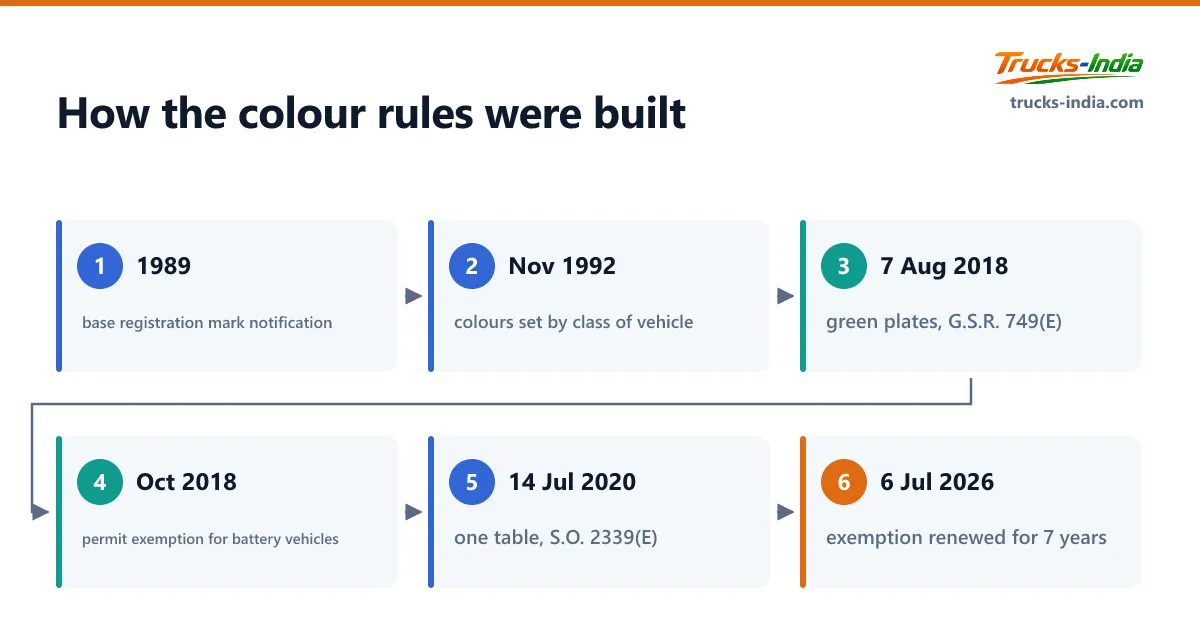
Through all of it the core rule never moved: transport vehicles carry black on yellow.
Converting a vehicle between white and yellow
A vehicle can move between the non transport and transport classes, but only through the RTO. The application changes the vehicle class on the record, and the owner settles the difference in road tax, obtains the permit and fitness certificate the new class needs, and updates the insurance policy. Only then does the plate change to match.
Changing the plate first and the paperwork later gets the order backwards, and a plate that does not match the RC fails at the first roadside check. The same principle applies to physical changes such as a new body: the RTO record changes first.
What to check on a used truck's plate
Before buying a used goods vehicle, compare the plate with the RC line by line.
- Colour against class. A goods carriage on the RC should carry a yellow plate, or a green one with yellow letters if it is battery operated.
- Number against record. Every character on both plates should match the registration number on the RC.
- Format. The plates should be high security plates, with the hologram, serial number and snap locks intact, not a locally painted copy.
- Nothing extra. No names, slogans or stickers on the plate area.
A mismatch on any of these is either a paperwork gap the seller should fix before sale, or a reason to walk away.
Other plate rules that apply to every truck
Colour is only one part of Rule 50. The rule also fixes the letters (English), the numerals (Arabic), the size and spacing, and the high security format for the plate itself. Names, slogans, decorative fonts and stickers on the plate are not allowed.
The Bharat series (BH) registration is for non transport vehicles only, so it is not an option for a goods vehicle working across states. A truck that moves between states relies on its national permit instead.
Keep the plate clean and readable, front and rear, and check it alongside the retro reflective tape when you inspect the vehicle. Follow the yellow number plate rules from the day of registration and the plate will never be the reason a truck is stopped.
Trucks to compare
A few popular trucks on Trucks India, with ex-showroom price and rated payload. Open one for its full price, specifications and mileage.
Browse more: Mini trucks, Light commercial vehicles, Heavy trucks, Tata Motors trucks, Ashok Leyland trucks, Mahindra trucks
Frequently asked questions
The registration mark notification under the Motor Vehicles Act assigns black letters on a yellow background to transport vehicles, which include all goods carriages and vehicles carrying paying passengers. This colour lets officers, toll staff and insurers identify a commercial vehicle at a glance.
Yellow letters on a green background. G.S.R. 749(E) of 7 August 2018 set yellow on green for battery operated transport vehicles and white on green for private battery operated vehicles. Rent a cab battery vehicles use black on green.
Only by being registered as a transport vehicle. The colour follows the vehicle class on the RTO record, so a private car or pickup moves to a yellow plate only after the RTO changes its class and the owner pays commercial tax and obtains a permit and fitness certificate.
It marks a transport vehicle under the Rent a Cab scheme, the self drive rental category. The vehicle is commercially registered but driven by the person who rents it.
Yes. The Motor Vehicles Act defines every goods carriage as a transport vehicle, whether it carries goods for hire or only the owner's own goods. A goods vehicle therefore always takes the transport plate.
No. The Bharat series registration is available only for non transport vehicles. A goods vehicle that works across states keeps its state registration and operates under a national permit.
Where this fits
The plate is one of several things checked at a roadside stop. Our guide to documents to carry in a truck covers the rest of the folder.
Every goods vehicle you buy will wear a yellow or green plate. Trucks India lists every commercial model in India with GVW, payload and price.
Call +91 93422 00875About the author
Lokesh R
CEO of Trucks India
Lokesh R is the founder of Trucks India, an independent heavy-vehicle marketplace and research platform operated from Chennai, Tamil Nadu, founded in 2025. Under his direction, Only Heavy publishes specifications and prices sourced from manufacturers, authorised dealer price lists and official regulatory schedules, with every model page checked by a named reviewer, prices re-verified monthly and after any GST revision, and no advertiser able to buy a rating, ranking or comparison result.


