
PF and ESI for Truck Drivers
When PF and ESI apply to truck drivers in India, the thresholds and wage ceilings, the Motor Transport Workers Act hours, and what a contract should say.

Lokesh R
CEO of Trucks India
Created 26 September 2026 · 6 min read

Most small transport operators employ drivers on an understanding rather than a contract, pay partly in cash, and have never looked at whether provident fund or state insurance applies to them.
For a genuinely small operation, often it does not. The thresholds are real and a two truck owner is usually below them. But the thresholds are lower than people assume, they are counted in a way that catches you out, and the moment you cross one the obligation is retrospective rather than starting from the day you noticed.
Three laws, not one
Operators tend to think of this as a single question. It is three, with different triggers.
The Employees' Provident Funds Act, which sets up retirement savings.
The Employees' State Insurance Act, which provides medical cover and sickness benefit.
The Motor Transport Workers Act 1961, which is specific to this industry and which almost nobody in it has read.
You can be inside one and outside the others. Check each separately.
Provident fund
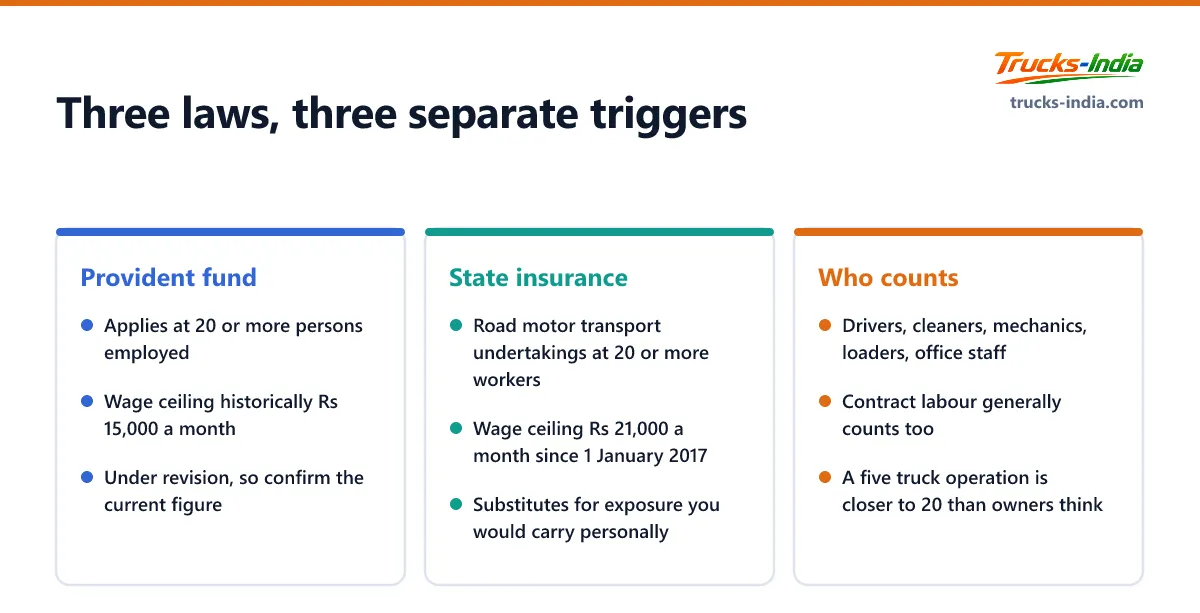
EPF applies to establishments employing 20 or more persons. Below that number the Act does not compulsorily apply, which is why most small transport operations sit outside it.
The wage ceiling for compulsory coverage has historically been ₹15,000 a month, meaning employees earning above that are not compulsorily covered although they may be enrolled voluntarily. Note that the wage ceiling has been under revision in recent reform, so confirm the figure applying to you rather than working from an article.
Two counting traps.
Everybody counts, not just drivers. Cleaners, mechanics, office staff, loaders on your payroll. A five truck operation with drivers, cleaners and two people in the office is closer to twenty than the owner thinks.
Contract labour generally counts too. Structuring people as contractors to stay under the line is a well travelled route that does not reliably work, because what matters is the substance of the arrangement rather than the label on it.
State insurance
ESI has a lower general threshold, but the number that applies to you is the one for your establishment type.
Road motor transport undertakings employing 20 or more workers are covered. So for a transport business the trigger sits at 20, the same as provident fund, rather than at the lower figure that applies to some other establishment types.
The wage ceiling for ESI coverage is ₹21,000 a month, raised from ₹15,000 with effect from 1 January 2017.
ESI is worth understanding rather than resenting. For a driver it provides medical treatment and sickness benefit, and for an employer it substitutes for exposure you would otherwise carry personally when a driver is injured or ill. That interacts with the legal liability to paid driver cover on your motor policy, which the insurance guide covers, and the two are not the same thing.
The Act nobody in trucking has read
The Motor Transport Workers Act 1961 is specific to motor transport undertakings and it sets working conditions directly.
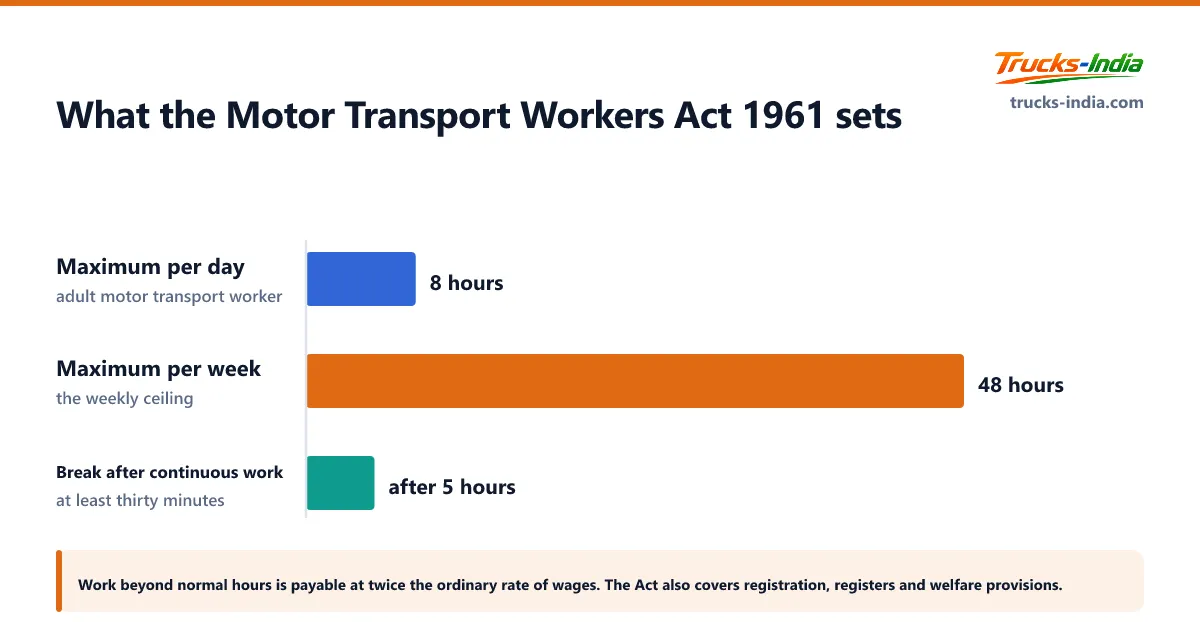
Hours. No adult motor transport worker shall be required or allowed to work more than eight hours in a day and forty eight hours in a week.
Rest. A break of at least thirty minutes after five hours of continuous work.
Overtime. Work beyond normal hours is payable at twice the ordinary rate of wages.
The Act also covers registration of the undertaking, maintenance of registers, and welfare provisions such as rest facilities and first aid.
Read those hours against how Indian long haul actually runs and the gap is obvious. That gap is a real exposure rather than a theoretical one, and it is also a road safety issue: a tired driver is the risk sitting behind every other risk in your operation.
The Act applies to motor transport undertakings employing above a small threshold of workers, so very small operations fall outside it. Confirm your own position.
What this costs, honestly
Where PF and ESI apply, they are employer contributions on top of wages, and they are a real percentage rather than a rounding error.
Budget for them as part of the driver's cost rather than as a surprise. Truck driver salary in India sets out the full picture: the wage, bhatta, statutory contributions where they apply, the legal liability cover, and the replacement cost when a driver leaves, which is the line owners omit entirely.
What to do if you are below the thresholds
Most single vehicle and small fleet owners are, and the answer is not to do nothing.
Write down the terms. What is the fixed wage, what is the bhatta rate, what are the trip incentives, who pays for what on the road, how is damage handled, what notice applies on either side. One page is enough and it prevents most disputes.
Take out legal liability to paid driver on the motor policy. Without it, an injury claim from your own driver lands on you personally. This is not optional in any practical sense and it is a small premium.
Consider a personal accident cover for the driver even where ESI does not apply. It is inexpensive and it is the difference between a family being supported and not.
Pay on time, every time. This ranks above the amount in every conversation about driver retention, and it is also, quietly, the most effective control against small scale pilferage, as the diesel theft guide explains.
Before you decide any of this
Thresholds, wage ceilings and the definition of wages have all been the subject of recent labour law reform, and several figures have moved or are moving.
Take your actual headcount and wage structure to a chartered accountant or a labour law consultant. This is exactly the kind of question where a general article gets you to the right question and a professional gets you to the right answer, and where getting it wrong is retrospective.
Frequently asked questions
EPF applies to establishments employing 20 or more persons, counting everybody on the payroll and generally contract labour too, not just drivers. Below that headcount it does not compulsorily apply. The wage ceiling for compulsory coverage has historically been ₹15,000 a month and has been under revision, so confirm the current figure.
Road motor transport undertakings employing 20 or more workers are covered, so the trigger for a transport business sits at 20 rather than the lower figure applying to some other establishment types. The wage ceiling for coverage is ₹21,000 a month, in force since 1 January 2017.
Under the Motor Transport Workers Act 1961, no adult motor transport worker may work more than eight hours a day or forty eight hours a week, with a break of at least thirty minutes after five hours of continuous work, and overtime payable at twice the ordinary rate.
Yes. The count is of persons employed by the establishment, not of drivers, so cleaners, mechanics, loaders and office staff all count, and contract labour generally counts too. A five truck operation is closer to the threshold than most owners assume.
Write down the employment terms on a single page, take legal liability to paid driver cover on your motor policy, consider a personal accident cover for the driver, and pay wages and bhatta on time. None of that is expensive and all of it prevents the situations that cost real money.
It is a well travelled route that does not reliably work, because what matters is the substance of the working arrangement rather than the label applied to it. Take your actual structure to a professional rather than relying on the description.
Where this fits
Wages are one line in the cost sheet. See our guide to truck driver salary in India.
Driver cost follows the class of vehicle you run. Trucks India lists payload, mileage and price for every model in India.
Call +91 93422 00875About the author
Lokesh R
CEO of Trucks India
Lokesh R is the founder of Trucks India, an independent heavy-vehicle marketplace and research platform operated from Chennai, Tamil Nadu, founded in 2025. Under his direction, Only Heavy publishes specifications and prices sourced from manufacturers, authorised dealer price lists and official regulatory schedules, with every model page checked by a named reviewer, prices re-verified monthly and after any GST revision, and no advertiser able to buy a rating, ranking or comparison result.


