
Truck Clutch Plate Life, Price and Common Clutch Problems
Find out how long a truck clutch plate lasts, what wears it out early, how to read slipping and judder, and what a clutch replacement costs in India today.

Lokesh R
CEO of Trucks India
Created 30 September 2026 · 8 min read

Key takeaways
- ZF's aftermarket guidance gives a clutch disc replacement interval of 2 lakh km on a medium duty truck and 4 lakh km on a heavy duty truck, under good use.
- Many Indian trucks need a clutch far sooner, because starting in too high a gear, riding the pedal and overloading turn clutch life into a driver habit.
- If engine revs rise faster than road speed when you accelerate in a high gear, the clutch is slipping.
- Parts sellers list a 430 mm heavy truck clutch plate at around Rs 7,250 and the cover assembly at around Rs 11,800, as of October 2026, before labour.
- Replace the plate, cover and release bearing together, because the labour to reach them is the same every time.
Two identical trucks on the same route can need new clutches a year apart. The difference is rarely the part. It is the person driving, the load on the back and the gear the truck pulls away in.
This guide explains truck clutch plate life in kilometres, what manufacturers say a clutch should last, what wears one out early, how to read the symptoms of truck clutch problems, and what a replacement costs in India today.
Truck clutch plate life: how many kilometres a clutch lasts
There is no single figure for truck clutch plate life, because a clutch wears only when it slips, and how much it slips is decided almost entirely by how the truck is driven and loaded.
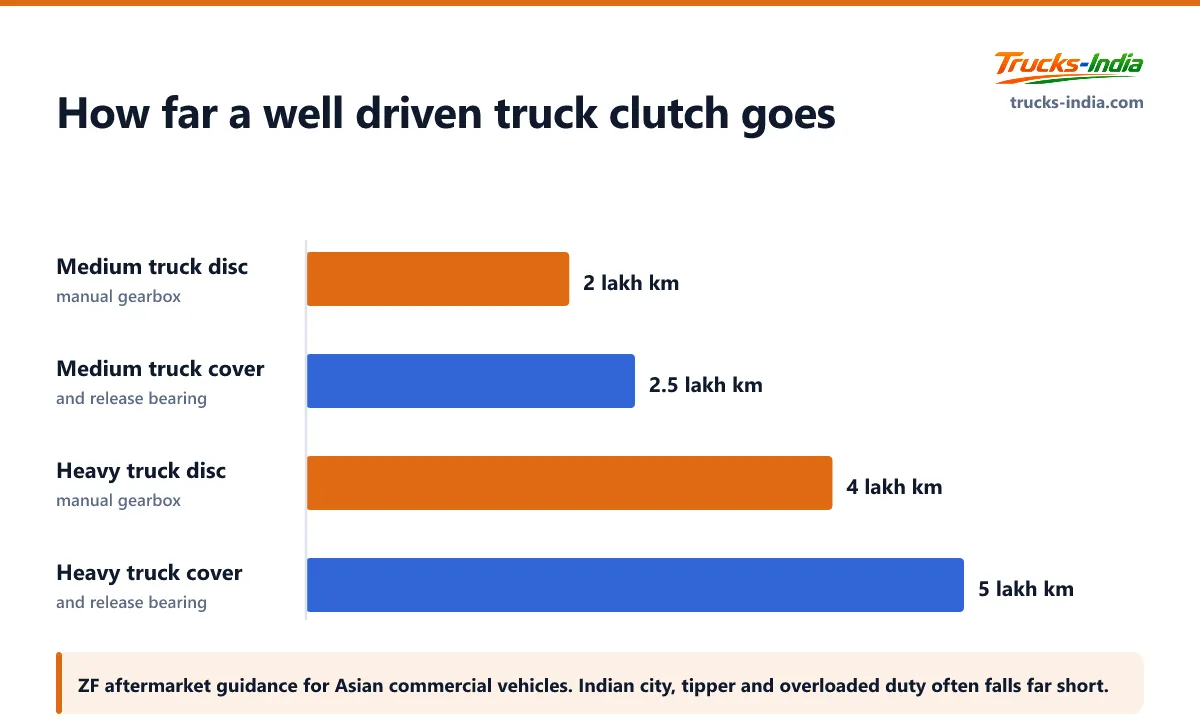
The best published reference comes from ZF, which makes Sachs clutches. Its aftermarket guidance for Asian commercial vehicles gives recommended replacement intervals for trucks with manual gearboxes. On a medium duty truck it puts the clutch disc at 2 lakh km, with the cover and release bearing at 2.5 lakh km. For a heavy duty truck the clutch disc is at 4 lakh km, with the cover and release bearing at 5 lakh km.
Those figures assume a clutch that is driven well. The disc carries the friction lining that wears, which is why ZF sets the cover and bearing intervals further out.
An engineering study shows how far good conditions can push it. A paper presented to SAE Brasil in 2011, on a 430 mm heavy duty clutch fitted to 74 tonne trucks on steep grades with experienced drivers, found the disc had worn only 10 percent after 2 lakh km. The authors described it as close to a lifetime part in that duty.
Indian reality is often very different. City distribution, tipper work, overloading and inexperienced drivers can finish a clutch in a fraction of those distances. The truck maintenance cost and schedule guide puts it plainly: the same vehicle on the same route can double or halve clutch life depending on who drives it.
What a lorry clutch plate actually is
Whether you call it a truck or a lorry clutch plate, the assembly is three main parts working together:
- Clutch plate (disc): the friction disc splined to the gearbox input shaft. This is the part that wears.
- Cover, or pressure plate: bolted to the flywheel, its spring clamps the plate.
- Release bearing: pushes on the cover's spring when the driver presses the pedal.
Sizes follow the truck's torque. Tata lists a 330 mm single plate dry friction clutch on the Tata Ultra T.16, and Eicher lists 330 mm on the Pro 3015. Heavy trucks step up to 430 mm: Tata specifies a 430 mm single plate push type clutch on its Signa 4830.T, and Eicher lists a 430 mm dry single plate on its Pro 6048XP specification page for the Eicher Pro 6048XP. Most also add a booster so the pedal stays manageable.
What wears a truck clutch out
A clutch dies of heat. Every second it spends partly engaged, the plate slides against the flywheel and the cover, and friction turns into temperature. Above a certain point the lining glazes and wear speeds up. The habits below all add heat.
- Starting in too high a gear. Eaton's clutch failure analysis guide lists learning to start in the right gear as the single most important point in driver training. A loaded truck pulling away in second or third forces a long, hot slip.
- Riding the clutch. A foot resting on the pedal keeps the clutch partly engaged and loads the release bearing all day.
- Holding on a slope with the clutch. Using the clutch instead of the brake to stop rolling back cooks the lining in seconds.
- Overloading. More weight means more slip at every start. Every tonne over the rated load shortens clutch life as well as tyre and brake life.
- Creeping in traffic. Slipping the clutch for long stretches in a jam does the same damage as a bad start, many times an hour. A lorry on city distribution can do this hundreds of times a day.
- Wrong adjustment. Too little free play and the clutch never fully clamps; too much and it never fully releases.
- Oil on the lining. A leaking engine rear seal or gearbox input seal contaminates the plate, and a new plate will fail the same way unless the leak is fixed.
- Dropping the clutch. Snapping the pedal up with high revs sends a shock through the plate springs, gearbox and driveline.
Shifting habits are covered in more depth in the guide to increasing truck mileage, because the same driving that saves a clutch also saves diesel.
Truck clutch problems: symptoms and what they mean
Truck clutch problems announce themselves before the truck stops moving. The common symptoms:
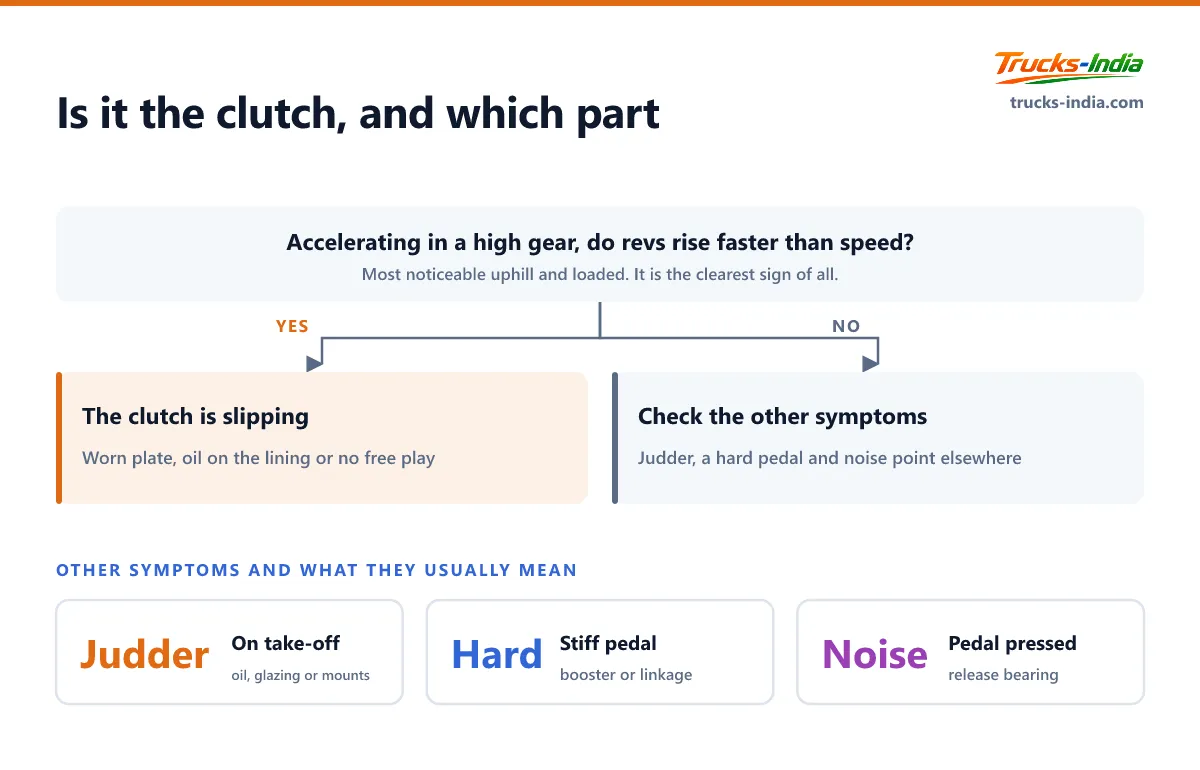
Slipping. Engine revs rise but the truck does not speed up to match, most noticeable in a high gear going uphill. The plate is worn, contaminated with oil, or has lost its free play.
Dragging or hard gear changes. Gears grind or will not go in even with the pedal fully down. The clutch is not releasing, usually from excess free play, a fault in the hydraulic or booster system, or a warped plate.
Judder on take-off. The truck shakes as the clutch engages. Oil on the lining, a glazed plate or worn engine and gearbox mounts are the usual causes.
Hard pedal. A pedal that needs much more effort than usual points at the booster, a dry linkage or a cover spring problem, not the plate.
Noise. A whirring or squeal with the pedal pressed is usually the release bearing. Noise with the pedal released points at the gearbox input bearing or the plate's damper springs.
Burning smell. A sharp smell after a hill start or a loaded manoeuvre means the lining has overheated. Once is a warning; regularly is a clutch on its way out.
Truck clutch plate price in India
Clutch prices vary by size, brand and whether you buy genuine parts from a dealer or aftermarket parts. Treat the figures below as a dated snapshot of the market, not a quote.
As of October 2026, parts sellers list a 430 mm clutch plate for Tata heavy trucks at around Rs 7,250 and the 430 mm clutch cover assembly at around Rs 11,800. Plate and cover together therefore come to roughly Rs 19,000 or more in parts for a heavy truck, before the release bearing and labour. Genuine parts bought from an authorised dealer usually cost more. Medium trucks with 330 mm clutches cost less.
What moves the bill:
- Genuine or aftermarket. Dealer parts cost more but carry the OEM warranty and fit.
- Lining type. Tata, for example, specifies an organic lined clutch on the Signa 4825.TK; ceramic button plates are sold for harder duty.
- Labour. The gearbox has to come out, which on a heavy truck can take most of a working day.
- Extra damage. A scored flywheel, a leaking seal or a worn booster adds to the job.
Replace the set, not just the plate
The labour to reach a clutch is the same whether you replace one part or three. Fitting a new plate against an old cover and a tired release bearing means paying for the gearbox to come out again soon. Replace the plate, cover and release bearing as a set, have the flywheel face checked, and fix any oil leak before the new plate goes in.
Clutch replacement is rarely covered by service contracts. As the extended warranty and AMC guide explains, most AMCs exclude wear items like the clutch, which is where the money actually goes.
How to make a truck clutch last longer
- Train every driver on starts. Loaded trucks pull away in first, or the crawler on a slope. Only an empty truck should use a higher starting gear, and only where the manual allows.
- Keep feet off the pedal between changes, and use the brake, not the clutch, to hold on a gradient.
- Check free play at every service. As the lining wears, free play changes, and the maintenance schedule includes clutch adjustment for this reason.
- Fix oil leaks around the bell housing at once.
- Track clutch life per vehicle and per driver. If one truck eats clutches, the record usually points to one driver or one route.
Truck clutch plate life is one of the few big maintenance costs a fleet owner can control almost entirely through training. Spend an hour with each new driver on starting gear and pedal habits, and the clutch can last several times as long.
Trucks to compare
A few popular trucks on Trucks India, with ex-showroom price and rated payload. Open one for its full price, specifications and mileage.
Browse more: Mini trucks, Light commercial vehicles, Heavy trucks, Tata Motors trucks, EKA trucks, Eicher trucks, Ashok Leyland trucks
Frequently asked questions
ZF's guidance for trucks with manual gearboxes gives a clutch disc replacement interval of 2 lakh km on medium duty trucks and 4 lakh km on heavy duty trucks under good use. Hard city or tipper work, overloading and poor driving habits can bring that down to a fraction.
As of October 2026, parts sellers list a 430 mm clutch plate for Tata heavy trucks at around Rs 7,250 and the cover assembly at around Rs 11,800. Genuine dealer parts usually cost more, and labour, the release bearing and any flywheel work come on top.
The clearest sign is slipping: engine revs rise but road speed does not follow, especially in a high gear uphill. Judder on take-off, grinding gear changes, a burning smell and noise when the pedal is pressed are other warning signs.
A worn friction lining, oil contamination from a leaking seal, or a lack of free play that stops the clutch clamping fully. Starting loaded trucks in too high a gear and riding the pedal are the habits that wear the lining out early.
A hard pedal usually points to the booster, a dry or worn linkage, or a problem with the cover spring rather than the clutch plate. Have the release system checked before replacing the plate.
Yes, in most cases. The gearbox has to come out either way, so replacing the plate, cover and release bearing together avoids paying for the same labour twice within a short time.
Where this fits
The clutch is one of the wear items in a service plan. See our guide to truck maintenance cost and schedule for the full schedule.
Clutch size and gearbox are chosen for the load a truck is built to carry. Trucks India lists every model sold in India with payload, mileage and price.
Call +91 93422 00875About the author
Lokesh R
CEO of Trucks India
Lokesh R is the founder of Trucks India, an independent heavy-vehicle marketplace and research platform operated from Chennai, Tamil Nadu, founded in 2025. Under his direction, Only Heavy publishes specifications and prices sourced from manufacturers, authorised dealer price lists and official regulatory schedules, with every model page checked by a named reviewer, prices re-verified monthly and after any GST revision, and no advertiser able to buy a rating, ranking or comparison result.


